
Changes to the National Flood Insurance Program NFIP
- Slides: 13
Changes to the National Flood Insurance Program (NFIP) Sandy Keefe Deputy Mitigation Division Director FEMA Region 6 March 27, 2013
Purpose § Provide overview of changes to the National Flood Insurance Program (NFIP) § Review R 6 demographics related to NFIP § Highlight potential demographic and Recovery implications § Review actions citizens and government officials can take 2
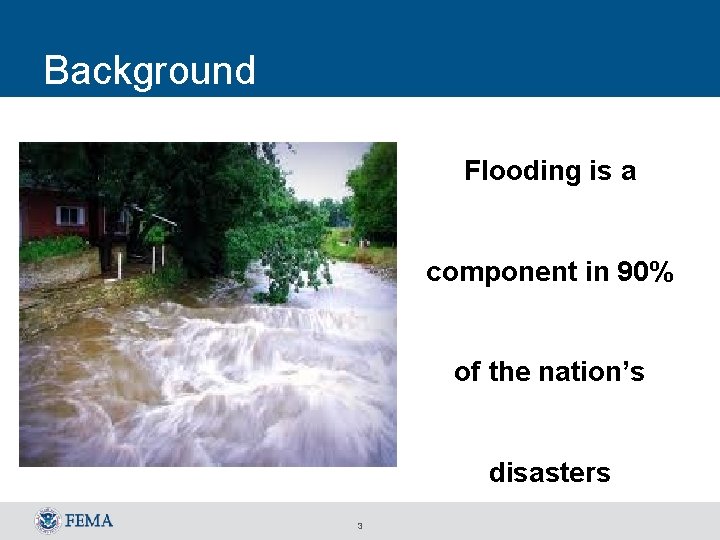
Background Flooding is a component in 90% of the nation’s disasters 3
Background § NFIP created in 1968 to reduce flood-related disaster costs • Managed by FEMA • Established quid pro quid: availability of flood insurance in exchange for local floodplain management • At beginning, exempted/grandfathered actuarial rate premium pricing for all properties built before FEMA issued its first flood maps • In FEMA Region 6, 42% of all policy holders pay non-actuarial or subsidized insurance premiums § July 2012: Congress passed Biggert-Waters NFIP Reform legislation • Requires the NFIP to use actuarial principles in rating policies • Phases out and removes premium subsidies • Subsidies can account for 40% to 70% of a policy’s premium 4
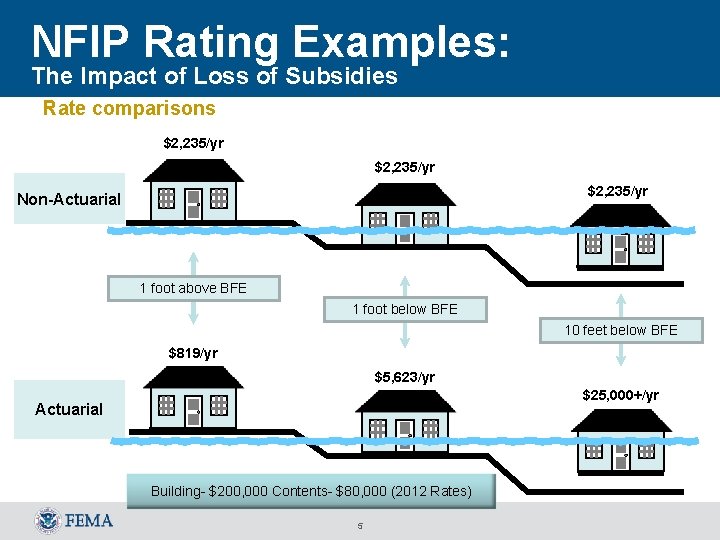
NFIP Rating Examples: The Impact of Loss of Subsidies Rate comparisons $2, 235/yr Non-Actuarial 1 foot above BFE 1 foot below BFE 10 feet below BFE $819/yr $5, 623/yr $25, 000+/yr Actuarial Building- $200, 000 Contents- $80, 000 (2012 Rates) 5
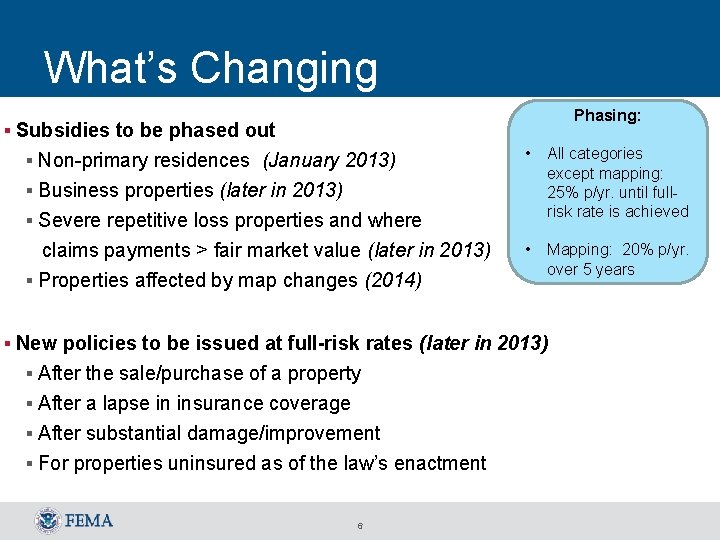
What’s Changing Phasing: § Subsidies to be phased out § Non-primary residences (January 2013) • All categories except mapping: 25% p/yr. until fullrisk rate is achieved • Mapping: 20% p/yr. over 5 years § Business properties (later in 2013) § Severe repetitive loss properties and where claims payments > fair market value (later in 2013) § Properties affected by map changes (2014) § New policies to be issued at full-risk rates (later in 2013) § After the sale/purchase of a property § After a lapse in insurance coverage § After substantial damage/improvement § For properties uninsured as of the law’s enactment 6
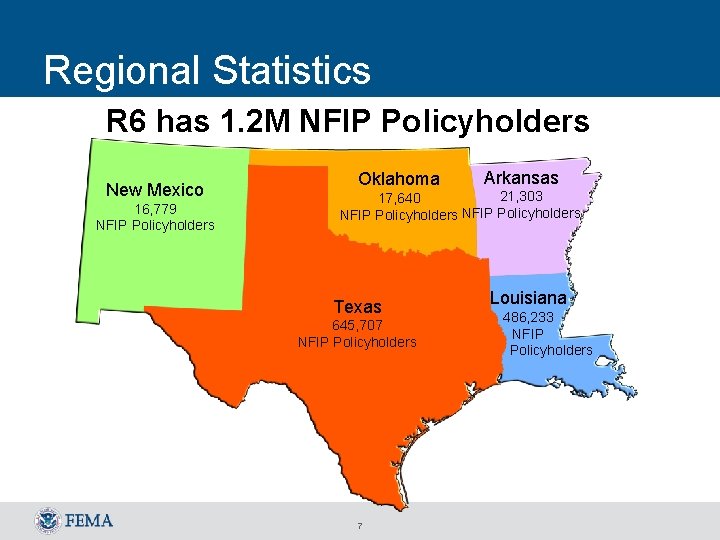
Regional Statistics R 6 has 1. 2 M NFIP Policyholders New Mexico 16, 779 NFIP Policyholders Oklahoma Arkansas 21, 303 17, 640 NFIP Policyholders Texas 645, 707 NFIP Policyholders 7 Louisiana 486, 233 NFIP Policyholders
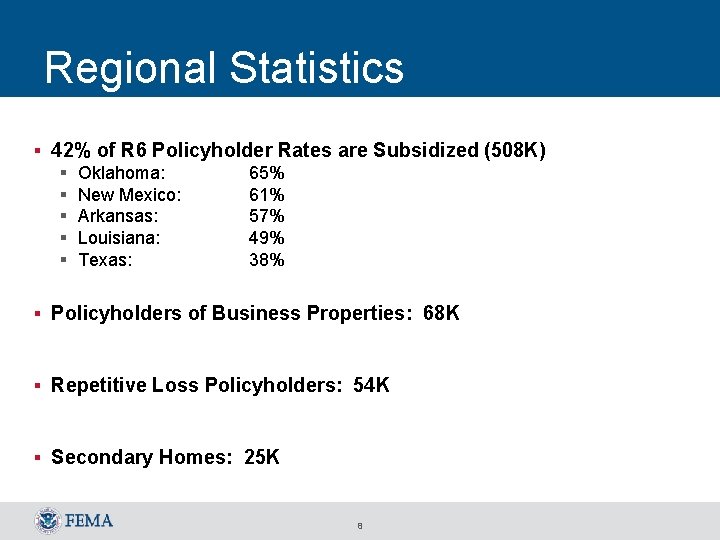
Regional Statistics § 42% of R 6 Policyholder Rates are Subsidized (508 K) § Oklahoma: 65% § New Mexico: 61% § Arkansas: 57% § Louisiana: 49% § Texas: 38% § Policyholders of Business Properties: 68 K § Repetitive Loss Policyholders: 54 K § Secondary Homes: 25 K 8
Ramifications to Consider § Does this make living in high-risk areas unaffordable for some citizens? § Does this impact Recovery operations in a flooding disaster or event? § Individual and Public Assistance – NFIP purchase requirement § Immediately after a disaster: • Do citizens know the impact of their rebuilding decisions? • Is this an opportunity to optimize interest in mitigation - elevations and buy-outs? § Might this change how states allocate or prioritize mitigation grant dollars? 9
What Policyholders Can Do: • Take a look at their current, effective flood maps • Talk with the local Floodplain Administrator to learn if there is a preliminary flood insurance rate map available • Know their risk and start planning for mitigation actions • Call their insurance agent for more details on their policy • Look into FEMA Mitigation programs available to them 10
Mitigation Programs Available § Increased Cost of Compliance (ICC) Program Up to $30, 000 for flood proofing, relocation, elevation, or demolition (FRED) after a flood. (residential properties only) § NFIP Community Rating System (CRS) Program Premium discounts up to 45% are available for policyholders in communities that participate in CRS § FEMA Hazard Mitigation and Severe Repetitive Loss Grant Programs 11
Regional Approach § Messaging and Education Campaign: • State and local hazard mitigation officers • State and local floodplain administrators • Insurance agents • Congressional offices • R 6 program staff § Post Disaster: Ensuring citizens have the information they need to make informed rebuilding and repair decisions as soon as possible § Overarching Message: Rebuilding higher reduces flood risk and insurance costs 12
Where to Find More Info: § www. fema. gov/hazard-mitigation-assistancefor numerous mitigation programs search for Hazard Mitigation Assistance Increased Cost Compliance Community Rating System Building Sciences § www. floodsmart. gov for more on flood risks and flood insurance § http: //maps. riskmap 6. com/ to view online flood maps § Ross. richardson@fema. dhs. gov Ph: 940 -898 -5210 13