
Changes to the Construction Act and a Legal

- Slides: 23
“Changes to the Construction Act” and a “Legal Update” Presented by Gregory Buckley – Senior Associate Jonathan Robinson – Solicitor Mc. Grigors’ Construction and Engineering Team [8260131_1] © Mc. Grigors LLP 2010
Changes to the Construction Act 1996 Part II of The Housing Grants, Construction and Regeneration Act 1996 applies to construction contracts and deals in particular with adjudication and payment (“the 1996 Act”). The Scheme for Construction Contracts (England Wales) Regulations 1998 (SI 1998/649) (“Scheme”) is implied into construction contracts which are not compliant with the 1996 Act. The Local Democracy Economic Development and Construction Act 2009 (“Construction Act 2009”) makes changes to the 1996 Act and comes into force: • 1 October 2011 (England Wales) and • 1 November 2011 (Scotland) Key areas affected include: • Payment • Suspension • Adjudication
The current position…. . the 1996 Act For “construction contracts” entered into between 1 May 1998 and 30 September 2011 (in England Wales) s. 104/105 – Construction Contract/”Construction Operations” s. 107 – Agreements in writing s. 108 – Adjudication s. 109 – Payment s. 110 – Payment Notice s. 111 – Withholding Notice s. 114 – Suspension [8260131_1] © Mc. Grigors LLP 2010 3
The transitional period……… The 2009 Act changes are not retrospective Currently negotiating a contract - what payment and adjudication provisions are to apply? All “construction contracts” entered into on or after 1 October 2011 (in England Wales) are subject to the 1996 Act (as amended by 2009 Act) [8260131_1] © Mc. Grigors LLP 2010 4
The 2009 Act and the changes it makes to the 1996 Act……. s. 107 of the 1996 Act is deleted – the requirement for a “construction contract” to be in writing The new payment and adjudication provisions therefore apply to: • “construction contracts” entered into on 1 October 2011 and onwards • whether in writing, oral or a combination of the two Nb. Section 108(2) [8260131_1] © Mc. Grigors LLP 2010 5
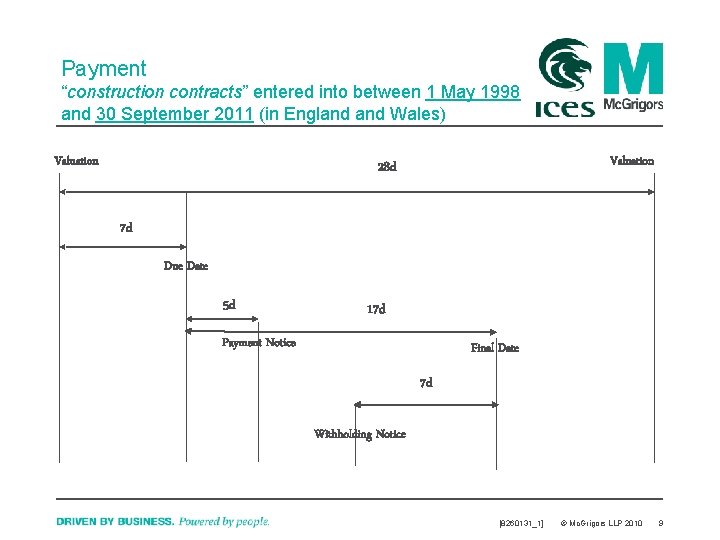
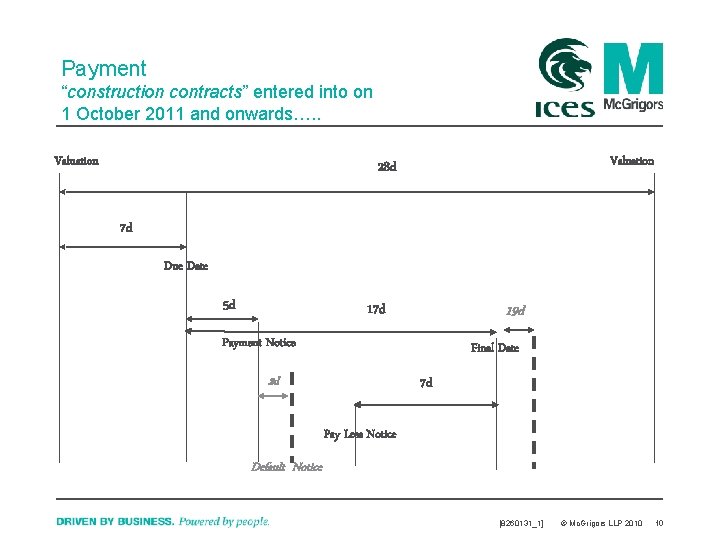
Payment The 2009 Act makes amendments to the payment provisions in the 1996 Act and provides a new regime for payment provisions in “construction contracts”. For “construction contracts” entered into on 1 October 2011 and onwards: • s. 109 – Entitlement to Stage Payments • s. 110 – Dates for Payment – an adequate mechanism is still required • s. 110 A - Payment Notices – prohibition on conditional payment clauses and ‘pay when certified’ clauses • Payer, Specified Person or Payee to give payment notice within 5 days of due date • Must specify sum considered due and provide the basis of the calculation • Still required even if the sum due is zero (s. 110 A(4)) [8260131_1] © Mc. Grigors LLP 2010 6
Payment • s. 110 B – ‘Default Payment Notice’ can be served by the payee: • if a payment notice is not given • and must include the same details as a ‘Payment Notice’ – BUT – a ‘Default Notice’ can only be served in circumstances where the payee has not already submitted an application for payment prior to the date for service of the payment notice – If ‘Default Payment Notice’ is given: • later than five days after the ‘Payment Due Date’ - it postpones the ‘Final Date for Payment’ by the same number of days as the ‘Default Payment Notice’ was late [8260131_1] © Mc. Grigors LLP 2010 7
Payment • s. 111 – Payment of notified sum • payer must pay notified sum unless the payer has issued a ‘Pay Less Notice’ – ‘Pay Less Notice’ is to (s. 111(4)): • specify the sum the payer considers is due; • the basis of the payer’s calculation; • Be given no later than the period prescribed in the “construction contract” • s. 111(10) – no requirement to pay if payee becomes insolvent [8260131_1] © Mc. Grigors LLP 2010 8
Payment “construction contracts” entered into between 1 May 1998 and 30 September 2011 (in England Wales) Valuation 28 d 7 d Due Date 5 d 17 d Payment Notice Final Date 7 d Withholding Notice [8260131_1] © Mc. Grigors LLP 2010 9
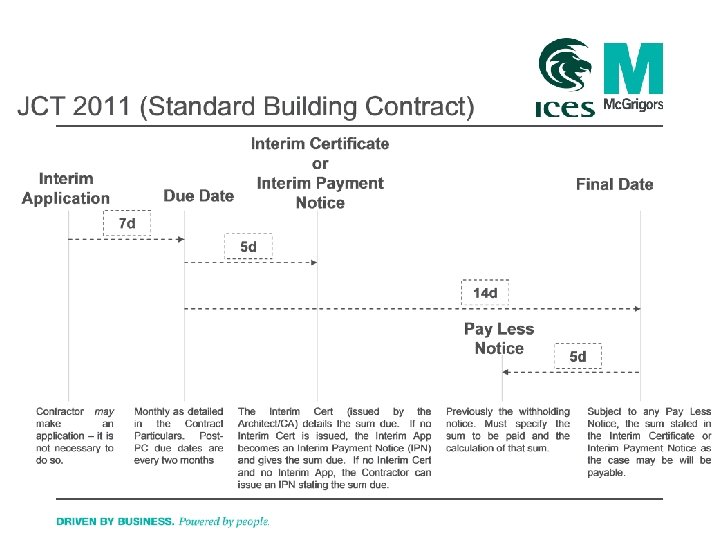
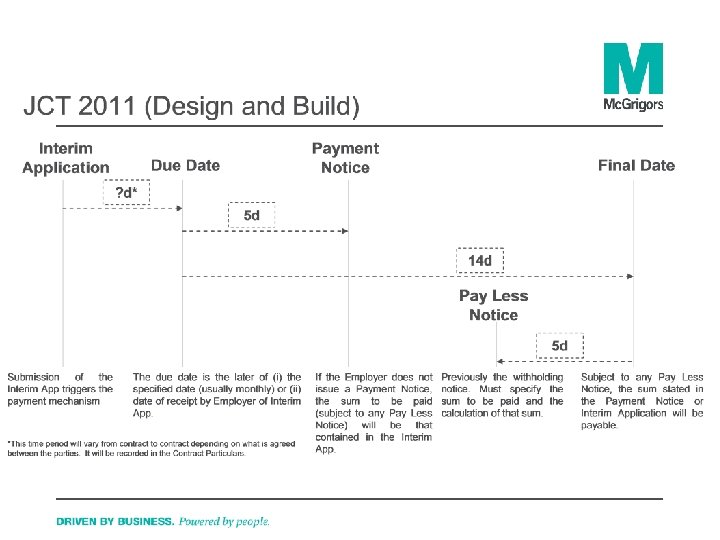
Payment “construction contracts” entered into on 1 October 2011 and onwards…. . Valuation 28 d 7 d Due Date 5 d 17 d 19 d Payment Notice Final Date 2 d 7 d Pay Less Notice Default Notice [8260131_1] © Mc. Grigors LLP 2010 10
Payment What scenarios could catch you out? Serving a Withholding Notice instead of a new Pay Less Notice and inadvertently breaching the requirements of the 2009 Act. Failing to appreciate that a payee’s ‘Default Notice’ equates to a “notified” sum. Failing to issue a valid “pay-less” notice. Not serving a “payment notice” because the sum due is zero and subsequently being faced with a default notice from the payee. [8260131_1] © Mc. Grigors LLP 2010 11
Suspension “construction contracts” entered into on 1 October 2011 and onwards…. . No common law right to suspend performance – must be a “construction contract” The 1996 Act introduced the right for an unpaid party to suspend performance if sums due were not paid. The 2009 Act enhances that right. Key changes: – Partial Suspension – s. 112(1) – Reasonable Costs and Expenses – s. 112(3 A) – Extension of time to cover remobilisation (which can extend beyond the period of suspension – s. 112(4)) A valid notice must still be served prior to suspending any obligations – check for any suspension right within your contract (as it may differ) [8260131_1] © Mc. Grigors LLP 2010 12
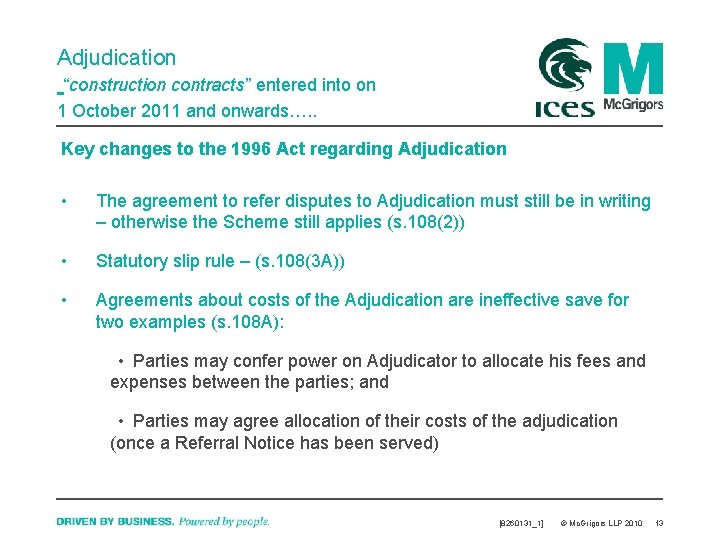
Adjudication “construction contracts” entered into on 1 October 2011 and onwards…. . Key changes to the 1996 Act regarding Adjudication • The agreement to refer disputes to Adjudication must still be in writing – otherwise the Scheme still applies (s. 108(2)) • Statutory slip rule – (s. 108(3 A)) • Agreements about costs of the Adjudication are ineffective save for two examples (s. 108 A): • Parties may confer power on Adjudicator to allocate his fees and expenses between the parties; and • Parties may agree allocation of their costs of the adjudication (once a Referral Notice has been served) [8260131_1] © Mc. Grigors LLP 2010 13
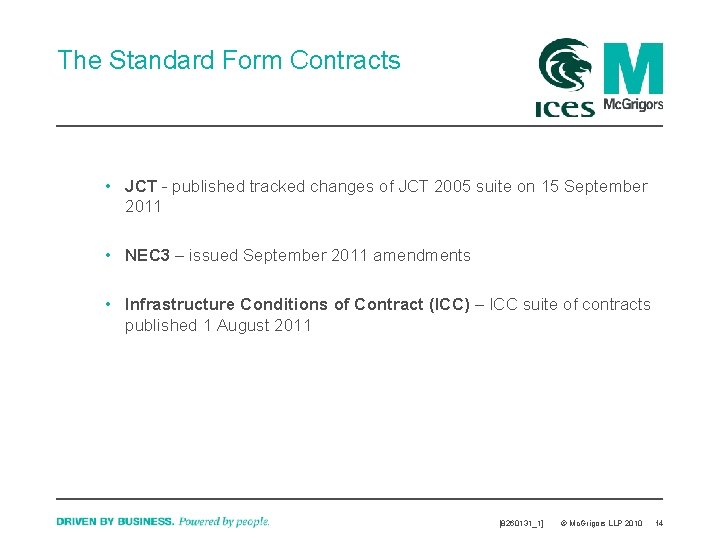
The Standard Form Contracts • JCT - published tracked changes of JCT 2005 suite on 15 September 2011 • NEC 3 – issued September 2011 amendments • Infrastructure Conditions of Contract (ICC) – ICC suite of contracts published 1 August 2011 [8260131_1] © Mc. Grigors LLP 2010 14
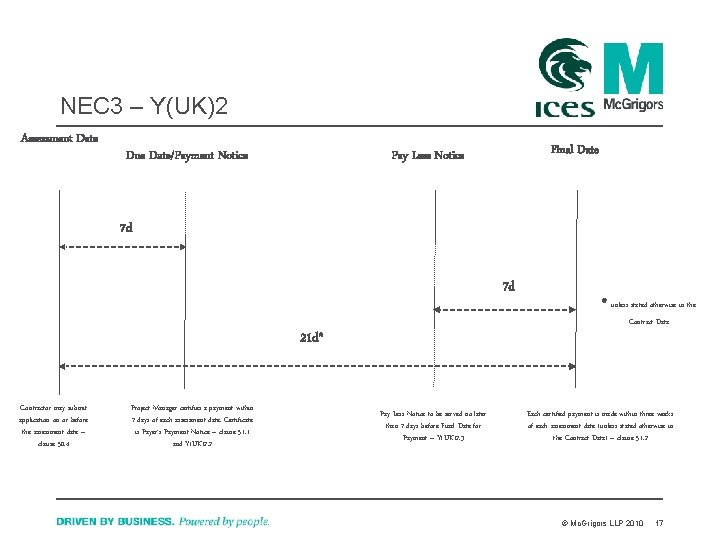
NEC 3 – Y(UK)2 Assessment Date Due Date/Payment Notice Final Date Pay Less Notice 7 d 7 d Contract Data 21 d* Contractor may submit application on or before the assessment date – clause 50. 4 Project Manager certifies a payment within 7 days of each assessment date. Certificate is Payer’s Payment Notice – clause 51. 1 and Y(UK)2. 2 * unless stated otherwise in the Pay Less Notice to be served no later than 7 days before Final Date for Payment – Y(UK)2. 3 Each certified payment is made within three weeks of each assessment date (unless stated otherwise in the Contract Data) – clause 51. 2 © Mc. Grigors LLP 2010 17
Practical Issues brought about by the changes to the Construction Act • Remember the date – 1 October 2011 (in England Wales); and that there is a transitional period (when both the 1996 and 2009 Acts apply) • It extends to any oral agreements you may make – records are even more important than ever • Follow the new payment process – the new provisions: - ‘Payment Notice’ can now be given by either party and must be given even if the amount due is zero - The new ‘Default Notice’ allows the payee to take control (should the payer fail to serve the Payment Notice) - Withholding Notices are gone – ‘Pay Less Notice’ • Understand suspension rights • Beware of unwritten contracts – mark all pre-contract negotiations ‘subject to contract’ [8260131_1] © Mc. Grigors LLP 2010 18
Topic 2 – A Legal Update Agenda • Enforcing an Adjudicator’s Award • Cross-contract set off • Expert witness immunity [8260131_1] © Mc. Grigors LLP 2010 19
Topic 2 – A Legal Update (a) Enforcing an Adjudicator’s Award • Enforcing an Adjudicator’s award – where the successful party is ‘insolvent’ and asking the court to enforce • Court has discretion to not enforce an Adjudicator’s decision and to grant a stay of execution– RSC Order 47, Rule 1(1) • Test: Is there a risk that the referring party may not be able to repay this money should the Adjudicator’s decision be overturned? • The court will exercise this discretion differently depending on the type of insolvency: • Insolvent liquidation • Administration • CVA • No insolvency procedure – but insolvency is imminent? The most recent case where these legal principles are set out is Pilon Limited v Breyer Group Plc [2010] EWHC 837 (TCC) [8260131_1] © Mc. Grigors LLP 2010 20
Topic 2 – A Legal Update (b) Set Off – Equitable Set Off • No express clause giving right to set-off – therefore no ‘legal set-off’ is available • Set-Off under the same contract and Cross-contract set-off – the differences • Equitable set-off maybe available between two different contracts: Test: so closely connected it would be manifestly unjust to refuse the ability to set-off? • Refusal by one party to perform another contract created the ‘close connection’. Geldof Metaalconstructie NV v Simon Carves Ltd [2010] EWCA • Remember to check whether your contract has an express clause that removes the availability of equitable set-off [8260131_1] © Mc. Grigors LLP 2010 21
Topic 2 – A Legal Update (c) Expert Witness Immunity • Retrospective abolishment of an expert’s immunity from liability • An expert is now liable (in negligence) for verbal evidence given and for advice given in preparation of a dispute resolution process • So, what duties does an expert now owe: - Contractual duty – express or implied - Tortious duty – reasonable skill and care • Experts might start being appointed more frequently by client and solicitor jointly – therefore any duty would be owed to the client and the solicitor • Think about recovery of fees – money on account • Review the terms and scope of your PI policy Jones v Kaney [2011] UKSC reported at [2011] 2 WLR 823 [8260131_1] © Mc. Grigors LLP 2010 22
THANK YOU Mc. Grigors LLP 1 The Avenue, Spinningfields Square, Manchester M 3 3 AP www. mcgrigors. com [8260131_1] © Mc. Grigors LLP 2010 23