
Changes to the APEGA Authentication Standard Prepared for



- Slides: 12
Changes to the APEGA Authentication Standard: Prepared for IEEE Matthew Oliver, CD, P. Eng. Dale Vanhooren, P. Geoph.
Presentation Outline • • • Speaker Introduction Key Changes of Authentication Standard Authentication Training Videos (49 mins) Break Addressing submitted questions and any new questions (40 mins)
Key New Considerations & Changes • Defining professional work products (PWP) • Clarifying what needs to be authenticated • Standardizing authentication and validation formats • Defining Responsible Members validation of PWP • Setting requirements for authentication of imported or exported PWP’s • Engineered and Customized goods • Addressing digital technology
Training Videos 1. 2. 3. 4. Essential Background Information Authentication Process and Responsibilities The Authentication Test Procedures for Authentication and Validation Section 1: Individual Licensed Professionals Section 2: Validation for RMs Section 3: Multiple Contributors & Non APEGA Contributors 5. 6. 7. 8. 9. Imported & Exported Work Products Commercial and Custom Engineered Goods Revising Professional Work Products Field Revisions during Continuous Operations Retention & Storage of Professional Work Products
BREAK
Questions
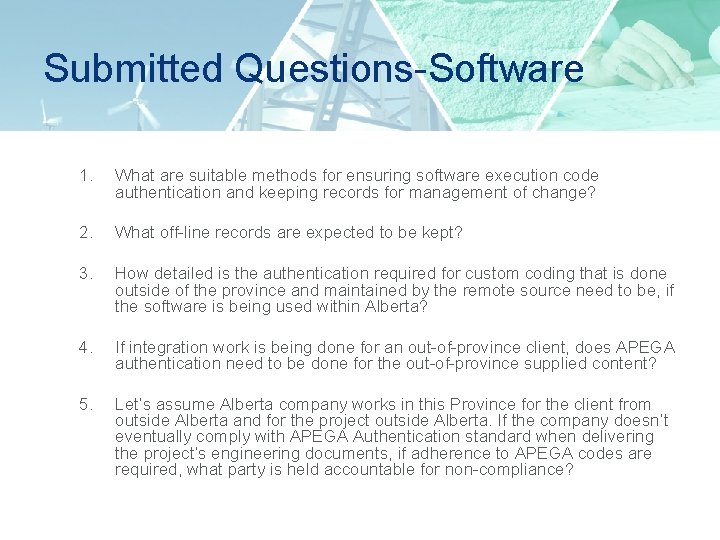
Submitted Questions-Software 1. What are suitable methods for ensuring software execution code authentication and keeping records for management of change? 2. What off-line records are expected to be kept? 3. How detailed is the authentication required for custom coding that is done outside of the province and maintained by the remote source need to be, if the software is being used within Alberta? 4. If integration work is being done for an out-of-province client, does APEGA authentication need to be done for the out-of-province supplied content? 5. Let’s assume Alberta company works in this Province for the client from outside Alberta and for the project outside Alberta. If the company doesn’t eventually comply with APEGA Authentication standard when delivering the project’s engineering documents, if adherence to APEGA codes are required, what party is held accountable for non-compliance?
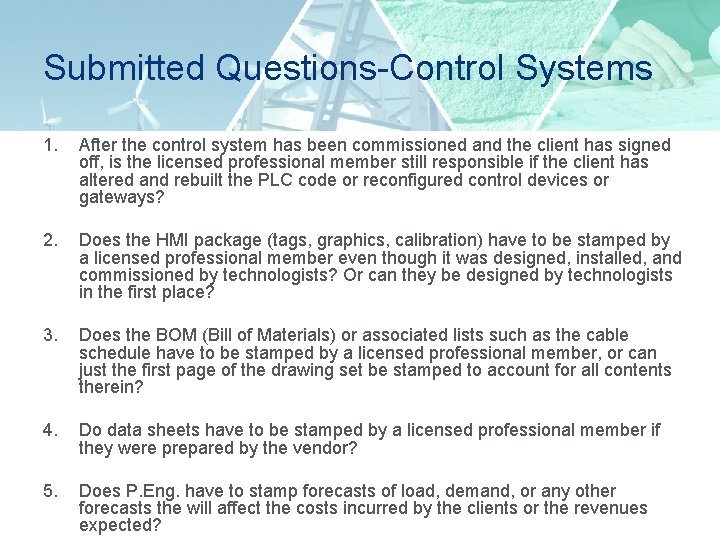
Submitted Questions-Control Systems 1. After the control system has been commissioned and the client has signed off, is the licensed professional member still responsible if the client has altered and rebuilt the PLC code or reconfigured control devices or gateways? 2. Does the HMI package (tags, graphics, calibration) have to be stamped by a licensed professional member even though it was designed, installed, and commissioned by technologists? Or can they be designed by technologists in the first place? 3. Does the BOM (Bill of Materials) or associated lists such as the cable schedule have to be stamped by a licensed professional member, or can just the first page of the drawing set be stamped to account for all contents therein? 4. Do data sheets have to be stamped by a licensed professional member if they were prepared by the vendor? 5. Does P. Eng. have to stamp forecasts of load, demand, or any other forecasts the will affect the costs incurred by the clients or the revenues expected?
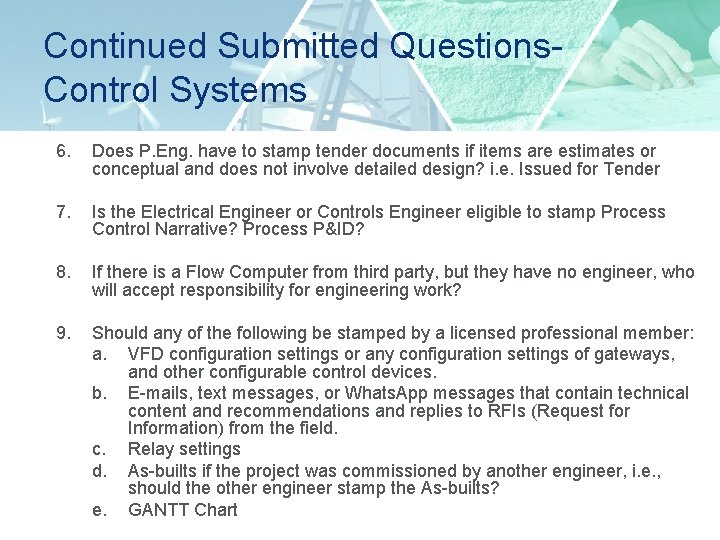
Continued Submitted Questions. Control Systems 6. Does P. Eng. have to stamp tender documents if items are estimates or conceptual and does not involve detailed design? i. e. Issued for Tender 7. Is the Electrical Engineer or Controls Engineer eligible to stamp Process Control Narrative? Process P&ID? 8. If there is a Flow Computer from third party, but they have no engineer, who will accept responsibility for engineering work? 9. Should any of the following be stamped by a licensed professional member: a. VFD configuration settings or any configuration settings of gateways, and other configurable control devices. b. E-mails, text messages, or Whats. App messages that contain technical content and recommendations and replies to RFIs (Request for Information) from the field. c. Relay settings d. As-builts if the project was commissioned by another engineer, i. e. , should the other engineer stamp the As-builts? e. GANTT Chart
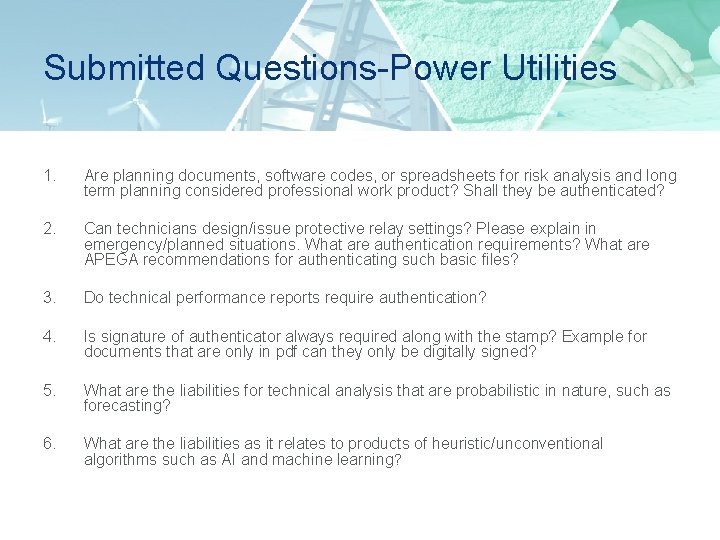
Submitted Questions-Power Utilities 1. Are planning documents, software codes, or spreadsheets for risk analysis and long term planning considered professional work product? Shall they be authenticated? 2. Can technicians design/issue protective relay settings? Please explain in emergency/planned situations. What are authentication requirements? What are APEGA recommendations for authenticating such basic files? 3. Do technical performance reports require authentication? 4. Is signature of authenticator always required along with the stamp? Example for documents that are only in pdf can they only be digitally signed? 5. What are the liabilities for technical analysis that are probabilistic in nature, such as forecasting? 6. What are the liabilities as it relates to products of heuristic/unconventional algorithms such as AI and machine learning?
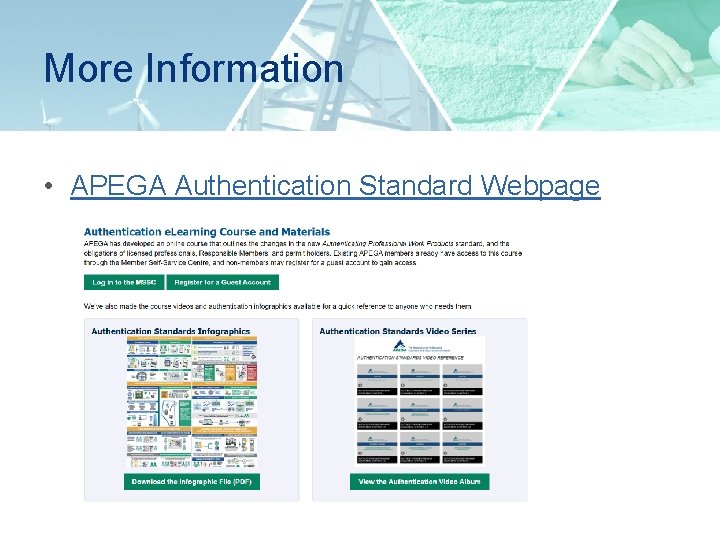
More Information • APEGA Authentication Standard Webpage
professionalpractice@apega. ca