
Changes to Tank Degassing and Cleaning Rules Texas
- Slides: 16
Changes to Tank Degassing and Cleaning Rules Texas Association of Environmental Professionals Air Quality Division • Tank Degassing and Cleaning Rules; TSH : May 15, • 2008 • Page. Teresa Hurley, P. E. • May 15, 2008
Tank Degassing and Cleaning Rules • What are the current requirements? • Why were the rules changed? • What changed? • When do changes take effect? • Questions Air Quality Division • Tank Degassing and Cleaning Rules; TSH : May 15, 2008 • Page 2
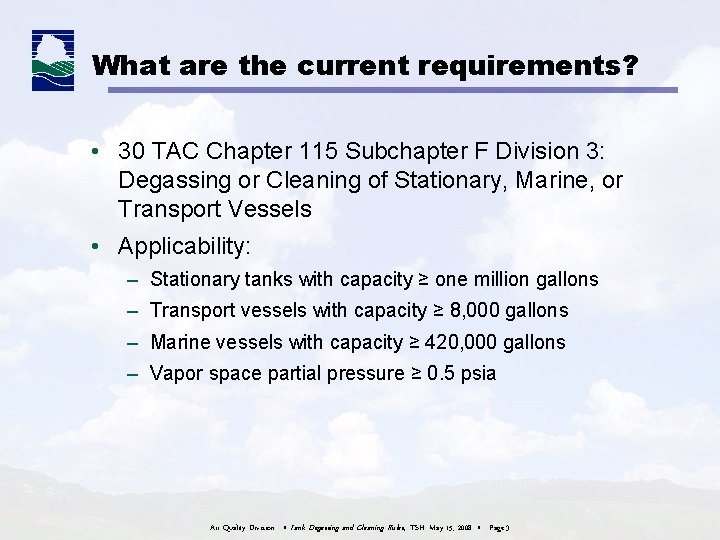
What are the current requirements? • 30 TAC Chapter 115 Subchapter F Division 3: Degassing or Cleaning of Stationary, Marine, or Transport Vessels • Applicability: – Stationary tanks with capacity ≥ one million gallons – Transport vessels with capacity ≥ 8, 000 gallons – Marine vessels with capacity ≥ 420, 000 gallons – Vapor space partial pressure ≥ 0. 5 psia Air Quality Division • Tank Degassing and Cleaning Rules; TSH : May 15, 2008 • Page 3
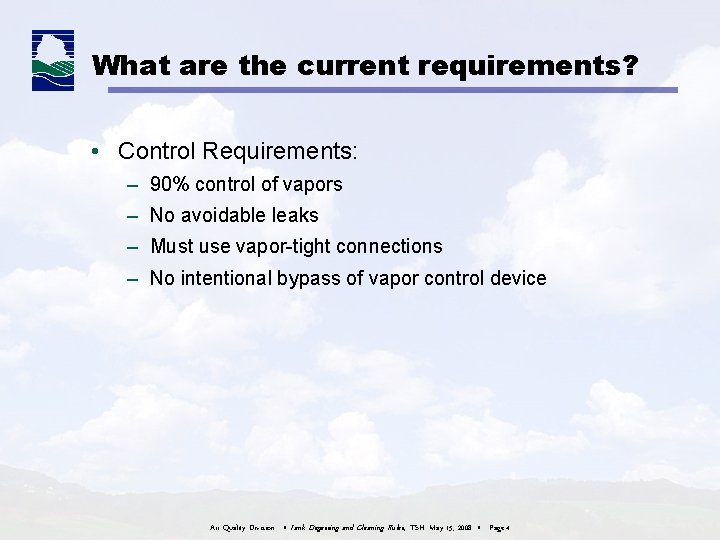
What are the current requirements? • Control Requirements: – 90% control of vapors – No avoidable leaks – Must use vapor-tight connections – No intentional bypass of vapor control device Air Quality Division • Tank Degassing and Cleaning Rules; TSH : May 15, 2008 • Page 4
What are the current requirements? • Vapors must be routed to control device until: – Partial vapor pressure < 0. 5 psia; 19, 000 ppm by weight; 34, 000 ppm by volume as methane; OR – Turnover of at least four vapor space volumes has occurred • Vapors can be vented to the atmosphere after any of the above conditions is satisfied Air Quality Division • Tank Degassing and Cleaning Rules; TSH : May 15, 2008 • Page 5
Why were the rules changed? • Studies have indicated that VOC emissions in HGB area are under-reported in emissions inventories. • Remote sensing study results have indicated that degassing emissions are under-reported. • Rule changes were made to reduce the previously under-reported emissions. Air Quality Division • Tank Degassing and Cleaning Rules; TSH : May 15, 2008 • Page 6
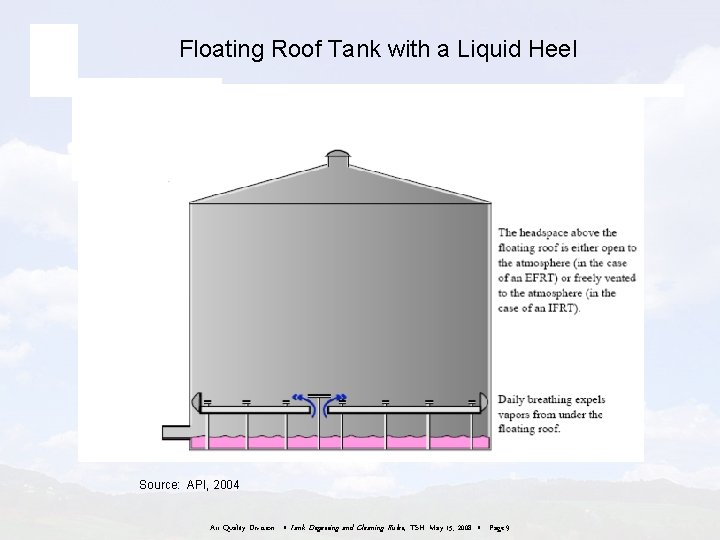
What changed? • Eliminated “four turnover” condition for allowing vent to atmosphere – Confusion over measurement: must be volume passing through tank vapor space; not measured after combustion control – Does not account for presence of residual liquid in the tank Air Quality Division • Tank Degassing and Cleaning Rules; TSH : May 15, 2008 • Page 7
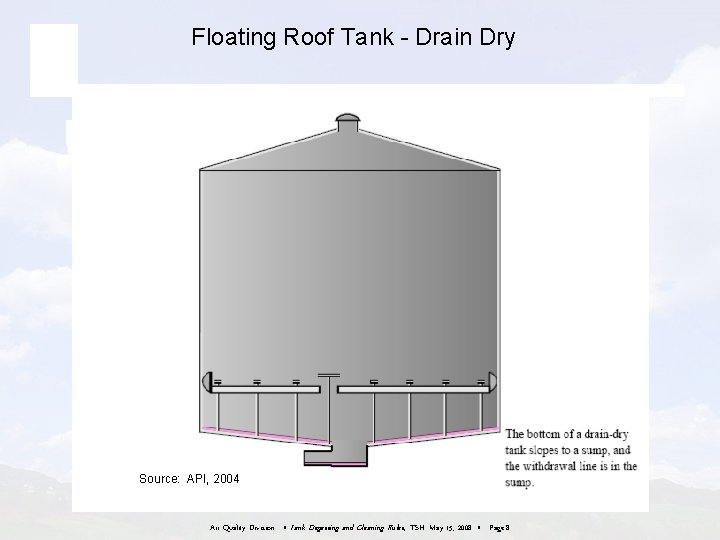
Floating Roof Tank - Drain Dry Source: API, 2004 Air Quality Division • Tank Degassing and Cleaning Rules; TSH : May 15, 2008 • Page 8
Floating Roof Tank with a Liquid Heel Source: API, 2004 Air Quality Division • Tank Degassing and Cleaning Rules; TSH : May 15, 2008 • Page 9
What changed? • Control degassing vapors until – VOC concentration of vapors ≤ 34, 000 ppmv as methane, or – < 50% of lower explosive limit Air Quality Division • Tank Degassing and Cleaning Rules; TSH : May 15, 2008 • Page 10
What changed? • Monitor VOC concentration of degassing vapors according to 115. 545(11) – Allow flexibility in monitoring methods – Maintain records to demonstrate that method works for compounds present Air Quality Division • Tank Degassing and Cleaning Rules; TSH : May 15, 2008 • Page 11
What changed? • Specified monitoring methods: – – – Test Method 21 (40 CFR Part 60, Appendix A) Test Method 18 (40 CFR Part 60, Appendix A) Bag samples Test Method 25 A (40 CFR Part 60, Appendix A) Portable hydrocarbon gas analyzer using appropriate detector – Lower explosive limit detector calibrated and maintained according to manufacturer's specifications Air Quality Division • Tank Degassing and Cleaning Rules; TSH : May 15, 2008 • Page 12
What changed? • Monitoring must continue while vapors are vented to atmosphere: – At least once every 12 hours if ventilation is continuous – If ventilation ceases for more than 4 hours, concentration must be rechecked before venting to atmosphere – Monitoring can be discontinued after five consecutive readings less than 34, 000 ppmv or 50% of LEL Air Quality Division • Tank Degassing and Cleaning Rules; TSH : May 15, 2008 • Page 13
What changed? • Require control of vapors for smaller tanks: – Capacity ≥ 250, 000 with vapor pressure ≥ 0. 5 psia – Capacity ≥ 75, 000 with vapor pressure > 2. 6 psia Air Quality Division • Tank Degassing and Cleaning Rules; TSH : May 15, 2008 • Page 14
When do changes take effect? • Compliance date for new requirements is January 1, 2009 Air Quality Division • Tank Degassing and Cleaning Rules; TSH : May 15, 2008 • Page 15
For more information Teresa S. Hurley, P. E. TCEQ Air Quality Planning Section 512 -239 -5316 thurley@tceq. state. tx. us Air Quality Division • Tank Degassing and Cleaning Rules; TSH : May 15, 2008 • Page 16