
Changes to Reserve Level Declaration Guidelines Stakeholder forum
- Slides: 14
Changes to Reserve Level Declaration Guidelines Stakeholder forum 12 October 2018 Jack Fox, Operational Forecasting
Agenda 1. 2. 3. 4. 5. 6. Background Review of performance of Guidelines Proposed changes Next steps Questions References 7/03/2021 2
Background • Recent changes to the NER • National Electricity Rule 4. 8. 4 A/B published on 19 December 2017 requires AEMO to produce a probabilistic assessment of reserves and account for actual, forecast, environmental or other conditions when performing this assessment. • AEMO, in consultation with stakeholders, published the Reserve Level Declaration Guidelines which set out how AEMO performs this probabilistic assessment • http: //aemo. com. au/Electricity/National-Electricity-Market. NEM/Security-and-reliability/Power-system-operation • The methodology set out in the Guidelines came into effect on 15 February 2018. 7/03/2021 3
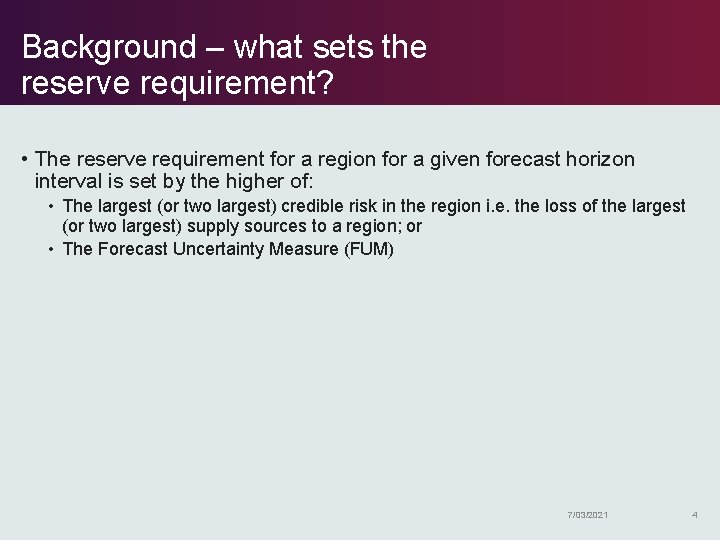
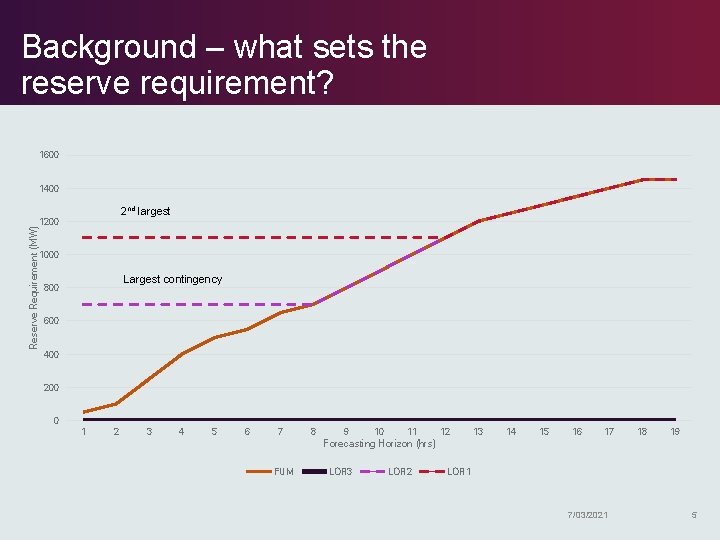
Background – what sets the reserve requirement? • The reserve requirement for a region for a given forecast horizon interval is set by the higher of: • The largest (or two largest) credible risk in the region i. e. the loss of the largest (or two largest) supply sources to a region; or • The Forecast Uncertainty Measure (FUM) 7/03/2021 4
Background – what sets the reserve requirement? 1600 Reserve Requirement (MW) 1400 2 nd largest contingency 1200 1000 Largest contingency 800 600 400 200 0 1 2 3 4 5 6 7 8 9 10 11 12 13 14 15 16 17 18 19 Forecasting Horizon (hrs) FUM LOR 3 LOR 2 LOR 1 7/03/2021 5
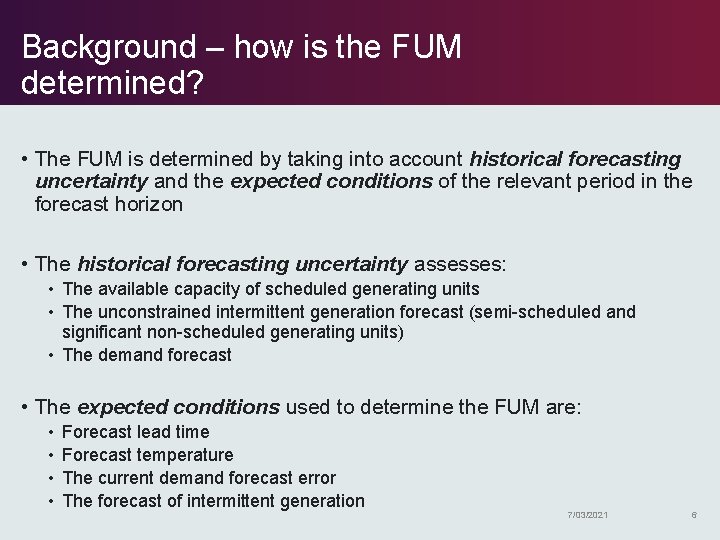
Background – how is the FUM determined? • The FUM is determined by taking into account historical forecasting uncertainty and the expected conditions of the relevant period in the forecast horizon • The historical forecasting uncertainty assesses: • The available capacity of scheduled generating units • The unconstrained intermittent generation forecast (semi-scheduled and significant non-scheduled generating units) • The demand forecast • The expected conditions used to determine the FUM are: • • Forecast lead time Forecast temperature The current demand forecast error The forecast of intermittent generation 7/03/2021 6
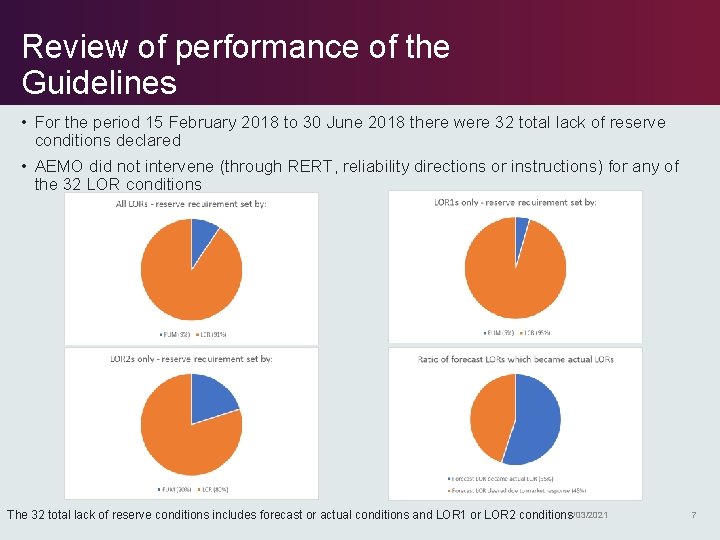
Review of performance of the Guidelines • For the period 15 February 2018 to 30 June 2018 there were 32 total lack of reserve conditions declared • AEMO did not intervene (through RERT, reliability directions or instructions) for any of the 32 LOR conditions The 32 total lack of reserve conditions includes forecast or actual conditions and LOR 1 or LOR 2 conditions 7/03/2021 7
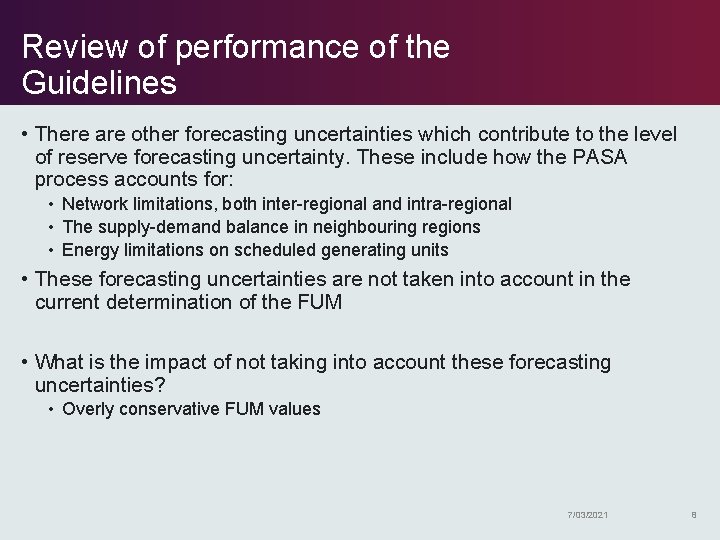
Review of performance of the Guidelines • There are other forecasting uncertainties which contribute to the level of reserve forecasting uncertainty. These include how the PASA process accounts for: • Network limitations, both inter-regional and intra-regional • The supply-demand balance in neighbouring regions • Energy limitations on scheduled generating units • These forecasting uncertainties are not taken into account in the current determination of the FUM • What is the impact of not taking into account these forecasting uncertainties? • Overly conservative FUM values 7/03/2021 8
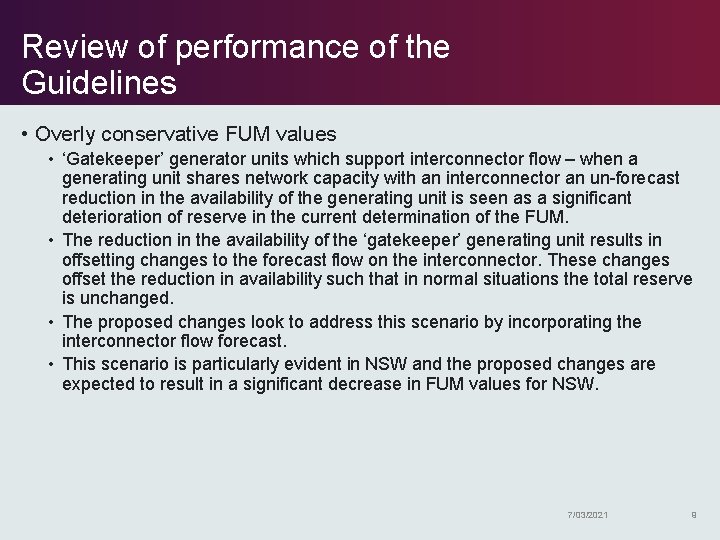
Review of performance of the Guidelines • Overly conservative FUM values • ‘Gatekeeper’ generator units which support interconnector flow – when a generating unit shares network capacity with an interconnector an un-forecast reduction in the availability of the generating unit is seen as a significant deterioration of reserve in the current determination of the FUM. • The reduction in the availability of the ‘gatekeeper’ generating unit results in offsetting changes to the forecast flow on the interconnector. These changes offset the reduction in availability such that in normal situations the total reserve is unchanged. • The proposed changes look to address this scenario by incorporating the interconnector flow forecast. • This scenario is particularly evident in NSW and the proposed changes are expected to result in a significant decrease in FUM values for NSW. 7/03/2021 9
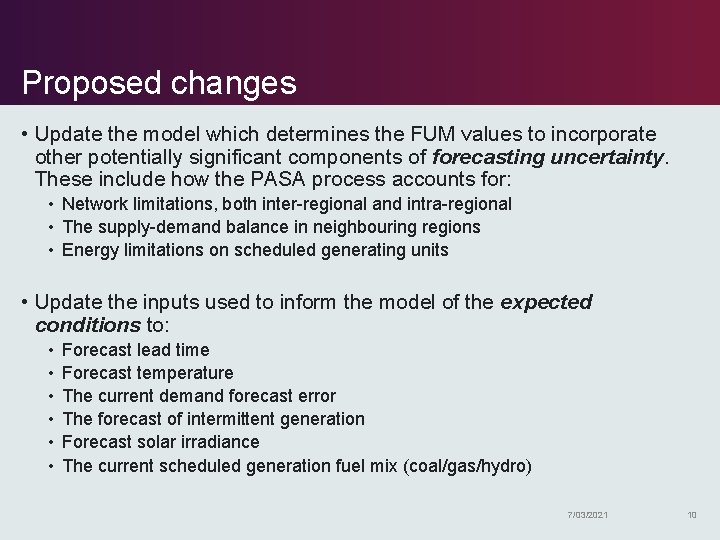
Proposed changes • Update the model which determines the FUM values to incorporate other potentially significant components of forecasting uncertainty. These include how the PASA process accounts for: • Network limitations, both inter-regional and intra-regional • The supply-demand balance in neighbouring regions • Energy limitations on scheduled generating units • Update the inputs used to inform the model of the expected conditions to: • • • Forecast lead time Forecast temperature The current demand forecast error The forecast of intermittent generation Forecast solar irradiance The current scheduled generation fuel mix (coal/gas/hydro) 7/03/2021 10
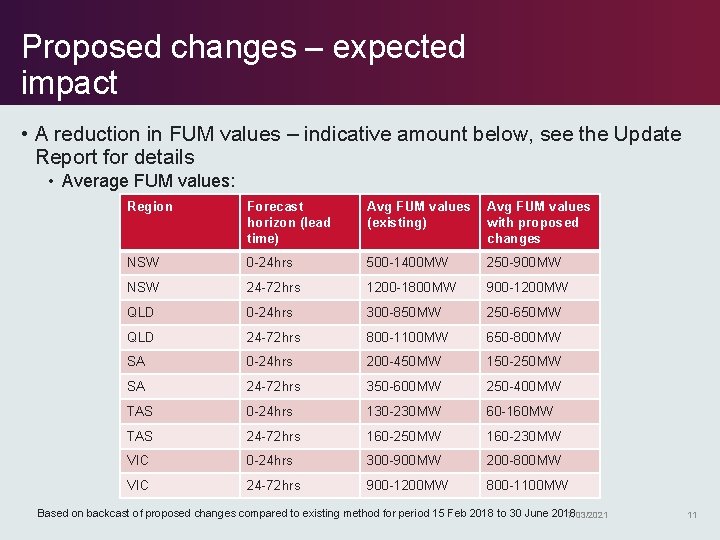
Proposed changes – expected impact • A reduction in FUM values – indicative amount below, see the Update Report for details • Average FUM values: Region Forecast horizon (lead time) Avg FUM values (existing) Avg FUM values with proposed changes NSW 0 -24 hrs 500 -1400 MW 250 -900 MW NSW 24 -72 hrs 1200 -1800 MW 900 -1200 MW QLD 0 -24 hrs 300 -850 MW 250 -650 MW QLD 24 -72 hrs 800 -1100 MW 650 -800 MW SA 0 -24 hrs 200 -450 MW 150 -250 MW SA 24 -72 hrs 350 -600 MW 250 -400 MW TAS 0 -24 hrs 130 -230 MW 60 -160 MW TAS 24 -72 hrs 160 -250 MW 160 -230 MW VIC 0 -24 hrs 300 -900 MW 200 -800 MW VIC 24 -72 hrs 900 -1200 MW 800 -1100 MW Based on backcast of proposed changes compared to existing method for period 15 Feb 2018 to 30 June 2018 7/03/2021 11
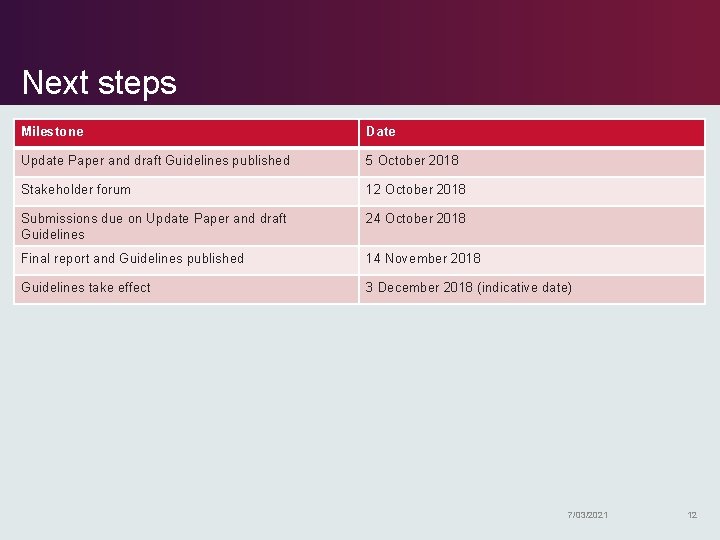
Next steps Milestone Date Update Paper and draft Guidelines published 5 October 2018 Stakeholder forum 12 October 2018 Submissions due on Update Paper and draft Guidelines 24 October 2018 Final report and Guidelines published 14 November 2018 Guidelines take effect 3 December 2018 (indicative date) 7/03/2021 12
Questions 7/03/2021 13
References • Consultation webpage including Update Paper and draft Guidelines: http: //aemo. com. au/Stakeholder-Consultation/Consultations/Changesto-Reserve-Level-Declaration-Guidelines • Current Reserve Level Declaration Guidelines: http: //aemo. com. au/Electricity/National-Electricity-Market-NEM/Security -and-reliability/Power-system-operation • Reserve Level Declaration Guidelines quarterly reports: http: //aemo. com. au/Electricity/National-Electricity-Market-NEM/Security -and-reliability/Power-system-operation/NEM-Lack-of-Reserve. Framework-Quarterly-Reports • For further info contact the Operational Forecasting team • Op. Forecasting@aemo. com. au 7/03/2021 14