
CHANGES OF INDICATORS OF SOCIAL INTELLIGENCE FOR SUBSTANCE
CHANGES OF INDICATORS OF SOCIAL INTELLIGENCE FOR SUBSTANCE USE DISORDERS PATIENTS AFTER TREATMENT Velga Sudraba, MD Riga Centre of Psychiatry and Addiction Disorders, Assoc. Proffes. Kristine Martinsone, Ph. D Riga Stradiņš University, Latvia
Background (1) O Social Intelligence is defined as a personality’s capacity, which is based on cognitive processes, emotional and social experience, understanding one-self and others and predicting his or her behavior. O Social Intelligence describes and establishes a personality’s skill: to successfully navigate through different social situations; to correctly define personal and external experiences; and allows taking adequate action in these SSA Symposium, 8 -9 Nov 2012 situations. 2
Background (2) O As pointed out by researchers (Ham and Garcia, 2010; Scheier et al. , 1999) social intelligence skills are directly related to alcohol and drug usage. In fact, the lower the skills, the higher the risk the addict will use drugs and vice versa; substance abuse creates disorders for social intelligence skills. SSA Symposium, 8 -9 Nov 2012 3
Research Objectives O to estimate indicator changes of Social Intelligence (SI) of substance use disorders (SUD) patients after detoxification and Minnesota program (MP) treatment SSA Symposium, 8 -9 Nov 2012 4
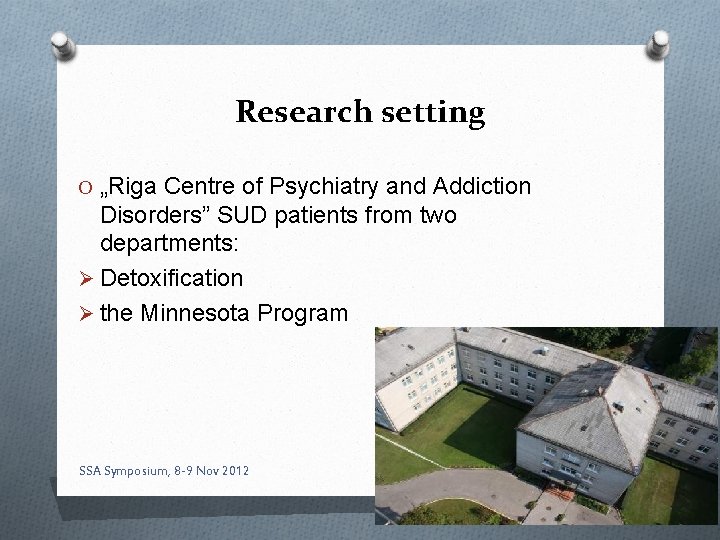
Research setting O „Riga Centre of Psychiatry and Addiction Disorders” SUD patients from two departments: Ø Detoxification Ø the Minnesota Program SSA Symposium, 8 -9 Nov 2012 5
Measurements O The first measurement was done at the beginning of treatment in MP or when detoxification was finished (patients are in equal state according towards uncontrolled psychoactive substances use. O The second measurement was done 6 months after treatment: Descriptive statistic and ANOVA were used for data procesing. SSA Symposium, 8 -9 Nov 2012 6
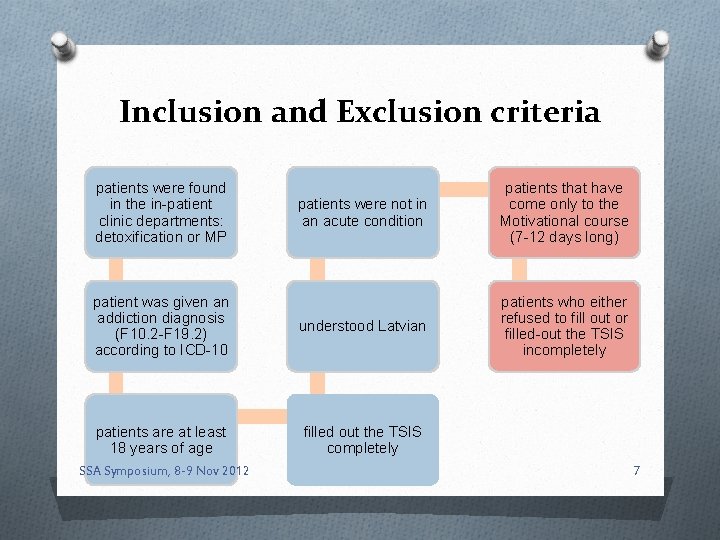
Inclusion and Exclusion criteria patients were found in the in-patient clinic departments: detoxification or MP patients were not in an acute condition patients that have come only to the Motivational course (7 -12 days long) patient was given an addiction diagnosis (F 10. 2 -F 19. 2) according to ICD-10 understood Latvian patients who either refused to fill out or filled-out the TSIS incompletely patients are at least 18 years of age filled out the TSIS completely SSA Symposium, 8 -9 Nov 2012 7
Participants in the first measurement O Selection of research was composed by 405 respondents with diagnosis of SUD (F 10. 2 – F 19. 2, ICD-10) Ø Patients from detoxification (n=201) with average 41, 7 (SD=11, 0); 70, 1% were male; 84, 1%- alcoholics Ø Patients from MP (n=204), average 39, 6 (SD=11, 1); 61, 3%- male; 79, 4%alcoholics SSA Symposium, 8 -9 Nov 2012 8
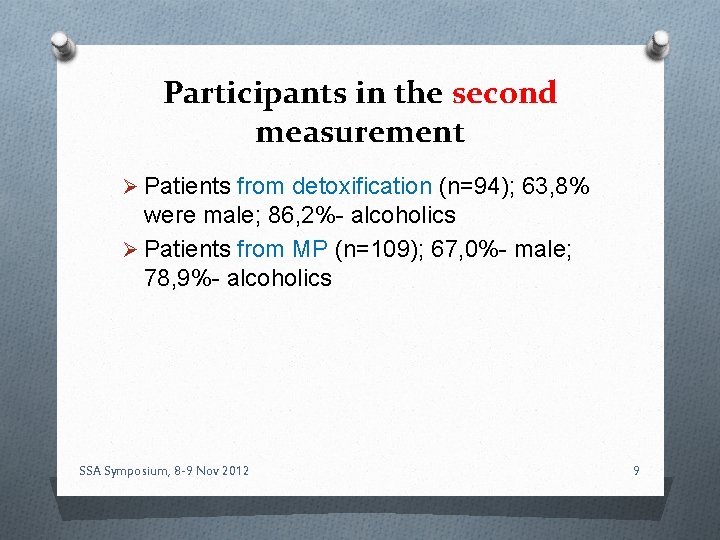
Participants in the second measurement Ø Patients from detoxification (n=94); 63, 8% were male; 86, 2%- alcoholics Ø Patients from MP (n=109); 67, 0%- male; 78, 9%- alcoholics SSA Symposium, 8 -9 Nov 2012 9

Research instrument O The Tromso Social Intelligence Scale (TSIS) (Silvera, Martinussen, Dahl, 2001) O contains 21 assertions O seven assertions in each SI component (Social information processing, Social skills and Social awareness) O the respondents must assess themselves by giving an assessment from one to seven; one meaning ’’completely unsuitable’’ and seven meaning ’’completely suitable. ’’ O TSIS was adapted in Latvia in 2006 (Kuzņecova, Šlosberga, 2006) SSA Symposium, 8 -9 Nov 2012 10
Results O SI indicators were counted and compared according to respondent`s addictions and treatment departments. O SI questionnaires only from patients, who took part in both measurements were counted. SSA Symposium, 8 -9 Nov 2012 11
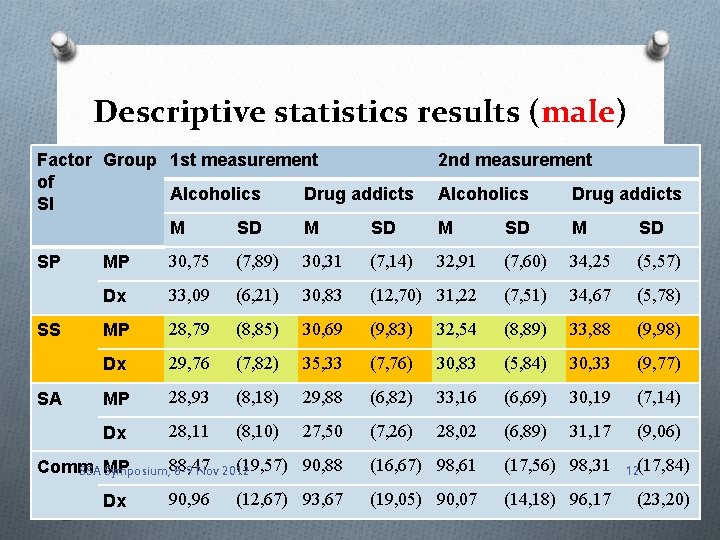
Descriptive statistics results (male) Factor Group 1 st measurement of Alcoholics Drug addicts SI M SD SP SS SA 2 nd measurement Alcoholics Drug addicts M SD MP 30, 75 (7, 89) 30, 31 (7, 14) 32, 91 (7, 60) 34, 25 (5, 57) Dx 33, 09 (6, 21) 30, 83 (12, 70) 31, 22 (7, 51) 34, 67 (5, 78) MP 28, 79 (8, 85) 30, 69 (9, 83) 32, 54 (8, 89) 33, 88 (9, 98) Dx 29, 76 (7, 82) 35, 33 (7, 76) 30, 83 (5, 84) 30, 33 (9, 77) MP 28, 93 (8, 18) 29, 88 (6, 82) 33, 16 (6, 69) 30, 19 (7, 14) Dx 28, 11 (8, 10) 27, 50 (7, 26) 28, 02 (6, 89) 31, 17 (9, 06) (19, 57) 90, 88 Comm SSA MP Symposium, 88, 47 8 -9 Nov 2012 (16, 67) 98, 61 (17, 56) 98, 31 12(17, 84) 90, 96 (19, 05) 90, 07 (14, 18) 96, 17 (23, 20) Dx (12, 67) 93, 67
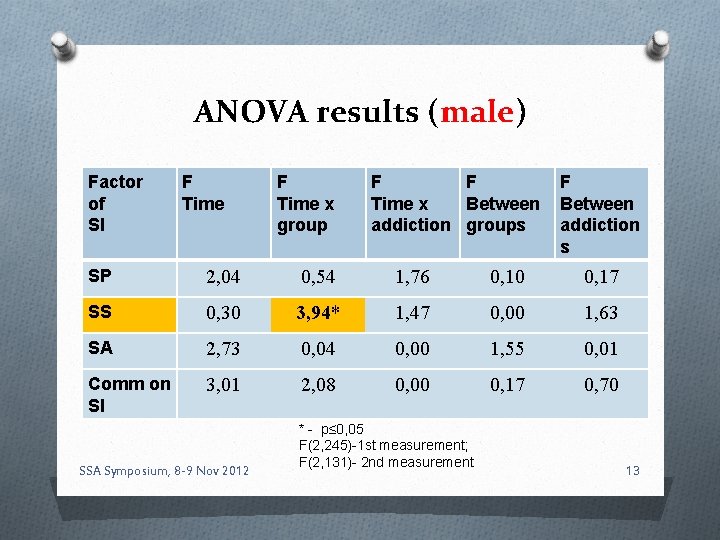
ANOVA results (male) Factor of SI F Time x group F F Time x Between addiction groups F Between addiction s SP 2, 04 0, 54 1, 76 0, 10 0, 17 SS 0, 30 3, 94* 1, 47 0, 00 1, 63 SA 2, 73 0, 04 0, 00 1, 55 0, 01 Comm on SI 3, 01 2, 08 0, 00 0, 17 0, 70 SSA Symposium, 8 -9 Nov 2012 * - p≤ 0, 05 F(2, 245)-1 st measurement; F(2, 131)- 2 nd measurement 13
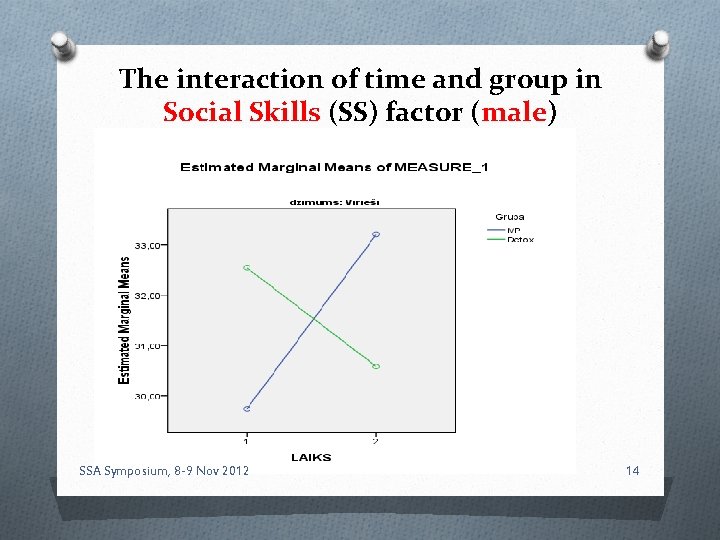
The interaction of time and group in Social Skills (SS) factor (male) SSA Symposium, 8 -9 Nov 2012 14
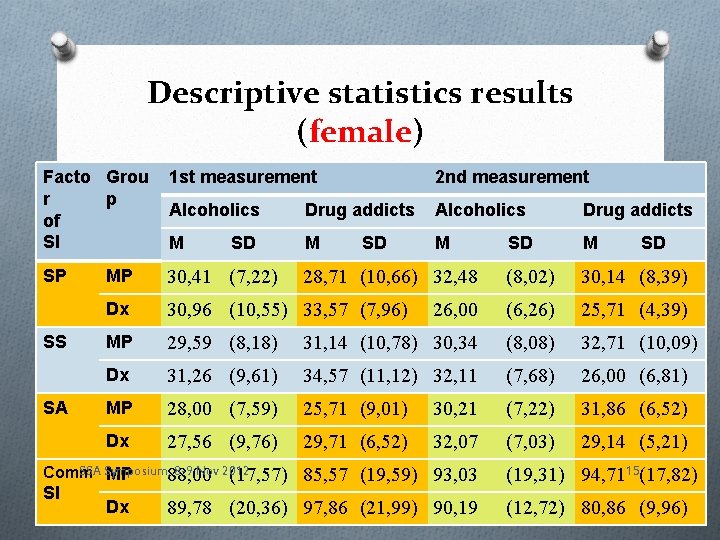
Descriptive statistics results (female) Facto Grou r p of SI 1 st measurement 2 nd measurement Alcoholics Drug addicts M M M SD M SP MP 30, 41 (7, 22) (8, 02) 30, 14 (8, 39) Dx 30, 96 (10, 55) 33, 57 (7, 96) 26, 00 (6, 26) 25, 71 (4, 39) MP 29, 59 (8, 18) 31, 14 (10, 78) 30, 34 (8, 08) 32, 71 (10, 09) Dx 31, 26 (9, 61) 34, 57 (11, 12) 32, 11 (7, 68) 26, 00 (6, 81) MP 28, 00 (7, 59) 25, 71 (9, 01) 30, 21 (7, 22) 31, 86 (6, 52) Dx 27, 56 (9, 76) 29, 71 (6, 52) 32, 07 (7, 03) 29, 14 (5, 21) SS SA SD SSA Symposium, 8 -9 Nov 2012 Comm MP 88, 00 (17, 57) SI Dx SD 28, 71 (10, 66) 32, 48 85, 57 (19, 59) 93, 03 89, 78 (20, 36) 97, 86 (21, 99) 90, 19 SD (19, 31) 94, 7115(17, 82) (12, 72) 80, 86 (9, 96)
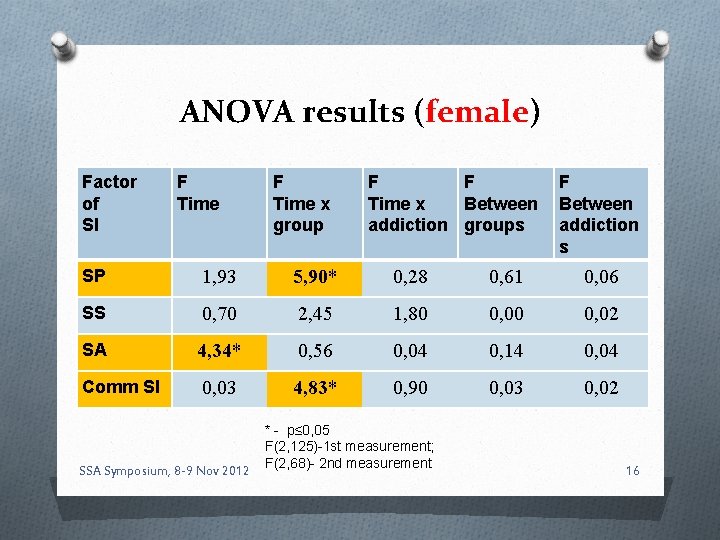
ANOVA results (female) Factor of SI F Time x group F F Time x Between addiction groups F Between addiction s SP 1, 93 5, 90* 0, 28 0, 61 0, 06 SS 0, 70 2, 45 1, 80 0, 02 SA 4, 34* 0, 56 0, 04 0, 14 0, 04 Comm SI 0, 03 4, 83* 0, 90 0, 03 0, 02 SSA Symposium, 8 -9 Nov 2012 * - p≤ 0, 05 F(2, 125)-1 st measurement; F(2, 68)- 2 nd measurement 16
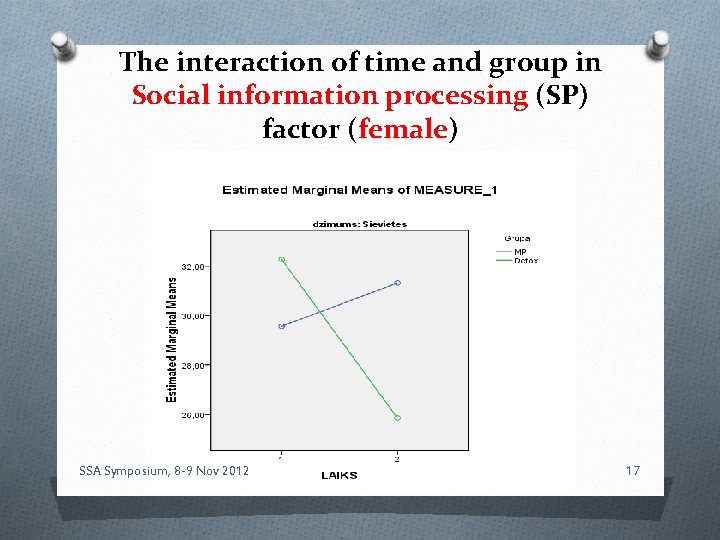
The interaction of time and group in Social information processing (SP) factor (female) SSA Symposium, 8 -9 Nov 2012 17
Conclusion O After results we gained, we found out, that increase of SI indicators is higher for respondents of Minnesota program. Related investigations show the same results (Dawson et al. , 2005; Dawson et al. , 2007), what points out, that MP offer a treatment that is focused on changes in patients thinking and behaviour and towards their skills of obtaining new patterns. O It is necessary to continue investigation, so we can estimate the duration of changes. O Results are helpful for specialists to understand more about acute and psychotherapeautical treatment influence on the changes of Social intellect during therapy process. Information of results might help to improve psychosocial functioning for SUD patients and help them to integrate into society without use of psychoactive substances. SSA Symposium, 8 -9 Nov 2012 18
References o Ham LS, Garcia TA. (2010) Assessment of Social Skills in Substance Use Disorders. In Nangle D. V. , Hansen D. J. , Erdley C. A. , Norton P. J. (eds). Practitioner’s Guide to Empirically Based Measures of Social Skills. New York: Springer Science+Business Media. pp. 225 -246. o Scheier LM, Botvin GJ, Diaz T, Griffin KW. (1999). Social skills, competence, and drug refusal efficacy as predictors of adolescent alcohol use. Journal of Drug Education, 29(3): 251 -278. o Silvera D. H. , Martinussen M. , Dahl T. (2001) The Tromso Social Intelligence Scale, a self-report measure of social intelligence. Scandinavian Journal of Psychology, 42, 313 -319. o Dawson DA, Goldstein RB, Grant BF. 2007. Rates and correlates of relapse among individuāls in remission from DSM-IV alcohol dependence: a 3 -year follow-up. Alcohol Clin Exp Res. 2007; 31(12): 2036 -45. o Dawson DA, Grant BF, Stinson FS, Chou PS, Huang B, Ruan WJ. , 2005. Recovery from DSM-IV alcohol dependence: United States, 2001 -2002. : Addiction. 100(3): 281 -92. SSA Symposium, 8 -9 Nov 2012 19
Thank you for your attention! SSA Symposium, 8 -9 Nov 2012 20
CHANGES OF INDICATORS OF SOCIAL INTELLIGENCE FOR SUBSTANCE USE DISORDERS PATIENTS AFTER TREATMENT Velga Sudraba, MD Riga Centre of Psychiatry and Addiction Disorders, Latvia E-mail: velgasudraba@gmail. com
- Slides: 21