
Changes in spatial segregation influence on the social
- Slides: 1
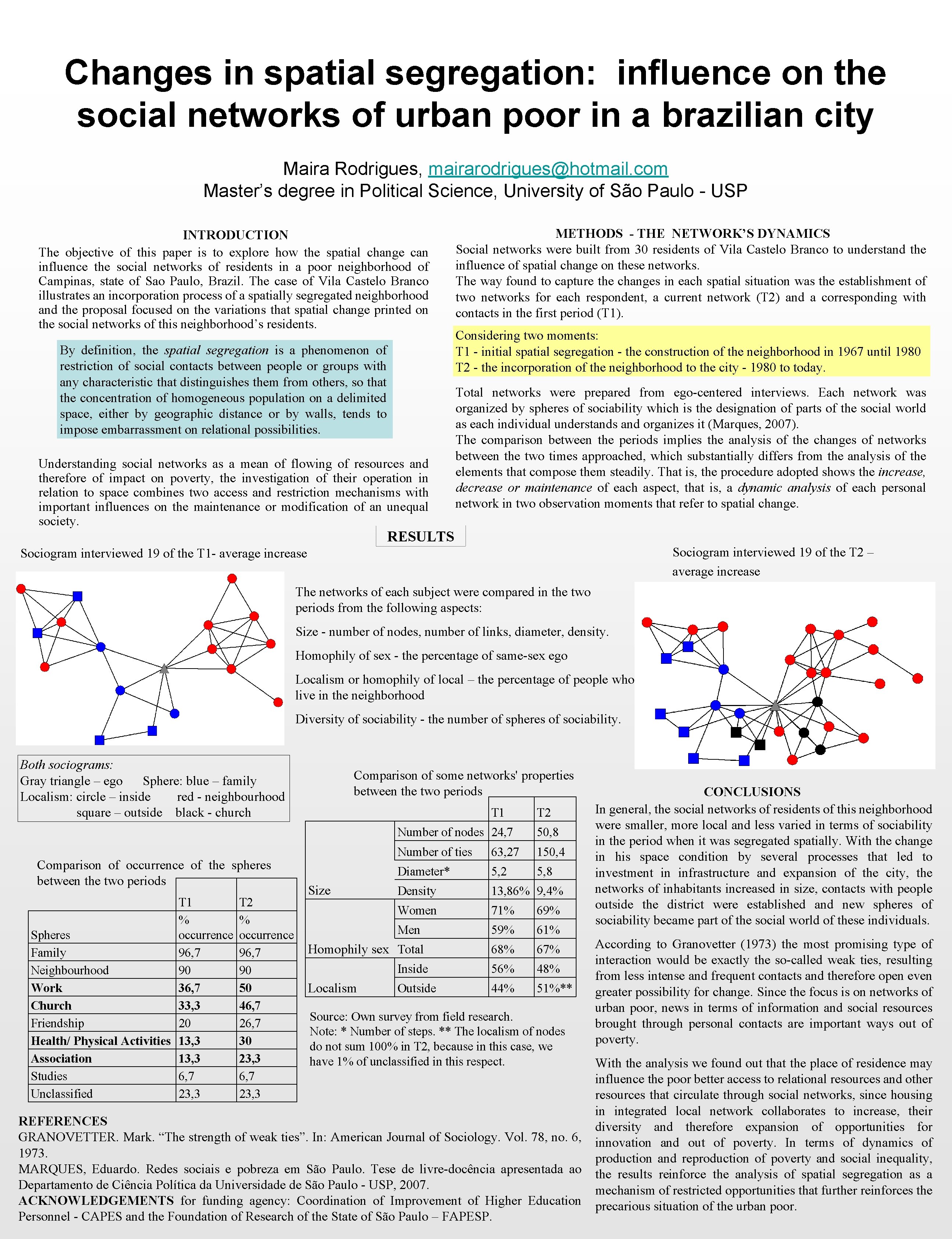
Changes in spatial segregation: influence on the social networks of urban poor in a brazilian city Maira Rodrigues, mairarodrigues@hotmail. com Master’s degree in Political Science, University of São Paulo - USP INTRODUCTION The objective of this paper is to explore how the spatial change can influence the social networks of residents in a poor neighborhood of Campinas, state of Sao Paulo, Brazil. The case of Vila Castelo Branco illustrates an incorporation process of a spatially segregated neighborhood and the proposal focused on the variations that spatial change printed on the social networks of this neighborhood’s residents. By definition, the spatial segregation is a phenomenon of restriction of social contacts between people or groups with any characteristic that distinguishes them from others, so that the concentration of homogeneous population on a delimited space, either by geographic distance or by walls, tends to impose embarrassment on relational possibilities. Understanding social networks as a mean of flowing of resources and therefore of impact on poverty, the investigation of their operation in relation to space combines two access and restriction mechanisms with important influences on the maintenance or modification of an unequal society. METHODS - THE NETWORK’S DYNAMICS Social networks were built from 30 residents of Vila Castelo Branco to understand the influence of spatial change on these networks. The way found to capture the changes in each spatial situation was the establishment of two networks for each respondent, a current network (T 2) and a corresponding with contacts in the first period (T 1). Considering two moments: T 1 - initial spatial segregation - the construction of the neighborhood in 1967 until 1980 T 2 - the incorporation of the neighborhood to the city - 1980 to today. Total networks were prepared from ego-centered interviews. Each network was organized by spheres of sociability which is the designation of parts of the social world as each individual understands and organizes it (Marques, 2007). The comparison between the periods implies the analysis of the changes of networks between the two times approached, which substantially differs from the analysis of the elements that compose them steadily. That is, the procedure adopted shows the increase, decrease or maintenance of each aspect, that is, a dynamic analysis of each personal network in two observation moments that refer to spatial change. RESULTS Sociogram interviewed 19 of the T 1 - average increase Sociogram interviewed 19 of the T 2 – average increase The networks of each subject were compared in the two periods from the following aspects: Size - number of nodes, number of links, diameter, density. Homophily of sex - the percentage of same-sex ego Localism or homophily of local – the percentage of people who live in the neighborhood Diversity of sociability - the number of spheres of sociability. Both sociograms: Gray triangle – ego Sphere: blue – family Localism: circle – inside red - neighbourhood square – outside black - church Comparison of occurrence of the spheres between the two periods T 1 % Spheres occurrence Family 96, 7 Neighbourhood 90 Work 36, 7 Church 33, 3 Friendship 20 Health/ Physical Activities 13, 3 Association 13, 3 Studies 6, 7 Unclassified 23, 3 T 2 % occurrence 96, 7 90 50 46, 7 26, 7 30 23, 3 6, 7 23, 3 Comparison of some networks' properties between the two periods T 1 T 2 Number of nodes 24, 7 50, 8 Number of ties 63, 27 150, 4 Diameter* 5, 2 5, 8 Density 13, 86% 9, 4% Women 71% 69% Men 59% 61% Homophily sex Total 68% 67% Inside 56% 48% Outside 44% 51%** Size Localism Source: Own survey from field research. Note: * Number of steps. ** The localism of nodes do not sum 100% in T 2, because in this case, we have 1% of unclassified in this respect. CONCLUSIONS In general, the social networks of residents of this neighborhood were smaller, more local and less varied in terms of sociability in the period when it was segregated spatially. With the change in his space condition by several processes that led to investment in infrastructure and expansion of the city, the networks of inhabitants increased in size, contacts with people outside the district were established and new spheres of sociability became part of the social world of these individuals. According to Granovetter (1973) the most promising type of interaction would be exactly the so-called weak ties, resulting from less intense and frequent contacts and therefore open even greater possibility for change. Since the focus is on networks of urban poor, news in terms of information and social resources brought through personal contacts are important ways out of poverty. With the analysis we found out that the place of residence may influence the poor better access to relational resources and other resources that circulate through social networks, since housing in integrated local network collaborates to increase, their REFERENCES diversity and therefore expansion of opportunities for GRANOVETTER. Mark. “The strength of weak ties”. In: American Journal of Sociology. Vol. 78, no. 6, innovation and out of poverty. In terms of dynamics of 1973. production and reproduction of poverty and social inequality, MARQUES, Eduardo. Redes sociais e pobreza em São Paulo. Tese de livre-docência apresentada ao the results reinforce the analysis of spatial segregation as a Departamento de Ciência Política da Universidade de São Paulo - USP, 2007. mechanism of restricted opportunities that further reinforces the ACKNOWLEDGEMENTS for funding agency: Coordination of Improvement of Higher Education precarious situation of the urban poor. Personnel - CAPES and the Foundation of Research of the State of São Paulo – FAPESP.