
Changes in Rising and Sinking Air Adiabatic Processes
Changes in Rising and Sinking Air: Adiabatic Processes Process Lapse Rates When air rises it is depressurized and expands. As a result its temperature falls. When unsaturated air rises, its rate of cooling or lapse rate is called the Dry Adiabatic Lapse Rate (DALR). It is a constant equal to, DALR 10 C/km. Expansion also causes Td of unsaturated air to decrease by about 2 C/km. If air rises and cools enough it eventually becomes saturated. When saturated air rises, T and Td cool together at the Saturated Adiabatic Lapse Rate (SALR). The SALR is always less than the DALR because vapor condenses and releases heat to the surroundings as saturated air cools. This offsets the cooling due to expansion. The warmer the saturated air more vapor it holds and the more rapid the condensation and heating rates. As a result, SALR < 5 C/km in very warm air SALR > 9 C/km in very cold air. Exact values of SALR and condensation rates can be found by using the Skew. T diagram. The next slide shows how rapidly cooling and condensation occur for two samples of air. The second slide gives a good approximation to use when you do not have a Skew-T diagram handy (i. e. , the rest of your lives).
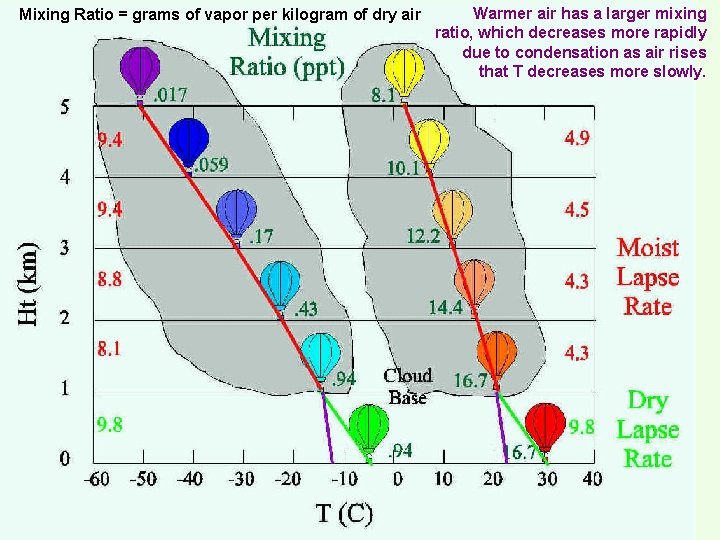
Mixing Ratio = grams of vapor per kilogram of dry air Warmer air has a larger mixing ratio, which decreases more rapidly due to condensation as air rises that T decreases more slowly.
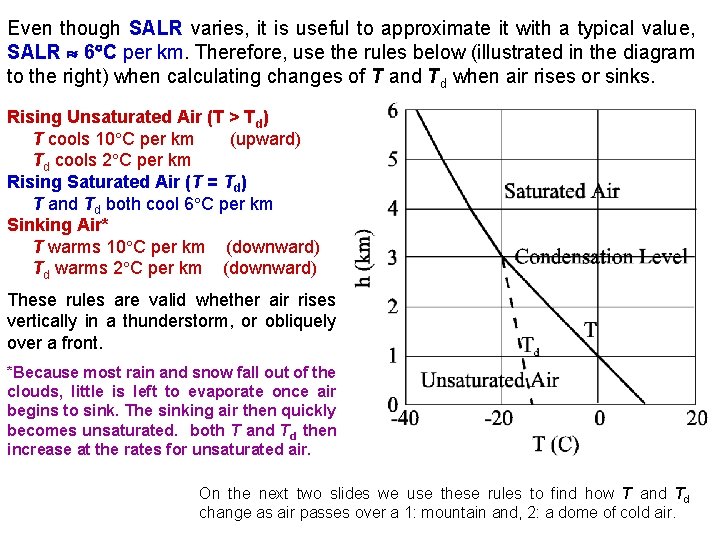
Even though SALR varies, it is useful to approximate it with a typical value, SALR 6 C per km. Therefore, use the rules below (illustrated in the diagram to the right) when calculating changes of T and Td when air rises or sinks. Rising Unsaturated Air (T > Td) T cools 10 C per km (upward) Td cools 2 C per km Rising Saturated Air (T = Td) T and Td both cool 6 C per km Sinking Air* T warms 10 C per km (downward) Td warms 2 C per km (downward) These rules are valid whether air rises vertically in a thunderstorm, or obliquely over a front. *Because most rain and snow fall out of the clouds, little is left to evaporate once air begins to sink. The sinking air then quickly becomes unsaturated. both T and Td then increase at the rates for unsaturated air. On the next two slides we use these rules to find how T and Td change as air passes over a 1: mountain and, 2: a dome of cold air.
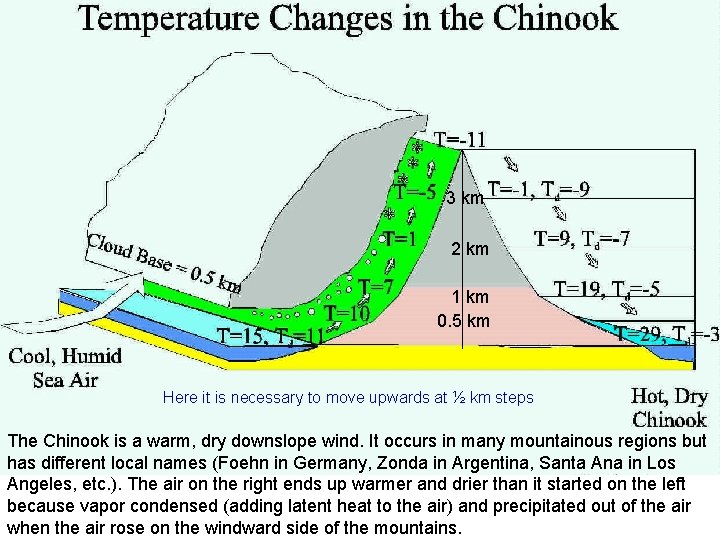
3 km 2 km 1 km 0. 5 km Here it is necessary to move upwards at ½ km steps The Chinook is a warm, dry downslope wind. It occurs in many mountainous regions but has different local names (Foehn in Germany, Zonda in Argentina, Santa Ana in Los Angeles, etc. ). The air on the right ends up warmer and drier than it started on the left because vapor condensed (adding latent heat to the air) and precipitated out of the air when the air rose on the windward side of the mountains.
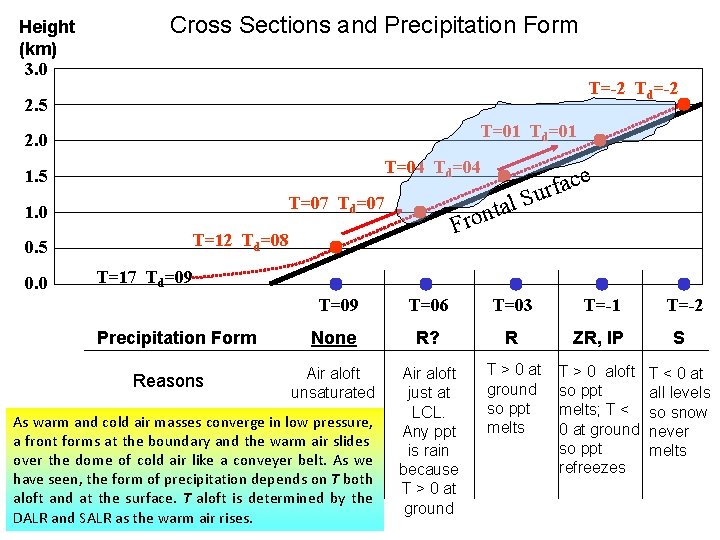
Height (km) 3. 0 Cross Sections and Precipitation Form T=-2 Td=-2 2. 5 T=01 Td=01 2. 0 T=04 Td=04 1. 5 0. 0 l a t n Fro T=07 Td=07 1. 0 e T=12 Td=08 ac f r u S T=17 Td=09 T=09 Precipitation Form Reasons T=06 T=03 T=-1 None R? R ZR, IP S Air aloft unsaturated Air aloft just at LCL. Any ppt is rain because T > 0 at ground so ppt melts T > 0 aloft so ppt melts; T < 0 at ground so ppt refreezes T < 0 at all levels so snow never melts As warm and cold air masses converge in low pressure, a front forms at the boundary and the warm air slides over the dome of cold air like a conveyer belt. As we have seen, the form of precipitation depends on T both aloft and at the surface. T aloft is determined by the DALR and SALR as the warm air rises. T=-2
When will air rise freely? When it is heated and buoyant and the atmosphere is unstable.
Stability Thunderstorms form when a rising bubble or parcel of air, which is indicated by the process lapse rate, is warmer and hence lighter than the sounding of the surrounding atmosphere. This condition is unstable. On the other hand, vertical motions are suppressed when the rising parcel is colder and denser than the surrounding atmosphere. This condition is stable and leads to polluted air when winds are light and there is a source of pollution. Therefore, Unstable Atmosphere Sounding T decreases faster with height than rising parcel. Sounding T decreases slower with height than rising parcel. Atmospheric stability is determined by the following steps: 1. Draw the sounding. 2. Lift a parcel of air from ground level using the process cooling rate for unsaturated air to the point of saturation and the process cooling rate for saturated air thereafter. 3. Compare temperatures of sounding and lifted parcel. The atmosphere is unstable if the lifted parcel is warmer then the sounding and stable if the lifted parcel is cooler. Sometimes, the lifted parcel will be cooler than the sounding for the first few hundred meters of lifting but warmer at some greater heights. This means that the atmosphere will need a push to get it going. Such an atmosphere is potentially unstable, and the instability will be realized only if the air near the ground is heated further, or if some atmospheric process forces the entire atmosphere to rise. Examples of forced rising include upslope flow against mountains or over frontal surfaces.
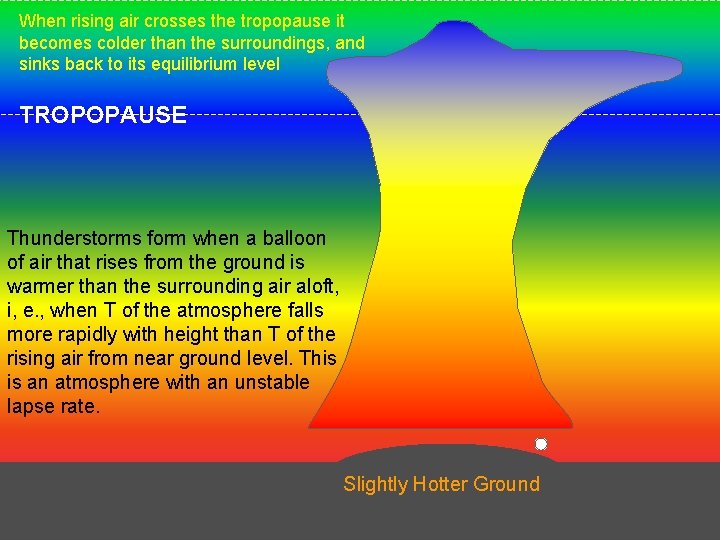
When rising air crosses the tropopause it becomes colder than the surroundings, and sinks back to its equilibrium level TROPOPAUSE Thunderstorms form when a balloon of air that rises from the ground is warmer than the surrounding air aloft, i, e. , when T of the atmosphere falls more rapidly with height than T of the rising air from near ground level. This is an atmosphere with an unstable lapse rate. Slightly Hotter Ground
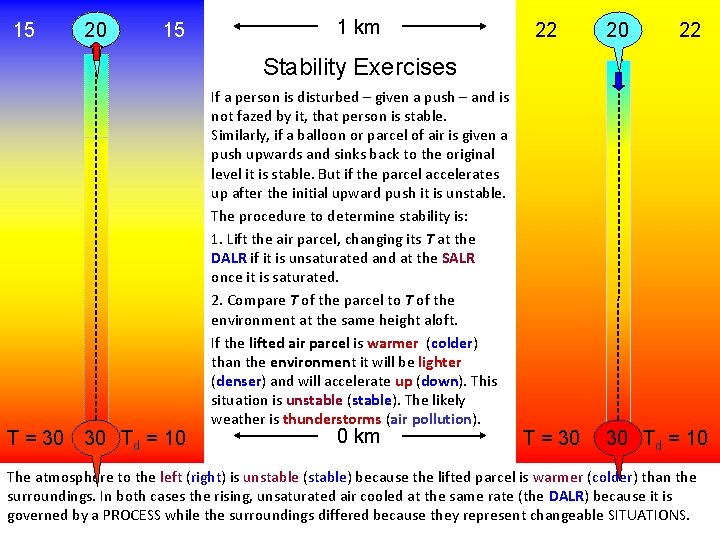
15 20 15 1 km 22 20 22 Stability Exercises T = 30 30 Td = 10 If a person is disturbed – given a push – and is not fazed by it, that person is stable. Similarly, if a balloon or parcel of air is given a push upwards and sinks back to the original level it is stable. But if the parcel accelerates up after the initial upward push it is unstable. The procedure to determine stability is: 1. Lift the air parcel, changing its T at the DALR if it is unsaturated and at the SALR once it is saturated. 2. Compare T of the parcel to T of the environment at the same height aloft. If the lifted air parcel is warmer (colder) than the environment it will be lighter (denser) and will accelerate up (down). This situation is unstable (stable). The likely weather is thunderstorms (air pollution). 0 km T = 30 30 Td = 10 The atmosphere to the left (right) is unstable (stable) because the lifted parcel is warmer (colder) than the surroundings. In both cases the rising, unsaturated air cooled at the same rate (the DALR) because it is governed by a PROCESS while the surroundings differed because they represent changeable SITUATIONS.
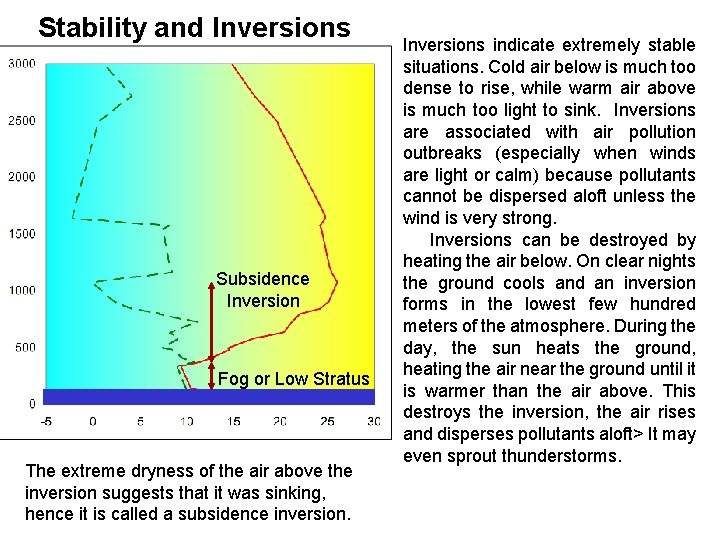
Stability and Inversions Subsidence Inversion Fog or Low Stratus The extreme dryness of the air above the inversion suggests that it was sinking, hence it is called a subsidence inversion. Inversions indicate extremely stable situations. Cold air below is much too dense to rise, while warm air above is much too light to sink. Inversions are associated with air pollution outbreaks (especially when winds are light or calm) because pollutants cannot be dispersed aloft unless the wind is very strong. Inversions can be destroyed by heating the air below. On clear nights the ground cools and an inversion forms in the lowest few hundred meters of the atmosphere. During the day, the sun heats the ground, heating the air near the ground until it is warmer than the air above. This destroys the inversion, the air rises and disperses pollutants aloft> It may even sprout thunderstorms.
The Skew_T Log_ p Diagram Thermodynamic diagrams are graphical computers for calculating adiabatic processes and resulting changes of temperature and humidity. (The first such diagram was created by James Watt, to calculate changes of pressure and temperature in the steam engine as water boiled and as steam condensed!) The Skew-T is the standard thermodynamic diagram used by meteorologists. It was designed to depict most soundings as more or less vertical lines. In the typical sounding diagram the x axis represents temperature and the y axis represents height or some function of decreasing pressure. Therefore, isotherms or lines of constant T are vertical lines while isobars or lines of constant pressure are horizontal lines. But T decreases so drastically with height in the troposphere, that the only way to depict atmospheric soundings as more or less vertical lines is to make isotherms slope up to the right. This is what makes the Skew-T so useful to meteorologists but so difficult to learn to read. The following slides show the Skew-T is designed and how it acts as a process calculator.
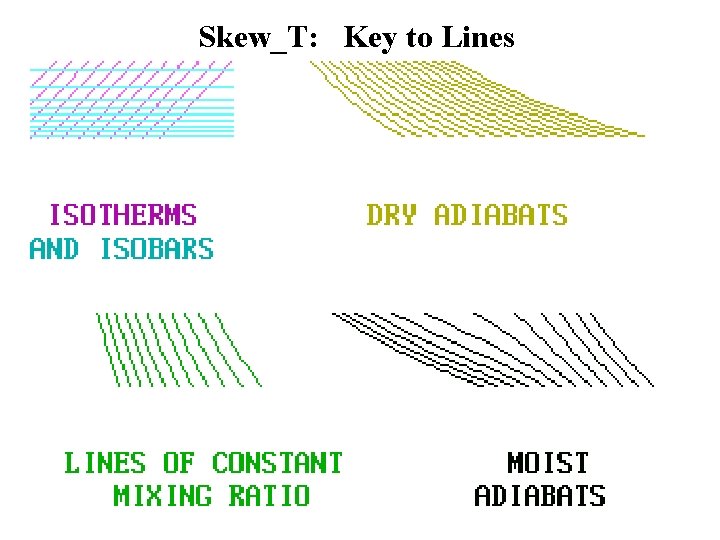
Skew_T: Key to Lines
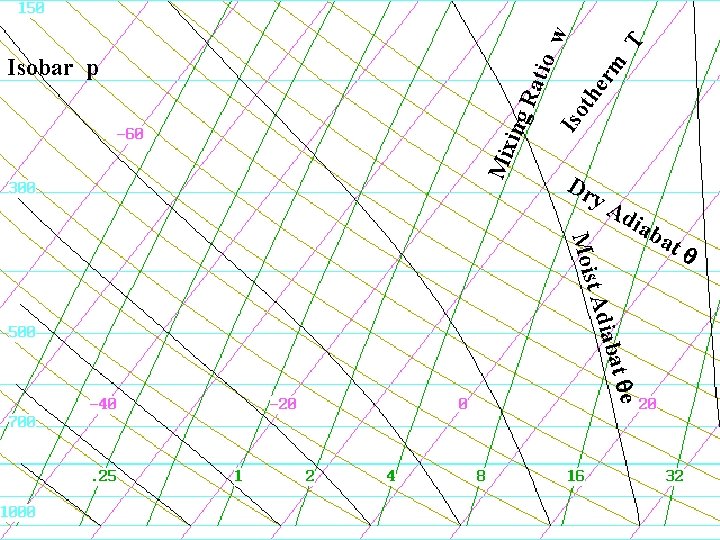
io m er Rat Iso th Mix ing Isobar p Dr y. A t qe iaba t Ad Mois dia ba tq T w
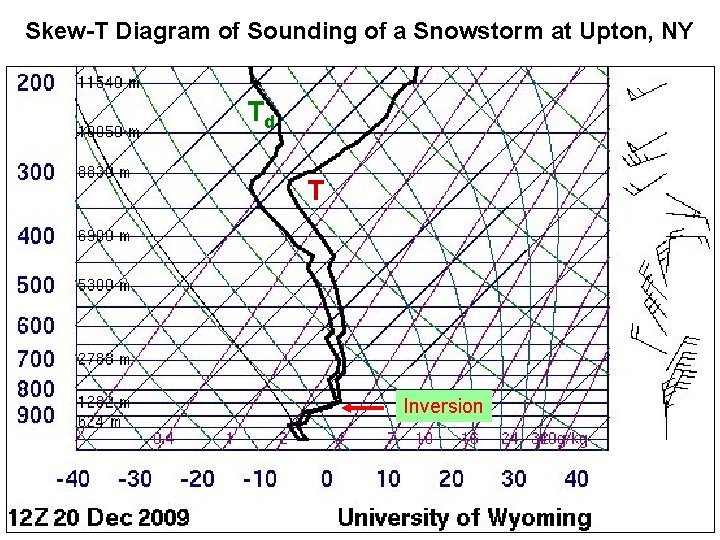
Skew-T Diagram of Sounding of a Snowstorm at Upton, NY Td T Inversion
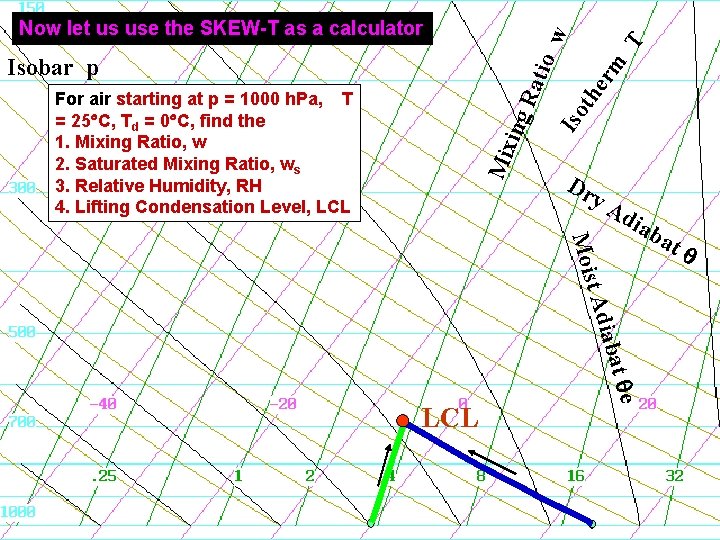
Mix ing T m er For air starting at p = 1000 h. Pa, T = 25 C, Td = 0 C, find the 1. Mixing Ratio, w 2. Saturated Mixing Ratio, ws 3. Relative Humidity, RH 4. Lifting Condensation Level, LCL Iso th Rat io Isobar p w Now let us use the SKEW-T as a calculator Dr y. A dia ba LCL t qe iaba t Ad Mois tq
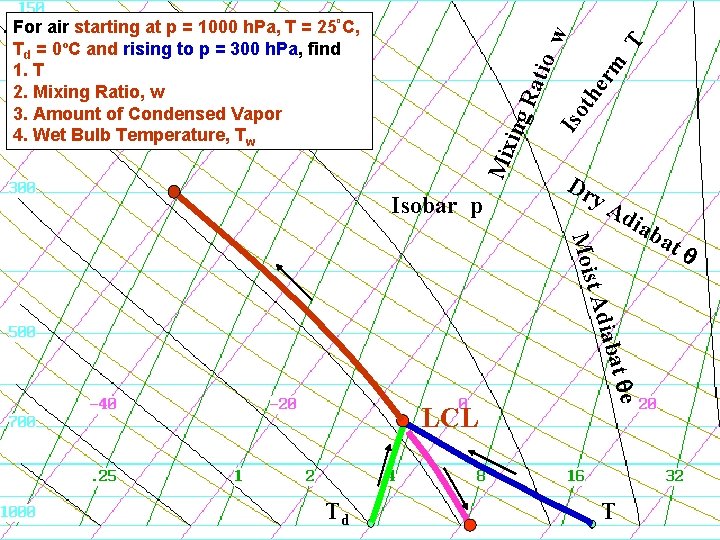
Mix Isobar p m er Iso th ing Rat io T w For air starting at p = 1000 h. Pa, T = 25ºC, Td = 0ºC and rising to p = 300 h. Pa, find 1. T 2. Mixing Ratio, w 3. Amount of Condensed Vapor 4. Wet Bulb Temperature, Tw Dr y. A dia ba LCL Td t qe iaba t Ad Mois tq T
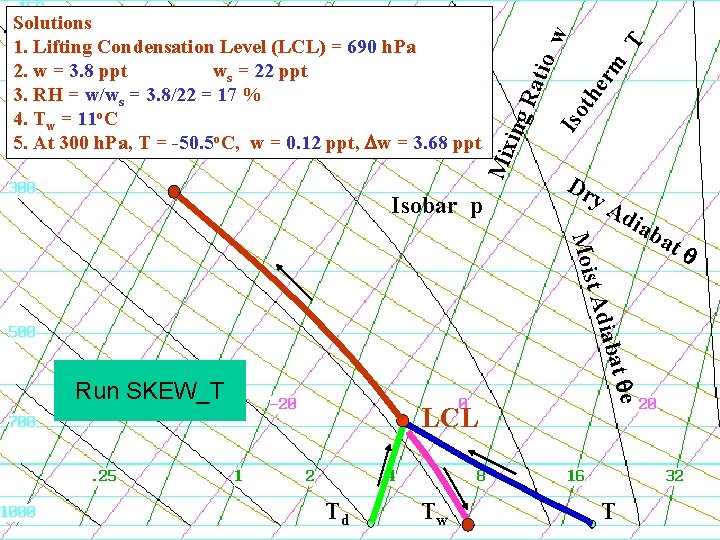
Isobar p T w Iso th er m io Rat ing Mix Solutions 1. Lifting Condensation Level (LCL) = 690 h. Pa 2. w = 3. 8 ppt ws = 22 ppt 3. RH = w/ws = 3. 8/22 = 17 % 4. Tw = 11 o. C 5. At 300 h. Pa, T = -50. 5 o. C, w = 0. 12 ppt, Dw = 3. 68 ppt Dr y. A dia ba Run SKEW_T LCL Td Tw t qe iaba t Ad Mois tq T
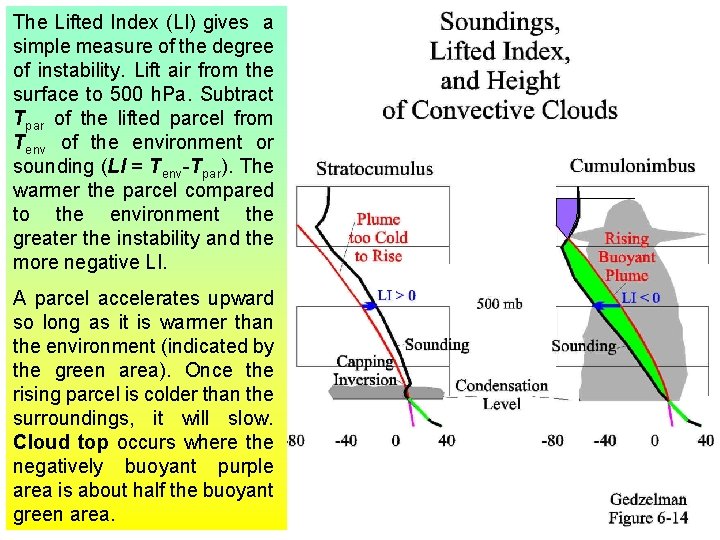
The Lifted Index (LI) gives a simple measure of the degree of instability. Lift air from the surface to 500 h. Pa. Subtract Tpar of the lifted parcel from Tenv of the environment or sounding (LI = Tenv-Tpar). The warmer the parcel compared to the environment the greater the instability and the more negative LI. A parcel accelerates upward so long as it is warmer than the environment (indicated by the green area). Once the rising parcel is colder than the surroundings, it will slow. Cloud top occurs where the negatively buoyant purple area is about half the buoyant green area.
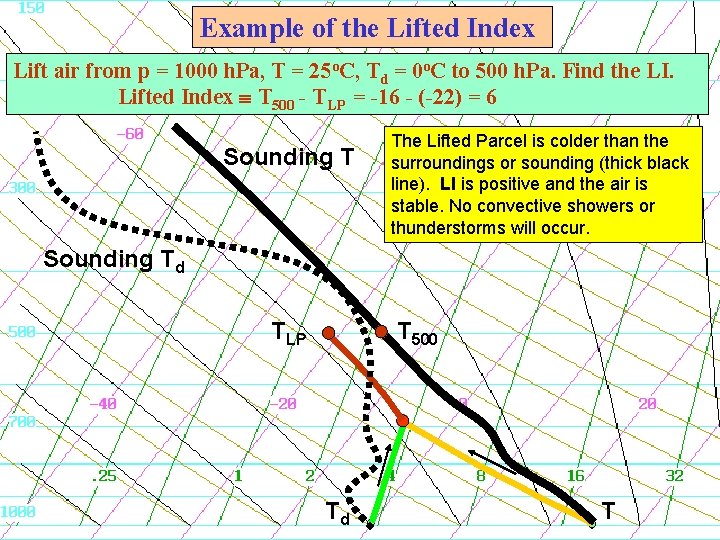
Example of the Lifted Index Lift air from p = 1000 h. Pa, T = 25 o. C, Td = 0 o. C to 500 h. Pa. Find the LI. Lifted Index T 500 - TLP = -16 - (-22) = 6 Sounding T The Lifted Parcel is colder than the surroundings or sounding (thick black line). LI is positive and the air is stable. No convective showers or thunderstorms will occur. Sounding Td TLP T 500 Td T
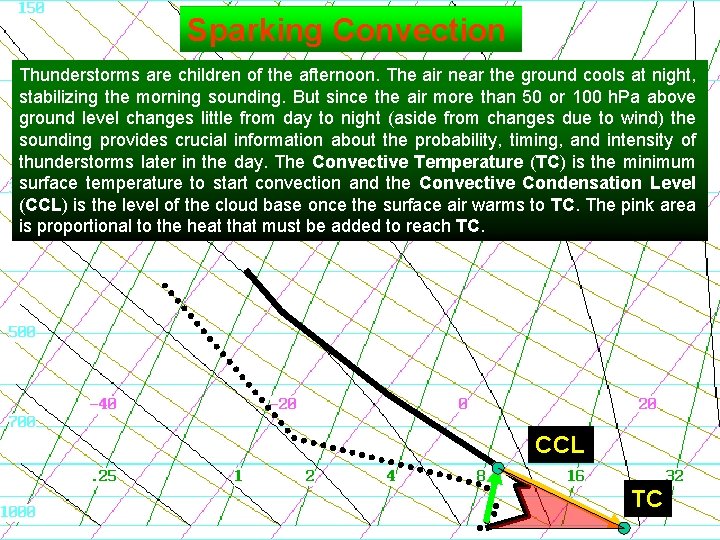
Sparking Convection Thunderstorms are children of the afternoon. The air near the ground cools at night, stabilizing the morning sounding. But since the air more than 50 or 100 h. Pa above ground level changes little from day to night (aside from changes due to wind) the sounding provides crucial information about the probability, timing, and intensity of thunderstorms later in the day. The Convective Temperature (TC) is the minimum surface temperature to start convection and the Convective Condensation Level (CCL) is the level of the cloud base once the surface air warms to TC. The pink area is proportional to the heat that must be added to reach TC. CCL TC
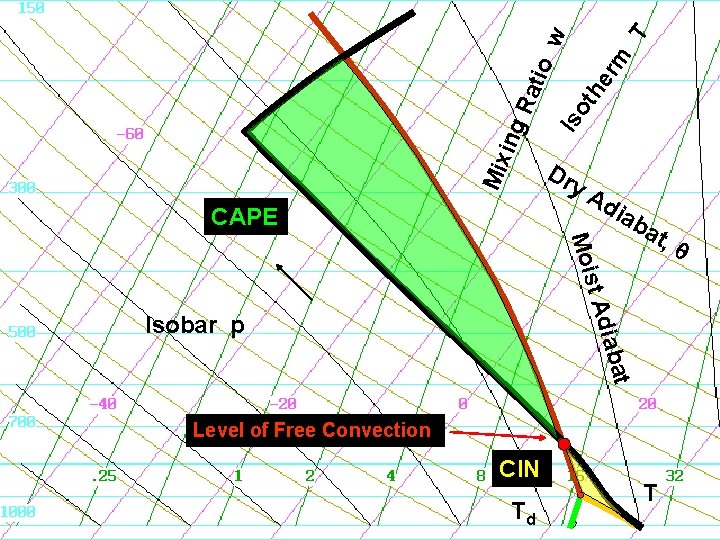
Convective Available Potential Energy Convective Inhibition CAPE or Convective Available Potential Energy is the maximum energy available to a rising air parcel in an unstable atmosphere. It is proportional to the green area between the Temperature of the Lifted Parcel and the Temperature of the Sounding of the next slide. Values of CAPE greater than 1500 indicate strong thunderstorms are possible. CIN or Convective Inhibition is the energy an air parcel near ground level needs to reach the Level of Free Convection (or level above which a rising parcel becomes warmer than the surrounding air – indicated by the red circle). Often in the morning the air near the ground is stable and restricts convection. Only when the Sun heats the air enough or when large scale motions lift the air enough is CIN eliminated. Then convection starts.
T ot he rm w Is Ra tio ing Mix CAPE Dr y. A dia b Mois at, t Ad iaba Isobar p t Level of Free Convection CIN Td T q
- Slides: 22