
Changes in Mathematics Teaching Project the schools Three

- Slides: 25
Changes in Mathematics Teaching Project: the schools
Three schools § Deliberately changing their practice to enable previously low attaining students to do better § Changing teaching methods § New kinds of grouping § One cohort throughout KS 3 § Applying ideas from ‘Deep Progress’
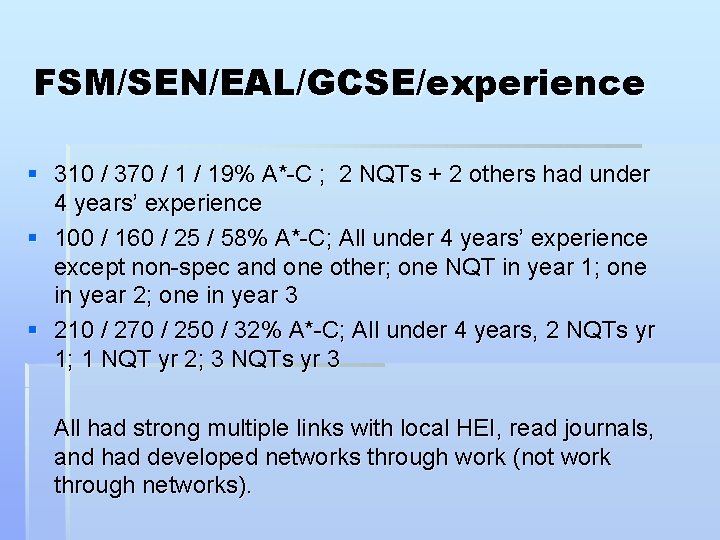
FSM/SEN/EAL/GCSE/experience § 310 / 370 / 19% A*-C ; 2 NQTs + 2 others had under 4 years’ experience § 100 / 160 / 25 / 58% A*-C; All under 4 years’ experience except non-spec and one other; one NQT in year 1; one in year 2; one in year 3 § 210 / 270 / 250 / 32% A*-C; All under 4 years, 2 NQTs yr 1; 1 NQT yr 2; 3 NQTs yr 3 All had strong multiple links with local HEI, read journals, and had developed networks through work (not work through networks).
Changes in Mathematics Teaching Project: what they did
Planning § Critical use of official documents § Developing own frameworks based on key ideas in mathematics and/or development of mathematical thinking § Teams collating resources, and disseminating them; knowing who has greatest knowledge and experience of resources § Organising, managing, giving time to sharing ideas § Shifting from tasks, tips, approaches that ‘work' to developing vertical teaching approaches § Shifting from using resources which allow for differentiated outcomes, to teaching approaches which enable everyone to learn key ideas?
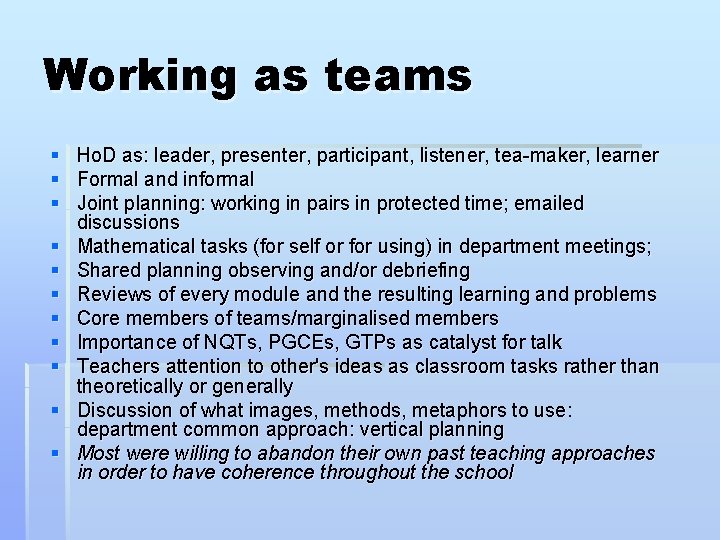
Working as teams § Ho. D as: leader, presenter, participant, listener, tea-maker, learner § Formal and informal § Joint planning: working in pairs in protected time; emailed discussions § Mathematical tasks (for self or for using) in department meetings; § Shared planning observing and/or debriefing § Reviews of every module and the resulting learning and problems § Core members of teams/marginalised members § Importance of NQTs, PGCEs, GTPs as catalyst for talk § Teachers attention to other's ideas as classroom tasks rather than theoretically or generally § Discussion of what images, methods, metaphors to use: department common approach: vertical planning § Most were willing to abandon their own past teaching approaches in order to have coherence throughout the school
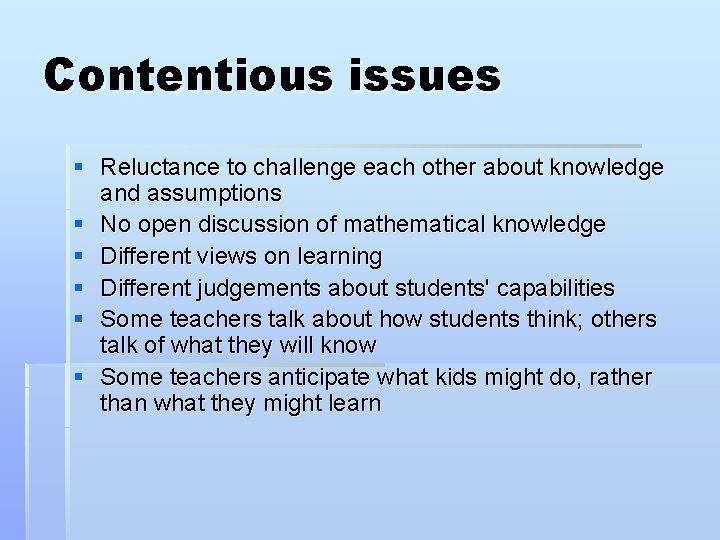
Contentious issues § Reluctance to challenge each other about knowledge and assumptions § No open discussion of mathematical knowledge § Different views on learning § Different judgements about students' capabilities § Some teachers talk about how students think; others talk of what they will know § Some teachers anticipate what kids might do, rather than what they might learn
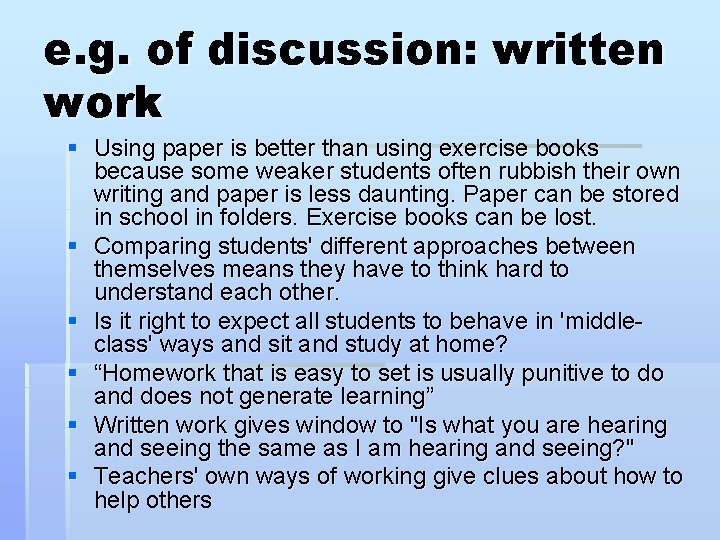
e. g. of discussion: written work § Using paper is better than using exercise books because some weaker students often rubbish their own writing and paper is less daunting. Paper can be stored in school in folders. Exercise books can be lost. § Comparing students' different approaches between themselves means they have to think hard to understand each other. § Is it right to expect all students to behave in 'middleclass' ways and sit and study at home? § “Homework that is easy to set is usually punitive to do and does not generate learning” § Written work gives window to "Is what you are hearing and seeing the same as I am hearing and seeing? " § Teachers' own ways of working give clues about how to help others
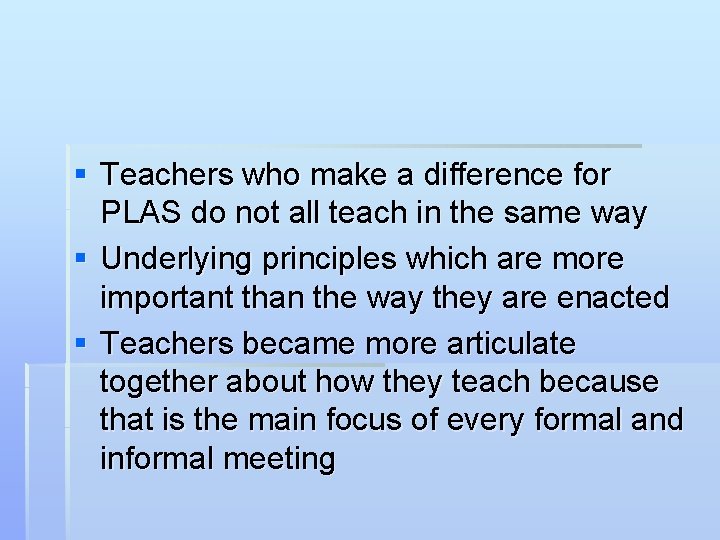
§ Teachers who make a difference for PLAS do not all teach in the same way § Underlying principles which are more important than the way they are enacted § Teachers became more articulate together about how they teach because that is the main focus of every formal and informal meeting
Changes in Mathematics Teaching Project: focus on learning
Tasks § 'tasks going anywhere' and 'students working at their own level' § range of possible objectives likely to arise in a lesson § access to the main mathematical ideas § "marriage between the teacher's objectives and what the students think of". § developing better questions to prompt extension of ideas, rather than providing extension questions
Development of mathematical habits § "chunks" of work which allowed exploration of maths, so that students can develop skills, resourcefulness and resilience within some coherent maths § not extended tasks but deeper learning of maths § “You had to offer tricky examples to make new methods necessary”
Changes in Mathematics Teaching Project: the lessons
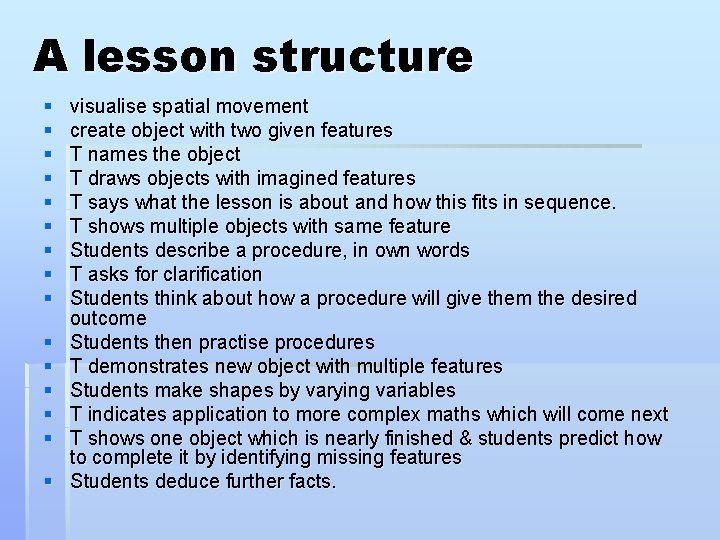
A lesson structure § § § § visualise spatial movement create object with two given features T names the object T draws objects with imagined features T says what the lesson is about and how this fits in sequence. T shows multiple objects with same feature Students describe a procedure, in own words T asks for clarification Students think about how a procedure will give them the desired outcome Students then practise procedures T demonstrates new object with multiple features Students make shapes by varying variables T indicates application to more complex maths which will come next T shows one object which is nearly finished & students predict how to complete it by identifying missing features Students deduce further facts.
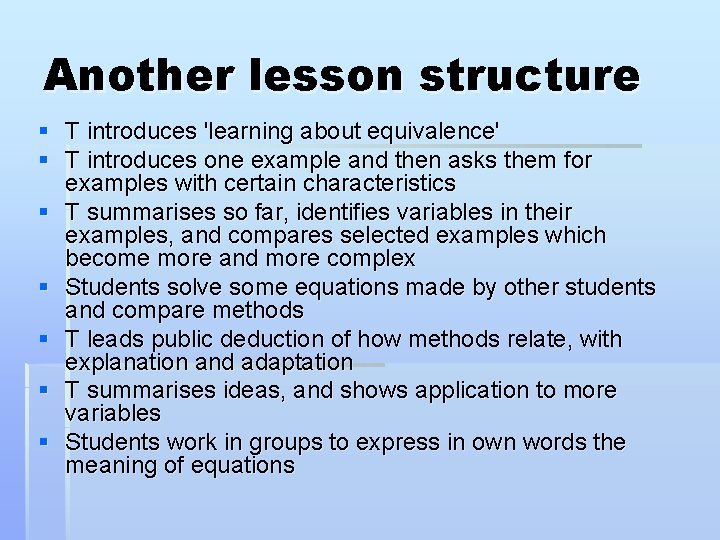
Another lesson structure § § § § T introduces 'learning about equivalence' T introduces one example and then asks them for examples with certain characteristics T summarises so far, identifies variables in their examples, and compares selected examples which become more and more complex Students solve some equations made by other students and compare methods T leads public deduction of how methods relate, with explanation and adaptation T summarises ideas, and shows application to more variables Students work in groups to express in own words the meaning of equations
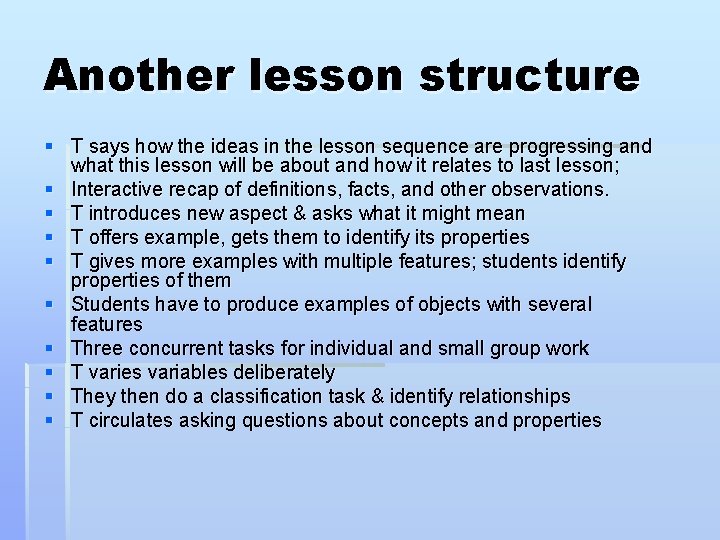
Another lesson structure § T says how the ideas in the lesson sequence are progressing and what this lesson will be about and how it relates to last lesson; § Interactive recap of definitions, facts, and other observations. § T introduces new aspect & asks what it might mean § T offers example, gets them to identify its properties § T gives more examples with multiple features; students identify properties of them § Students have to produce examples of objects with several features § Three concurrent tasks for individual and small group work § T varies variables deliberately § They then do a classification task & identify relationships § T circulates asking questions about concepts and properties
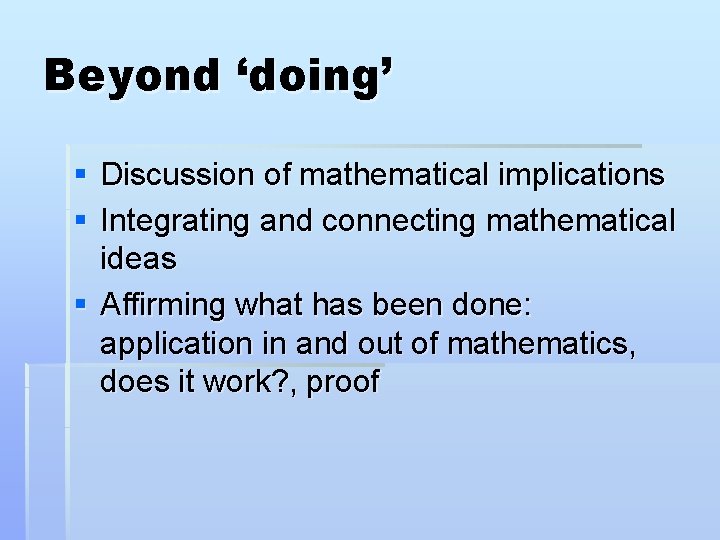
Beyond ‘doing’ § Discussion of mathematical implications § Integrating and connecting mathematical ideas § Affirming what has been done: application in and out of mathematics, does it work? , proof
Changes in Mathematics Teaching Project: the students
What do you do in maths? comparing year 7 to year 6 § More writing, listening, practical work and shared work on the board § Less use of textbooks, worksheets and computers and less discussion in groups
Imagine you are holding a pen. . . § § § § objectives and/or dates doing sums copying from board questions and answers working out what we are asked to write worksheets (wide range observed) making up own questions (1 – but common observation)
Doing maths at home § 29/33 reported doing maths at home: Doing homework (29) Home finance (5) Maths on computer (4) Extra work given by parents (3) Making up own sums (2) Helping siblings (1)
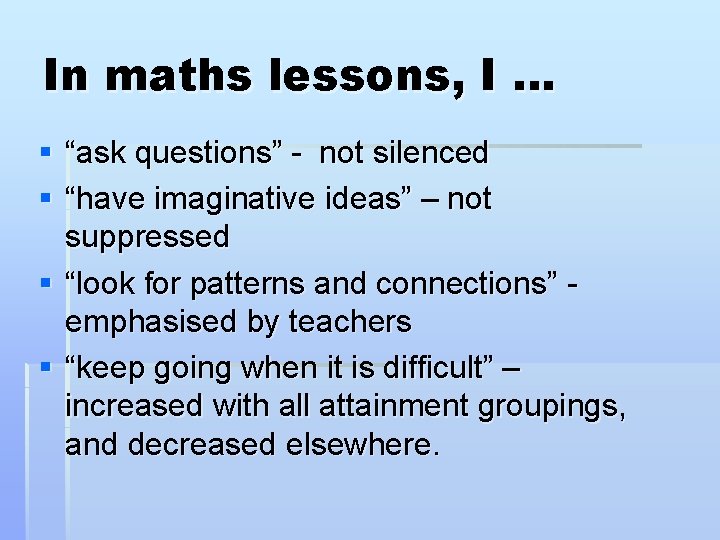
In maths lessons, I … § “ask questions” - not silenced § “have imaginative ideas” – not suppressed § “look for patterns and connections” emphasised by teachers § “keep going when it is difficult” – increased with all attainment groupings, and decreased elsewhere.
Changes in Mathematics Teaching Project: the results
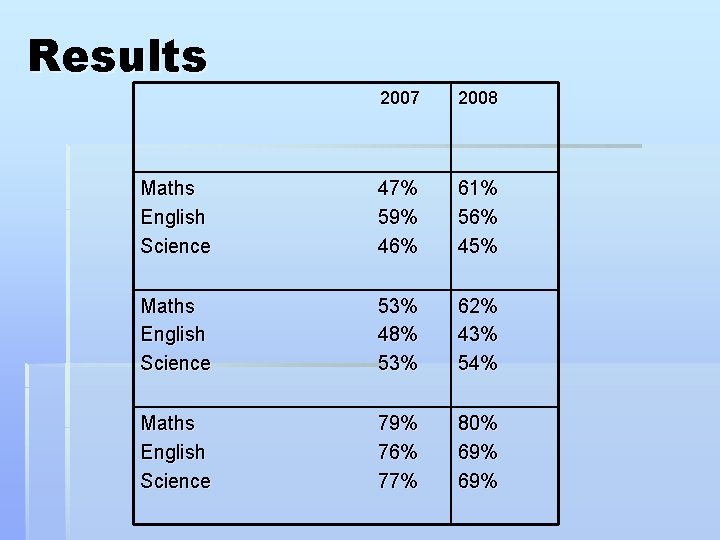
Results 2007 2008 Maths English Science 47% 59% 46% 61% 56% 45% Maths English Science 53% 48% 53% 62% 43% 54% Maths English Science 79% 76% 77% 80% 69%
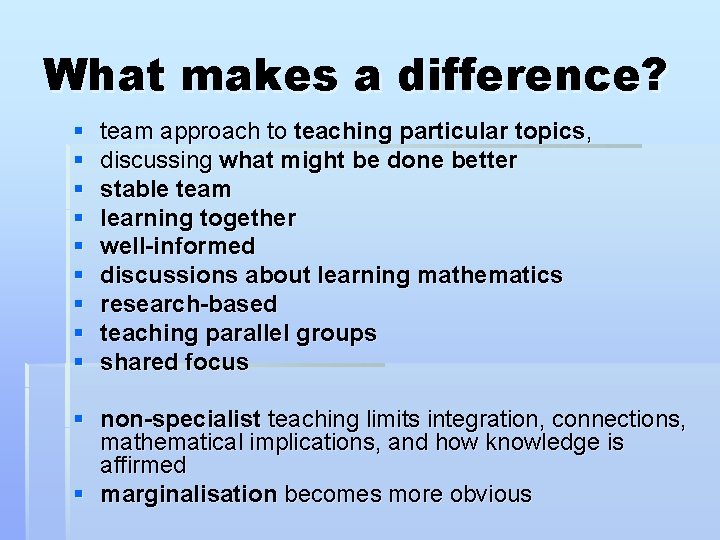
What makes a difference? § § § § § team approach to teaching particular topics, discussing what might be done better stable team learning together well-informed discussions about learning mathematics research-based teaching parallel groups shared focus § non-specialist teaching limits integration, connections, mathematical implications, and how knowledge is affirmed § marginalisation becomes more obvious