
Changes in food demand Growing demand for local
- Slides: 13
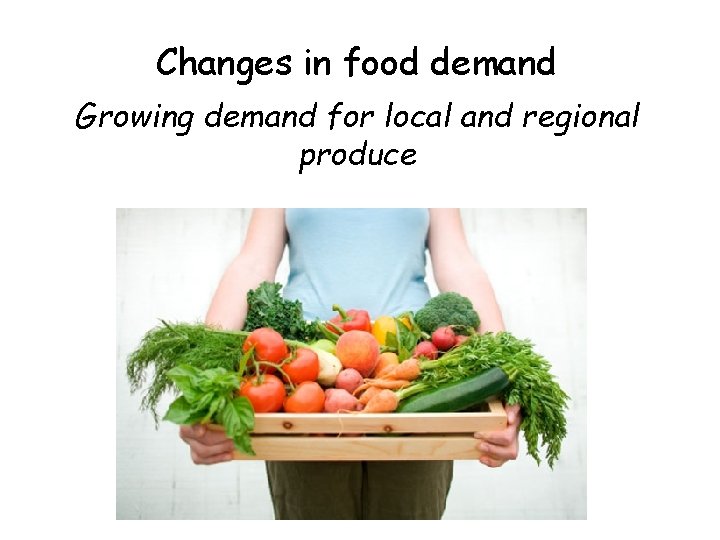
Changes in food demand Growing demand for local and regional produce
Starter: The top 5 global supermarket giants? 1. Wal-Mart (USA) 2. Carrefour (France) 3. Metro (Germany) 4. Tesco (UK) 5. Lidl Stiftung Co (Germany)
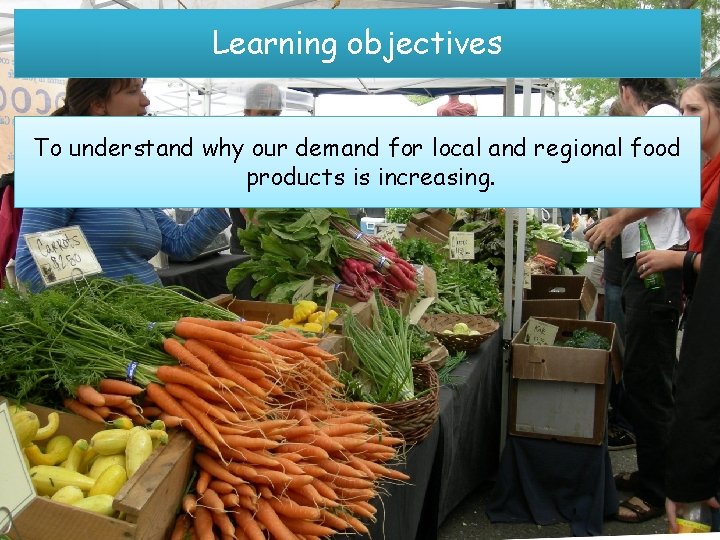
Learning objectives To understand why our demand for local and regional food products is increasing.
Supermarkets vs. independent shops • Over the last 10 -20 years the change in shopping has led to an increased amount of food being sold by major supermarkets. • Grocery sales in the UK are dominated by Tesco, Sainsburys, Asda and Morrisons. • These ‘big four’ had a combined market share of 75% of the UK grocery market in 2013. Supermarkets can easily source cheap and attractive food, and they have out-competed smaller, independent shops.
Activity: Tescopoly? What are the implication of this for local independent stores? Read the information on the hand-out ‘What’s wrong with supermarkets? ’ Complete the tasks at the bottom of the page. See ‘supermarkets exposed’ pg. 227 of your textbook
Increasing demand for local and regional produce • Greater awareness of the origins and traceability of the food and we buy has resulted in consumers purchasing more and more local and regional produce. • 70% of Brits want to buy local and regional food and 49% want to buy more than they do now. • The most popular local produce is vegetables and fruit. Other popular food products include eggs, bread, milk, red meat and poultry. Source: Institute of Grocery Distribution, 2005
Activity: Locally produced food 1. Highlight advantages on sheet. 2. Read pages 231 -232 in your text book and take notes.
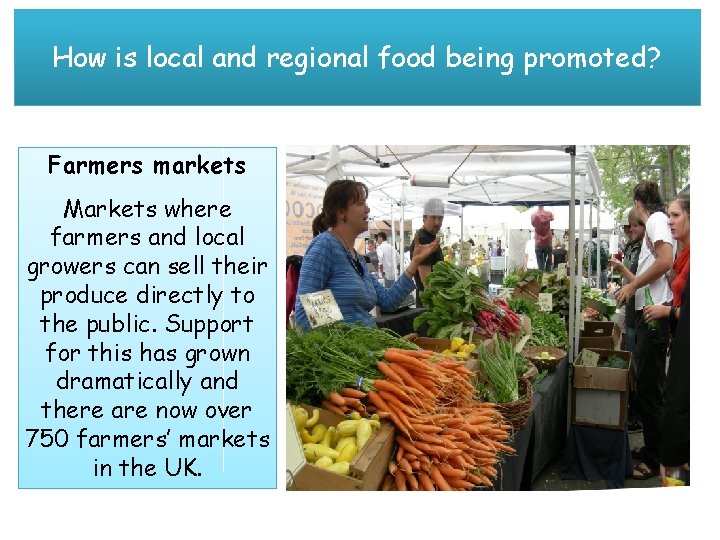
How is local and regional food being promoted? Farmers markets Markets where farmers and local growers can sell their produce directly to the public. Support for this has grown dramatically and there are now over 750 farmers’ markets in the UK.
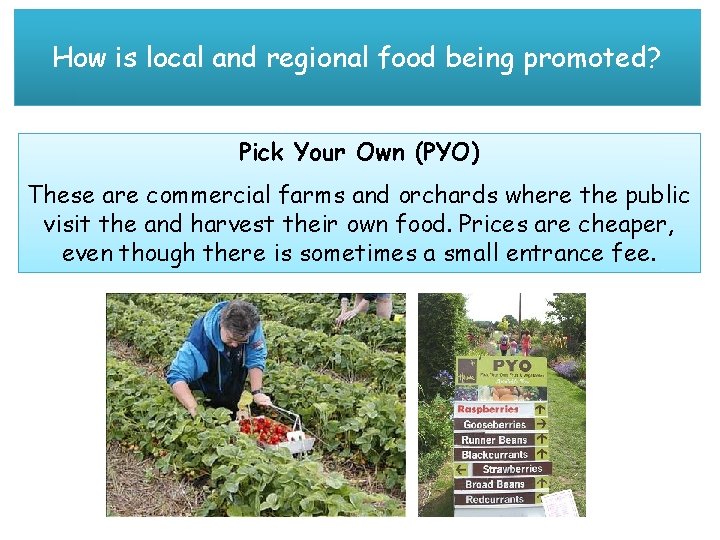
How is local and regional food being promoted? Pick Your Own (PYO) These are commercial farms and orchards where the public visit the and harvest their own food. Prices are cheaper, even though there is sometimes a small entrance fee.
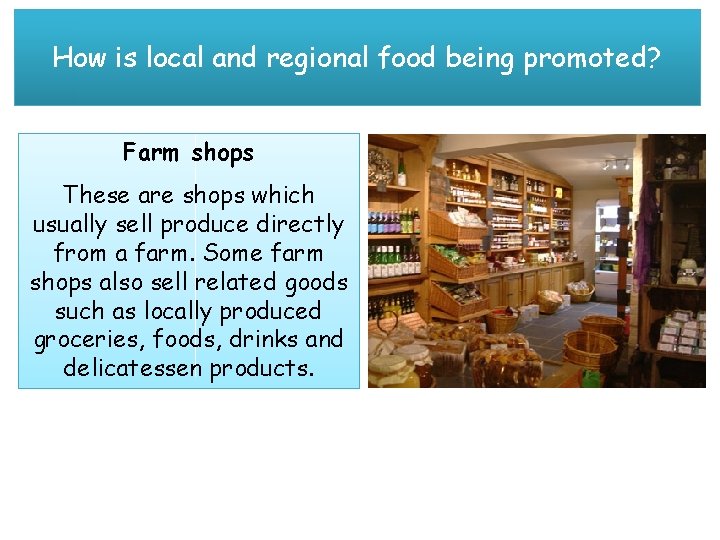
How is local and regional food being promoted? Farm shops These are shops which usually sell produce directly from a farm. Some farm shops also sell related goods such as locally produced groceries, foods, drinks and delicatessen products.
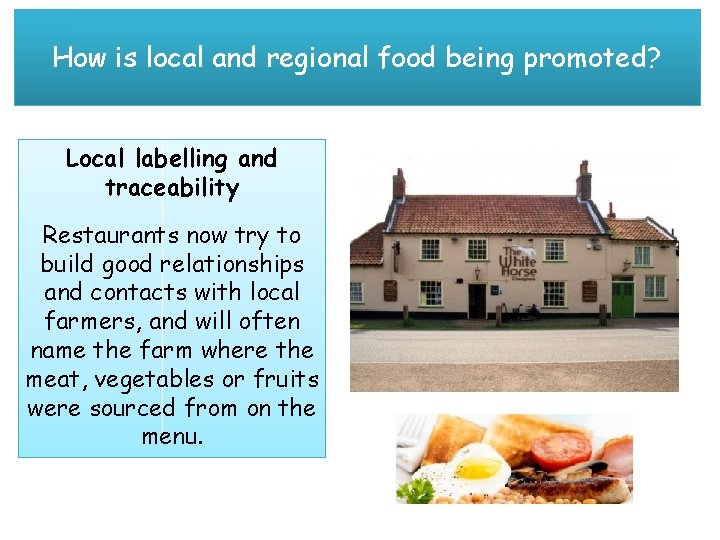
How is local and regional food being promoted? Local labelling and traceability Restaurants now try to build good relationships and contacts with local farmers, and will often name the farm where the meat, vegetables or fruits were sourced from on the menu.
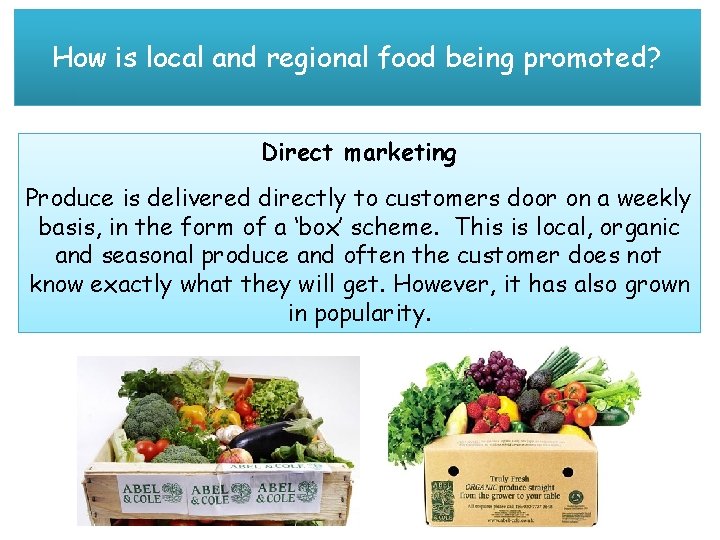
How is local and regional food being promoted? Direct marketing Produce is delivered directly to customers door on a weekly basis, in the form of a ‘box’ scheme. This is local, organic and seasonal produce and often the customer does not know exactly what they will get. However, it has also grown in popularity.
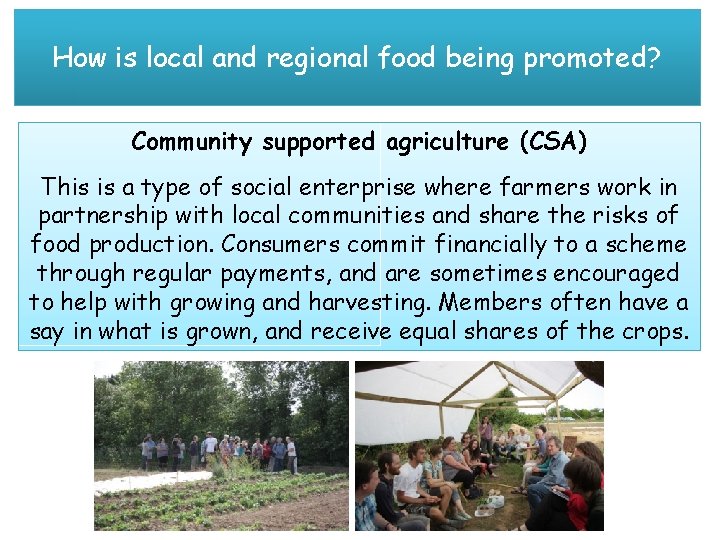
How is local and regional food being promoted? Community supported agriculture (CSA) This is a type of social enterprise where farmers work in partnership with local communities and share the risks of food production. Consumers commit financially to a scheme through regular payments, and are sometimes encouraged to help with growing and harvesting. Members often have a say in what is grown, and receive equal shares of the crops.