
Changes in Demographics Mass Media and Entertainment 1920s
- Slides: 10
Changes in Demographics, Mass Media and Entertainment 1920’s Learning Unit Mrs. Deming
Americans on the Move l Demographics—statistics that describe a population – – l race income Major demographic changes in the 1920’s – – – Movement away from the countryside Farmers will struggling with dropping market prices Industrial and commercial economy
African Americans on the Move l Early 1900’s African Americans took part in the Great Migration to the North – – Great job opportunities Escape the increasing violence in the South Many factories refused to hire blacks for anything other than menial jobs Lower wages if hired
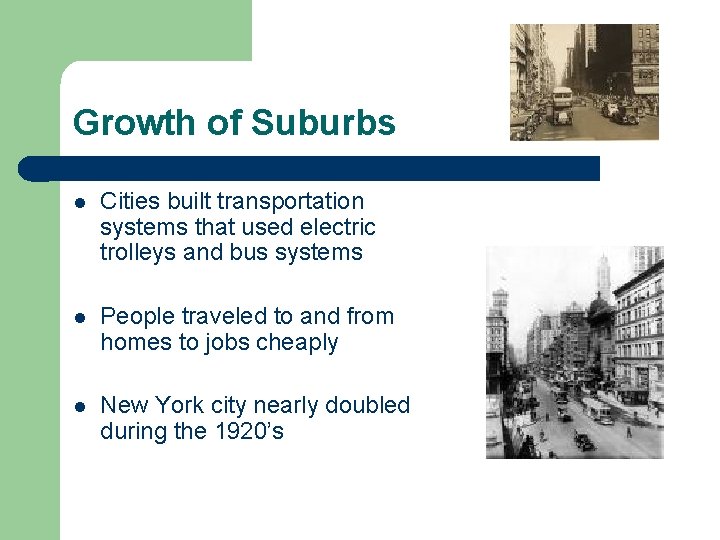
Growth of Suburbs l Cities built transportation systems that used electric trolleys and bus systems l People traveled to and from homes to jobs cheaply l New York city nearly doubled during the 1920’s
Mass Media l Films, nationwide news gatherings, radio broadcasting—produced the beginnings of a national culture l Mass media—print, film and broadcast methods of communicating information to large numbers of people
Mass Media l Pioneer filmmakers in Hollywood—center of the entertainment industry l Pioneer filmmakers faced many difficulties l Cecil B. De. Mille set up his first studio in a rented barn… l Culture of movies, movie stars and entertainment reporters grew out of the 1920’s
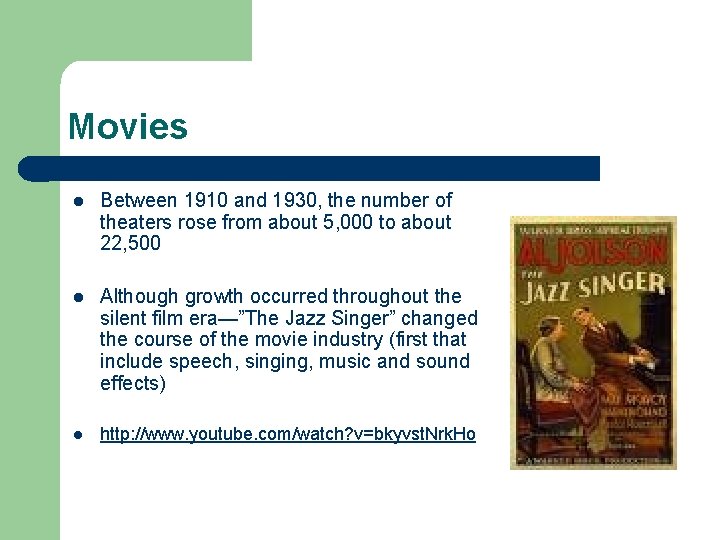
Movies l Between 1910 and 1930, the number of theaters rose from about 5, 000 to about 22, 500 l Although growth occurred throughout the silent film era—”The Jazz Singer” changed the course of the movie industry (first that include speech, singing, music and sound effects) l http: //www. youtube. com/watch? v=bkyvst. Nrk. Ho
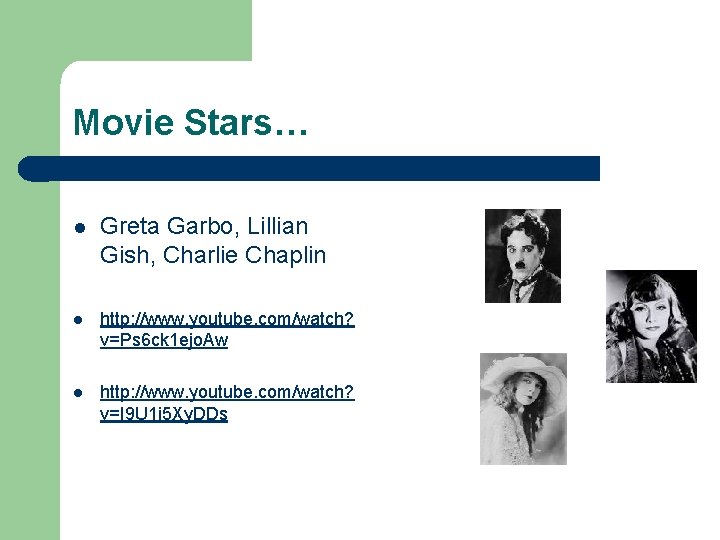
Movie Stars… l Greta Garbo, Lillian Gish, Charlie Chaplin l http: //www. youtube. com/watch? v=Ps 6 ck 1 ejo. Aw l http: //www. youtube. com/watch? v=I 9 U 1 i 5 Xy. DDs
Newspapers and Magazines l The use of newsprint roughly doubled in the US between 1914 and 1927 l Tabloids—compact newspaper that relies on large headlines, few words and many pictures; sensationalism, scandals, crimes, etc. l By 1929, Americans were buying more than 200 million copies of popular magazines such as the Saturday Evening Post, Reader’s Digest, Ladies’ Home Journal and Time
Radio l By 1922, more than 500 stations were on the air l NBC—National Broadcasting Company linked many stations together l Much of the country was listening to the same jokes, commercials, music, sports events, religious services and news.