
Changes in Climate Weather vs Climate Weather is
- Slides: 11
Changes in Climate
Weather vs. Climate Weather is defined as: the state of the atmosphere at any given time ◦ Weather is a short term measurement of what’s happening in the atmosphere Climate is defined as: the average of all the weather data that describes a place or region ◦ Climate is the accumulation of all the weather information over a long period of time (i. e. many years, decades, centuries or even longer)
Measuring Climate � Recent climate data is available through records of direct measurements � Past climate data is collected through geologic data including: ◦ Sea floor studies: studying sediments in the sea floor can tell us about earth’s temperature over millions of years ◦ Glaciers: Glaciers contain detailed records of temperature, snowfall, composition of the atmosphere, debris (i. e. ash, dust, pollen, pollution etc. ) ◦ Tree rings: Trees usually add a ring to their trunk each year. By studying the size of the rings, we can learn about the conditions present when the ring was created.
Causes of Climate Change Causes of climate change can be natural or man made Natural causes include: Plate movement, volcanic activity, changes in earth’s motion and changes in solar activity Human influence includes: changing vegetation and ground cover, increasing CO 2 levels, increasing aerosols
Plate Tectonics Different latitudes have different temperatures Plate tectonics causes plates to move across different latitudes, causing a change in climate
Volcanic Activity Volcanoes release ash and dust into the atmosphere This increases the amount of sunlight being reflected or absorbed Less sunlight reaches earth’s surface, and the temperatures are decreased
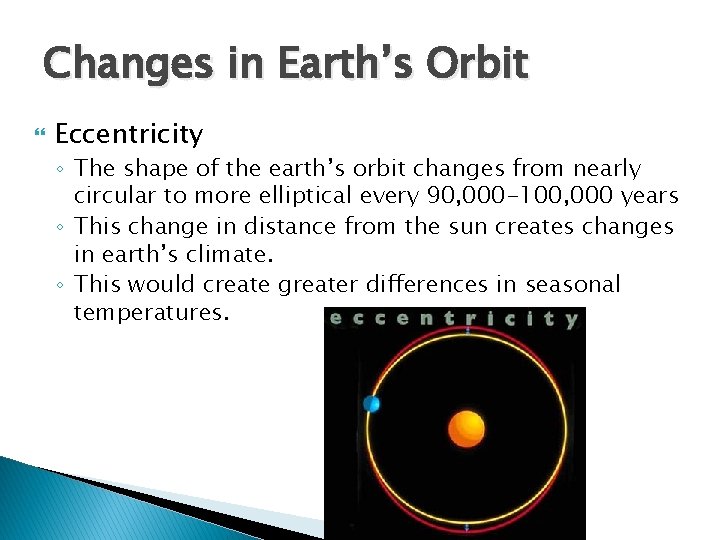
Changes in Earth’s Orbit Eccentricity ◦ The shape of the earth’s orbit changes from nearly circular to more elliptical every 90, 000 -100, 000 years ◦ This change in distance from the sun creates changes in earth’s climate. ◦ This would create greater differences in seasonal temperatures.
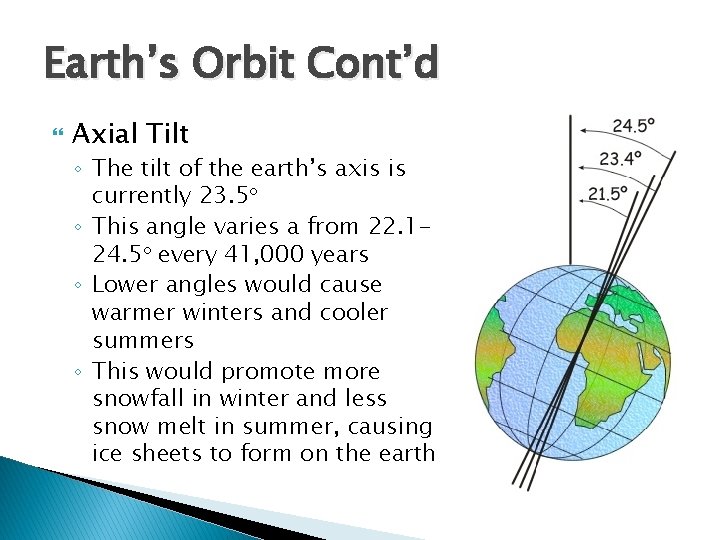
Earth’s Orbit Cont’d Axial Tilt ◦ The tilt of the earth’s axis is currently 23. 5° ◦ This angle varies a from 22. 124. 5° every 41, 000 years ◦ Lower angles would cause warmer winters and cooler summers ◦ This would promote more snowfall in winter and less snow melt in summer, causing ice sheets to form on the earth
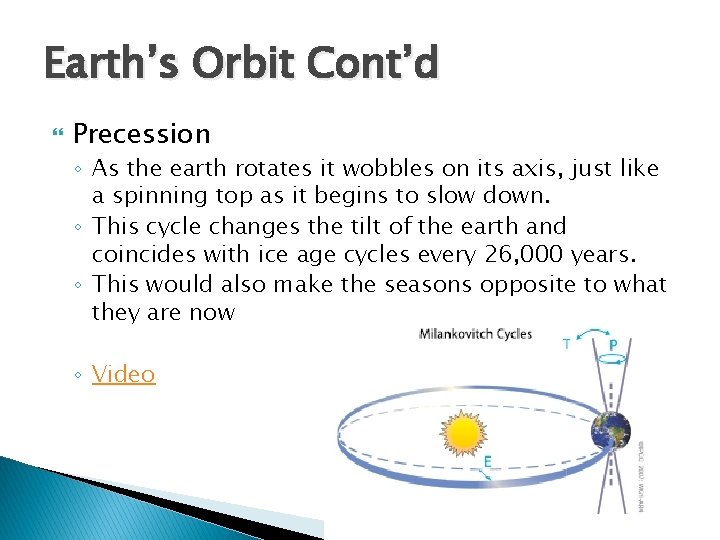
Earth’s Orbit Cont’d Precession ◦ As the earth rotates it wobbles on its axis, just like a spinning top as it begins to slow down. ◦ This cycle changes the tilt of the earth and coincides with ice age cycles every 26, 000 years. ◦ This would also make the seasons opposite to what they are now ◦ Video
Solar Activity The sun typically generates a constant amount of radiation that makes its way to earth Over time, slight variations in the amount of solar radiation may affect the average global temperature. Scientists think that approximately one third of the current warming of earth’s atmosphere is due to increased solar activity
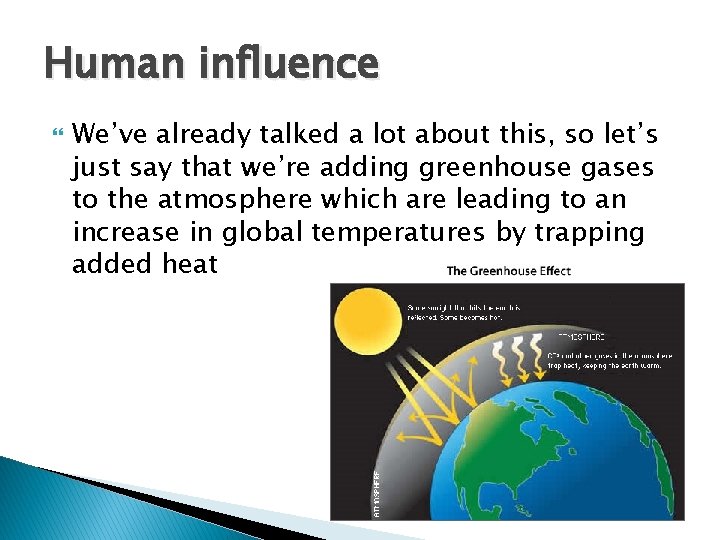
Human influence We’ve already talked a lot about this, so let’s just say that we’re adding greenhouse gases to the atmosphere which are leading to an increase in global temperatures by trapping added heat