
Changes Are ComingNew Revenue Recognition Standard Topic 606






- Slides: 35
Changes Are Coming-New Revenue Recognition Standard: Topic 606 Mark Robins Assurance Director Aronson LLC mrobins@aronsonllc. com | 240. 364. 2645 © Aronson LLC | aronsonllc. com |
Mark Robins is a director in Aronson’s Nonprofit & Association Services Group. Prior to focusing his specialization on nonprofit organizations, he spent time with the Employee Benefit Plan Services Group. Mark specializes in assurance and consulting services for foundations, public charities, schools and service organizations. His experience with fair value concepts, investment portfolios, federal compliance and revenue recognition issues allows him to be a valued resource for nonprofit organizations. As an active participant in the accounting profession, Mark has taught several classes on financial reporting and auditing topics. He is also extensively involved in nonprofit accounting research to advance technical compliance and has contributed a number of blog posts to © Aronson LLC | aronsonllc. com 2
Agenda • • • Scope Effective date Adoption Core principles Example © Aronson LLC | aronsonllc. com
Scope and Background
Scope • Excluded – – – – Contributions Leases Investments Equity method investments Derivatives Guarantees Nonmonetary exchanges © Aronson LLC | aronsonllc. com 5
Effective date • Effective for periods ending after December 15, 2018 – For example: calendar year 2019 – Years ending June 30, 2020 – Years ending September 30, 2020 © Aronson LLC | aronsonllc. com 6
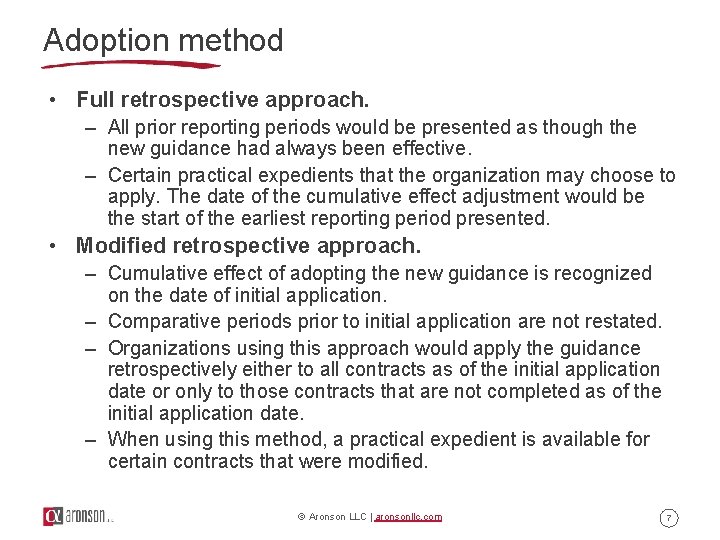
Adoption method • Full retrospective approach. – All prior reporting periods would be presented as though the new guidance had always been effective. – Certain practical expedients that the organization may choose to apply. The date of the cumulative effect adjustment would be the start of the earliest reporting period presented. • Modified retrospective approach. – Cumulative effect of adopting the new guidance is recognized on the date of initial application. – Comparative periods prior to initial application are not restated. – Organizations using this approach would apply the guidance retrospectively either to all contracts as of the initial application date or only to those contracts that are not completed as of the initial application date. – When using this method, a practical expedient is available for certain contracts that were modified. © Aronson LLC | aronsonllc. com 7
Core principles • Revenue should be recognized to depict the transfer of promised goods or services to customers at an amount representing the consideration to which the organization expects to be entitled in exchange for those goods or services. © Aronson LLC | aronsonllc. com 8
The 5 Steps
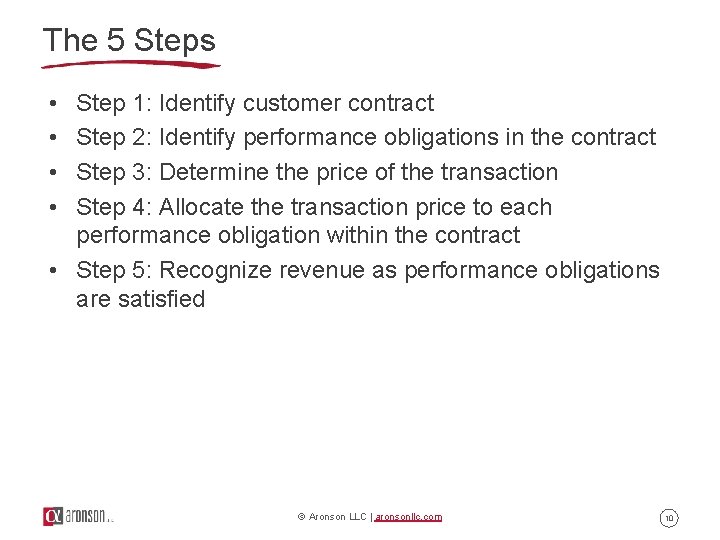
The 5 Steps • • Step 1: Identify customer contract Step 2: Identify performance obligations in the contract Step 3: Determine the price of the transaction Step 4: Allocate the transaction price to each performance obligation within the contract • Step 5: Recognize revenue as performance obligations are satisfied © Aronson LLC | aronsonllc. com 10
Step 1: Identify customer contract • Contract: an agreement between two or more parties that creates enforceable rights and obligations. A contract may take many forms (that is, it may be written, verbal, or implied by ordinary business practices). • Customer: party that has contracted with an entity to obtain goods or services that are an output of the entity’s ordinary activities in exchange for consideration. © Aronson LLC | aronsonllc. com 11
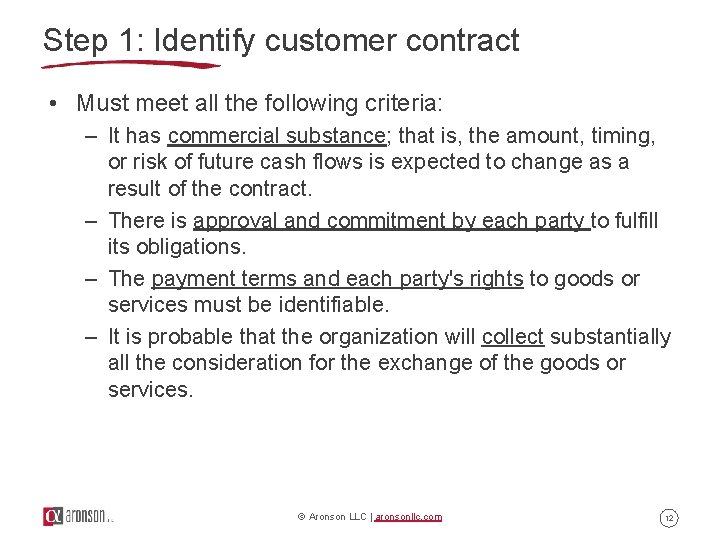
Step 1: Identify customer contract • Must meet all the following criteria: – It has commercial substance; that is, the amount, timing, or risk of future cash flows is expected to change as a result of the contract. – There is approval and commitment by each party to fulfill its obligations. – The payment terms and each party's rights to goods or services must be identifiable. – It is probable that the organization will collect substantially all the consideration for the exchange of the goods or services. © Aronson LLC | aronsonllc. com 12
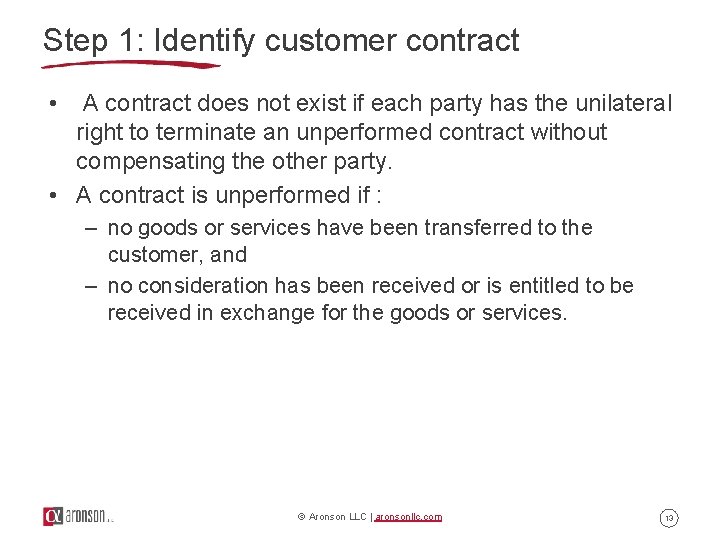
Step 1: Identify customer contract • A contract does not exist if each party has the unilateral right to terminate an unperformed contract without compensating the other party. • A contract is unperformed if : – no goods or services have been transferred to the customer, and – no consideration has been received or is entitled to be received in exchange for the goods or services. © Aronson LLC | aronsonllc. com 13
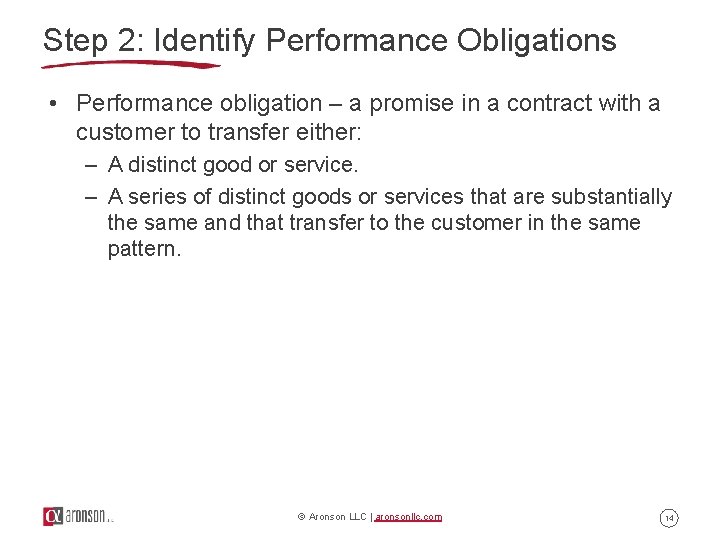
Step 2: Identify Performance Obligations • Performance obligation – a promise in a contract with a customer to transfer either: – A distinct good or service. – A series of distinct goods or services that are substantially the same and that transfer to the customer in the same pattern. © Aronson LLC | aronsonllc. com 14
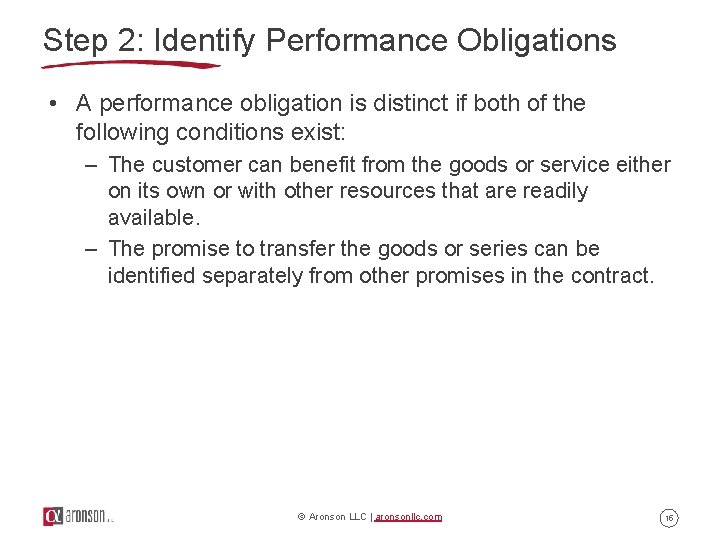
Step 2: Identify Performance Obligations • A performance obligation is distinct if both of the following conditions exist: – The customer can benefit from the goods or service either on its own or with other resources that are readily available. – The promise to transfer the goods or series can be identified separately from other promises in the contract. © Aronson LLC | aronsonllc. com 15
Step 2: Identify Performance Obligations • Indicators that two or more promises to transfer goods or services are not separately identifiable include the following: – The good or service is an input used to create the end product (output) promised to the customer in the contract. – The good or service substantially changes or customizes another good or service promised in the contract. – The good or service is highly dependent on or highly interrelated with another good or service promised in the contract. © Aronson LLC | aronsonllc. com 16
Step 3: Determine the Transaction Price • Transaction price – amount of consideration to which an organization expects to be entitled for providing the promised goods or services to the customer, excluding sales taxes or similar amounts collected on behalf of third parties. © Aronson LLC | aronsonllc. com 17
Step 3: Determine the Transaction Price • Determine the effect of the following and assume the contract will not be renewed, cancelled, or modified: – – – Variable consideration Constraints on estimates of variable consideration Existence of significant financing components Noncash consideration Consideration payable to the customer © Aronson LLC | aronsonllc. com 18
Step 3: Determine the Transaction Price • Variable consideration is estimated using one of the following methods: – Expected value method – summing the probabilityweighted amounts in a range of possible consideration amounts. – Most likely amount method – a single most likely mount within a range of amounts that are entitled to receive. © Aronson LLC | aronsonllc. com 19
Step 4: Allocate the Transaction Price • Allocate to each performance obligations based on the relative standalone price at contract inception © Aronson LLC | aronsonllc. com 20
Step 4: Allocate the Transaction Price • Estimation methods for standalone selling price: – Adjusted market assessment approach – Expected costs plus a margin approach – Residual approach © Aronson LLC | aronsonllc. com 21
Step 4: Allocate the Transaction Price • Subsequent transaction price changes: – Allocate the change on the same basis at contract inception – Recognized as increases or decreases in revenue in the period the change occurs © Aronson LLC | aronsonllc. com 22
Step 5: Recognize revenue • Over a period of time, or • At a point in time • When the customer takes control of the good or service © Aronson LLC | aronsonllc. com 23
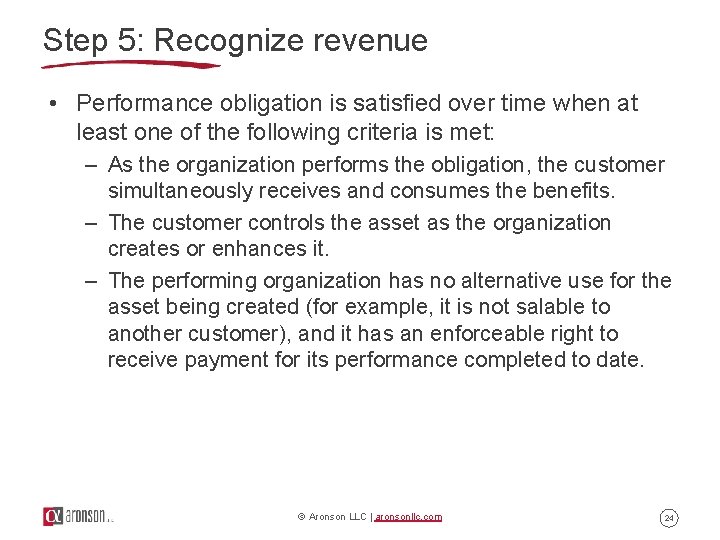
Step 5: Recognize revenue • Performance obligation is satisfied over time when at least one of the following criteria is met: – As the organization performs the obligation, the customer simultaneously receives and consumes the benefits. – The customer controls the asset as the organization creates or enhances it. – The performing organization has no alternative use for the asset being created (for example, it is not salable to another customer), and it has an enforceable right to receive payment for its performance completed to date. © Aronson LLC | aronsonllc. com 24
Step 5: Recognize revenue • Recognizing revenue over time – Output method – Input method • Method should be applied consistently © Aronson LLC | aronsonllc. com 25
Example – Membership Dues
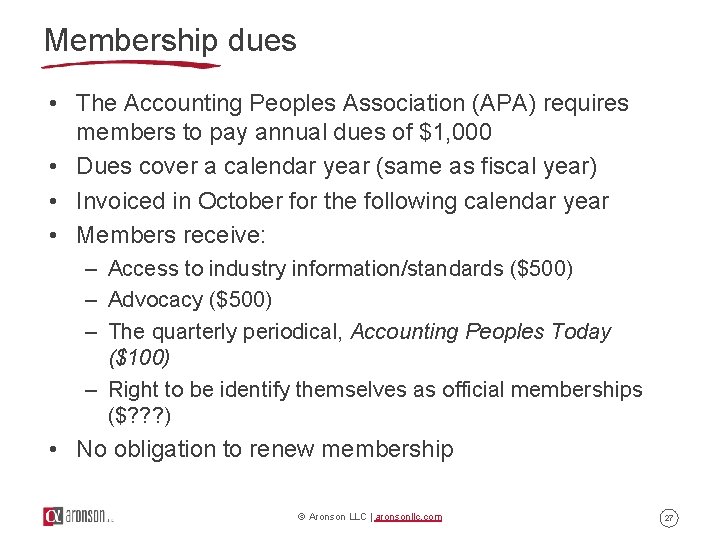
Membership dues • The Accounting Peoples Association (APA) requires members to pay annual dues of $1, 000 • Dues cover a calendar year (same as fiscal year) • Invoiced in October for the following calendar year • Members receive: – Access to industry information/standards ($500) – Advocacy ($500) – The quarterly periodical, Accounting Peoples Today ($100) – Right to be identify themselves as official memberships ($? ? ? ) • No obligation to renew membership © Aronson LLC | aronsonllc. com 27
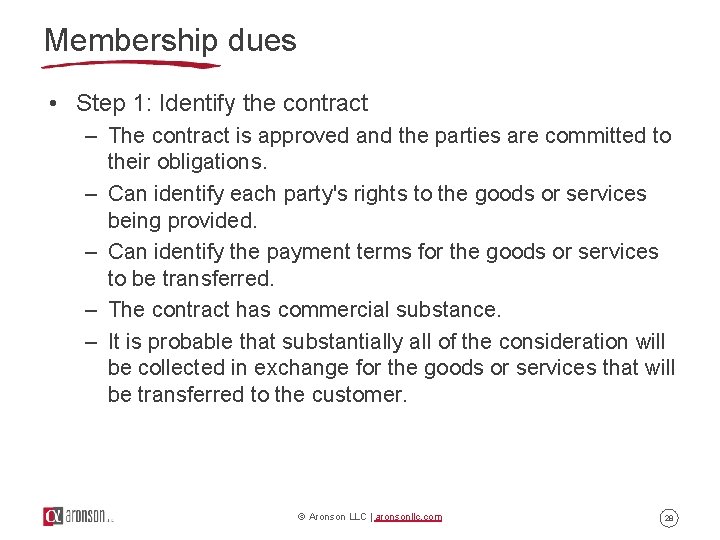
Membership dues • Step 1: Identify the contract – The contract is approved and the parties are committed to their obligations. – Can identify each party's rights to the goods or services being provided. – Can identify the payment terms for the goods or services to be transferred. – The contract has commercial substance. – It is probable that substantially all of the consideration will be collected in exchange for the goods or services that will be transferred to the customer. © Aronson LLC | aronsonllc. com 28
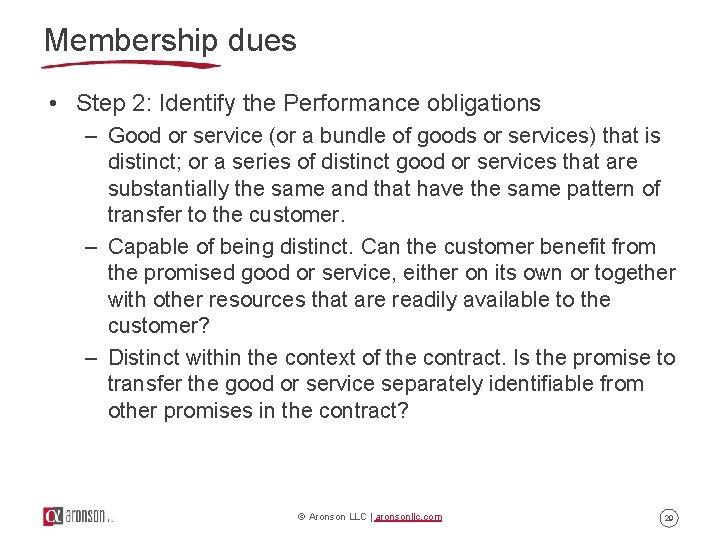
Membership dues • Step 2: Identify the Performance obligations – Good or service (or a bundle of goods or services) that is distinct; or a series of distinct good or services that are substantially the same and that have the same pattern of transfer to the customer. – Capable of being distinct. Can the customer benefit from the promised good or service, either on its own or together with other resources that are readily available to the customer? – Distinct within the context of the contract. Is the promise to transfer the good or service separately identifiable from other promises in the contract? © Aronson LLC | aronsonllc. com 29
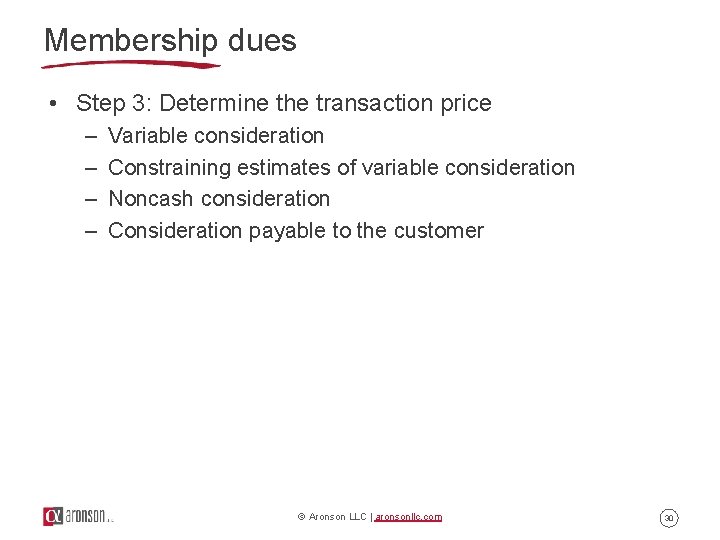
Membership dues • Step 3: Determine the transaction price – – Variable consideration Constraining estimates of variable consideration Noncash consideration Consideration payable to the customer © Aronson LLC | aronsonllc. com 30
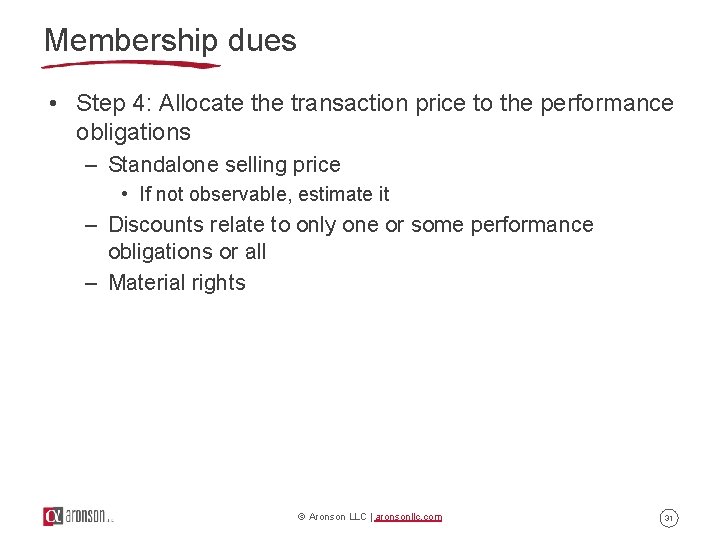
Membership dues • Step 4: Allocate the transaction price to the performance obligations – Standalone selling price • If not observable, estimate it – Discounts relate to only one or some performance obligations or all – Material rights © Aronson LLC | aronsonllc. com 31
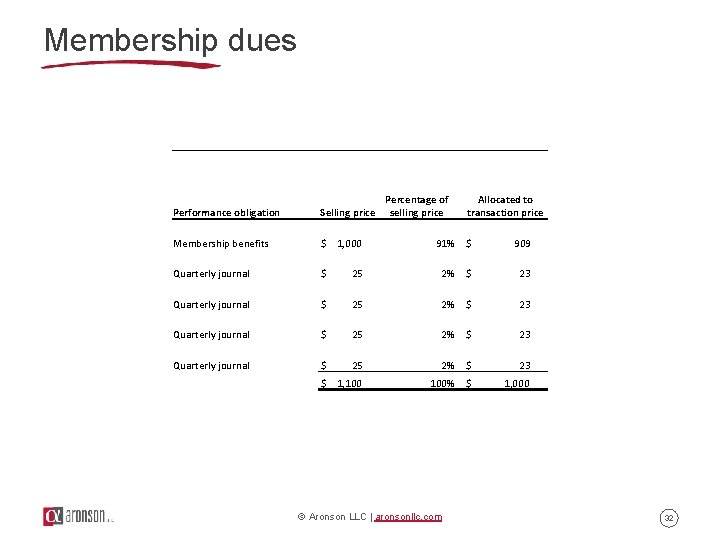
Membership dues Percentage of Allocated to selling price transaction price Performance obligation Selling price Membership benefits $ 1, 000 91% $ 909 Quarterly journal $ 25 2% $ 23 $ 1, 100% $ 1, 000 © Aronson LLC | aronsonllc. com 32
Membership dues • Step 5: Recognize revenue – At a point in time or over time • A good or service is transferred when (or as) the customer obtains control of that good or service. • Criteria for over time: – The customer simultaneously receives and consumes the benefits provided by the entity's performance as the entity performs. – The entity's performance creates or enhances an asset that the customer controls as the asset is created or enhanced. – The entity's performance does not create an asset with an alternative use to the entity, and the entity has an enforceable right to payment for performance completed to date. © Aronson LLC | aronsonllc. com 33
Questions? © Aronson LLC | aronsonllc. com 34
Mark Robins Assurance Director Aronson LLC mrobins@aronsonllc. com 240. 364. 2645 © Aronson LLC | aronsonllc. com |