
Change over time Working with diachronic data Brezina
Change over time: Working with diachronic data Brezina, V. (2018). Statistics in Corpus Linguistics: A Practical Guide. Cambridge: Cambridge University Press. 1

Think about and discuss 1. Which colour terms are most popular? 2. Does this change over time? 3. How would you investigate this? Brezina, V. (2018). Statistics in Corpus Linguistics: A Practical Guide. Cambridge: Cambridge University Press. 3

Where to start? Brezina, V. (2018). Statistics in Corpus Linguistics: A Practical Guide. Cambridge: Cambridge University Press. 4
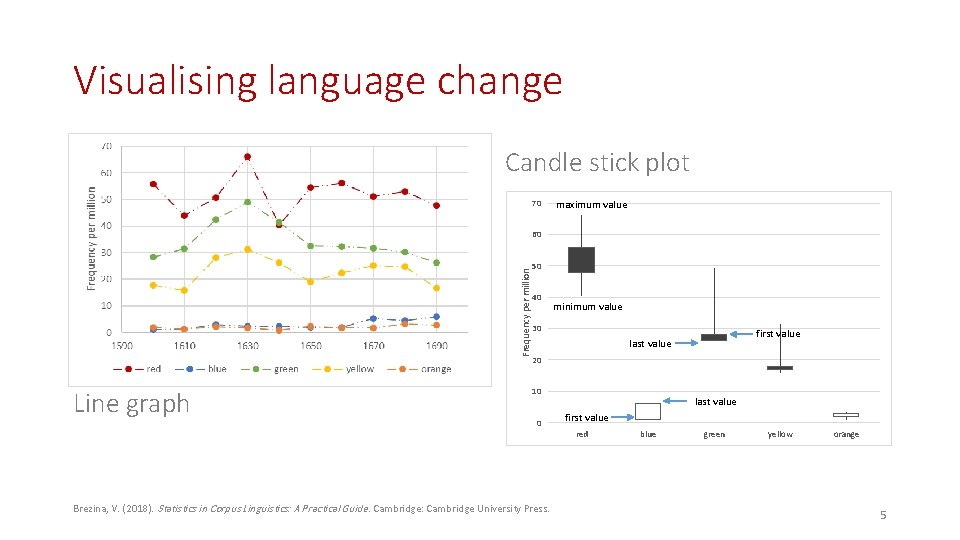
Visualising language change Candle stick plot 70 maximum value 60 Frequency per million 50 40 minimum value 30 first value last value 20 Line graph 10 0 Brezina, V. (2018). Statistics in Corpus Linguistics: A Practical Guide. Cambridge: Cambridge University Press. last value first value red blue green yellow orange 5
Measuring time § Time – a continuous (scale) variable; this means that we can measure time on a continuum of centuries, decades, years, months, weeks, days, hours, minutes, seconds, milliseconds etc. § Studies involving time as a variable – diachronic/longitudinal studies. § Change over time vs. stability over time. § Diachronic corpora: diachronic representativeness. § Diachronic polysemy, e. g. pre-2000 s: web, tweet, cloud Brezina, V. (2018). Statistics in Corpus Linguistics: A Practical Guide. Cambridge: Cambridge University Press. 6
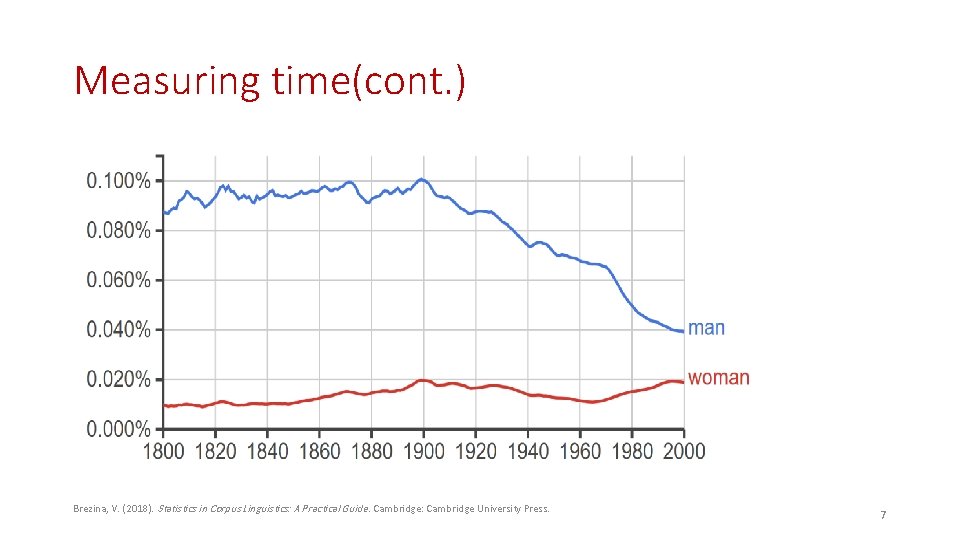
Measuring time(cont. ) Brezina, V. (2018). Statistics in Corpus Linguistics: A Practical Guide. Cambridge: Cambridge University Press. 7
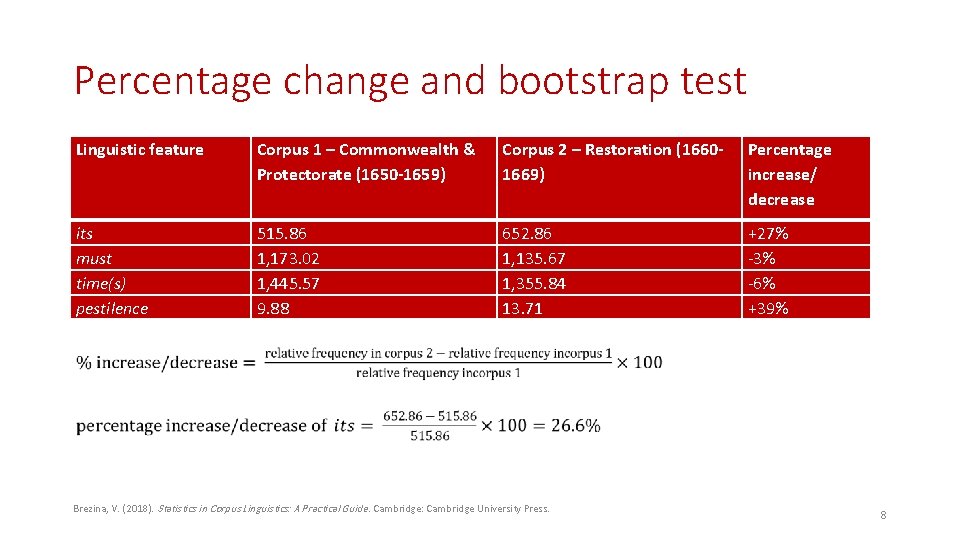
Percentage change and bootstrap test Linguistic feature Corpus 1 – Commonwealth & Protectorate (1650 -1659) Corpus 2 – Restoration (16601669) Percentage increase/ decrease its must time(s) pestilence 515. 86 1, 173. 02 1, 445. 57 9. 88 652. 86 1, 135. 67 1, 355. 84 13. 71 +27% -3% -6% +39% Brezina, V. (2018). Statistics in Corpus Linguistics: A Practical Guide. Cambridge: Cambridge University Press. 8
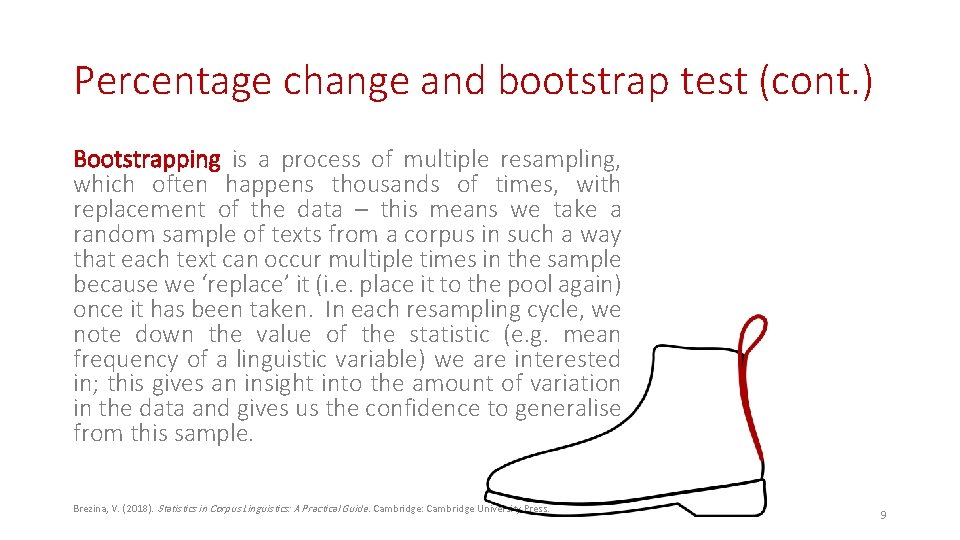
Percentage change and bootstrap test (cont. ) Bootstrapping is a process of multiple resampling, which often happens thousands of times, with replacement of the data – this means we take a random sample of texts from a corpus in such a way that each text can occur multiple times in the sample because we ‘replace’ it (i. e. place it to the pool again) once it has been taken. In each resampling cycle, we note down the value of the statistic (e. g. mean frequency of a linguistic variable) we are interested in; this gives an insight into the amount of variation in the data and gives us the confidence to generalise from this sample. Brezina, V. (2018). Statistics in Corpus Linguistics: A Practical Guide. Cambridge: Cambridge University Press. 9
Bootstrap test § Corpus tests: A, B, C, D and E Brezina, V. (2018). Statistics in Corpus Linguistics: A Practical Guide. Cambridge: Cambridge University Press. 10
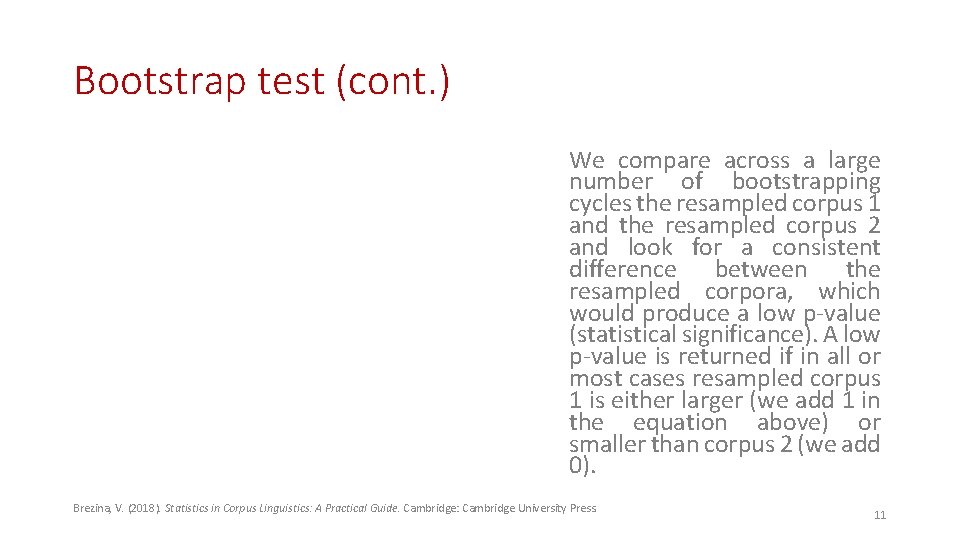
Bootstrap test (cont. ) We compare across a large number of bootstrapping cycles the resampled corpus 1 and the resampled corpus 2 and look for a consistent difference between the resampled corpora, which would produce a low p-value (statistical significance). A low p-value is returned if in all or most cases resampled corpus 1 is either larger (we add 1 in the equation above) or smaller than corpus 2 (we add 0). Brezina, V. (2018). Statistics in Corpus Linguistics: A Practical Guide. Cambridge: Cambridge University Press. 11
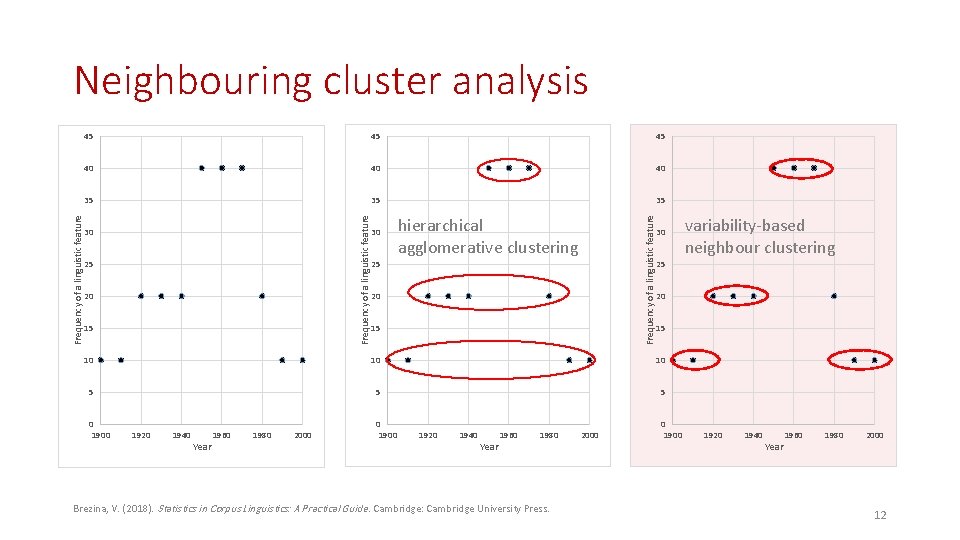
Neighbouring cluster analysis 45 40 40 40 35 35 35 30 30 25 hierarchical agglomerative clustering Frequency of a linguistic feature 45 30 25 20 15 15 10 10 10 5 5 5 0 1900 1920 1940 Year 1960 1980 2000 0 1900 variability-based neighbour clustering 1920 1940 Year 1960 1980 Brezina, V. (2018). Statistics in Corpus Linguistics: A Practical Guide. Cambridge: Cambridge University Press. 2000 0 1900 1920 1940 Year 1960 1980 2000 12
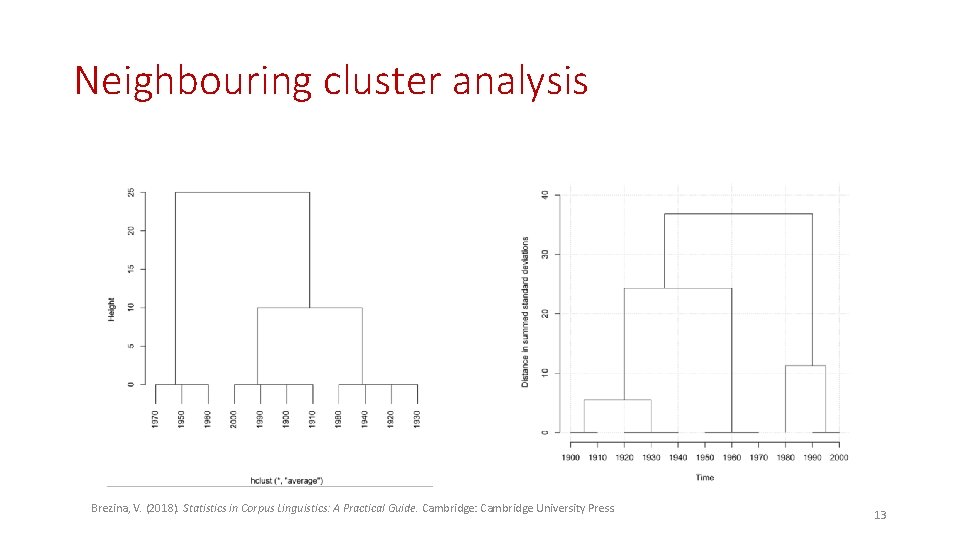
Neighbouring cluster analysis Brezina, V. (2018). Statistics in Corpus Linguistics: A Practical Guide. Cambridge: Cambridge University Press. 13
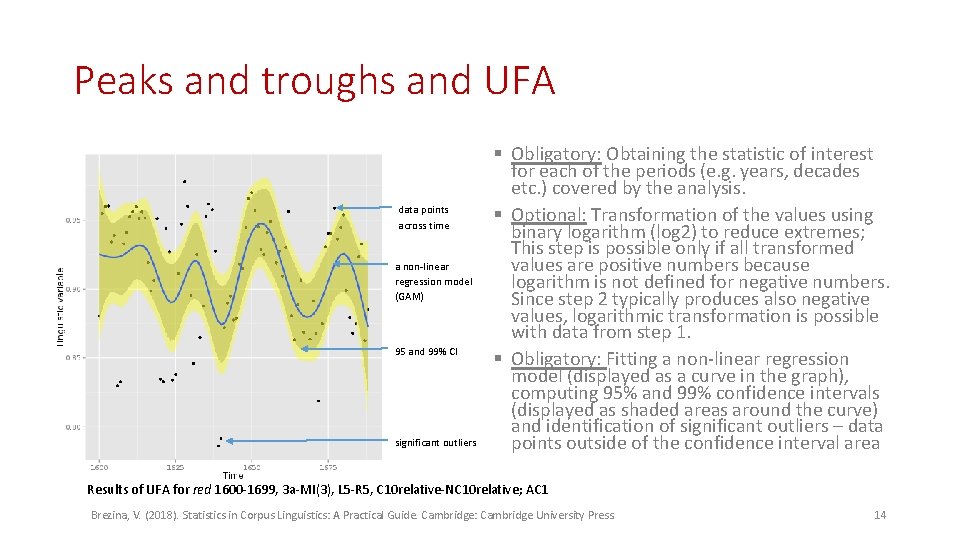
Peaks and troughs and UFA data points across time a non-linear regression model (GAM) 95 and 99% CI significant outliers § Obligatory: Obtaining the statistic of interest for each of the periods (e. g. years, decades etc. ) covered by the analysis. § Optional: Transformation of the values using binary logarithm (log 2) to reduce extremes; This step is possible only if all transformed values are positive numbers because logarithm is not defined for negative numbers. Since step 2 typically produces also negative values, logarithmic transformation is possible with data from step 1. § Obligatory: Fitting a non-linear regression model (displayed as a curve in the graph), computing 95% and 99% confidence intervals (displayed as shaded areas around the curve) and identification of significant outliers – data points outside of the confidence interval area Results of UFA for red 1600 -1699, 3 a-MI(3), L 5 -R 5, C 10 relative-NC 10 relative; AC 1 Brezina, V. (2018). Statistics in Corpus Linguistics: A Practical Guide. Cambridge: Cambridge University Press. 14
Things to remember § Historical analyses, because they use available and imperfect data, require critical consideration of i) diachronic representativeness of corpora, ii) alternative interpretations of linguistic development and iii) fluctuation of the meaning of linguistic forms. § Visualization options include line graphs, boxplots and error bars, sparklines and candlestick plots. § The bootstrapping test is used to compare two corpora (representing different points in time); it makes use of a technique of multiple resampling of corpus data. § Peaks and troughs is a technique which fits a non-linear regression to historical data, producing a graph which highlights significant outliers in the process of historical development of language and discourse. § UFA (Usage Fluctuation Analysis) is a complex procedure combining automatic collocation comparison in a given historical period and the peaks and troughs technique. Brezina, V. (2018). Statistics in Corpus Linguistics: A Practical Guide. Cambridge: Cambridge University Press. 15
- Slides: 15