
Change of Tree Types and Estimation of Tree
- Slides: 1
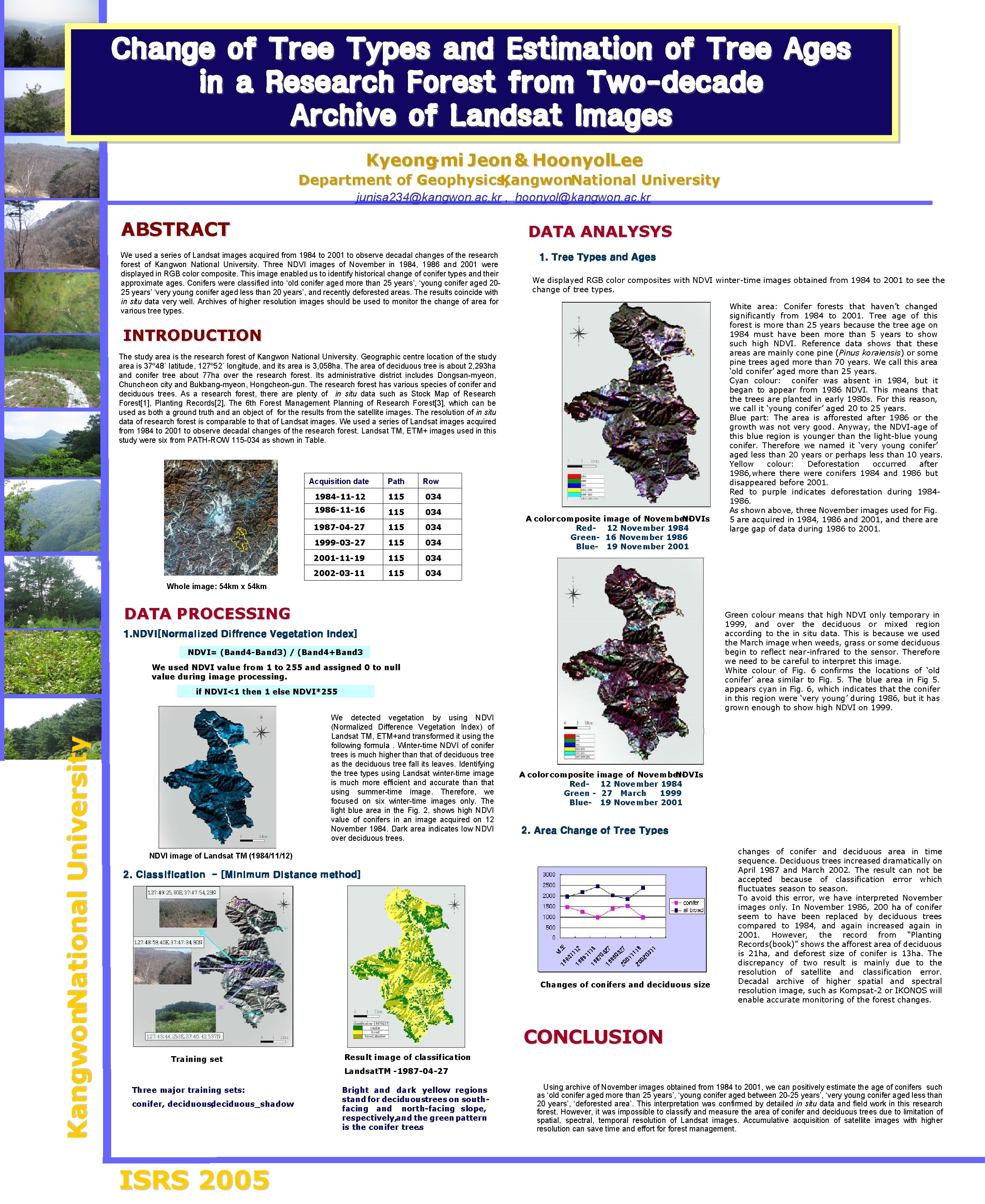
Change of Tree Types and Estimation of Tree Ages in a Research Forest from Two-decade Archive of Landsat Images Kyeong-mi Jeon & Hoonyol. Lee Department of Geophysics, Kangwon. National University junisa 234@kangwon. ac. kr , hoonyol@kangwon. ac. kr ABSTRACT DATA ANALYSYS We used a series of Landsat images acquired from 1984 to 2001 to observe decadal changes of the research forest of Kangwon National University. Three NDVI images of November in 1984, 1986 and 2001 were displayed in RGB color composite. This image enabled us to identify historical change of conifer types and their approximate ages. Conifers were classified into ‘old conifer aged more than 25 years’, ‘young conifer aged 2025 years’ ‘very young conifer aged less than 20 years’, and recently deforested areas. The results coincide with in situ data very well. Archives of higher resolution images should be used to monitor the change of area for various tree types. 1. Tree Types and Ages We displayed RGB color composites with NDVI winter-time images obtained from 1984 to 2001 to see the change of tree types. INTRODUCTION The study area is the research forest of Kangwon National University. Geographic centre location of the study area is 37º 48´ latitude, 127º 52´ longitude, and its area is 3, 058 ha. The area of deciduous tree is about 2, 293 ha and conifer tree about 77 ha over the research forest. Its administrative district includes Dongsan-myeon, Chuncheon city and Bukbang-myeon, Hongcheon-gun. The research forest has various species of conifer and deciduous trees. As a research forest, there are plenty of in situ data such as Stock Map of Research Forest[1], Planting Records[2], The 6 th Forest Management Planning of Research Forest[3], which can be used as both a ground truth and an object of for the results from the satellite images. The resolution of in situ data of research forest is comparable to that of Landsat images. We used a series of Landsat images acquired from 1984 to 2001 to observe decadal changes of the research forest. Landsat TM, ETM+ images used in this study were six from PATH-ROW 115 -034 as shown in Table. Acquisition date Path Row 1984 -11 -12 115 034 1986 -11 -16 115 034 1987 -04 -27 115 034 1999 -03 -27 115 034 2001 -11 -19 115 034 2002 -03 -11 115 034 A color composite Red. Green. Blue- image of November. NDVIs. 12 November 1984 16 November 1986 19 November 2001 White area: Conifer forests that haven’t changed significantly from 1984 to 2001. Tree age of this forest is more than 25 years because the tree age on 1984 must have been more than 5 years to show such high NDVI. Reference data shows that these areas are mainly cone pine (Pinus koraiensis) or some pine trees aged more than 70 years. We call this area ‘old conifer’ aged more than 25 years. Cyan colour: conifer was absent in 1984, but it began to appear from 1986 NDVI. This means that the trees are planted in early 1980 s. For this reason, we call it ‘young conifer’ aged 20 to 25 years. Blue part: The area is afforested after 1986 or the growth was not very good. Anyway, the NDVI-age of this blue region is younger than the light-blue young conifer. Therefore we named it ‘very young conifer’ aged less than 20 years or perhaps less than 10 years. Yellow colour: Deforestation occurred after 1986, where there were conifers 1984 and 1986 but disappeared before 2001. Red to purple indicates deforestation during 19841986. As shown above, three November images used for Fig. 5 are acquired in 1984, 1986 and 2001, and there are large gap of data during 1986 to 2001. Whole image: 54 km x 54 km DATA PROCESSING Green colour means that high NDVI only temporary in 1999, and over the deciduous or mixed region according to the in situ data. This is because we used the March image when weeds, grass or some deciduous begin to reflect near-infrared to the sensor. Therefore we need to be careful to interpret this image. White colour of Fig. 6 confirms the locations of ‘old conifer’ area similar to Fig. 5. The blue area in Fig 5. appears cyan in Fig. 6, which indicates that the conifer in this region were ‘very young’ during 1986, but it has grown enough to show high NDVI on 1999. 1. NDVI[Normalized Diffrence Vegetation Index] NDVI= (Band 4 -Band 3) / (Band 4+Band 3 We used NDVI value from 1 to 255 and assigned 0 to null value during image processing. Kangwon. National University if NDVI<1 then 1 else NDVI*255 We detected vegetation by using NDVI (Normalized Difference Vegetation Index) of Landsat TM, ETM+and transformed it using the following formula. Winter-time NDVI of conifer trees is much higher than that of deciduous tree as the deciduous tree fall its leaves. Identifying the tree types using Landsat winter-time image is much more efficient and accurate than that using summer-time image. Therefore, we focused on six winter-time images only. The light blue area in the Fig. 2, shows high NDVI value of conifers in an image acquired on 12 November 1984. Dark area indicates low NDVI over deciduous trees. A color composite image of November. NDVIs. Red- 12 November 1984 Green - 27 March 1999 Blue- 19 November 2001 2. Area Change of Tree Types NDVI image of Landsat TM (1984/11/12) 2. Classification - [Minimum Distance method] Changes of conifers and deciduous size changes of conifer and deciduous area in time sequence. Deciduous trees increased dramatically on April 1987 and March 2002. The result can not be accepted because of classification error which fluctuates season to season. To avoid this error, we have interpreted November images only. In November 1986, 200 ha of conifer seem to have been replaced by deciduous trees compared to 1984, and again increased again in 2001. However, the record from “Planting Records(book)” shows the afforest area of deciduous is 21 ha, and deforest size of conifer is 13 ha. The discrepancy of two result is mainly due to the resolution of satellite and classification error. Decadal archive of higher spatial and spectral resolution image, such as Kompsat-2 or IKONOS will enable accurate monitoring of the forest changes. CONCLUSION Training set Result image of classification Landsat. TM -1987 -04 -27 Three major training sets: conifer, deciduous_shadow. ISRS 2005 Bright and dark yellow regions stand for deciduoustrees on southfacing and north-facing slope, respectively, and the green pattern is the conifer trees. Using archive of November images obtained from 1984 to 2001, we can positively estimate the age of conifers such as ‘old conifer aged more than 25 years’, ‘young conifer aged between 20 -25 years’, ‘very young conifer aged less than 20 years’, ‘deforested area’. This interpretation was confirmed by detailed in situ data and field work in this research forest. However, it was impossible to classify and measure the area of conifer and deciduous trees due to limitation of spatial, spectral, temporal resolution of Landsat images. Accumulative acquisition of satellite images with higher resolution can save time and effort forest management.