
Change Management Framework Select slides that support a

- Slides: 42
Change Management Framework Select slides that support a dialogue on what change is and why it is critical
Change Management Defined Change Management is the discipline of preparing people for and supporting them through a business, technical and/or organizational change. The overarching goal is to achieve the desired level of organizational performance as soon as possible. Benefits § Leadership is aligned on strategy, urgency for change, key actions required to manage the transition § Critical risks are identified, managed and mitigated § Business as usual remains uninterrupted by transformation activities § Operational readiness is quickly achieved at all levels of the organization § Individual and team performance dips are minimized
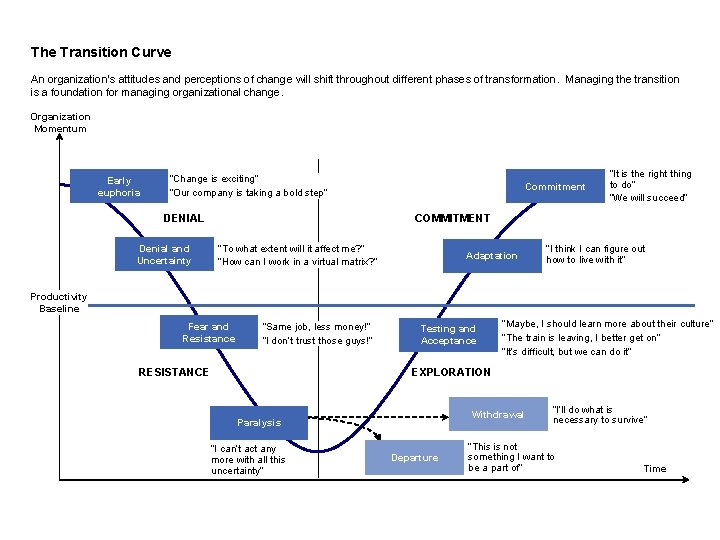
The Transition Curve An organization’s attitudes and perceptions of change will shift throughout different phases of transformation. Managing the transition is a foundation for managing organizational change. Organization Momentum Early euphoria “Change is exciting” “Our company is taking a bold step” DENIAL Denial and Uncertainty Commitment “It is the right thing to do” “We will succeed” COMMITMENT “To what extent will it affect me? “ “How can I work in a virtual matrix? ” Adaptation “I think I can figure out how to live with it” Productivity Baseline Fear and Resistance “Same job, less money!” “I don’t trust those guys!“ RESISTANCE Testing and Acceptance “Maybe, I should learn more about their culture” “The train is leaving, I better get on” “It’s difficult, but we can do it” EXPLORATION Withdrawal Paralysis “I can’t act any more with all this uncertainty” Departure “I’ll do what is necessary to survive” “This is not something I want to be a part of” Time
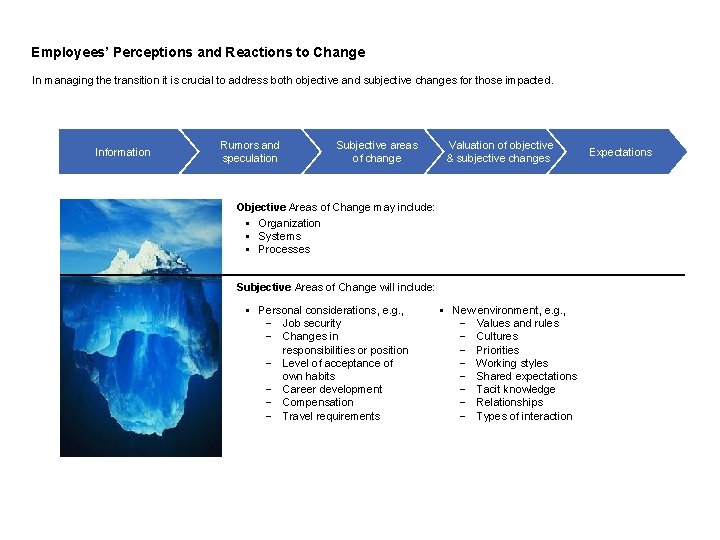
Employees’ Perceptions and Reactions to Change In managing the transition it is crucial to address both objective and subjective changes for those impacted. Information Rumors and speculation Subjective areas of change Valuation of objective & subjective changes Objective Areas of Change may include: § Organization § Systems § Processes Subjective Areas of Change will include: § Personal considerations, e. g. , – Job security – Changes in responsibilities or position – Level of acceptance of own habits – Career development – Compensation – Travel requirements § New environment, e. g. , – Values and rules – Cultures – Priorities – Working styles – Shared expectations – Tacit knowledge – Relationships – Types of interaction Expectations
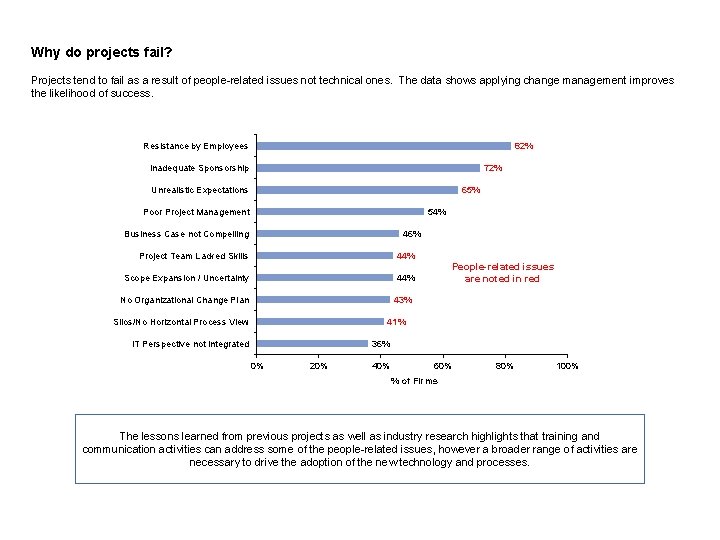
Why do projects fail? Projects tend to fail as a result of people-related issues not technical ones. The data shows applying change management improves the likelihood of success. 82% Resistance by Employees 72% Inadequate Sponsorship Unrealistic Expectations 65% Poor Project Management 54% Business Case not Compelling 46% Project Team Lacked Skills 44% Scope Expansion / Uncertainty 44% No Organizational Change Plan People-related issues are noted in red 43% Silos/No Horizontal Process View 41% 36% IT Perspective not Integrated 0% 20% 40% 60% 80% 100% % of Firms The lessons learned from previous projects as well as industry research highlights that training and communication activities can address some of the people-related issues, however a broader range of activities are necessary to drive the adoption of the new technology and processes.
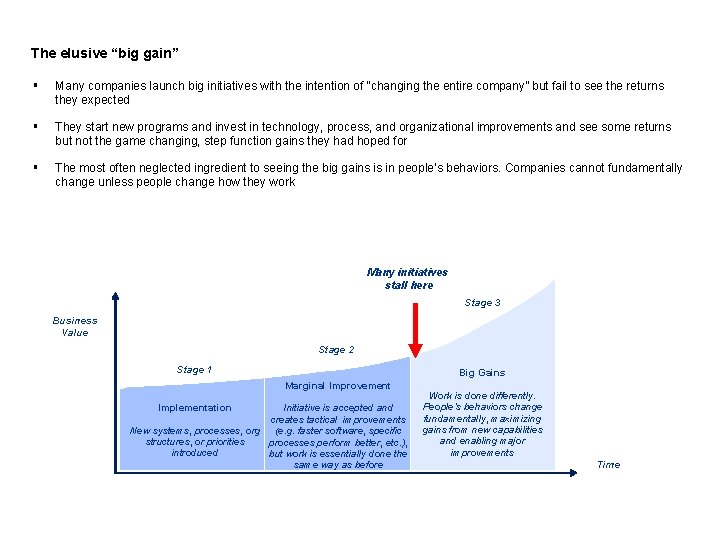
The elusive “big gain” § Many companies launch big initiatives with the intention of “changing the entire company” but fail to see the returns they expected § They start new programs and invest in technology, process, and organizational improvements and see some returns but not the game changing, step function gains they had hoped for § The most often neglected ingredient to seeing the big gains is in people’s behaviors. Companies cannot fundamentally change unless people change how they work Many initiatives stall here Stage 3 Business Value Stage 2 Stage 1 Big Gains Marginal Improvement Implementation Initiative is accepted and creates tactical improvements New systems, processes, org (e. g. faster software, specific structures, or priorities processes perform better, etc. ), introduced but work is essentially done the same way as before Work is done differently. People’s behaviors change fundamentally, maximizing gains from new capabilities and enabling major improvements Time
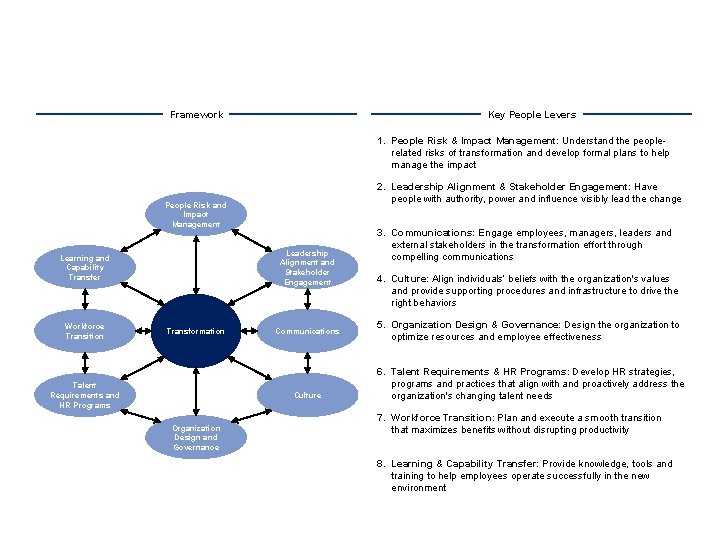
Framework Key People Levers 1. People Risk & Impact Management: Understand the peoplerelated risks of transformation and develop formal plans to help manage the impact 2. Leadership Alignment & Stakeholder Engagement: Have people with authority, power and influence visibly lead the change People Risk and Impact Management Leadership Alignment and Stakeholder Engagement Learning and Capability Transfer Workforce Transition Transformation Talent Requirements and HR Programs Communications Culture Organization Design and Governance 3. Communications: Engage employees, managers, leaders and external stakeholders in the transformation effort through compelling communications 4. Culture: Align individuals’ beliefs with the organization's values and provide supporting procedures and infrastructure to drive the right behaviors 5. Organization Design & Governance: Design the organization to optimize resources and employee effectiveness 6. Talent Requirements & HR Programs: Develop HR strategies, programs and practices that align with and proactively address the organization's changing talent needs 7. Workforce Transition: Plan and execute a smooth transition that maximizes benefits without disrupting productivity 8. Learning & Capability Transfer: Provide knowledge, tools and training to help employees operate successfully in the new environment
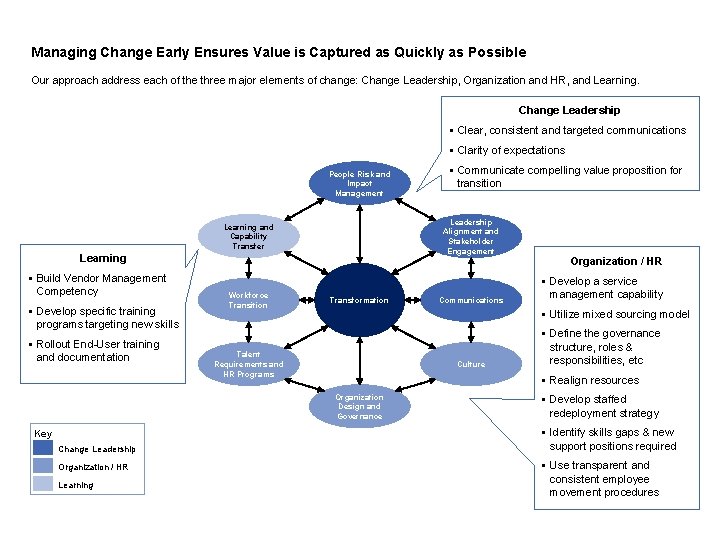
Managing Change Early Ensures Value is Captured as Quickly as Possible Our approach address each of the three major elements of change: Change Leadership, Organization and HR, and Learning. Change Leadership § Clear, consistent and targeted communications § Clarity of expectations People Risk and Impact Management Leadership Alignment and Stakeholder Engagement Learning and Capability Transfer Learning § Build Vendor Management Competency § Develop specific training programs targeting new skills § Rollout End-User training and documentation Workforce Transition Transformation Change Leadership Organization / HR Learning Communications Organization / HR § Develop a service management capability § Utilize mixed sourcing model Talent Requirements and HR Programs Culture § Define the governance structure, roles & responsibilities, etc § Realign resources Organization Design and Governance Key § Communicate compelling value proposition for transition § Develop staffed redeployment strategy § Identify skills gaps & new support positions required § Use transparent and consistent employee movement procedures
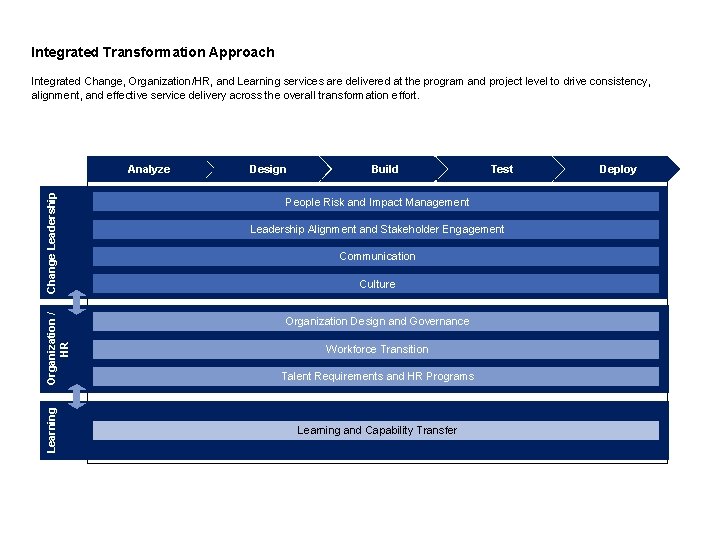
Integrated Transformation Approach Integrated Change, Organization/HR, and Learning services are delivered at the program and project level to drive consistency, alignment, and effective service delivery across the overall transformation effort. Learning Organization / HR Change Leadership Analyze Design Build Test People Risk and Impact Management Leadership Alignment and Stakeholder Engagement Communication Culture Organization Design and Governance Workforce Transition Talent Requirements and HR Programs Learning and Capability Transfer Deploy
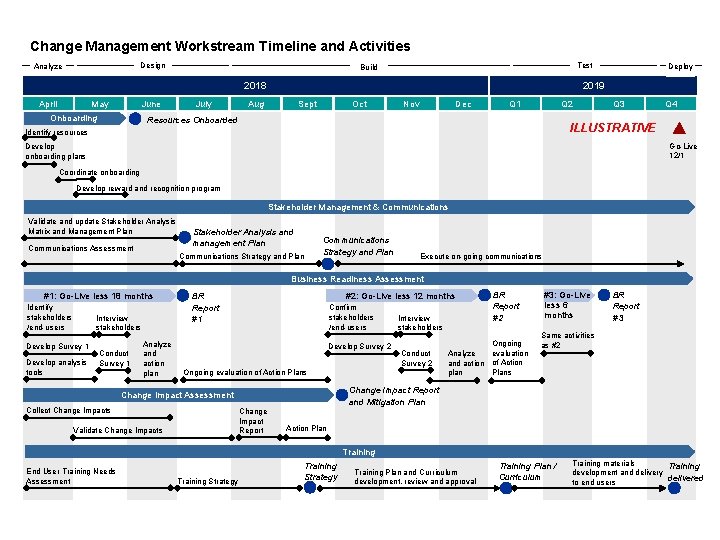
Change Management Workstream Timeline and Activities Design Analyze Test Build 2018 April May June Onboarding July Deploy 2019 Aug Sept Oct Nov Dec Q 1 Q 2 Resources Onboarded Q 3 Q 4 ILLUSTRATIVE Identify resources Go-Live 12/1 Develop onboarding plans Coordinate onboarding Develop reward and recognition program Stakeholder Management & Communications Validate and update Stakeholder Analysis Matrix and Management Plan Communications Assessment Stakeholder Analysis and management Plan Communications Strategy and Plan Execute on-going communications Business Readiness Assessment #1: Go-Live less 18 months Identify stakeholders /end-users Interview stakeholders Develop Survey 1 Develop analysis tools Conduct Survey 1 Analyze and action plan #2: Go-Live less 12 months BR Report #1 Confirm stakeholders /end-users Develop Survey 2 Interview stakeholders Conduct Survey 2 Ongoing evaluation of Action Plans Change Impact Report Validate Change Impacts Ongoing evaluation Analyze and action of Action Plans plan #3: Go-Live less 6 months BR Report #3 Same activities as #2 Change Impact Report and Mitigation Plan Change Impact Assessment Collect Change Impacts BR Report #2 Action Plan Training End User Training Needs Assessment Training Strategy Training Plan and Curriculum development, review and approval Training Plan / Curriculum Training materials Training development and delivery delivered to end users
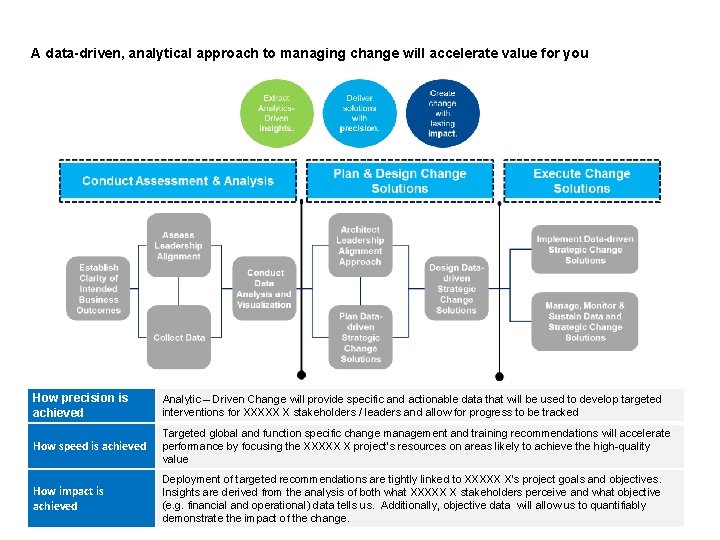
A data-driven, analytical approach to managing change will accelerate value for you How precision is achieved Analytic – Driven Change will provide specific and actionable data that will be used to develop targeted interventions for XXXXX X stakeholders / leaders and allow for progress to be tracked How speed is achieved Targeted global and function specific change management and training recommendations will accelerate performance by focusing the XXXXX X project’s resources on areas likely to achieve the high-quality value How impact is achieved Deployment of targeted recommendations are tightly linked to XXXXX X’s project goals and objectives. Insights are derived from the analysis of both what XXXXX X stakeholders perceive and what objective (e. g. financial and operational) data tells us. Additionally, objective data will allow us to quantifiably demonstrate the impact of the change.
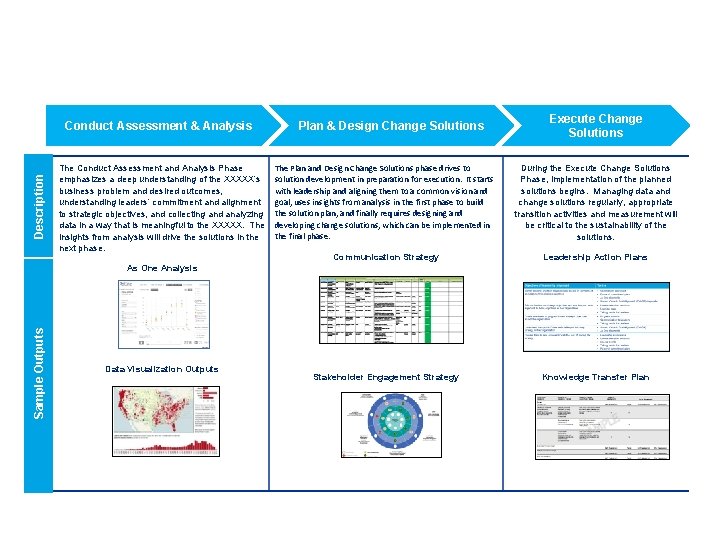
Description Conduct Assessment & Analysis The Conduct Assessment and Analysis Phase emphasizes a deep understanding of the XXXXX’s business problem and desired outcomes, understanding leaders’ commitment and alignment to strategic objectives, and collecting and analyzing data in a way that is meaningful to the XXXXX. The insights from analysis will drive the solutions in the next phase. Plan & Design Change Solutions Execute Change Solutions The Plan and Design Change Solutions phase drives to solution development in preparation for execution. It starts with leadership and aligning them to a common vision and goal, uses insights from analysis in the first phase to build the solution plan, and finally requires designing and developing change solutions, which can be implemented in the final phase. During the Execute Change Solutions Phase, implementation of the planned solutions begins. Managing data and change solutions regularly, appropriate transition activities and measurement will be critical to the sustainability of the solutions. Communication Strategy Leadership Action Plans Stakeholder Engagement Strategy Knowledge Transfer Plan Sample Outputs As One Analysis Data Visualization Outputs
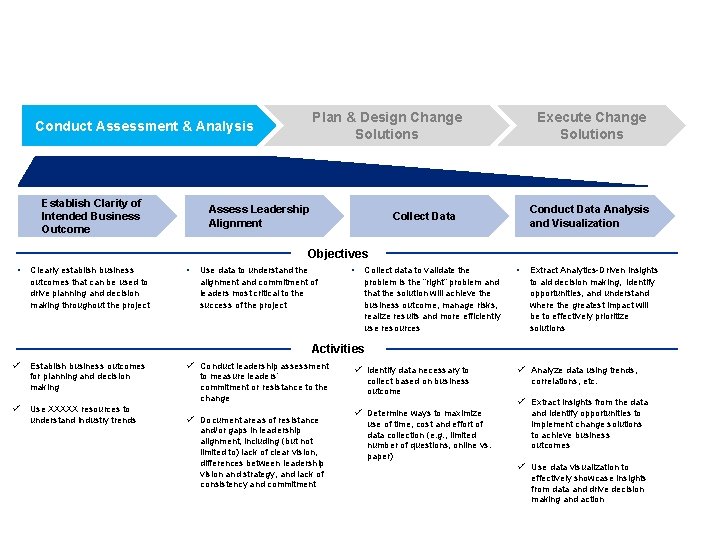
Plan & Design Change Solutions Conduct Assessment & Analysis Establish Clarity of Intended Business Outcome Assess Leadership Alignment Execute Change Solutions Conduct Data Analysis and Visualization Collect Data Objectives • Clearly establish business outcomes that can be used to drive planning and decision making throughout the project • Use data to understand the alignment and commitment of leaders most critical to the success of the project • Collect data to validate the problem is the “right” problem and that the solution will achieve the business outcome, manage risks, realize results and more efficiently use resources • Extract Analytics-Driven insights to aid decision making, identify opportunities, and understand where the greatest impact will be to effectively prioritize solutions Activities ü ü Establish business outcomes for planning and decision making Use XXXXX resources to understand industry trends ü Conduct leadership assessment to measure leaders’ commitment or resistance to the change ü Document areas of resistance and/or gaps in leadership alignment, including (but not limited to) lack of clear vision, differences between leadership vision and strategy, and lack of consistency and commitment ü Identify data necessary to collect based on business outcome ü Analyze data using trends, correlations, etc. ü Extract insights from the data ü Determine ways to maximize use of time, cost and effort of data collection (e. g. , limited number of questions, online vs. paper) and identify opportunities to implement change solutions to achieve business outcomes ü Use data visualization to effectively showcase insights from data and drive decision making and action
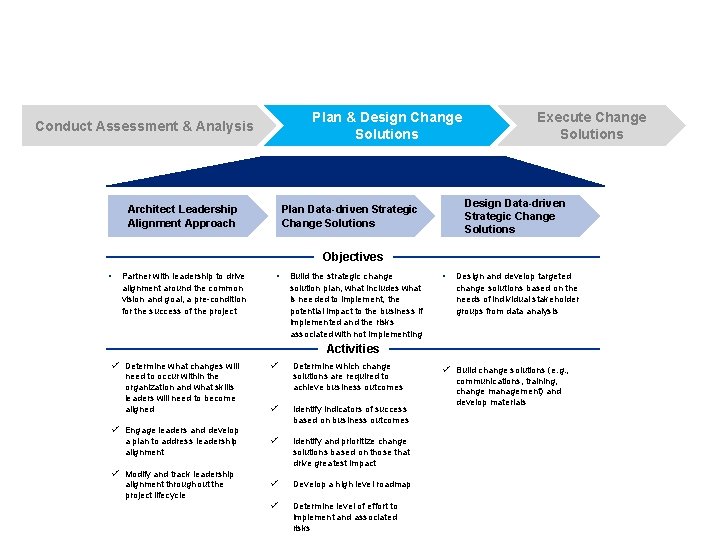
Plan & Design Change Solutions Conduct Assessment & Analysis Architect Leadership Alignment Approach Execute Change Solutions Design Data-driven Strategic Change Solutions Plan Data-driven Strategic Change Solutions Objectives • Partner with leadership to drive alignment around the common vision and goal, a pre-condition for the success of the project • Build the strategic change solution plan, what includes what is needed to implement, the potential impact to the business if implemented and the risks associated with not implementing • Design and develop targeted change solutions based on the needs of individual stakeholder groups from data analysis Activities ü Determine what changes will need to occur within the organization and what skills leaders will need to become aligned ü Determine which change solutions are required to achieve business outcomes ü Identify indicators of success based on business outcomes ü Identify and prioritize change solutions based on those that drive greatest impact ü Develop a high level roadmap ü Determine level of effort to implement and associated risks ü Engage leaders and develop a plan to address leadership alignment ü Modify and track leadership alignment throughout the project lifecycle ü Build change solutions (e. g. , communications, training, change management) and develop materials
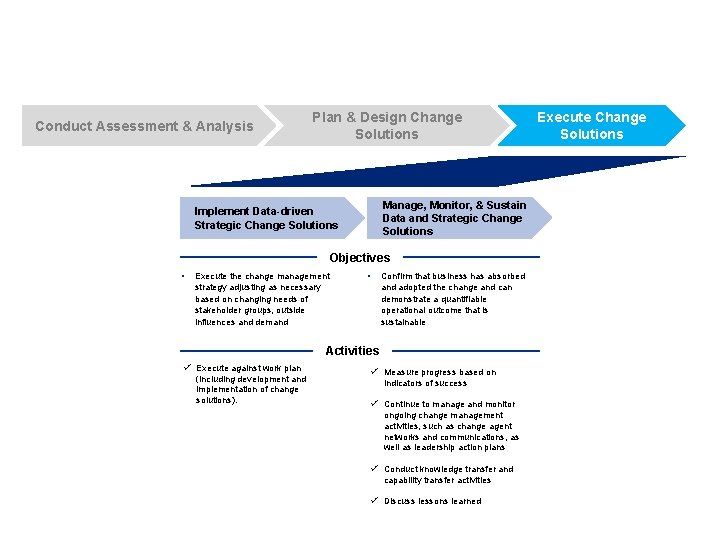
Conduct Assessment & Analysis Plan & Design Change Solutions Manage, Monitor, & Sustain Data and Strategic Change Solutions Implement Data-driven Strategic Change Solutions Objectives • Execute the change management strategy adjusting as necessary based on changing needs of stakeholder groups, outside influences and demand • Confirm that business has absorbed and adopted the change and can demonstrate a quantifiable operational outcome that is sustainable Activities ü Execute against work plan (including development and implementation of change solutions). ü Measure progress based on indicators of success ü Continue to manage and monitor ongoing change management activities, such as change agent networks and communications, as well as leadership action plans ü Conduct knowledge transfer and capability transfer activities ü Discuss lessons learned Execute Change Solutions
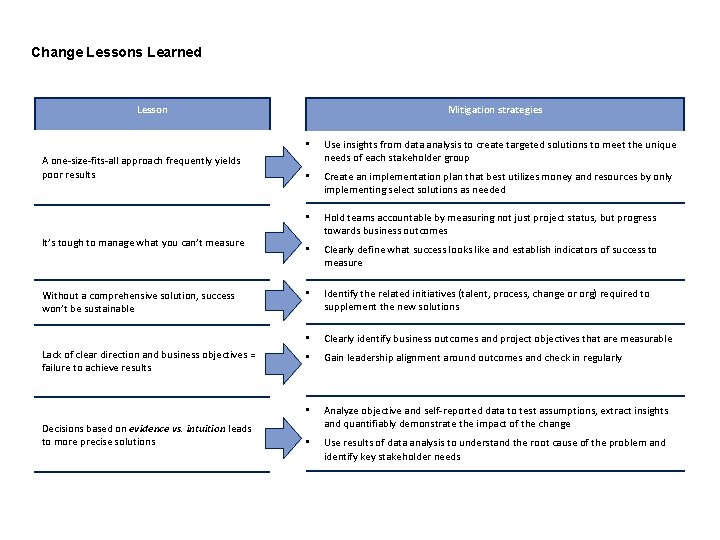
Change Lessons Learned Mitigation strategies Lesson A one-size-fits-all approach frequently yields poor results It’s tough to manage what you can’t measure Without a comprehensive solution, success won’t be sustainable Lack of clear direction and business objectives = failure to achieve results Decisions based on evidence vs. intuition leads to more precise solutions • Use insights from data analysis to create targeted solutions to meet the unique needs of each stakeholder group • Create an implementation plan that best utilizes money and resources by only implementing select solutions as needed • Hold teams accountable by measuring not just project status, but progress towards business outcomes • Clearly define what success looks like and establish indicators of success to measure • Identify the related initiatives (talent, process, change or org) required to supplement the new solutions • Clearly identify business outcomes and project objectives that are measurable • Gain leadership alignment around outcomes and check in regularly • Analyze objective and self-reported data to test assumptions, extract insights and quantifiably demonstrate the impact of the change • Use results of data analysis to understand the root cause of the problem and identify key stakeholder needs
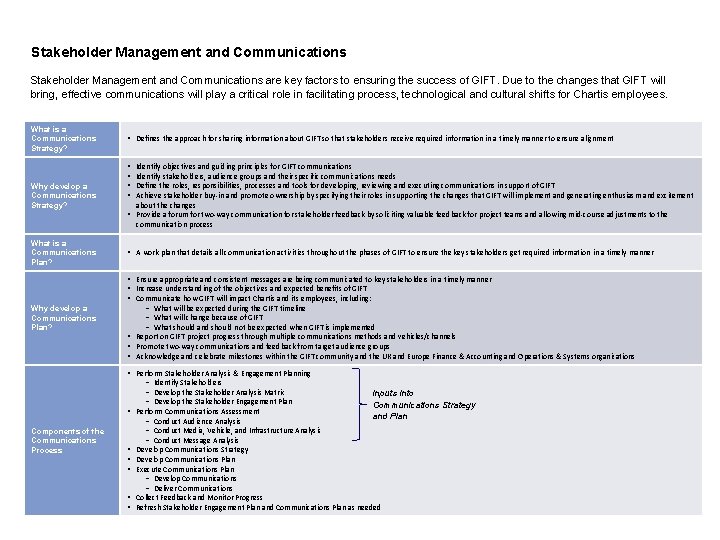
Stakeholder Management and Communications are key factors to ensuring the success of GIFT. Due to the changes that GIFT will bring, effective communications will play a critical role in facilitating process, technological and cultural shifts for Chartis employees. What is a Communications Strategy? Why develop a Communications Strategy? § Defines the approach for sharing information about GIFT so that stakeholders receive required information in a timely manner to ensure alignment § § Identify objectives and guiding principles for GIFT communications Identify stakeholders, audience groups and their specific communications needs Define the roles, responsibilities, processes and tools for developing, reviewing and executing communications in support of GIFT Achieve stakeholder buy-in and promote ownership by specifying their roles in supporting the changes that GIFT will implement and generating enthusiasm and excitement about the changes § Provide a forum for two-way communication for stakeholder feedback by soliciting valuable feedback for project teams and allowing mid-course adjustments to the communication process What is a Communications Plan? § A work plan that details all communication activities throughout the phases of GIFT to ensure the key stakeholders get required information in a timely manner Why develop a Communications Plan? § Ensure appropriate and consistent messages are being communicated to key stakeholders in a timely manner § Increase understanding of the objectives and expected benefits of GIFT § Communicate how GIFT will impact Chartis and its employees, including: What will be expected during the GIFT timeline What will change because of GIFT What should and should not be expected when GIFT is implemented § Report on GIFT project progress through multiple communications methods and vehicles/channels § Promote two-way communications and feedback from target audience groups § Acknowledge and celebrate milestones within the GIFT community and the UK and Europe Finance & Accounting and Operations & Systems organizations Components of the Communications Process § Perform Stakeholder Analysis & Engagement Planning Identify Stakeholders Develop the Stakeholder Analysis Matrix Inputs into Develop the Stakeholder Engagement Plan Communications Strategy § Perform Communications Assessment and Plan Conduct Audience Analysis Conduct Media, Vehicle, and Infrastructure Analysis Conduct Message Analysis § Develop Communications Strategy § Develop Communications Plan § Execute Communications Plan Develop Communications Deliver Communications § Collect Feedback and Monitor Progress § Refresh Stakeholder Engagement Plan and Communications Plan as needed
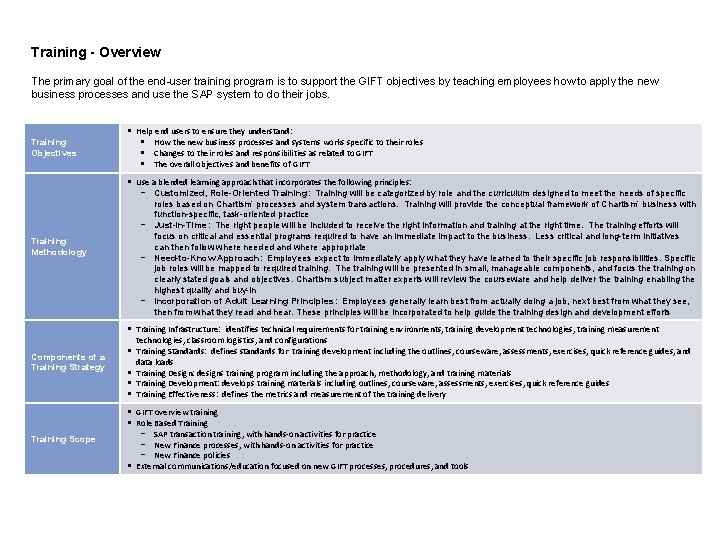
Training - Overview The primary goal of the end-user training program is to support the GIFT objectives by teaching employees how to apply the new business processes and use the SAP system to do their jobs. Training Objectives § Help end users to ensure they understand: § How the new business processes and systems works specific to their roles § Changes to their roles and responsibilities as related to GIFT § The overall objectives and benefits of GIFT § Use a blended learning approach that incorporates the following principles: Customized, Role-Oriented Training: Training will be categorized by role and the curriculum designed to meet the needs of specific Training Methodology roles based on Chartism’ processes and system transactions. Training will provide the conceptual framework of Chartism’ business with function-specific, task-oriented practice Just-in-Time: The right people will be included to receive the right information and training at the right time. The training efforts will focus on critical and essential programs required to have an immediate impact to the business. Less critical and long-term initiatives can then follow where needed and where appropriate Need-to-Know Approach: Employees expect to immediately apply what they have learned to their specific job responsibilities. Specific job roles will be mapped to required training. The training will be presented in small, manageable components, and focus the training on clearly stated goals and objectives. Chartism subject matter experts will review the courseware and help deliver the training enabling the highest quality and buy-in Incorporation of Adult Learning Principles: Employees generally learn best from actually doing a job, next best from what they see, then from what they read and hear. These principles will be incorporated to help guide the training design and development efforts § Training Infrastructure: identifies technical requirements for training environments, training development technologies, training measurement technologies, classroom logistics, and configurations Components of a Training Strategy Training Scope § Training Standards: defines standards for training development including the outlines, courseware, assessments, exercises, quick reference guides, and data loads § Training Design: designs training program including the approach, methodology, and training materials § Training Development: develops training materials including outlines, courseware, assessments, exercises, quick reference guides § Training Effectiveness: defines the metrics and measurement of the training delivery § GIFT overview training § Role Based Training SAP transaction training, with hands-on activities for practice New Finance processes, with hands-on activities for practice New Finance policies § External communications/education focused on new GIFT processes, procedures, and tools
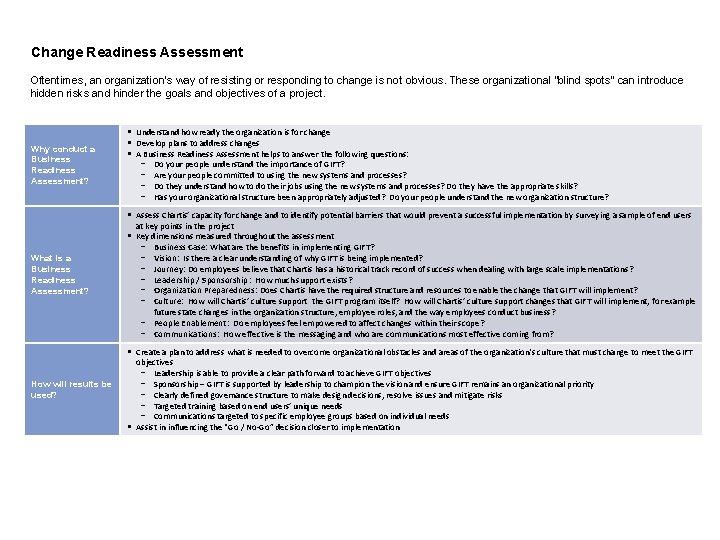
Change Readiness Assessment Oftentimes, an organization’s way of resisting or responding to change is not obvious. These organizational “blind spots” can introduce hidden risks and hinder the goals and objectives of a project. Why conduct a Business Readiness Assessment? § Understand how ready the organization is for change § Develop plans to address changes § A Business Readiness Assessment helps to answer the following questions: Do your people understand the importance of GIFT? Are your people committed to using the new systems and processes? Do they understand how to do their jobs using the new systems and processes? Do they have the appropriate skills? Has your organizational structure been appropriately adjusted? Do your people understand the new organization structure? § Assess Chartis’ capacity for change and to identify potential barriers that would prevent a successful implementation by surveying a sample of end users at key points in the project What is a Business Readiness Assessment? § Key dimensions measured throughout the assessment Business Case: What are the benefits in implementing GIFT? Vision: Is there a clear understanding of why GIFT is being implemented? Journey: Do employees believe that Chartis has a historical track record of success when dealing with large scale implementations? Leadership / Sponsorship: How much support exists? Organization Preparedness: Does Chartis have the required structure and resources to enable the change that GIFT will implement? Culture: How will Chartis’ culture support the GIFT program itself? How will Chartis’ culture support changes that GIFT will implement, for example future state changes in the organization structure, employee roles, and the way employees conduct business? People Enablement: Do employees feel empowered to affect changes within their scope? Communications: How effective is the messaging and who are communications most effective coming from? § Create a plan to address what is needed to overcome organizational obstacles and areas of the organization's culture that must change to meet the GIFT How will results be used? objectives Leadership is able to provide a clear path forward to achieve GIFT objectives Sponsorship – GIFT is supported by leadership to champion the vision and ensure GIFT remains an organizational priority Clearly defined governance structure to make design decisions, resolve issues and mitigate risks Targeted training based on end users’ unique needs Communications targeted to specific employee groups based on individual needs § Assist in influencing the “Go / No-Go” decision closer to implementation
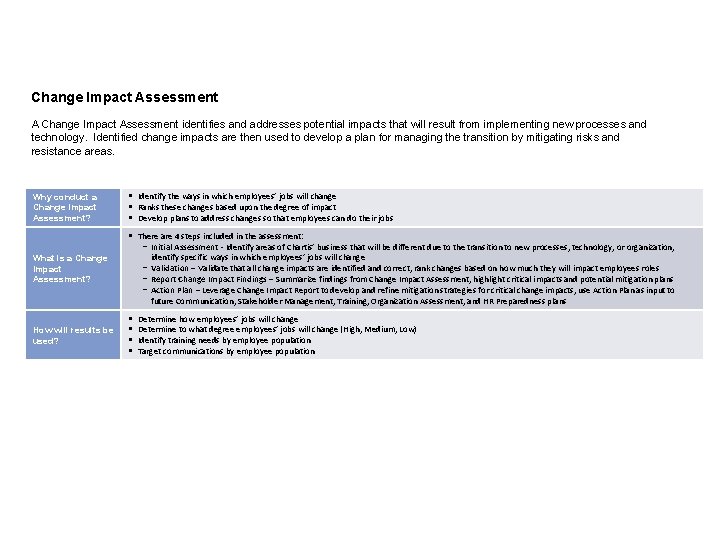
Change Impact Assessment A Change Impact Assessment identifies and addresses potential impacts that will result from implementing new processes and technology. Identified change impacts are then used to develop a plan for managing the transition by mitigating risks and resistance areas. Why conduct a Change Impact Assessment? § Identify the ways in which employees’ jobs will change § Ranks these changes based upon the degree of impact § Develop plans to address changes so that employees can do their jobs § There are 4 steps included in the assessment: Initial Assessment - Identify areas of Chartis’ business that will be different due to the transition to new processes, technology, or organization, identify specific ways in which employees’ jobs will change What is a Change Impact Assessment? Validation – Validate that all change impacts are identified and correct, rank changes based on how much they will impact employees roles Report Change Impact Findings – Summarize findings from Change Impact Assessment, highlight critical impacts and potential mitigation plans Action Plan – Leverage Change Impact Report to develop and refine mitigation strategies for critical change impacts, use Action Plan as input to future Communication, Stakeholder Management, Training, Organization Assessment, and HR Preparedness plans How will results be used? § § Determine how employees’ jobs will change Determine to what degree employees’ jobs will change (High, Medium, Low) Identify training needs by employee population Target communications by employee population
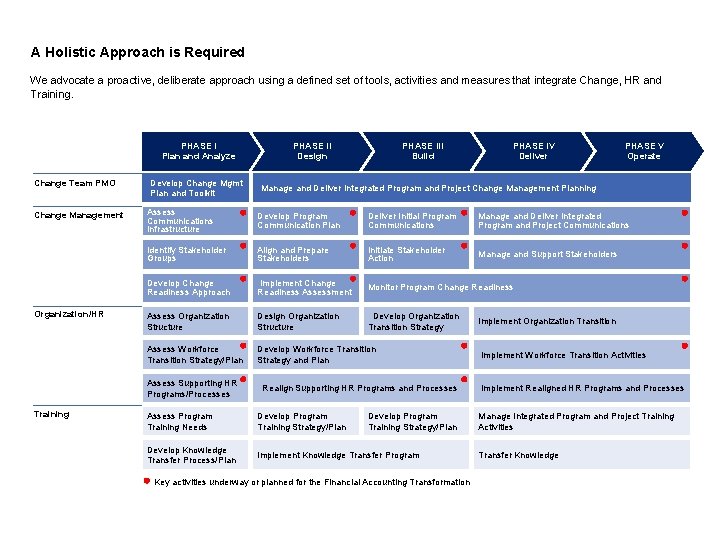
A Holistic Approach is Required We advocate a proactive, deliberate approach using a defined set of tools, activities and measures that integrate Change, HR and Training. PHASE I Plan and Analyze Change Team PMO Change Management Organization/HR Develop Change Mgmt Plan and Toolkit PHASE III Build PHASE IV Deliver PHASE V Operate Manage and Deliver Integrated Program and Project Change Management Planning Assess Communications Infrastructure Develop Program Communication Plan Deliver Initial Program Communications Manage and Deliver Integrated Program and Project Communications Identify Stakeholder Groups Align and Prepare Stakeholders Initiate Stakeholder Action Manage and Support Stakeholders Develop Change Readiness Approach Implement Change Readiness Assessment Monitor Program Change Readiness Assess Organization Structure Design Organization Structure Develop Organization Transition Strategy Assess Workforce Transition Strategy/Plan Develop Workforce Transition Strategy and Plan Assess Supporting HR Programs/Processes Training PHASE II Design Realign Supporting HR Programs and Processes Assess Program Training Needs Develop Program Training Strategy/Plan Develop Knowledge Transfer Process/Plan Implement Knowledge Transfer Program Key activities underway or planned for the Financial Accounting Transformation Implement Organization Transition Implement Workforce Transition Activities Implement Realigned HR Programs and Processes Manage Integrated Program and Project Training Activities Transfer Knowledge
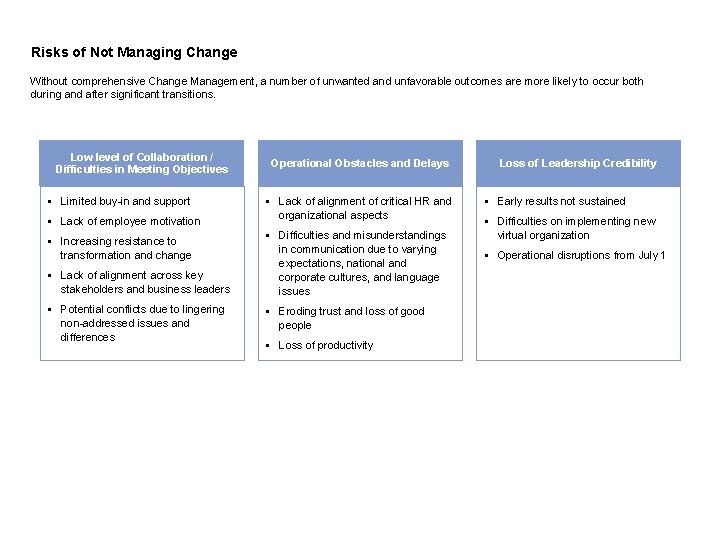
Risks of Not Managing Change Without comprehensive Change Management, a number of unwanted and unfavorable outcomes are more likely to occur both during and after significant transitions. Low level of Collaboration / Difficulties in Meeting Objectives § Limited buy-in and support § Lack of employee motivation § Increasing resistance to transformation and change § Lack of alignment across key stakeholders and business leaders § Potential conflicts due to lingering non-addressed issues and differences Operational Obstacles and Delays § Lack of alignment of critical HR and organizational aspects § Difficulties and misunderstandings in communication due to varying expectations, national and corporate cultures, and language issues § Eroding trust and loss of good people § Loss of productivity Loss of Leadership Credibility § Early results not sustained § Difficulties on implementing new virtual organization § Operational disruptions from July 1
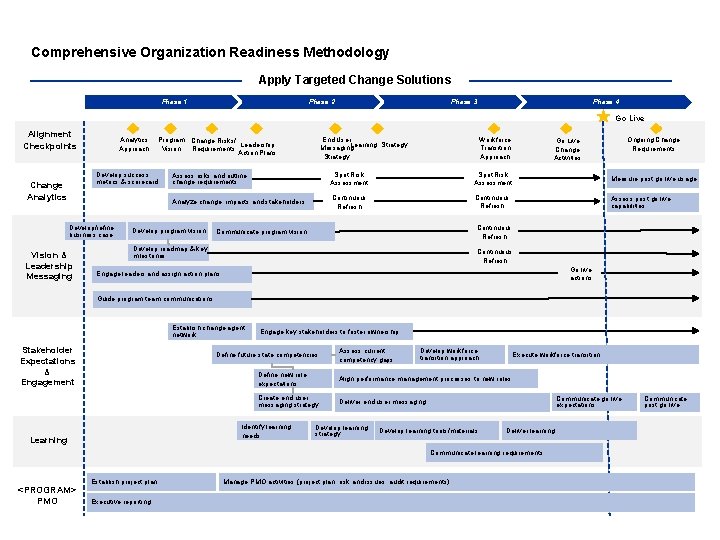
Comprehensive Organization Readiness Methodology Apply Targeted Change Solutions Phase 1 Phase 2 Phase 3 Phase 4 Go Live Alignment Checkpoints Analytics Approach Develop success metrics & scorecard Change Analytics Develop/refine business case Vision & Leadership Messaging End User Learning Strategy Messaging Strategy Program Change Risks/ Leadership Vision Requirements Action Plans Workforce Transition Approach Ongoing Change Requirements Go Live Change Activities Assess risks and outline change requirements Spot Risk Assessment Measure post go live usage Analyze change impacts and stakeholders Continuous Refresh Assess post go live capabilities Develop program vision Continuous Refresh Communicate program vision Develop roadmap & key milestones Continuous Refresh Go live actions Engage leaders and assign action plans Guide program team communications Establish change agent network Stakeholder Expectations & Engagement Engage key stakeholders to foster ownership Define future state competencies Develop workforce transition approach Execute workforce transition Define new role expectations Align performance management processes to new roles Create end user messaging strategy Deliver end user messaging Identify learning needs Learning Assess current competency gaps Develop learning strategy Communicate go live expectations Develop learning tools/materials Deliver learning Communicate learning requirements <PROGRAM> PMO Establish project plan Executive reporting Manage PMO activities (project plan, risk and issues, audit requirements) Communicate post go live
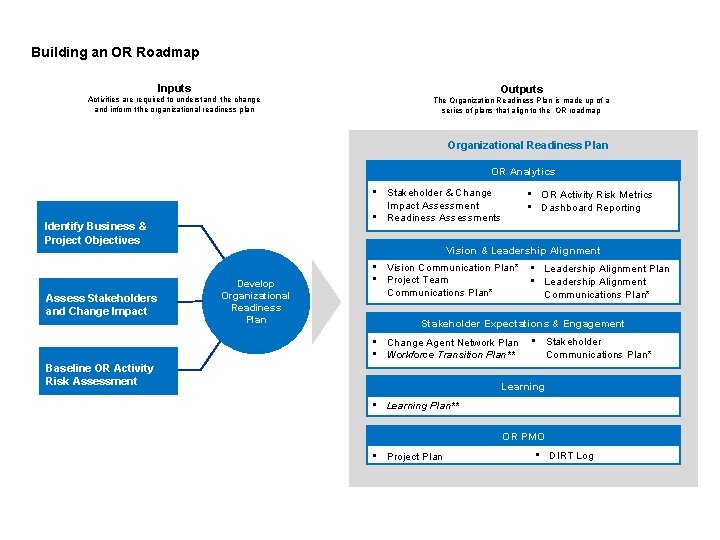
Building an OR Roadmap Inputs Outputs Activities are required to understand the change and inform tthe organizational readiness plan The Organization Readiness Plan is made up of a series of plans that align to the OR roadmap Organizational Readiness Plan OR Analytics • Stakeholder & Change Impact Assessment • Readiness Assessments Identify Business & Project Objectives Assess Stakeholders and Change Impact • OR Activity Risk Metrics • Dashboard Reporting Vision & Leadership Alignment Develop Organizational Readiness Plan • Vision Communication Plan* • Project Team Communications Plan* • Leadership Alignment Plan • Leadership Alignment Communications Plan* Stakeholder Expectations & Engagement • Change Agent Network Plan • Workforce Transition Plan** Baseline OR Activity Risk Assessment • Stakeholder Communications Plan* Learning • Learning Plan** OR PMO • Project Plan • DIRT Log
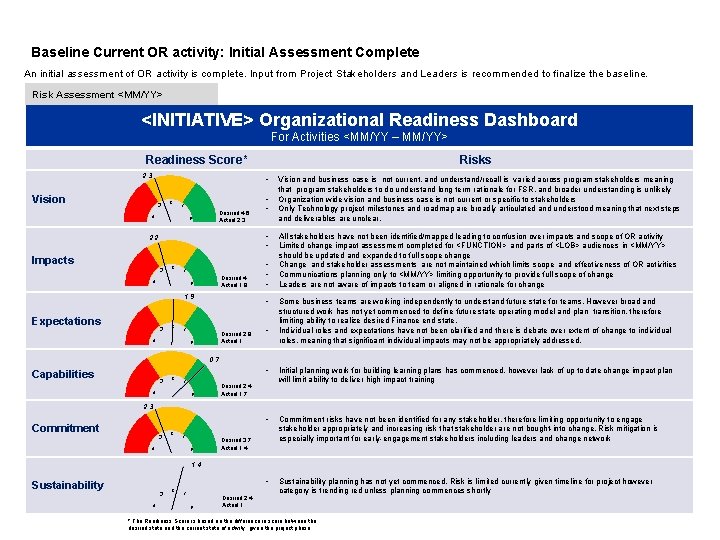
Baseline Current OR activity: Initial Assessment Complete An initial assessment of OR activity is complete. Input from Project Stakeholders and Leaders is recommended to finalize the baseline. Risk Assessment <MM/YY> <INITIATIVE> Organizational Readiness Dashboard For Activities <MM/YY – MM/YY> Readiness Score* 2. 3 Risks • Vision 3 2 1 4 0 Desired 4. 6 Actual 2. 3 • • 2. 2 Impacts 3 2 1 4 Desired 4 Actual 1. 8 0 1. 9 Expectations • • 3 2 • 1 4 • • • Desired 2. 9 Actual 1 0 • Vision and business case is not current, and understand/recall is varied across program stakeholders meaning that program stakeholders to do understand long term rationale for FSR, and broader understanding is unlikely Organization wide vision and business case is not current or specific to stakeholders Only Technology project milestones and roadmap are broadly articulated and understood meaning that next steps and deliverables are unclear. All stakeholders have not been identified/mapped leading to confusion over impacts and scope of OR activity Limited change impact assessment completed for <FUNCTION> and parts of <LOB> audiences in <MM/YY> should be updated and expanded to full scope change Change and stakeholder assessments are not maintained which limits scope and effectiveness of OR activities Communications planning only to <MM/YY> limiting opportunity to provide full scope of change Leaders are not aware of impacts to team or aligned in rationale for change Some business teams are working independently to understand future state for teams. However broad and structured work has not yet commenced to define future state operating model and plan transition, therefore limiting ability to realize desired Finance end state. Individual roles and expectations have not been clarified and there is debate over extent of change to individual roles, meaning that significant individual impacts may not be appropriately addressed. 0. 7 Capabilities 3 2 1 4 0 • Initial planning work for building learning plans has commenced, however lack of up to date change impact plan will limit ability to deliver high impact training • Commitment risks have not been identified for any stakeholder, therefore limiting opportunity to engage stakeholder appropriately and increasing risk that stakeholder are not bought-into change. Risk mitigation is especially important for early-engagement stakeholders including leaders and change network • Sustainability planning has not yet commenced. Risk is limited currently given timeline for project however category is trending red unless planning commences shortly Desired 2. 4 Actual 1. 7 2. 3 Commitment 3 2 1 4 0 Desired 3. 7 Actual 1. 4 Sustainability 3 4 2 1 0 Desired 2. 4 Actual 1 * The Readiness Score is based on the difference in score between the desired state and the current state of activity, given the project phase.
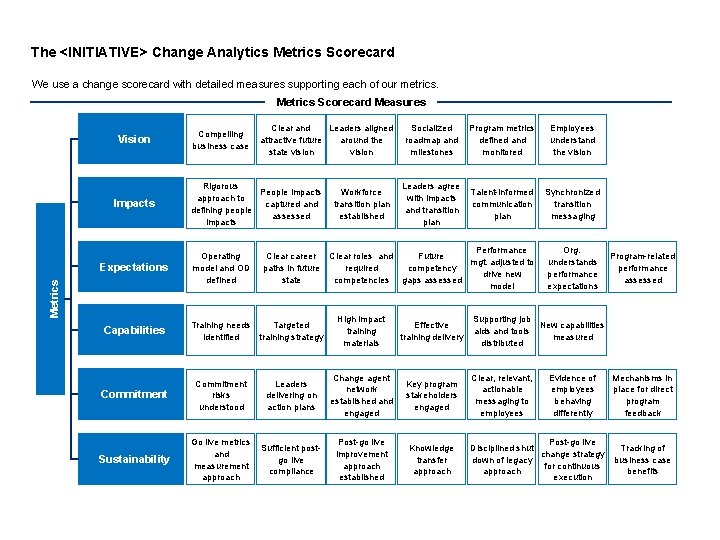
The <INITIATIVE> Change Analytics Metrics Scorecard We use a change scorecard with detailed measures supporting each of our metrics. Metrics Scorecard Measures Vision Impacts Metrics Expectations Capabilities Compelling business case Clear and Leaders aligned attractive future around the state vision Rigorous People impacts approach to captured and defining people assessed impacts Operating model and OD defined Clear career paths in future state Training needs Targeted identified training strategy Workforce transition plan established Clear roles and required competencies Socialized roadmap and milestones Program metrics defined and monitored Employees understand the vision Leaders agree with impacts and transition plan Talent-informed communication plan Synchronized transition messaging Performance Future mgt. adjusted to competency drive new gaps assessed model Org. understands performance expectations High impact training materials Effective training delivery Supporting job aids and tools distributed New capabilities measured Clear, relevant, actionable messaging to employees Evidence of employees behaving differently Commitment risks understood Leaders delivering on action plans Change agent network established and engaged Key program stakeholders engaged Sustainability Go live metrics and measurement approach Sufficient postgo live compliance Post-go live improvement approach established Knowledge transfer approach Post-go live Disciplined shut change strategy down of legacy for continuous approach execution Program-related performance assessed Mechanisms in place for direct program feedback Tracking of business case benefits
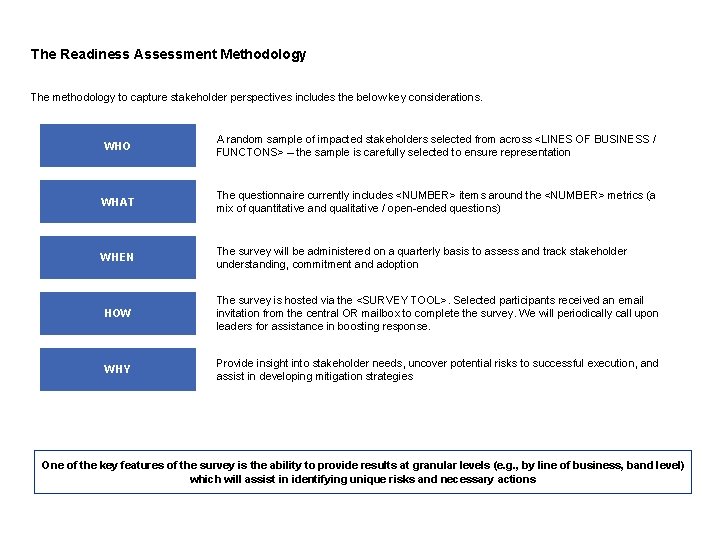
The Readiness Assessment Methodology The methodology to capture stakeholder perspectives includes the below key considerations. WHO A random sample of impacted stakeholders selected from across <LINES OF BUSINESS / FUNCTONS> – the sample is carefully selected to ensure representation WHAT The questionnaire currently includes <NUMBER> items around the <NUMBER> metrics (a mix of quantitative and qualitative / open-ended questions) WHEN The survey will be administered on a quarterly basis to assess and track stakeholder understanding, commitment and adoption HOW The survey is hosted via the <SURVEY TOOL>. Selected participants received an email invitation from the central OR mailbox to complete the survey. We will periodically call upon leaders for assistance in boosting response. WHY Provide insight into stakeholder needs, uncover potential risks to successful execution, and assist in developing mitigation strategies One of the key features of the survey is the ability to provide results at granular levels (e. g. , by line of business, band level) which will assist in identifying unique risks and necessary actions
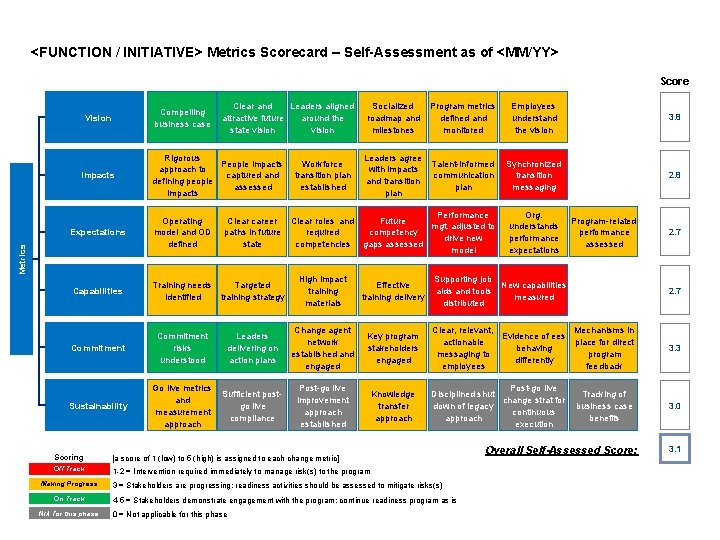
<FUNCTION / INITIATIVE> Metrics Scorecard – Self-Assessment as of <MM/YY> Score Compelling business case Vision Impacts Metrics Expectations Capabilities Clear and Leaders aligned attractive future around the state vision Rigorous People impacts approach to captured and defining people assessed impacts Operating model and OD defined Clear career paths in future state Training needs Targeted identified training strategy Workforce transition plan established Clear roles and required competencies Socialized roadmap and milestones Program metrics defined and monitored Employees understand the vision 3. 8 Leaders agree with impacts and transition plan Talent-informed communication plan Synchronized transition messaging 2. 8 Performance Future mgt. adjusted to competency drive new gaps assessed model Org. understands performance expectations High impact training materials Effective training delivery Commitment risks understood Leaders delivering on action plans Change agent network established and engaged Key program stakeholders engaged Sustainability Go live metrics and measurement approach Sufficient postgo live compliance Post-go live improvement approach established Knowledge transfer approach Scoring [a score of 1 (low) to 5 (high) is assigned to each change metric] Off Track 1 -2 = Intervention required immediately to manage risk(s) to the program Making Progress On Track N/A for this phase Supporting job aids and tools distributed 2. 7 New capabilities measured 2. 7 Clear, relevant, Mechanisms in Evidence of ees actionable place for direct behaving messaging to program differently employees feedback 3. 3 Post-go live Disciplined shut change strat for down of legacy continuous approach execution 3. 0 3 = Stakeholders are progressing; readiness activities should be assessed to mitigate risks(s) 4 -5 = Stakeholders demonstrate engagement with the program; continue readiness program as is 0 = Not applicable for this phase Program-related performance assessed Tracking of business case benefits Overall Self-Assessed Score: 3. 1
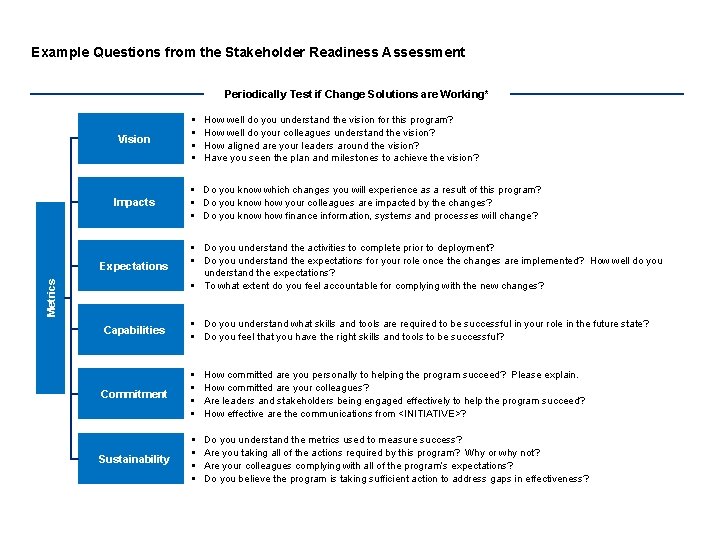
Example Questions from the Stakeholder Readiness Assessment Periodically Test if Change Solutions are Working* Vision Impacts Metrics Expectations § § How well do you understand the vision for this program? How well do your colleagues understand the vision? How aligned are your leaders around the vision? Have you seen the plan and milestones to achieve the vision? § Do you know which changes you will experience as a result of this program? § Do you know how your colleagues are impacted by the changes? § Do you know how finance information, systems and processes will change? § Do you understand the activities to complete prior to deployment? § Do you understand the expectations for your role once the changes are implemented? How well do you understand the expectations? § To what extent do you feel accountable for complying with the new changes? Capabilities § Do you understand what skills and tools are required to be successful in your role in the future state? § Do you feel that you have the right skills and tools to be successful? Commitment § § How committed are you personally to helping the program succeed? Please explain. How committed are your colleagues? Are leaders and stakeholders being engaged effectively to help the program succeed? How effective are the communications from <INITIATIVE>? Sustainability § § Do you understand the metrics used to measure success? Are you taking all of the actions required by this program? Why or why not? Are your colleagues complying with all of the program’s expectations? Do you believe the program is taking sufficient action to address gaps in effectiveness?
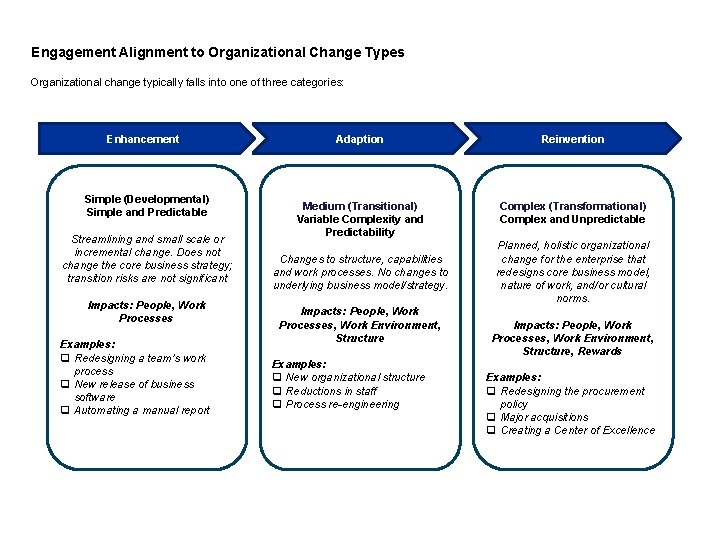
Engagement Alignment to Organizational Change Types Organizational change typically falls into one of three categories: Enhancement Simple (Developmental) Simple and Predictable Streamlining and small scale or incremental change. Does not change the core business strategy; transition risks are not significant Impacts: People, Work Processes Examples: q Redesigning a team’s work process q New release of business software q Automating a manual report Adaption Reinvention Medium (Transitional) Variable Complexity and Predictability Complex (Transformational) Complex and Unpredictable Changes to structure, capabilities and work processes. No changes to underlying business model/strategy. Impacts: People, Work Processes, Work Environment, Structure Examples: q New organizational structure q Reductions in staff q Process re-engineering Planned, holistic organizational change for the enterprise that redesigns core business model, nature of work, and/or cultural norms. Impacts: People, Work Processes, Work Environment, Structure, Rewards Examples: q Redesigning the procurement policy q Major acquisitions q Creating a Center of Excellence
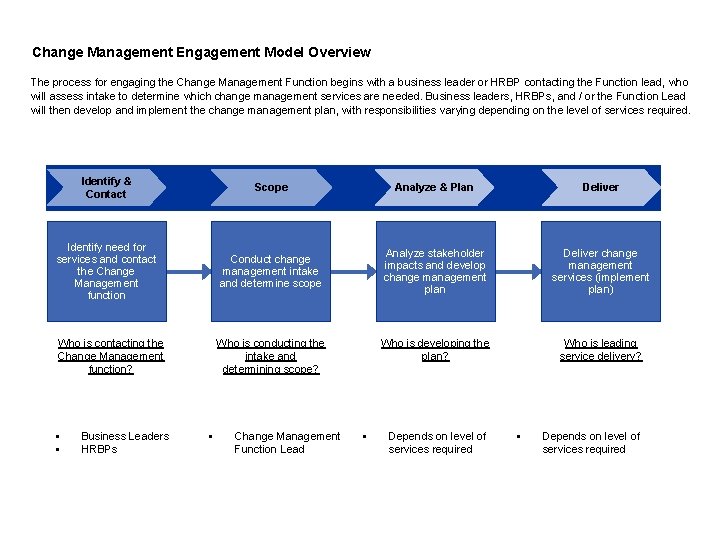
Change Management Engagement Model Overview The process for engaging the Change Management Function begins with a business leader or HRBP contacting the Function lead, who will assess intake to determine which change management services are needed. Business leaders, HRBPs, and / or the Function Lead will then develop and implement the change management plan, with responsibilities varying depending on the level of services required. Identify & Contact Scope Analyze & Plan Deliver Identify need for services and contact the Change Management function Conduct change management intake and determine scope Analyze stakeholder impacts and develop change management plan Deliver change management services (implement plan) Who is contacting the Change Management function? Who is conducting the intake and determining scope? Who is developing the plan? Who is leading service delivery? § § Business Leaders HRBPs § Change Management Function Lead § Depends on level of services required
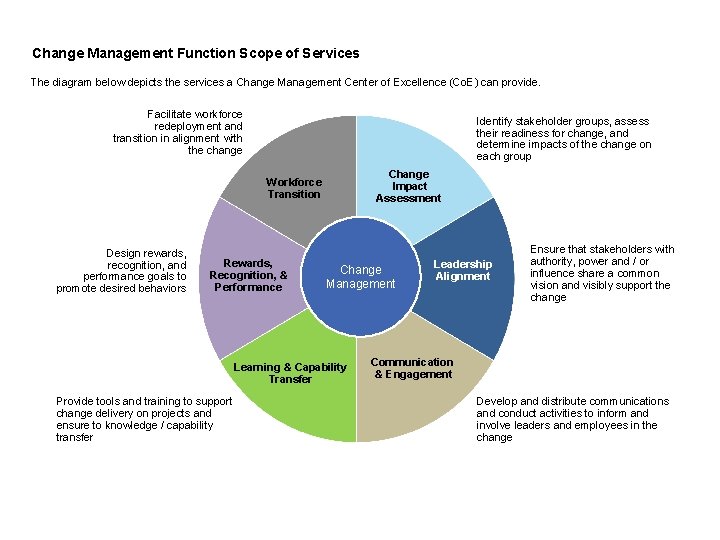
Change Management Function Scope of Services The diagram below depicts the services a Change Management Center of Excellence (Co. E) can provide. Facilitate workforce redeployment and transition in alignment with the change Identify stakeholder groups, assess their readiness for change, and determine impacts of the change on each group Change Impact Assessment Workforce Transition Design rewards, recognition, and performance goals to promote desired behaviors Rewards, Recognition, & Performance Change Management Learning & Capability Transfer Provide tools and training to support change delivery on projects and ensure to knowledge / capability transfer Leadership Alignment Ensure that stakeholders with authority, power and / or influence share a common vision and visibly support the change Communication & Engagement Develop and distribute communications and conduct activities to inform and involve leaders and employees in the change
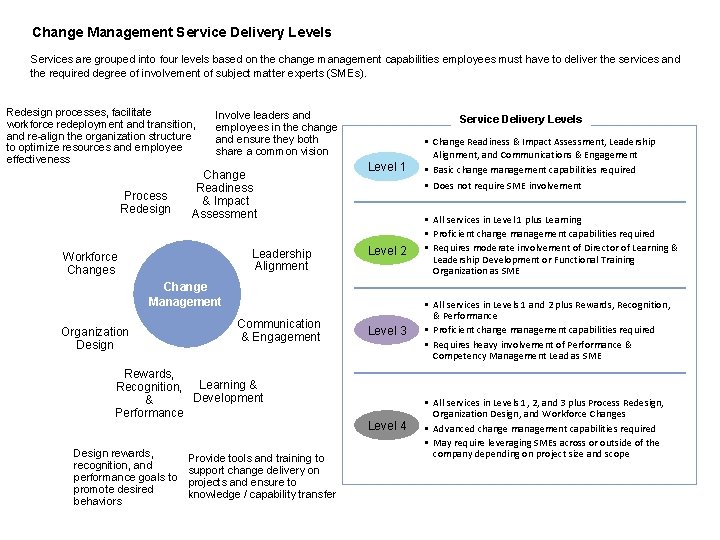
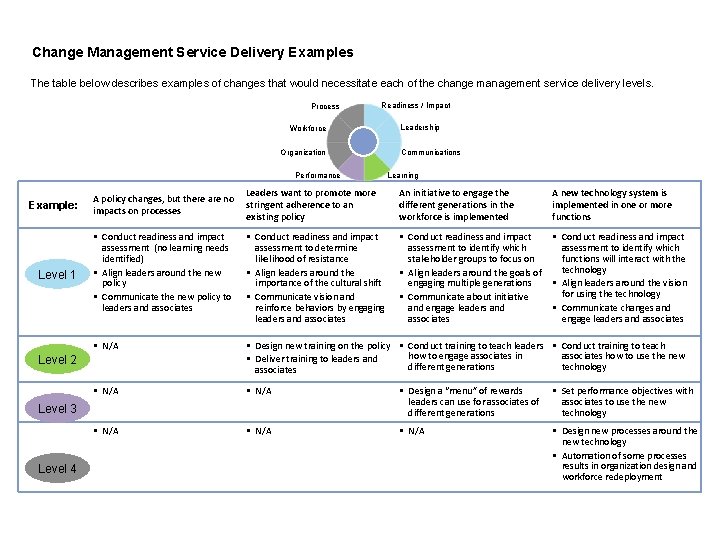
Change Management Service Delivery Levels Services are grouped into four levels based on the change management capabilities employees must have to deliver the services and the required degree of involvement of subject matter experts (SMEs). Redesign processes, facilitate workforce redeployment and transition, and re-align the organization structure to optimize resources and employee effectiveness Process Redesign Involve leaders and employees in the change and ensure they both share a common vision Change Readiness & Impact Assessment Leadership Alignment Workforce Changes Service Delivery Levels Level 1 Level 2 Change Management Organization Design Communication & Engagement Rewards, Recognition, Learning & Development & Performance Design rewards, recognition, and performance goals to promote desired behaviors Provide tools and training to support change delivery on projects and ensure to knowledge / capability transfer § Change Readiness & Impact Assessment, Leadership Alignment, and Communications & Engagement § Basic change management capabilities required § Does not require SME involvement § All services in Level 1 plus Learning § Proficient change management capabilities required § Requires moderate involvement of Director of Learning & Leadership Development or Functional Training Organization as SME Level 3 § All services in Levels 1 and 2 plus Rewards, Recognition, & Performance § Proficient change management capabilities required § Requires heavy involvement of Performance & Competency Management Lead as SME Level 4 § All services in Levels 1, 2, and 3 plus Process Redesign, Organization Design, and Workforce Changes § Advanced change management capabilities required § May require leveraging SMEs across or outside of the company depending on project size and scope
Change Management Service Delivery Examples The table below describes examples of changes that would necessitate each of the change management service delivery levels. Process Readiness / Impact Workforce Organization Performance Communications Learning Leaders want to promote more stringent adherence to an existing policy An initiative to engage the different generations in the workforce is implemented A new technology system is implemented in one or more functions § Conduct readiness and impact assessment (no learning needs identified) § Align leaders around the new policy § Communicate the new policy to leaders and associates § Conduct readiness and impact assessment to determine likelihood of resistance § Align leaders around the importance of the cultural shift § Communicate vision and reinforce behaviors by engaging leaders and associates § Conduct readiness and impact assessment to identify which stakeholder groups to focus on § Align leaders around the goals of engaging multiple generations § Communicate about initiative and engage leaders and associates § Conduct readiness and impact assessment to identify which functions will interact with the technology § Align leaders around the vision for using the technology § Communicate changes and engage leaders and associates § N/A § Design new training on the policy § Conduct training to teach leaders § Conduct training to teach how to engage associates in associates how to use the new § Deliver training to leaders and different generations technology associates § N/A § Design a “menu” of rewards leaders can use for associates of different generations § Set performance objectives with associates to use the new technology § N/A § Design new processes around the new technology § Automation of some processes results in organization design and workforce redeployment Example: A policy changes, but there are no impacts on processes Level 1 Level 2 Level 3 Level 4 Leadership
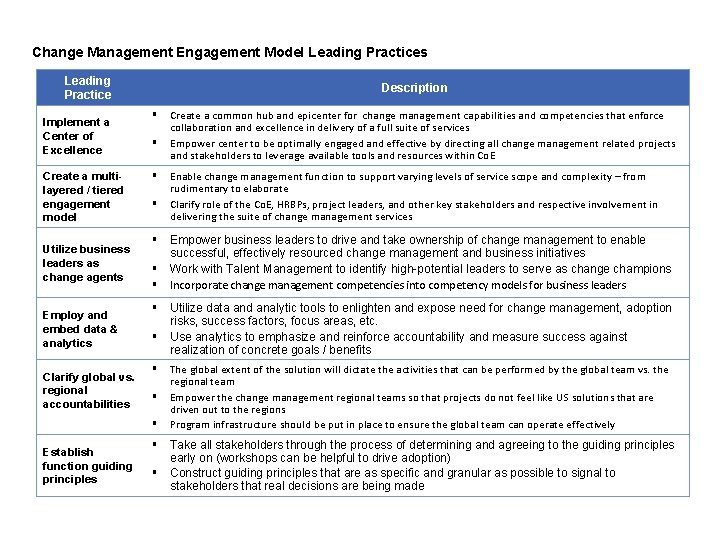
Change Management Engagement Model Leading Practices Leading Practice Implement a Center of Excellence Create a multilayered / tiered engagement model Description § § Create a common hub and epicenter for change management capabilities and competencies that enforce collaboration and excellence in delivery of a full suite of services Empower center to be optimally engaged and effective by directing all change management related projects and stakeholders to leverage available tools and resources within Co. E Enable change management function to support varying levels of service scope and complexity – from rudimentary to elaborate Clarify role of the Co. E, HRBPs, project leaders, and other key stakeholders and respective involvement in delivering the suite of change management services Utilize business leaders as change agents § Empower business leaders to drive and take ownership of change management to enable successful, effectively resourced change management and business initiatives § Work with Talent Management to identify high-potential leaders to serve as change champions § Incorporate change management competencies into competency models for business leaders Employ and embed data & analytics § Utilize data and analytic tools to enlighten and expose need for change management, adoption risks, success factors, focus areas, etc. § Use analytics to emphasize and reinforce accountability and measure success against realization of concrete goals / benefits Clarify global vs. regional accountabilities § § § Establish function guiding principles The global extent of the solution will dictate the activities that can be performed by the global team vs. the regional team Empower the change management regional teams so that projects do not feel like US solutions that are driven out to the regions Program infrastructure should be put in place to ensure the global team can operate effectively § Take all stakeholders through the process of determining and agreeing to the guiding principles early on (workshops can be helpful to drive adoption) § Construct guiding principles that are as specific and granular as possible to signal to stakeholders that real decisions are being made
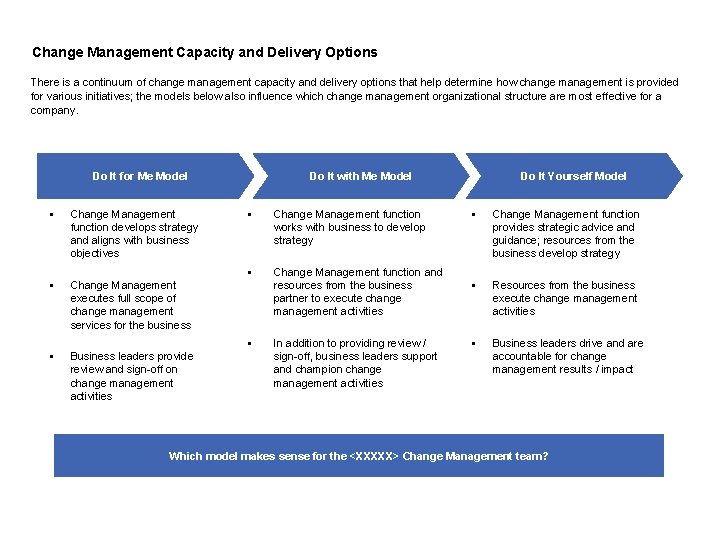
Change Management Capacity and Delivery Options There is a continuum of change management capacity and delivery options that help determine how change management is provided for various initiatives; the models below also influence which change management organizational structure are most effective for a company. Do It for Me Model § § Change Management function develops strategy and aligns with business objectives Do It with Me Model § Change Management function works with business to develop strategy § Change Management function and resources from the business partner to execute change management activities Change Management executes full scope of change management services for the business § § Business leaders provide review and sign-off on change management activities In addition to providing review / sign-off, business leaders support and champion change management activities Do It Yourself Model § Change Management function provides strategic advice and guidance; resources from the business develop strategy § Resources from the business execute change management activities § Business leaders drive and are accountable for change management results / impact Which model makes sense for the <XXXXX> Change Management team?
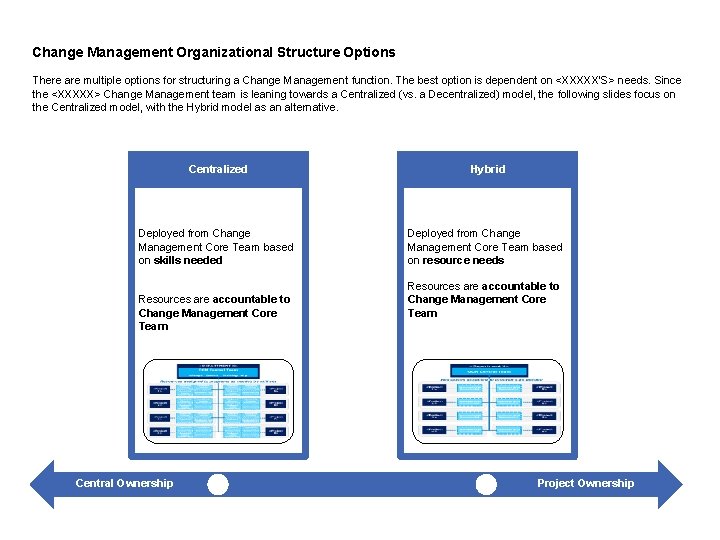
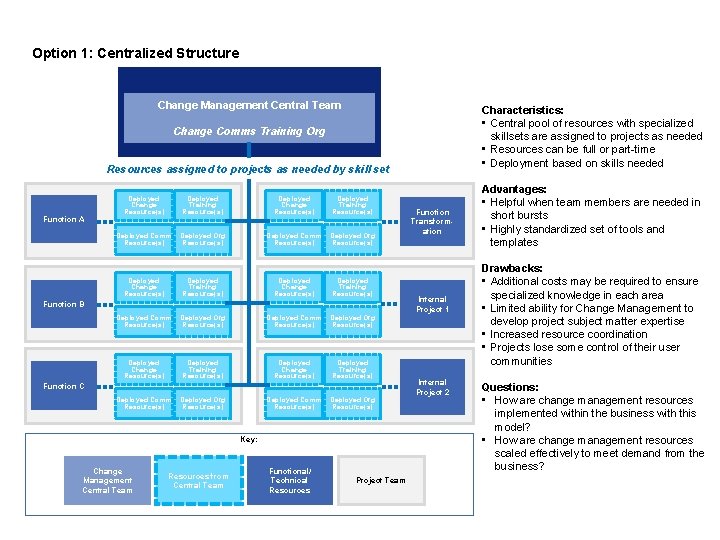
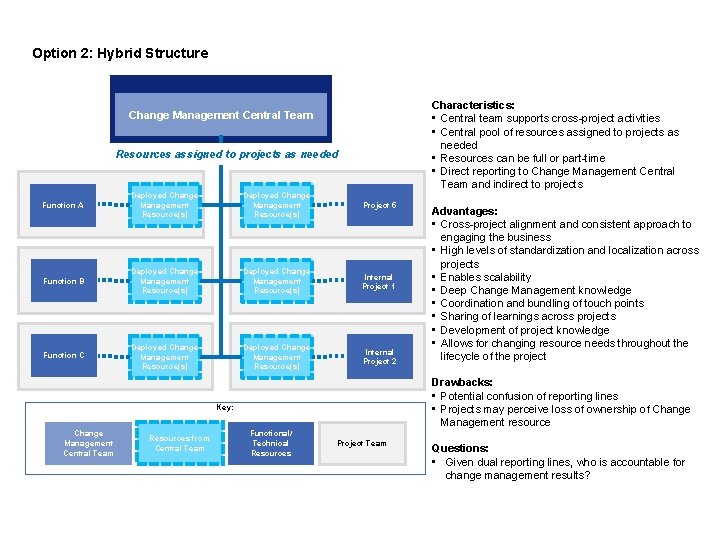
Change Management Organizational Structure Options There are multiple options for structuring a Change Management function. The best option is dependent on <XXXXX’S> needs. Since the <XXXXX> Change Management team is leaning towards a Centralized (vs. a Decentralized) model, the following slides focus on the Centralized model, with the Hybrid model as an alternative. Centralized Hybrid Deployed from Change Management Core Team based on skills needed Deployed from Change Management Core Team based on resource needs Resources are accountable to Change Management Core Team Central Ownership Resources are accountable to Change Management Core Team Project Ownership
Option 1: Centralized Structure Change Management Central Team Characteristics: • Central pool of resources with specialized skillsets are assigned to projects as needed • Resources can be full or part-time • Deployment based on skills needed Change Comms Training Org Resources assigned to projects as needed by skill set Function A Deployed Change Resource(s) Deployed Training Resource(s) Deployed Comm Resource(s) Deployed Org Resource(s) Deployed Change Resource(s) Deployed Training Resource(s) Deployed Comm Resource(s) Deployed Org Resource(s) Function B Function C Key: Change Management Central Team Resources from Central Team Functional/ Technical Resources Project Team Function Transformation Internal Project 1 Internal Project 2 Advantages: • Helpful when team members are needed in short bursts • Highly standardized set of tools and templates Drawbacks: • Additional costs may be required to ensure specialized knowledge in each area • Limited ability for Change Management to develop project subject matter expertise • Increased resource coordination • Projects lose some control of their user communities Questions: • How are change management resources implemented within the business with this model? • How are change management resources scaled effectively to meet demand from the business?
Option 2: Hybrid Structure Characteristics: • Central team supports cross-project activities • Central pool of resources assigned to projects as needed • Resources can be full or part-time • Direct reporting to Change Management Central Team and indirect to projects Change Management Central Team Resources assigned to projects as needed Function A Deployed Change Management Resource(s) Project 5 Function B Deployed Change Management Resource(s) Internal Project 1 Function C Deployed Change Management Resource(s) Internal Project 2 Drawbacks: • Potential confusion of reporting lines • Projects may perceive loss of ownership of Change Management resource Key: Change Management Central Team Resources from Central Team Advantages: • Cross-project alignment and consistent approach to engaging the business • High levels of standardization and localization across projects • Enables scalability • Deep Change Management knowledge • Coordination and bundling of touch points • Sharing of learnings across projects • Development of project knowledge • Allows for changing resource needs throughout the lifecycle of the project Functional/ Technical Resources Project Team Questions: • Given dual reporting lines, who is accountable for change management results?
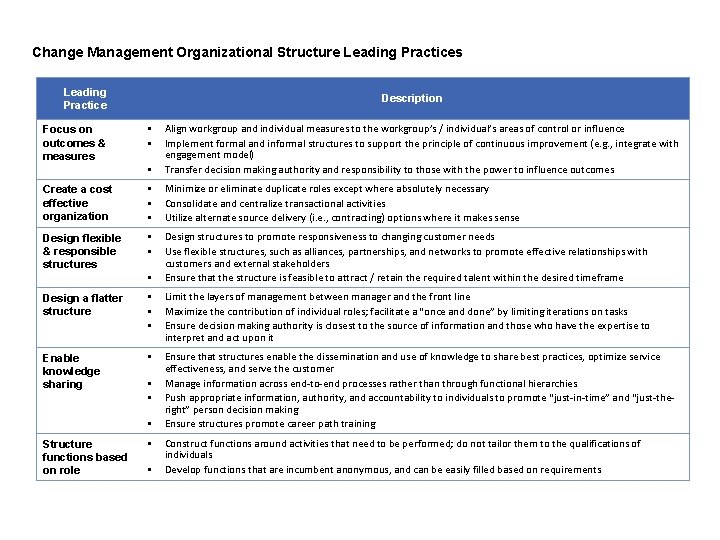
Change Management Organizational Structure Leading Practices Leading Practice Description § Align workgroup and individual measures to the workgroup’s / individual’s areas of control or influence Implement formal and informal structures to support the principle of continuous improvement (e. g. , integrate with engagement model) Transfer decision making authority and responsibility to those with the power to influence outcomes Create a cost effective organization § § § Minimize or eliminate duplicate roles except where absolutely necessary Consolidate and centralize transactional activities Utilize alternate source delivery (i. e. , contracting) options where it makes sense Design flexible & responsible structures § § Design structures to promote responsiveness to changing customer needs Use flexible structures, such as alliances, partnerships, and networks to promote effective relationships with customers and external stakeholders Ensure that the structure is feasible to attract / retain the required talent within the desired timeframe Focus on outcomes & measures § § § Design a flatter structure § § § Limit the layers of management between manager and the front line Maximize the contribution of individual roles; facilitate a “once and done” by limiting iterations on tasks Ensure decision making authority is closest to the source of information and those who have the expertise to interpret and act upon it Enable knowledge sharing § Ensure that structures enable the dissemination and use of knowledge to share best practices, optimize service effectiveness, and serve the customer Manage information across end-to-end processes rather than through functional hierarchies Push appropriate information, authority, and accountability to individuals to promote “just-in-time” and “just-theright” person decision making Ensure structures promote career path training § § § Structure functions based on role § § Construct functions around activities that need to be performed; do not tailor them to the qualifications of individuals Develop functions that are incumbent anonymous, and can be easily filled based on requirements
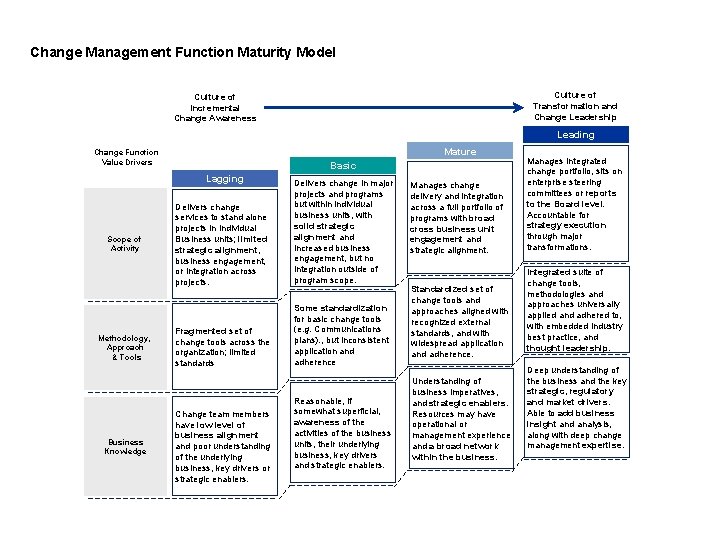
Change Management Function Maturity Model Culture of Transformation and Change Leadership Culture of Incremental Change Awareness Leading Mature Change Function Value Drivers Basic Lagging Scope of Activity Methodology, Approach & Tools Business Knowledge Delivers change services to stand alone projects in individual Business units; limited strategic alignment, business engagement, or integration across projects. Delivers change in major projects and programs but within individual business units, with solid strategic alignment and increased business engagement, but no integration outside of program scope. Fragmented set of change tools across the organization; limited standards Some standardization for basic change tools (e. g. Communications plans). , but inconsistent application and adherence Change team members have low level of business alignment and poor understanding of the underlying business, key drivers or strategic enablers. Reasonable, if somewhat superficial, awareness of the activities of the business units, their underlying business, key drivers and strategic enablers. Manages change delivery and integration across a full portfolio of programs with broad cross business unit engagement and strategic alignment. Standardized set of change tools and approaches aligned with recognized external standards, and with widespread application and adherence. Understanding of business imperatives, and strategic enablers. Resources may have operational or management experience and a broad network within the business. Manages integrated change portfolio, sits on enterprise steering committees or reports to the Board level. Accountable for strategy execution through major transformations. Integrated suite of change tools, methodologies and approaches universally applied and adhered to, with embedded industry best practice, and thought leadership. Deep understanding of the business and the key strategic, regulatory and market drivers. Able to add business insight and analysis, along with deep change management expertise.
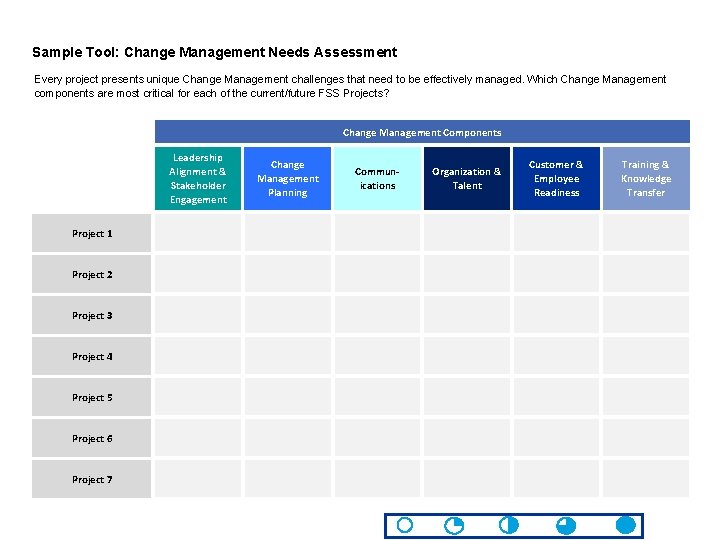
Sample Tool: Change Management Needs Assessment Every project presents unique Change Management challenges that need to be effectively managed. Which Change Management components are most critical for each of the current/future FSS Projects? Change Management Components Leadership Alignment & Stakeholder Engagement Project 1 Project 2 Project 3 Project 4 Project 5 Project 6 Project 7 Change Management Planning Communications Organization & Talent Customer & Employee Readiness Training & Knowledge Transfer