
Change Management Body of Knowledge CMBOK Chapter 1
Change Management Body of Knowledge (CMBOK) Chapter 1: A Change Management Prospective
Exploring the CMBOK – Chapter 1 • This presentation provides an overview of Chapter 1 of the CMBOK: “A Change Management Prospective”. • It is the first in a series of presentations that will eventually cover all 13 chapters. • It does contain additional information to reinforce what the CMBOK is stating. • It is not intended to cover everything you need to pass a certification test – but it will get you started. • Yes, these slides are a bit verbose – this is to facilitate later self-study and help those where English is not their first language.
The Change Manager • Change Managers exist as a distinct professional group primarily because they have a thorough knowledge of change management principles and how to apply them • Change Managers connect intentionally and systematically with other professionals in a wide range of disciplines to enable effective change to take place
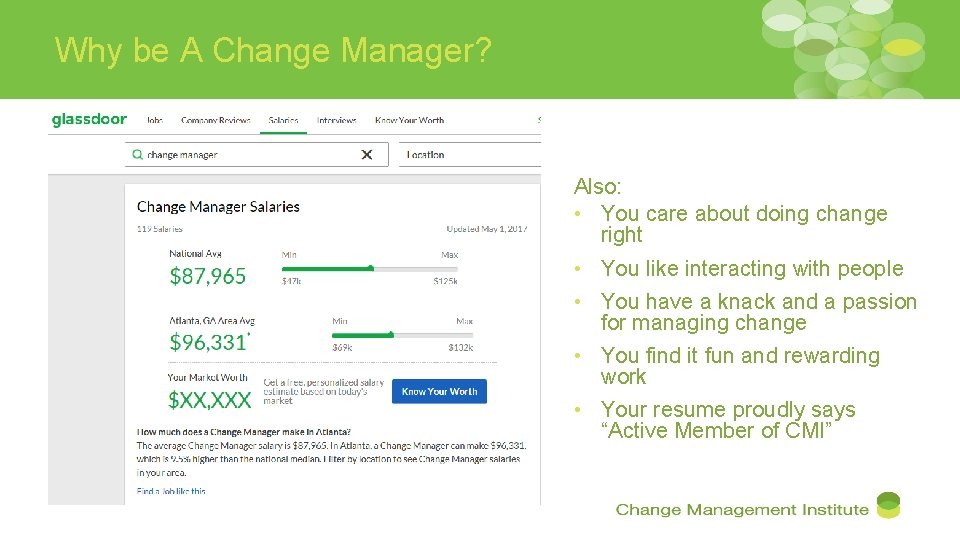
Why be A Change Manager? Also: • You care about doing change right • You like interacting with people • You have a knack and a passion for managing change • You find it fun and rewarding work • Your resume proudly says “Active Member of CMI”
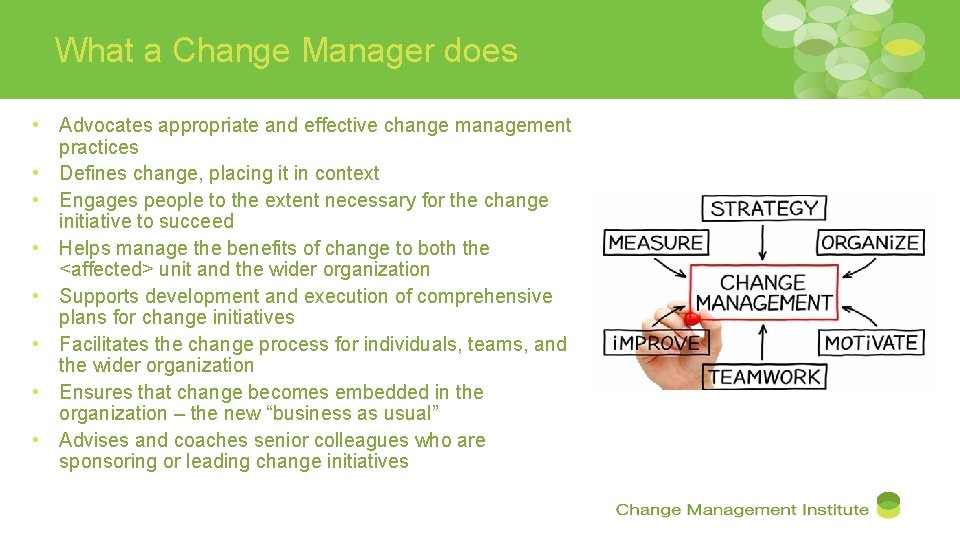
What a Change Manager does • Advocates appropriate and effective change management practices • Defines change, placing it in context • Engages people to the extent necessary for the change initiative to succeed • Helps manage the benefits of change to both the <affected> unit and the wider organization • Supports development and execution of comprehensive plans for change initiatives • Facilitates the change process for individuals, teams, and the wider organization • Ensures that change becomes embedded in the organization – the new “business as usual” • Advises and coaches senior colleagues who are sponsoring or leading change initiatives
What a Change Manager also Knows • Historically, most change initiatives fail to deliver the promised benefits • This fact highlights the importance of a relentless focus on good change management practices • Following good practices greatly increases the probability of successful change • Structuring the change initiative and working with operational managers will ensure the best possible chance of delivering the expected benefits • Not having a plan for change is a de facto plan to fail
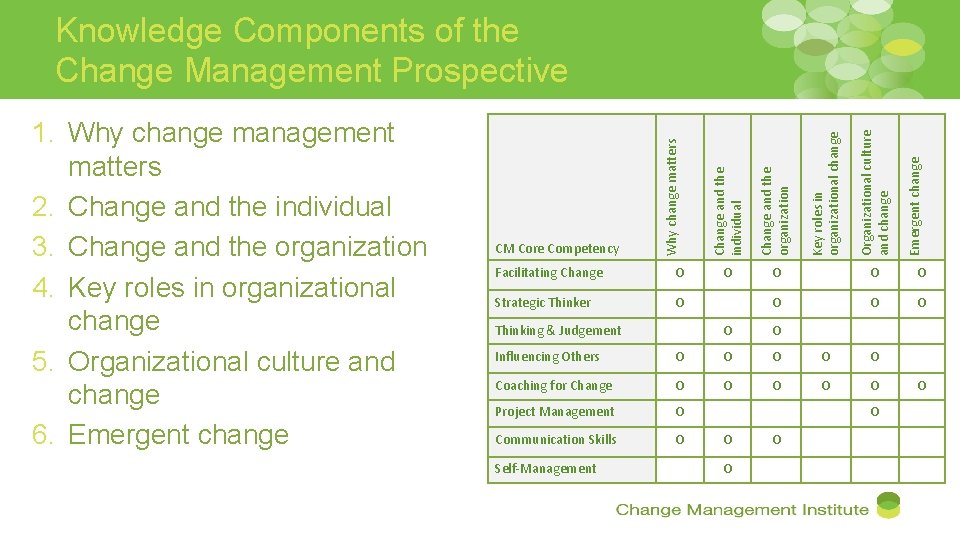
Facilitating Change O Strategic Thinker O Thinking & Judgement O O O O O Influencing Others O O O Coaching for Change O O O Project Management O Communication Skills O Self-Management Emergent change Organizational culture and change Key roles in organizational change Change and the organization CM Core Competency Change and the individual 1. Why change management matters 2. Change and the individual 3. Change and the organization 4. Key roles in organizational change 5. Organizational culture and change 6. Emergent change Why change matters Knowledge Components of the Change Management Prospective O O O
Why Change Management Matters • Effective change managers must advocate the importance of good practice. • They also need to clearly articulate the high-level factors that lead to effective change implementation. • Organization leaders are often overly optimistic about a change. They see clearly how beneficial a proposed change will be and assume that others will also. • They have confidence that existing situations will easily transfer to the changed situation • They often define too narrowly the range of people who are affected • The change manager’s ability to offer caution, based on good research, can help define the change more realistically • They must also be able to explain the best practices for change in a short “elevator speech”. It is not the strongest of the species that survives, nor the most intelligent that survives. It is the one that is most adaptable to change. - Charles Darwin
Why Change Management Matters Change Managers should know: • Current research over the past two decades shows ~30% of all changes are mostly or wholly successful (Hughes 2011). • Applying change management best practices will increase the probability of successfully implementing a change (Prosci 2012). • It is important to prepare the organization and its people for the change. • There are key considerations when designing a change process (Hailey 2008). • • • Clarity of Roles Clarity of Vision Strong Champions Sufficient Resources Engagement Communication
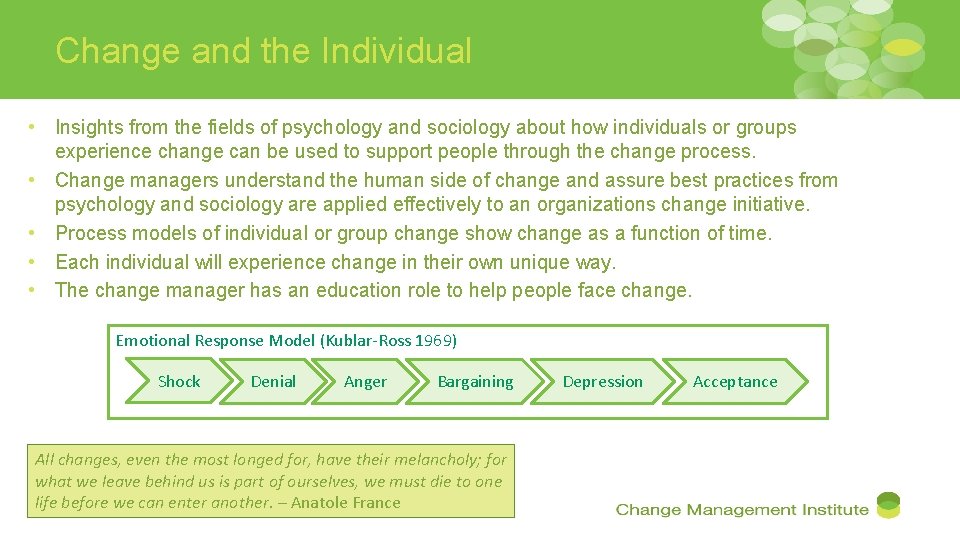
Change and the Individual • Insights from the fields of psychology and sociology about how individuals or groups experience change can be used to support people through the change process. • Change managers understand the human side of change and assure best practices from psychology and sociology are applied effectively to an organizations change initiative. • Process models of individual or group change show change as a function of time. • Each individual will experience change in their own unique way. • The change manager has an education role to help people face change. Emotional Response Model (Kublar-Ross 1969) Shock Denial Anger Bargaining All changes, even the most longed for, have their melancholy; for what we leave behind us is part of ourselves, we must die to one life before we can enter another. – Anatole France Depression Acceptance
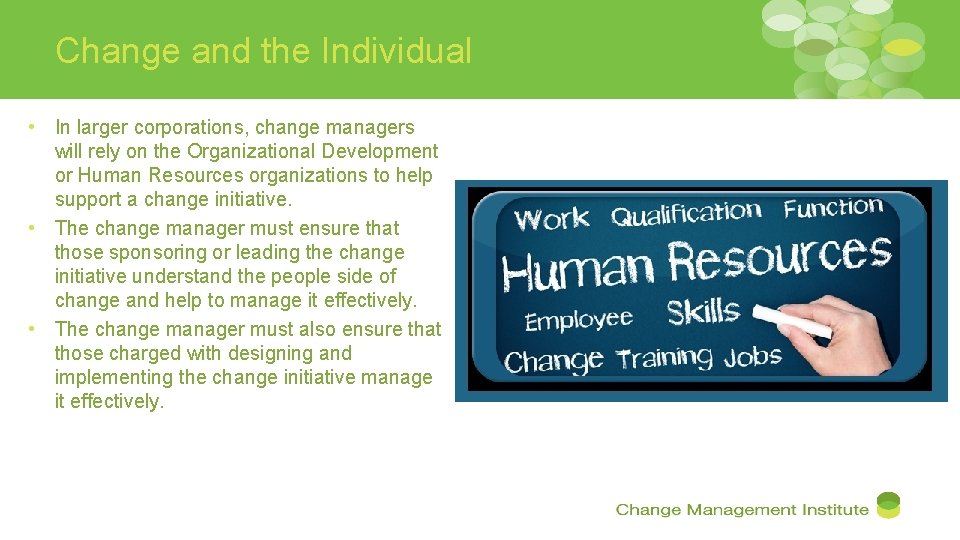
Change and the Individual • In larger corporations, change managers will rely on the Organizational Development or Human Resources organizations to help support a change initiative. • The change manager must ensure that those sponsoring or leading the change initiative understand the people side of change and help to manage it effectively. • The change manager must also ensure that those charged with designing and implementing the change initiative manage it effectively.
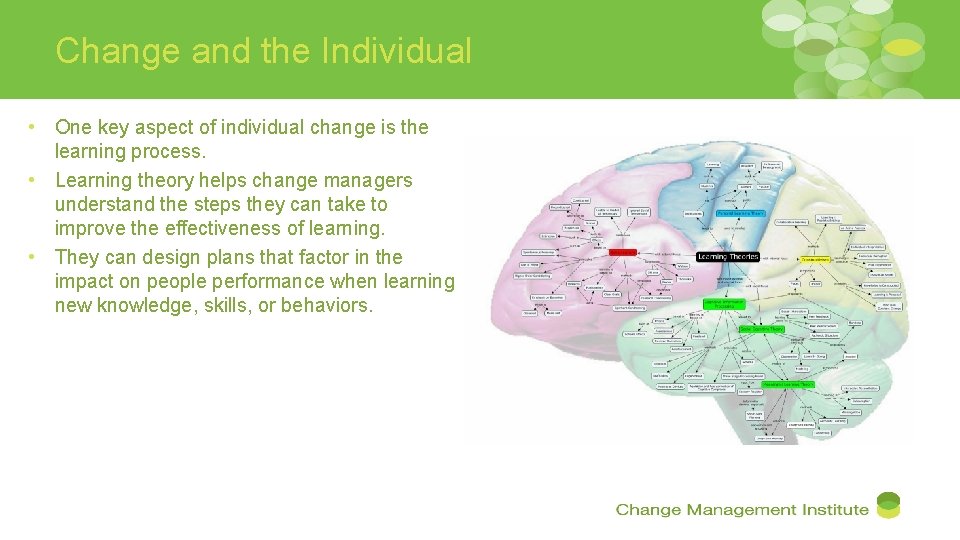
Change and the Individual • One key aspect of individual change is the learning process. • Learning theory helps change managers understand the steps they can take to improve the effectiveness of learning. • They can design plans that factor in the impact on people performance when learning new knowledge, skills, or behaviors.
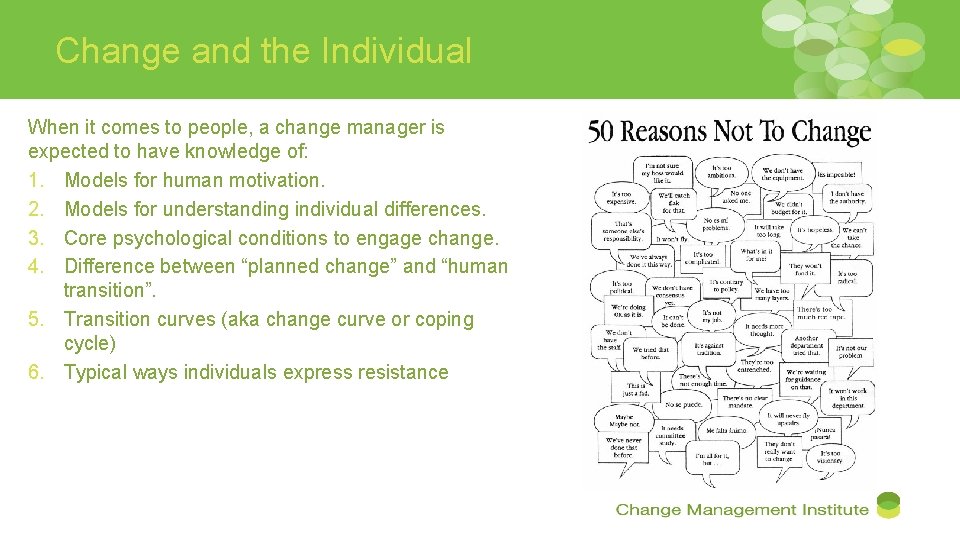
Change and the Individual When it comes to people, a change manager is expected to have knowledge of: 1. Models for human motivation. 2. Models for understanding individual differences. 3. Core psychological conditions to engage change. 4. Difference between “planned change” and “human transition”. 5. Transition curves (aka change curve or coping cycle) 6. Typical ways individuals express resistance
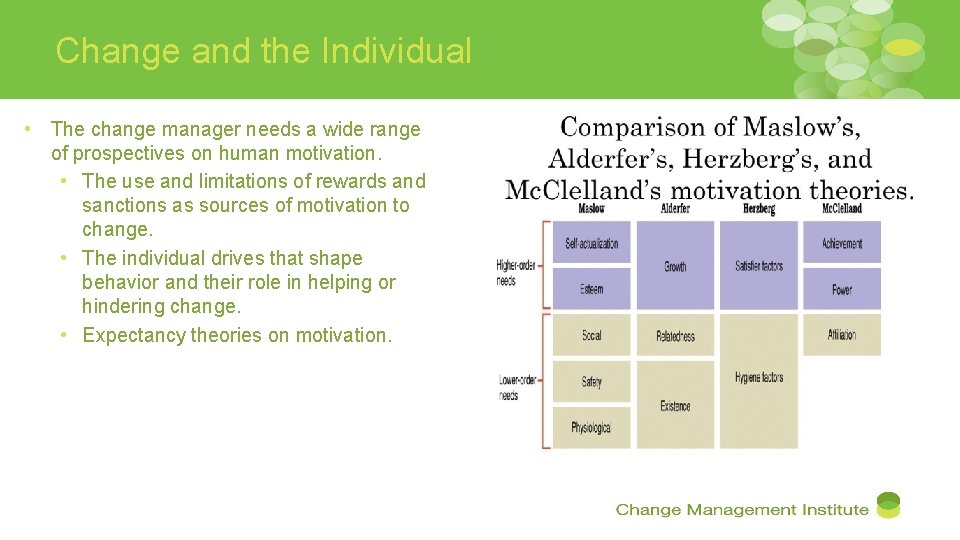
Change and the Individual • The change manager needs a wide range of prospectives on human motivation. • The use and limitations of rewards and sanctions as sources of motivation to change. • The individual drives that shape behavior and their role in helping or hindering change. • Expectancy theories on motivation.
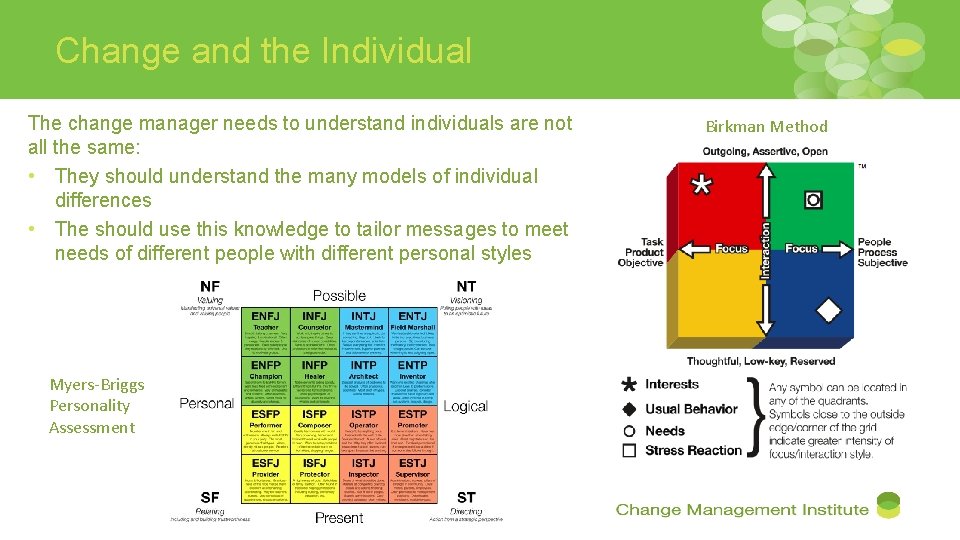
Change and the Individual The change manager needs to understand individuals are not all the same: • They should understand the many models of individual differences • The should use this knowledge to tailor messages to meet needs of different people with different personal styles Myers-Briggs Personality Assessment Birkman Method
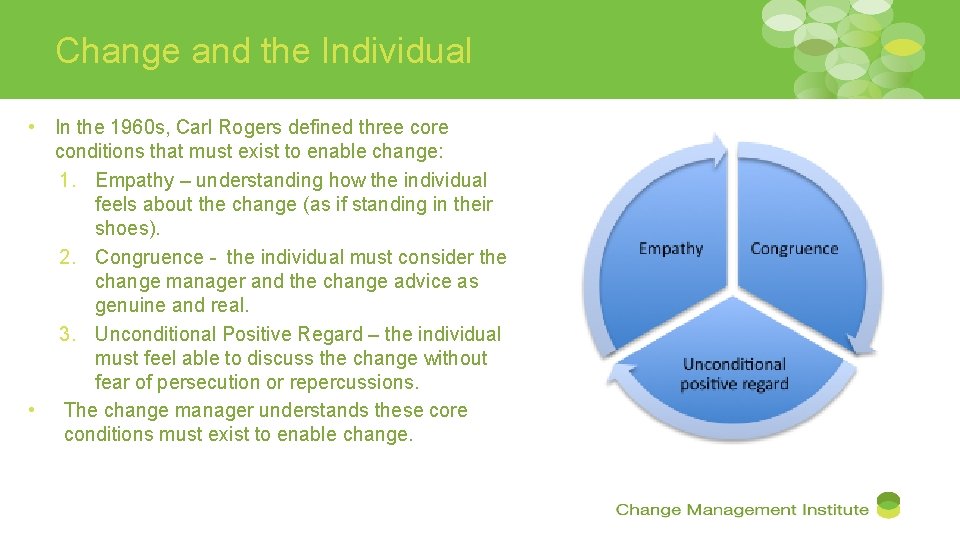
Change and the Individual • In the 1960 s, Carl Rogers defined three core conditions that must exist to enable change: 1. Empathy – understanding how the individual feels about the change (as if standing in their shoes). 2. Congruence - the individual must consider the change manager and the change advice as genuine and real. 3. Unconditional Positive Regard – the individual must feel able to discuss the change without fear of persecution or repercussions. • The change manager understands these core conditions must exist to enable change.
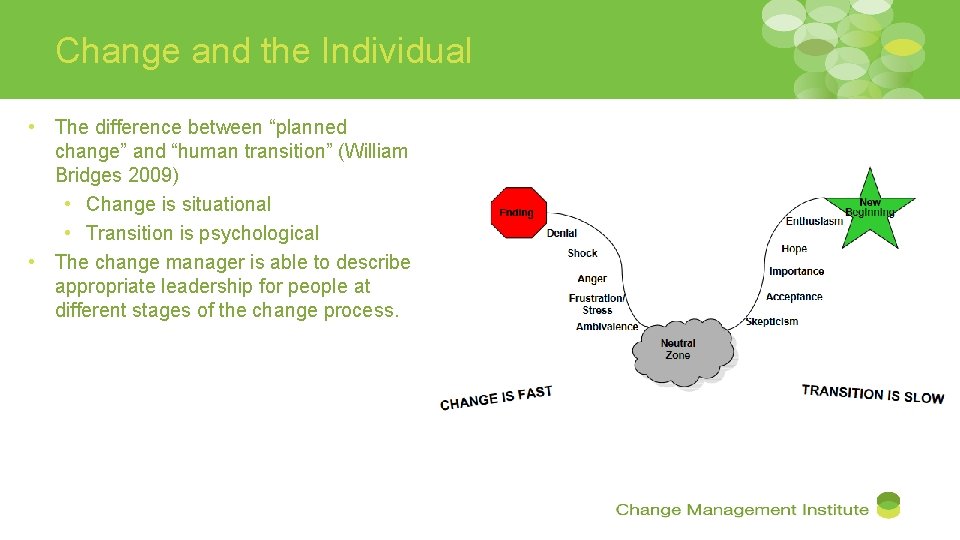
Change and the Individual • The difference between “planned change” and “human transition” (William Bridges 2009) • Change is situational • Transition is psychological • The change manager is able to describe appropriate leadership for people at different stages of the change process.
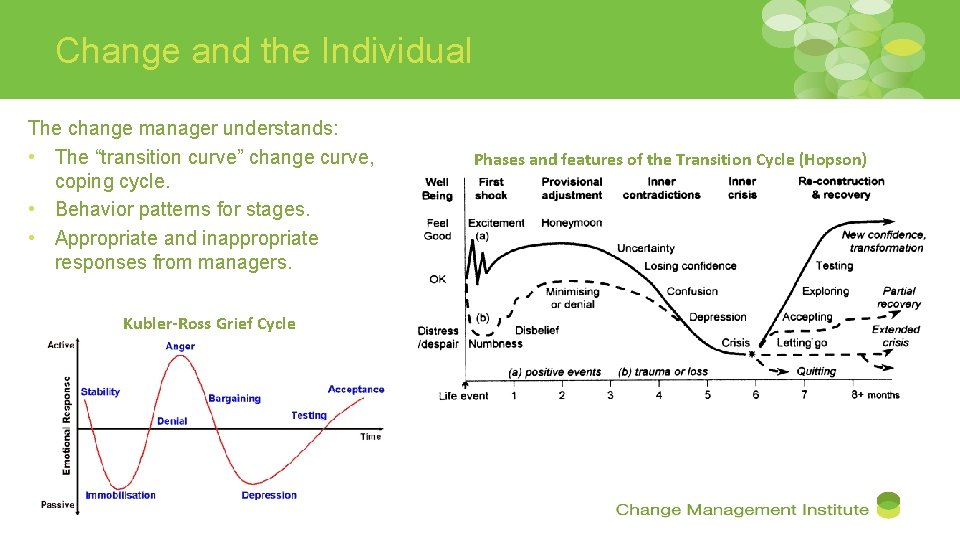
Change and the Individual The change manager understands: • The “transition curve” change curve, coping cycle. • Behavior patterns for stages. • Appropriate and inappropriate responses from managers. Kubler-Ross Grief Cycle Phases and features of the Transition Cycle (Hopson)
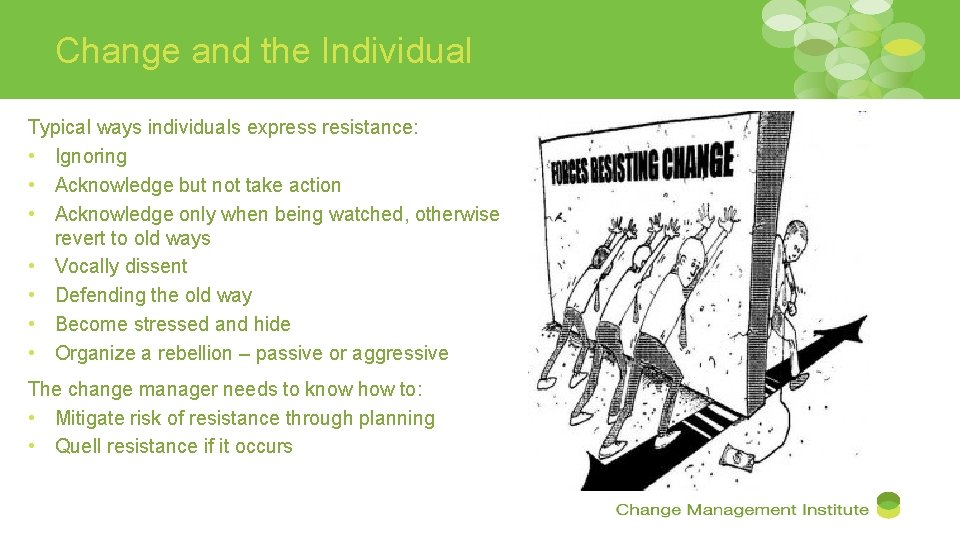
Change and the Individual Typical ways individuals express resistance: • Ignoring • Acknowledge but not take action • Acknowledge only when being watched, otherwise revert to old ways • Vocally dissent • Defending the old way • Become stressed and hide • Organize a rebellion – passive or aggressive The change manager needs to know how to: • Mitigate risk of resistance through planning • Quell resistance if it occurs
Change and the Organization • Change managers need to understand how organizational change works – and why it often does not work • Effective change manages distinguish the scope and scale of change and calibrate the change approach accordingly • The understand the many models for change to insure: • Right actions are planned • Right people are involved • They understand the corporate structure and culture, and its current adaptability to change No great improvements in the lot of mankind are possible, until a great change takes place in the fundamental constitution of their modes of thought – John Stuart Mill
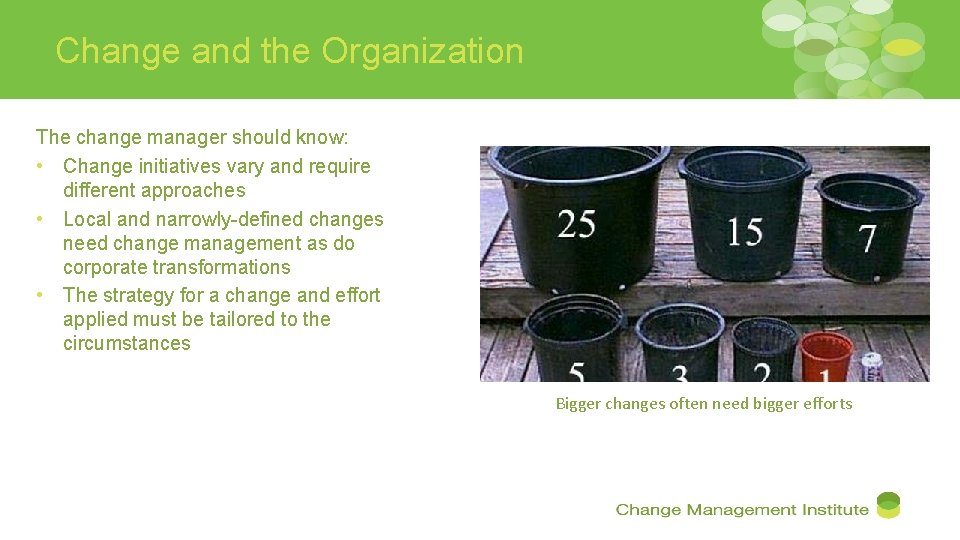
Change and the Organization The change manager should know: • Change initiatives vary and require different approaches • Local and narrowly-defined changes need change management as do corporate transformations • The strategy for a change and effort applied must be tailored to the circumstances Bigger changes often need bigger efforts
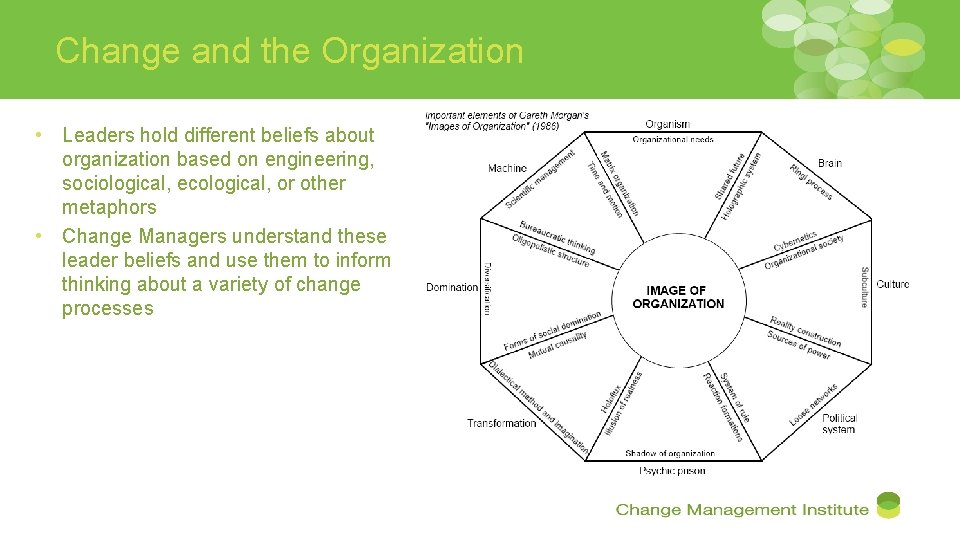
Change and the Organization • Leaders hold different beliefs about organization based on engineering, sociological, ecological, or other metaphors • Change Managers understand these leader beliefs and use them to inform thinking about a variety of change processes
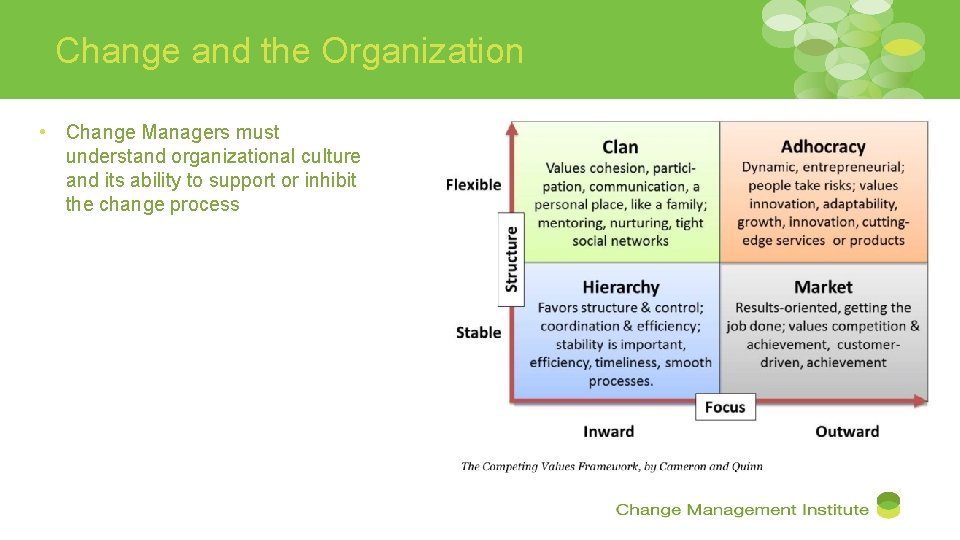
Change and the Organization • Change Managers must understand organizational culture and its ability to support or inhibit the change process
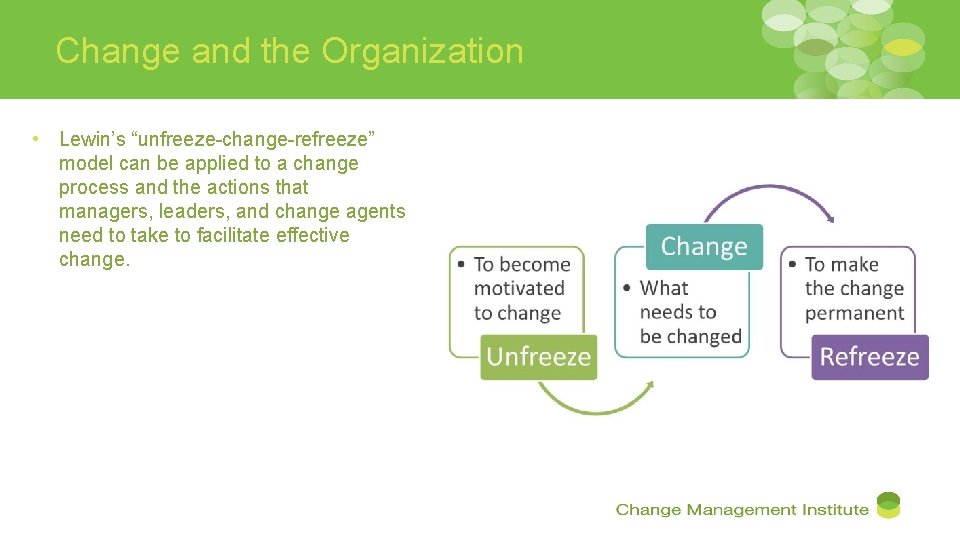
Change and the Organization • Lewin’s “unfreeze-change-refreeze” model can be applied to a change process and the actions that managers, leaders, and change agents need to take to facilitate effective change.
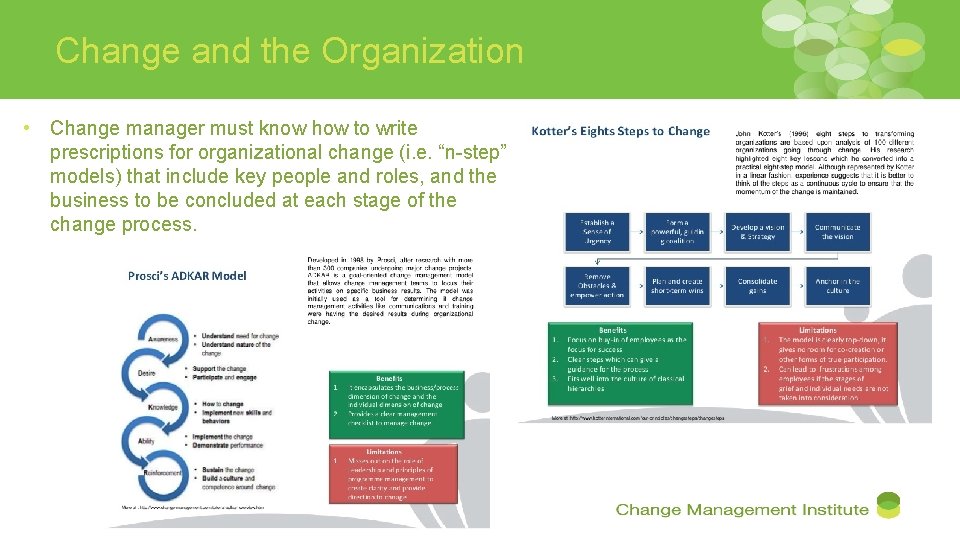
Change and the Organization • Change manager must know how to write prescriptions for organizational change (i. e. “n-step” models) that include key people and roles, and the business to be concluded at each stage of the change process.
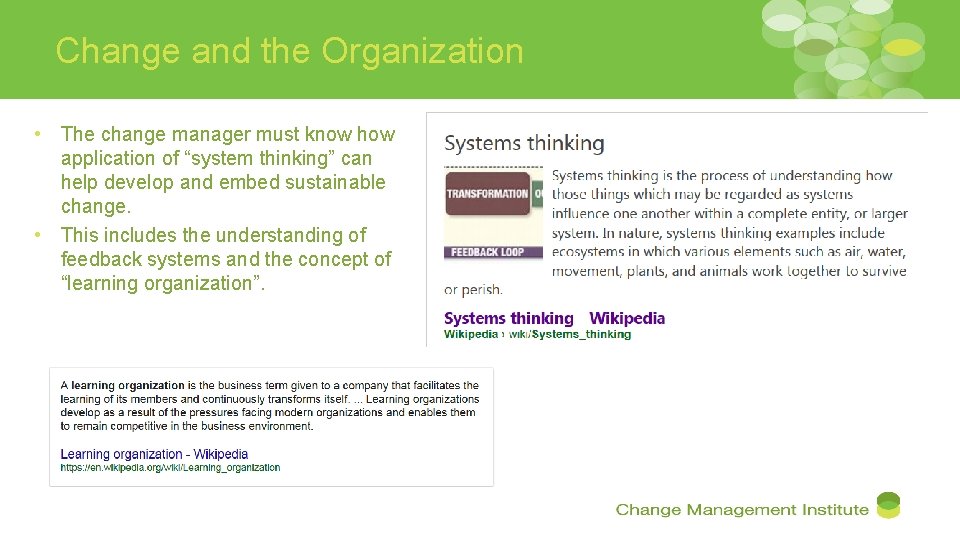
Change and the Organization • The change manager must know how application of “system thinking” can help develop and embed sustainable change. • This includes the understanding of feedback systems and the concept of “learning organization”.
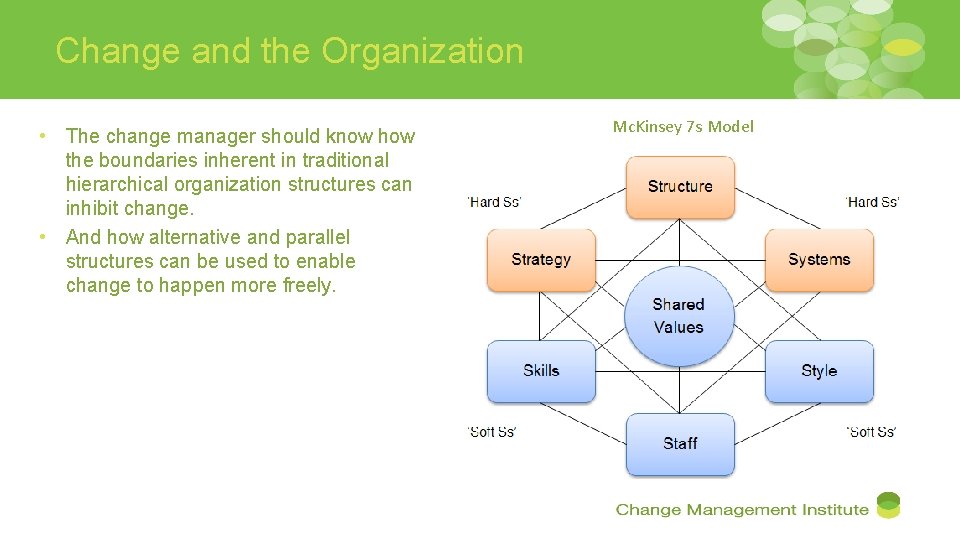
Change and the Organization • The change manager should know how the boundaries inherent in traditional hierarchical organization structures can inhibit change. • And how alternative and parallel structures can be used to enable change to happen more freely. Mc. Kinsey 7 s Model
Key Roles in Organizational Change • Roles of individuals and groups associated with a change initiative need to be defined and fulfilled to maximize the probability of the initiative’s success. • To gain traction, a change idea must picked up by someone with the authority and drive to make something happen – a sponsor • Research suggests that effective sponsorship may the single most significant determinant of success for a change initiative. • Senior, Middle, Line managers and people at all levels who are impacted by the change need to be involved appropriately for effective change to be implemented. There is nothing more difficult to take in hand, more perilous to conduct, or more uncertain in its success, than to take the lead in the introduction of a new order of things. The challenges of change are always hard. It is important that we begin to unpack those challenges that confront this nation and realize that we each have a role that requires us to change and become more responsible for shaping our own future. – Niccolo Machiavelli, The Prince (1532)
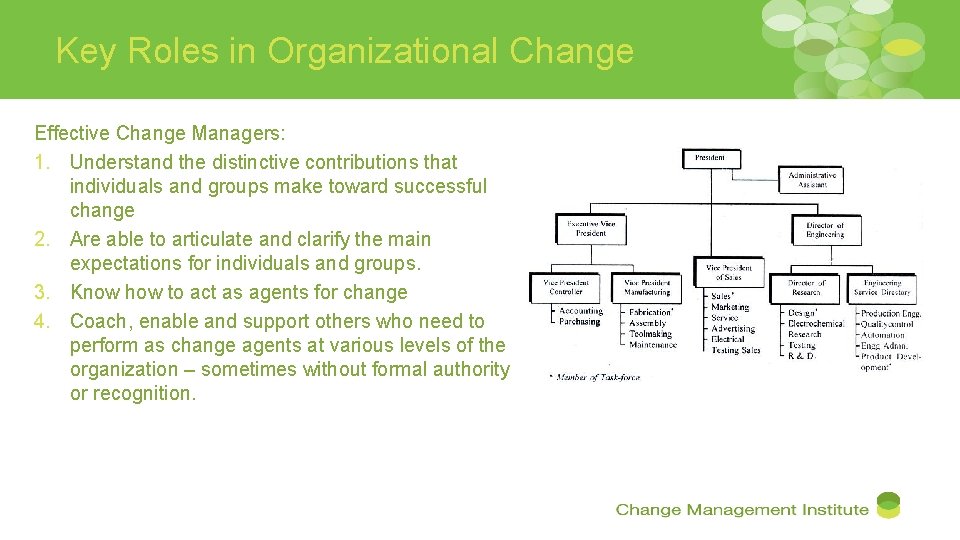
Key Roles in Organizational Change Effective Change Managers: 1. Understand the distinctive contributions that individuals and groups make toward successful change 2. Are able to articulate and clarify the main expectations for individuals and groups. 3. Know how to act as agents for change 4. Coach, enable and support others who need to perform as change agents at various levels of the organization – sometimes without formal authority or recognition.
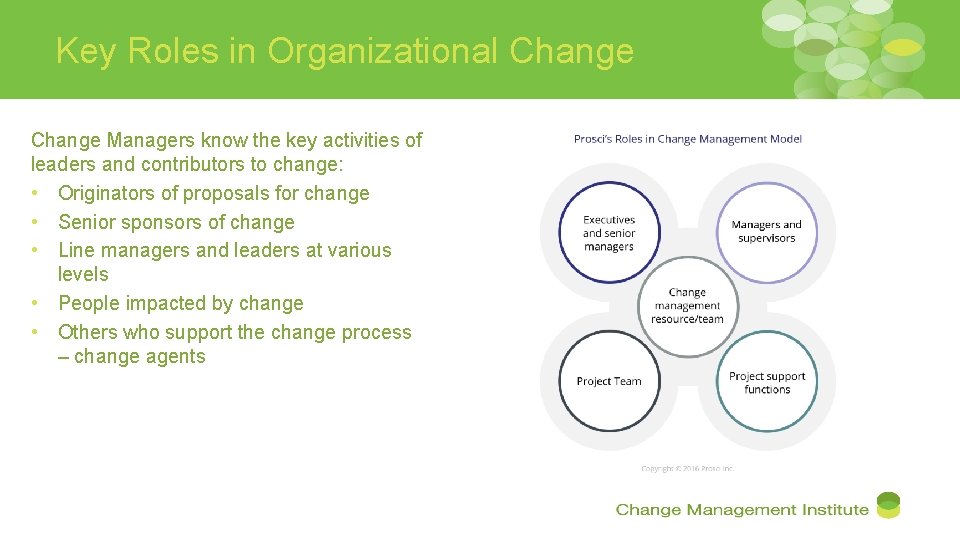
Key Roles in Organizational Change Managers know the key activities of leaders and contributors to change: • Originators of proposals for change • Senior sponsors of change • Line managers and leaders at various levels • People impacted by change • Others who support the change process – change agents
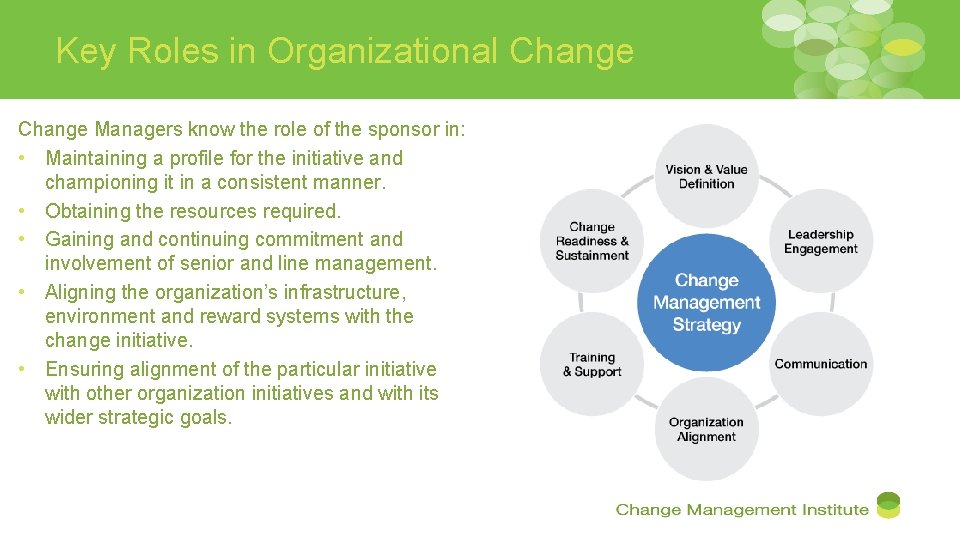
Key Roles in Organizational Change Managers know the role of the sponsor in: • Maintaining a profile for the initiative and championing it in a consistent manner. • Obtaining the resources required. • Gaining and continuing commitment and involvement of senior and line management. • Aligning the organization’s infrastructure, environment and reward systems with the change initiative. • Ensuring alignment of the particular initiative with other organization initiatives and with its wider strategic goals.
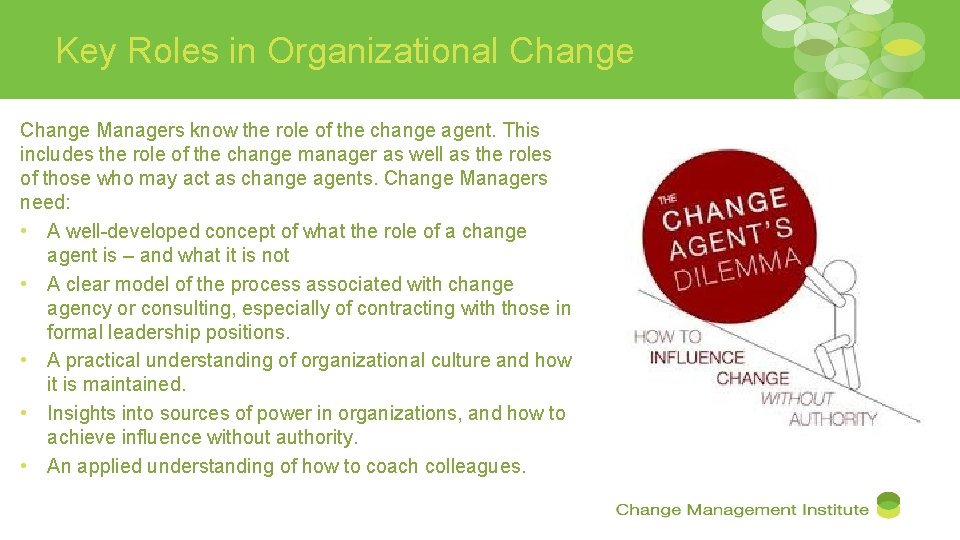
Key Roles in Organizational Change Managers know the role of the change agent. This includes the role of the change manager as well as the roles of those who may act as change agents. Change Managers need: • A well-developed concept of what the role of a change agent is – and what it is not • A clear model of the process associated with change agency or consulting, especially of contracting with those in formal leadership positions. • A practical understanding of organizational culture and how it is maintained. • Insights into sources of power in organizations, and how to achieve influence without authority. • An applied understanding of how to coach colleagues.
Key Roles in Organizational Change Managers need to know: • The ways in which middle management can be engaged and become effective advocates for change in their areas. • The ways in which middle managers can become barriers to, or distorters of, effective communication. • The ways in which a variety of team structures found in organizations can be made more effective and can be used to support change.
Organizational Culture and Change Definition: • Organizational culture is the unspoken, often unrecognized, system of beliefs and expectations that structures the way in which the people in the organization view what is appropriate, or even possible behavior. • i. e. “the way we do things around here” In today’s business environment, significant transformation cannot happen without the simultaneous transformation of a critical mass of leaders’ and employees’ mindsets and behavior. Conscious transformation means attending to the consciousness of the people in your organization, including your own. – Beyond Change Management, Dean Anderson and Linda Ackerman-Anderson
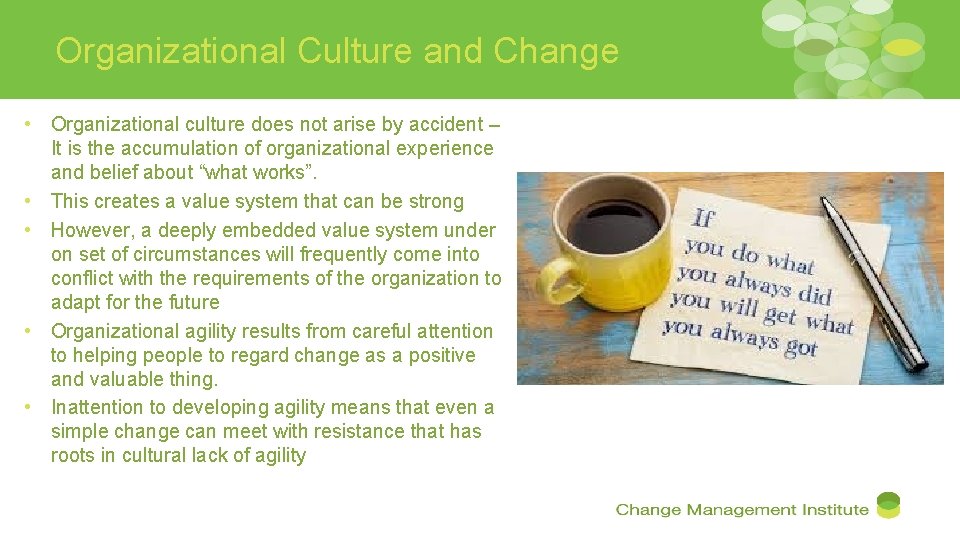
Organizational Culture and Change • Organizational culture does not arise by accident – It is the accumulation of organizational experience and belief about “what works”. • This creates a value system that can be strong • However, a deeply embedded value system under on set of circumstances will frequently come into conflict with the requirements of the organization to adapt for the future • Organizational agility results from careful attention to helping people to regard change as a positive and valuable thing. • Inattention to developing agility means that even a simple change can meet with resistance that has roots in cultural lack of agility
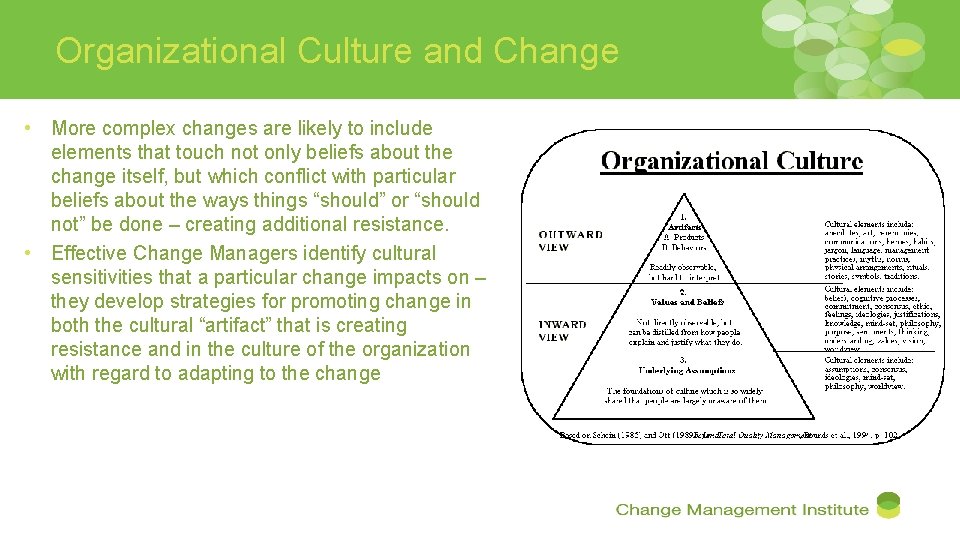
Organizational Culture and Change • More complex changes are likely to include elements that touch not only beliefs about the change itself, but which conflict with particular beliefs about the ways things “should” or “should not” be done – creating additional resistance. • Effective Change Managers identify cultural sensitivities that a particular change impacts on – they develop strategies for promoting change in both the cultural “artifact” that is creating resistance and in the culture of the organization with regard to adapting to the change
Organizational Culture and Change The change mangers personal tool kit contains: • An awareness of culture • The insight to recognize cultures contribution to change • The understanding of strategies leaders can use to shape culture
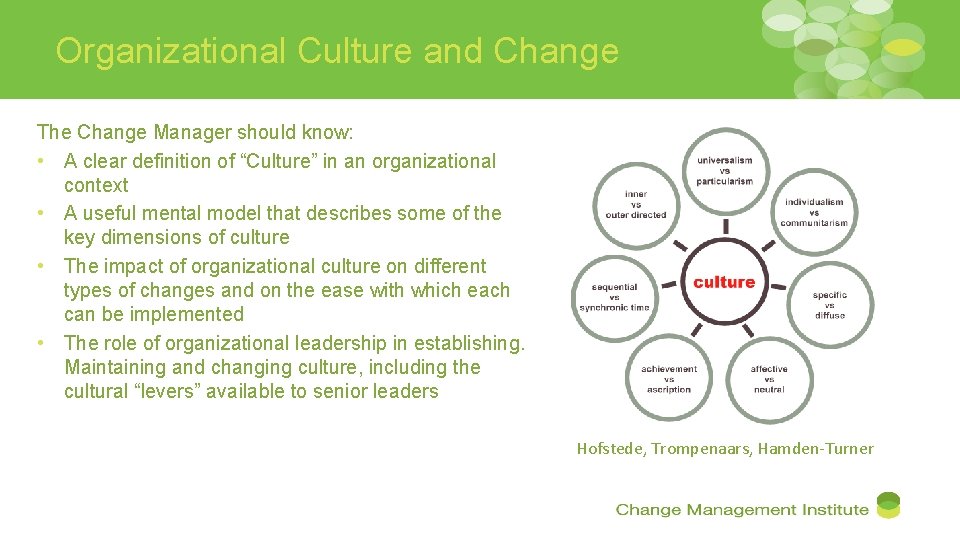
Organizational Culture and Change The Change Manager should know: • A clear definition of “Culture” in an organizational context • A useful mental model that describes some of the key dimensions of culture • The impact of organizational culture on different types of changes and on the ease with which each can be implemented • The role of organizational leadership in establishing. Maintaining and changing culture, including the cultural “levers” available to senior leaders Hofstede, Trompenaars, Hamden-Turner
Emergent Change Emergent change occurs when: • A need for changed patterns of values and behavior in the organization is identified. • The direction of such change is specified. • Organizational leaders take coordinated action to stimulate, encourage and reinforce these new patterns. One way to find food for thought is to use the fork in the road, the bifurcation that marks the place of emergence in which a new line of development begins to branch off – William Irwin Thompson, Philosopher
Emergent Change Emergent change is different • When the core of the change is to systems, structures, processes and practices, then planning and scheduling is possible • When the core of the change is in the discretionary decisions people make about their patterns of values and behaviors, no dates can be fixed in advance. • People will engage with new patterns of behavior individually and in their own time. • Change Managers must give careful thought to the direction of change that is required and to the indicators which will show progress being made.
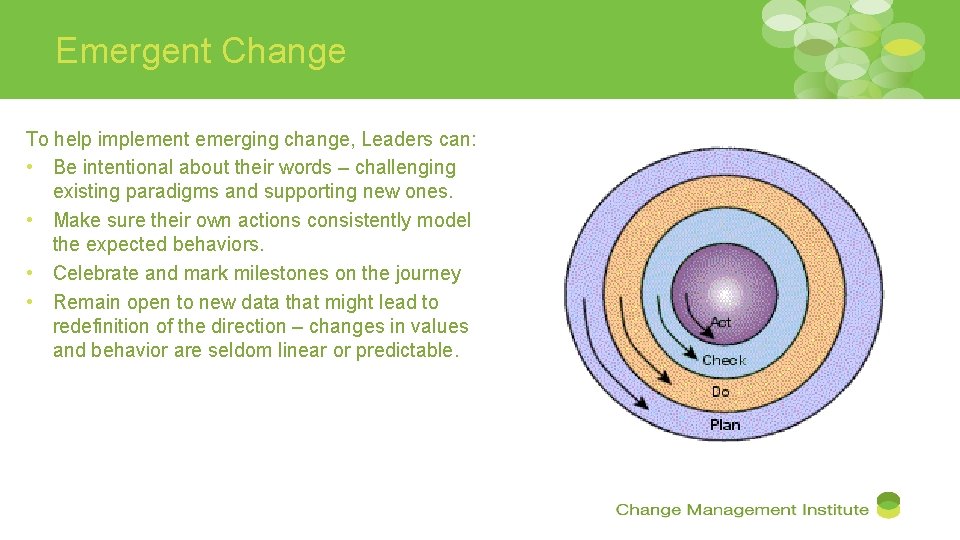
Emergent Change To help implement emerging change, Leaders can: • Be intentional about their words – challenging existing paradigms and supporting new ones. • Make sure their own actions consistently model the expected behaviors. • Celebrate and mark milestones on the journey • Remain open to new data that might lead to redefinition of the direction – changes in values and behavior are seldom linear or predictable.
Emergent Change Effective Change Managers help their senior colleagues and organizational leaders to: • Set appropriate direction. • Find relevant behavioral indicators. • Identify tipping points. • Create an environment supportive of the new values and behaviors.
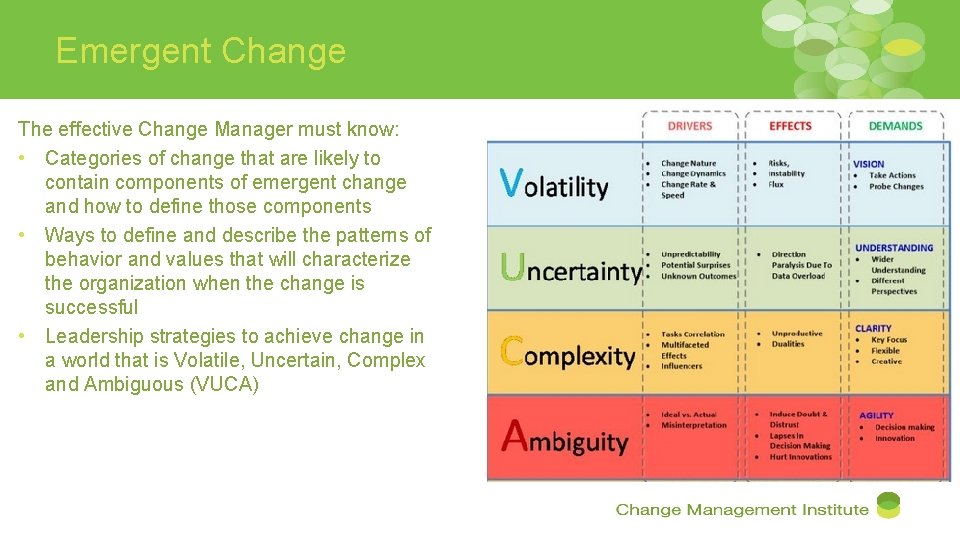
Emergent Change The effective Change Manager must know: • Categories of change that are likely to contain components of emergent change and how to define those components • Ways to define and describe the patterns of behavior and values that will characterize the organization when the change is successful • Leadership strategies to achieve change in a world that is Volatile, Uncertain, Complex and Ambiguous (VUCA)
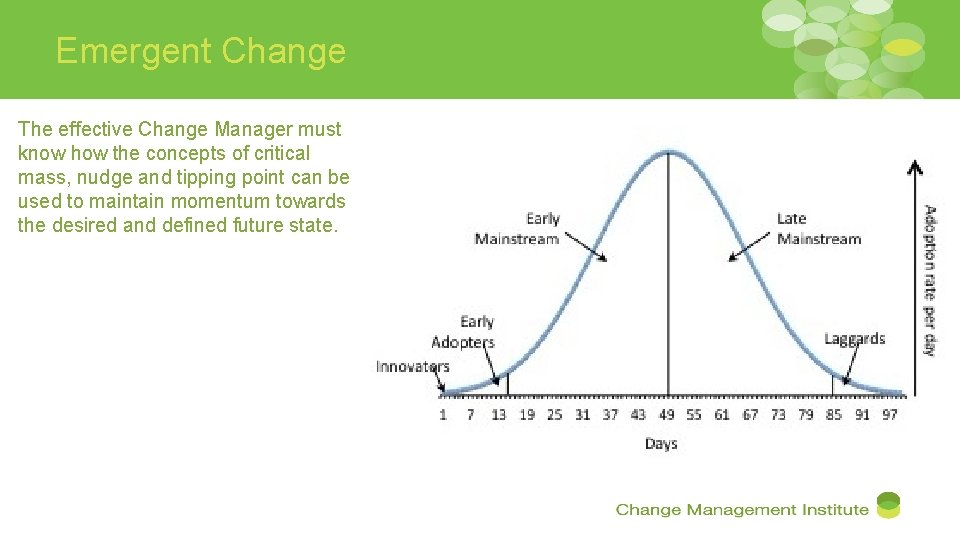
Emergent Change The effective Change Manager must know how the concepts of critical mass, nudge and tipping point can be used to maintain momentum towards the desired and defined future state.

Questions? Note: Images used in the presentation are for education purpose only
- Slides: 45