
Change Leadership What is change Success Factors An
- Slides: 12
Change Leadership What is change? Success Factors An Approach to Change Leadership The Quest – Performance improvement and public value www. opm. co. uk/futureleadership/
The Quest Improving Performance The manager, in today’s world, doesn’t get paid to be a steward of resources, a favoured term not so many years ago. He or she gets paid for one and only one thing – to make things better (incrementally and dramatically), to change things, to act – today’ Tom Peters co-author of ‘In Search of Excellence’ The overall aim of managerial work is to create public value… Mark Moore, author of Creating Public Value
The challenge to achieve public value It is tough for public services – Multiple and powerful stakeholders – Intangible results Delivering value to the public is all you are in business to do How many of the following are you grappling with at the moment? – Results Based Accountability/Turning the Curve – Individual budgets, In Control and/or individual commissioning – Place making – Strategic joint commissioning Your strategy to achieve public value is something to be done not just written about – creativity + commitment + complexity
It’s been difficult for 500 years! ‘It should be borne in mind that there is nothing more difficult to handle, more doubtful of success, and more dangerous to carry through than initiating changes in a state’s constitution. The innovator makes enemies of all those who prospered under the old order, and only lukewarm support is forthcoming from those who would prosper under the new. Their support is lukewarm partly from fear of their adversaries, who have the existing laws on their side, and partly because men are generally incredulous, never really trusting new things unless they have tested them by experience. ’ Niccolo Machiavelli 1513 – The Prince (Translation: George Bull, Penguin, 1961)
Change Exercise • In groups discuss your examples of a change process that worked well. Make notes about why it worked well on flip chart. • Now repeat the exercise for a change process that did not work well. Make notes on flip chart. • Feedback key elements that could be beneficial for Future Change Leadership
The context for leadership of local services • Genuine local accountability, with locally determined priorities and plans, is very close at hand • Leaders in public service will no longer be rewarded for managing the perfect service but for identifying and delivering the outcomes people want and need • Integrated solutions must make sense to customers, users, citizens
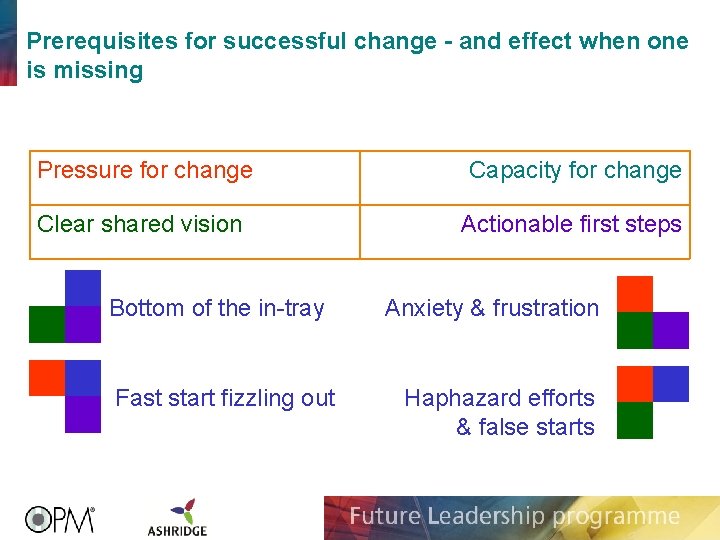
Prerequisites for successful change - and effect when one is missing Pressure for change Capacity for change Clear shared vision Actionable first steps Bottom of the in-tray Fast start fizzling out Anxiety & frustration Haphazard efforts & false starts
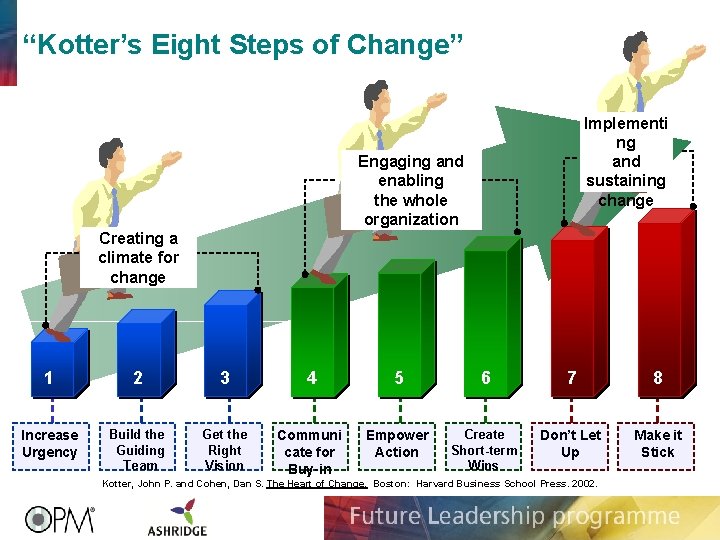
“Kotter’s Eight Steps of Change” Implementi ng and sustaining change Engaging and enabling the whole organization Creating a climate for change 1 2 3 4 5 6 7 8 Increase Urgency Build the Guiding Team Get the Right Vision Communi cate for Buy-in Empower Action Create Short-term Wins Don’t Let Up Make it Stick Kotter, John P. and Cohen, Dan S. The Heart of Change. Boston: Harvard Business School Press. 2002.
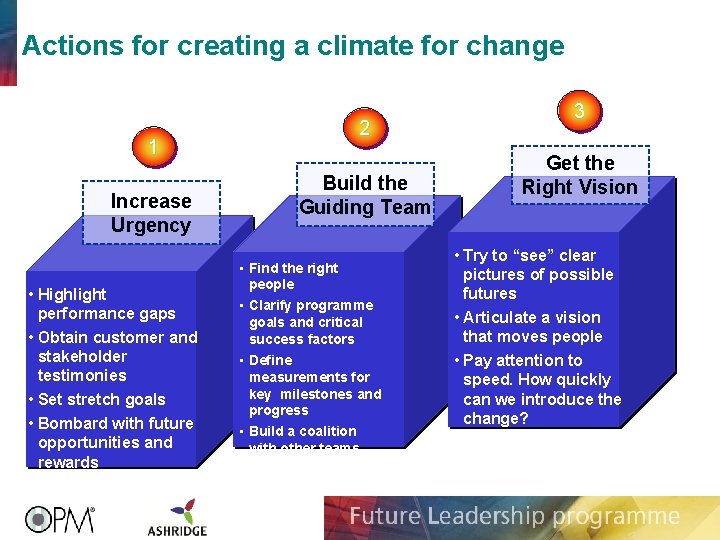
Actions for creating a climate for change 1 Increase Urgency • Highlight performance gaps • Obtain customer and stakeholder testimonies • Set stretch goals • Bombard with future opportunities and rewards 2 Build the Guiding Team • Find the right people • Clarify programme goals and critical success factors • Define measurements for key milestones and progress • Build a coalition with other teams and initiatives 3 Get the Right Vision • Try to “see” clear pictures of possible futures • Articulate a vision that moves people • Pay attention to speed. How quickly can we introduce the change?
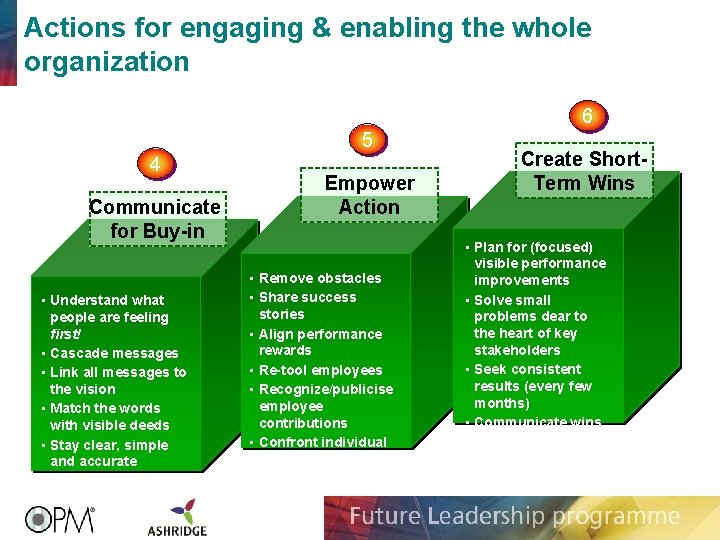
Actions for engaging & enabling the whole organization 6 5 4 Communicate for Buy-in • Understand what people are feeling first! • Cascade messages • Link all messages to the vision • Match the words with visible deeds • Stay clear, simple and accurate Empower Action • Remove obstacles • Share success stories • Align performance rewards • Re-tool employees • Recognize/publicise employee contributions • Confront individual resistance Create Short. Term Wins • Plan for (focused) visible performance improvements • Solve small problems dear to the heart of key stakeholders • Seek consistent results (every few months) • Communicate wins visibly
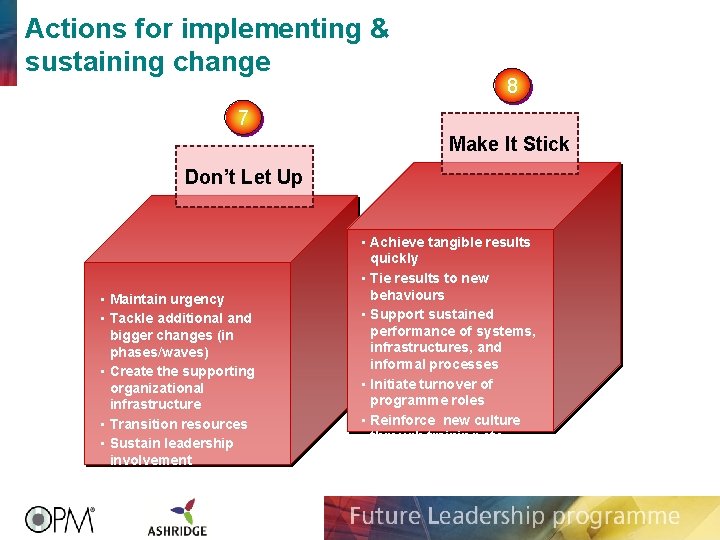
Actions for implementing & sustaining change 8 7 Make It Stick Don’t Let Up • Maintain urgency • Tackle additional and bigger changes (in phases/waves) • Create the supporting organizational infrastructure • Transition resources • Sustain leadership involvement • Achieve tangible results quickly • Tie results to new behaviours • Support sustained performance of systems, infrastructures, and informal processes • Initiate turnover of programme roles • Reinforce new culture through training etc
Change Exercise • In pairs each identify a change that you have recently experienced and consider this in the light of a recognised approach to change management • To what extent does the recognised approach and practice match? • How might future practice be enhanced in the knowledge of theory? • How might theory be modified in the light of your experience?