
Change A Universal Human Experience Managing the Impact

- Slides: 26
Change – A Universal Human Experience Managing the Impact of Loss and Grief and Trauma Holy Trinity Anglican Church Wentworth Falls 14 th May 2016 Dr Geoffrey Glassock AM, FAPS 1
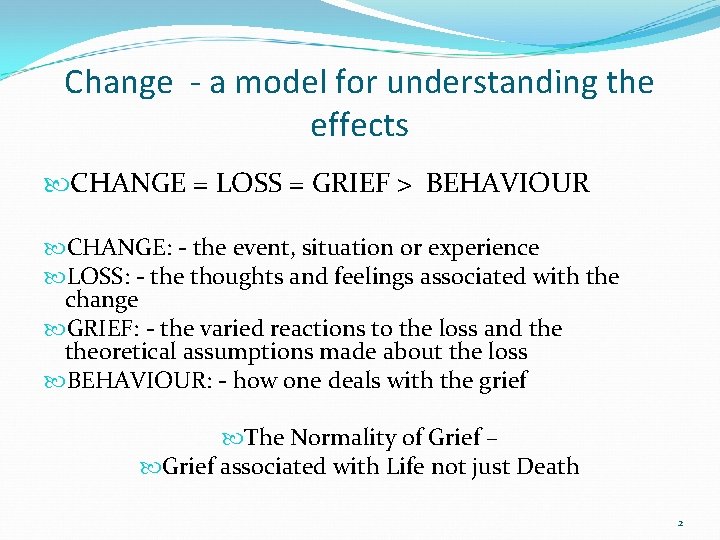
Change - a model for understanding the effects CHANGE = LOSS = GRIEF > BEHAVIOUR CHANGE: - the event, situation or experience LOSS: - the thoughts and feelings associated with the change GRIEF: - the varied reactions to the loss and theoretical assumptions made about the loss BEHAVIOUR: - how one deals with the grief The Normality of Grief – Grief associated with Life not just Death 2
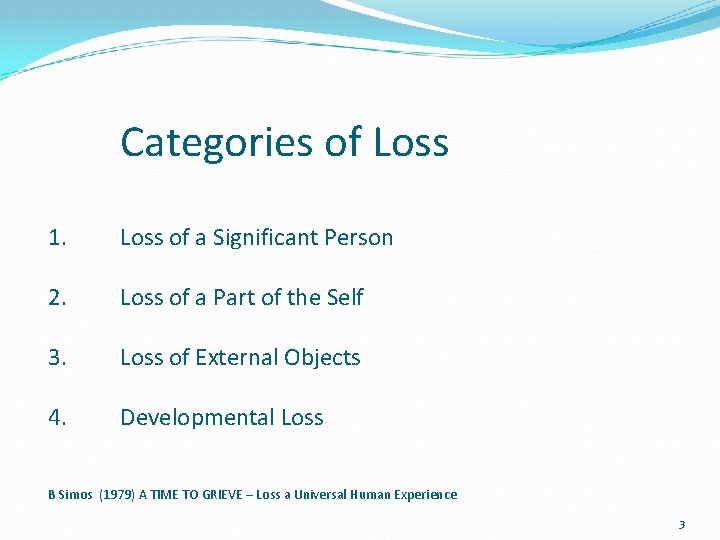
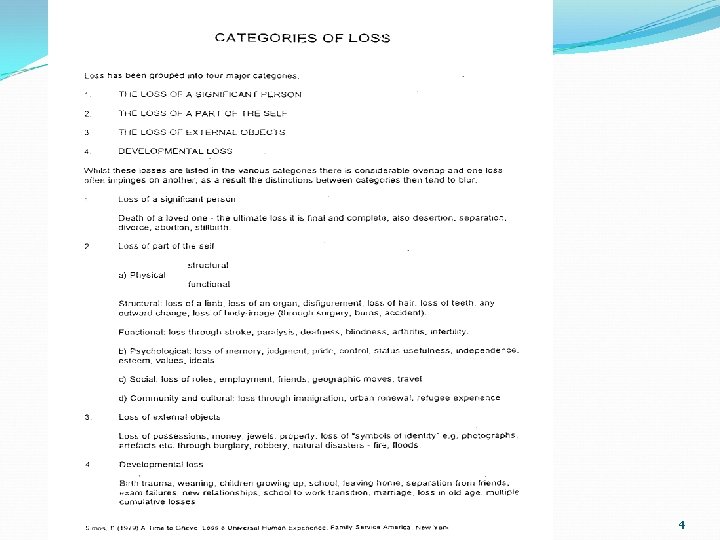
Categories of Loss 1. Loss of a Significant Person 2. Loss of a Part of the Self 3. Loss of External Objects 4. Developmental Loss B Simos (1979) A TIME TO GRIEVE – Loss a Universal Human Experience 3
4
Modes of Death Each Mode of death will bring differing grief reactions Natural Accidental Suicidal Homicidal Harvard Bereavement Study Parkes & Weiss (1983) 5
Changes in Grief thinking Recognition of John Bowlby’s Attachment theory particularly in relation to trauma Stage & Phase models or Tasks to be performed seen to have problems for people Acceptance, closure, ‘breaking the tie that binds’ etc Emphasis on Continuing Bonds – a relationship after death ‘Communion of Saints’ Meaning making 6
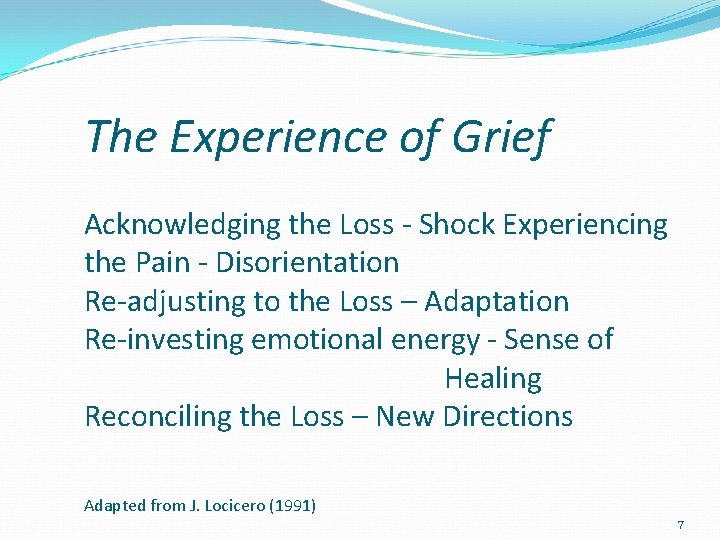
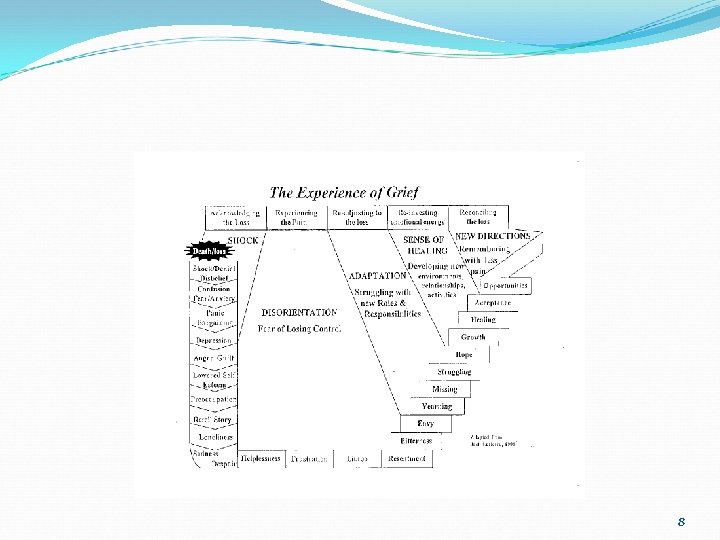
The Experience of Grief Acknowledging the Loss - Shock Experiencing the Pain - Disorientation Re-adjusting to the Loss – Adaptation Re-investing emotional energy - Sense of Healing Reconciling the Loss – New Directions Adapted from J. Locicero (1991) 7
8
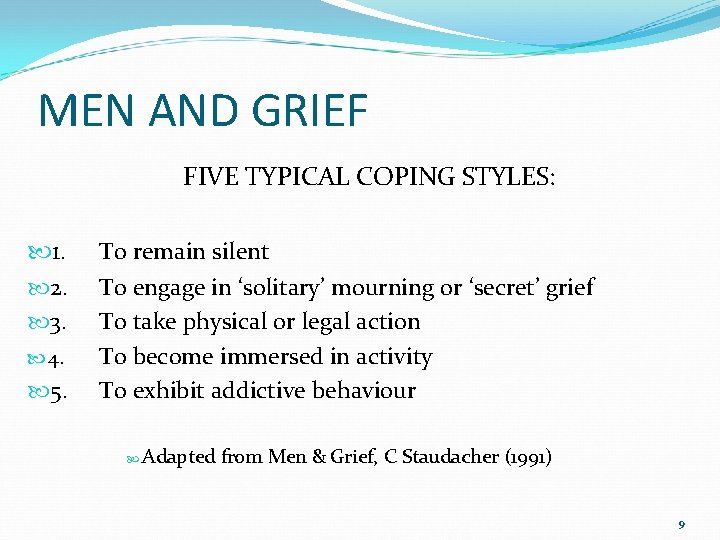
MEN AND GRIEF FIVE TYPICAL COPING STYLES: 1. 2. 3. 4. 5. To remain silent To engage in ‘solitary’ mourning or ‘secret’ grief To take physical or legal action To become immersed in activity To exhibit addictive behaviour Adapted from Men & Grief, C Staudacher (1991) 9
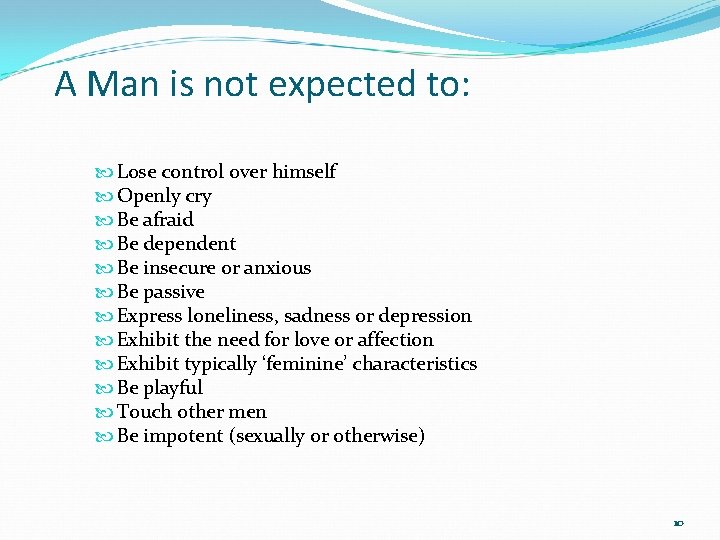
A Man is not expected to: Lose control over himself Openly cry Be afraid Be dependent Be insecure or anxious Be passive Express loneliness, sadness or depression Exhibit the need for love or affection Exhibit typically ‘feminine’ characteristics Be playful Touch other men Be impotent (sexually or otherwise) 10
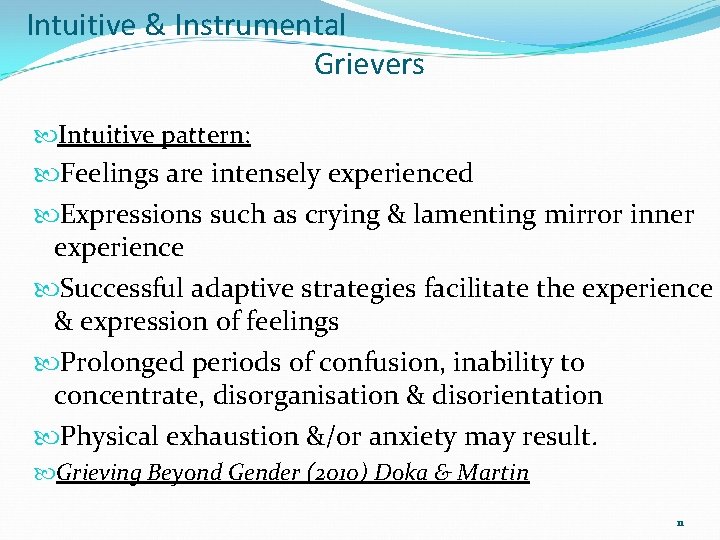
Intuitive & Instrumental Grievers Intuitive pattern: Feelings are intensely experienced Expressions such as crying & lamenting mirror inner experience Successful adaptive strategies facilitate the experience & expression of feelings Prolonged periods of confusion, inability to concentrate, disorganisation & disorientation Physical exhaustion &/or anxiety may result. Grieving Beyond Gender (2010) Doka & Martin 11
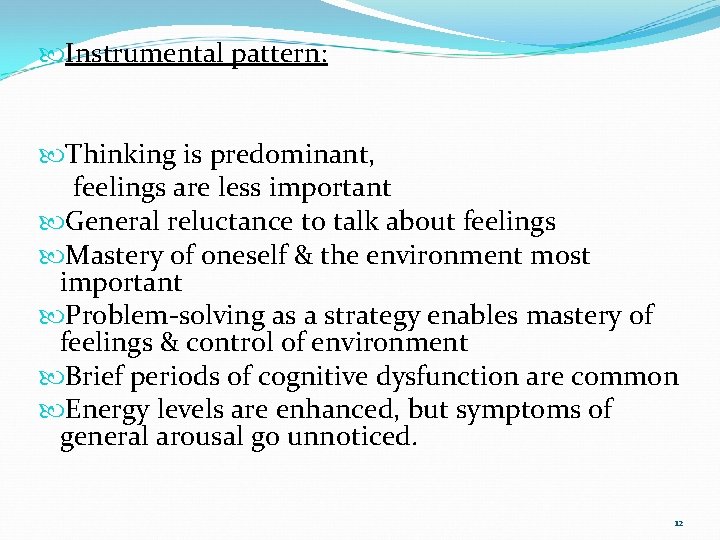
Instrumental pattern: Thinking is predominant, feelings are less important General reluctance to talk about feelings Mastery of oneself & the environment most important Problem-solving as a strategy enables mastery of feelings & control of environment Brief periods of cognitive dysfunction are common Energy levels are enhanced, but symptoms of general arousal go unnoticed. 12
Raphael & Martinek (1997: 374) The picture of grief or bereavement reactions & trauma was inevitably complicated by Lindemann’s (1944) classic clinical description of the symptomatology & management of acute grief. This was derived from his work with the survivors of the Cocoanut Grove nightclub fire in Boston, and many of those people had themselves not only been bereaved, but also severely traumatised. Lindemann made no effort to dissect out these separate phenomena. 13
Traumatic Grief The grief experienced by families of homicide victims is at once the same & different from that experienced by most bereaved individuals. The same – grief must be fully experienced if the family is to come to terms with the loss (Worden) Different – manner of death forces conditions on family survivors as overwhelming. 14
Worden (1991, 2009 4 th Ed’n) Grief therapy for people with ‘acute or complicated grief’ Grief counselling for ‘normal grieving’ Revised thinking on Task 4 ‘enduring connection’ Rando (1993) Theories of Complicated Mourning Terms used: normal, abnormal, delayed, distorted, acute, chronic, absent, inhibited, traumatic etc. 15
Many of the people in Lindemann’s study were severely traumatised by their experiences. The difference between ‘normal and ‘traumatic’ bereavement can be understood in terms of Intrusion and avoidance. Reexperiencing (intrusion) is present in both T & N bereavement. The difference is the degree of avoidance. People with normal bereavement do not avoid intrusive thoughts – they may be welcomed. People who have experienced traumatic bereavement will have intrusive images & avoidant behaviour with the fear of threat/danger in their experiences 16
Selby Jacobs in Traumatic Grief elaborates on this: “The bereaved person with separation distress is preoccupied with the deceased person, seeks for reminders of the dead person, and is aroused and focused on the lost person. In contrast, the traumatised person is preoccupied with the scene of the trauma & the violent encounter with death, and wishes to avoid reminders of the event, & is hypervigilantly aroused & oriented to threat, danger or the return of a similar threat”. 17
Traumatic Grief (TG) is associated with present distress and disability. Prigerson & colleagues “demonstrated that TG as assessed by the Inventory of Complicated Grief (ICG) 6 months after a loss is positively associated with: impaired role performance, functional impairment, subjective sleep disturbance, low self esteem, depression & anxiety. 18
Traumatic grief They also found that TG was associated with a high risk of cancer, cardiac disorders, alcohol & substance abuse, suicidal ideation among older widows and widowers. Young adults with high levels of TG symptoms increased risk of suicide ideation”. 19
MY ASSUMPTIVE WORLD My family My self My friends My job My health My hobbies My faith My overseas holiday My retirement etc. 20
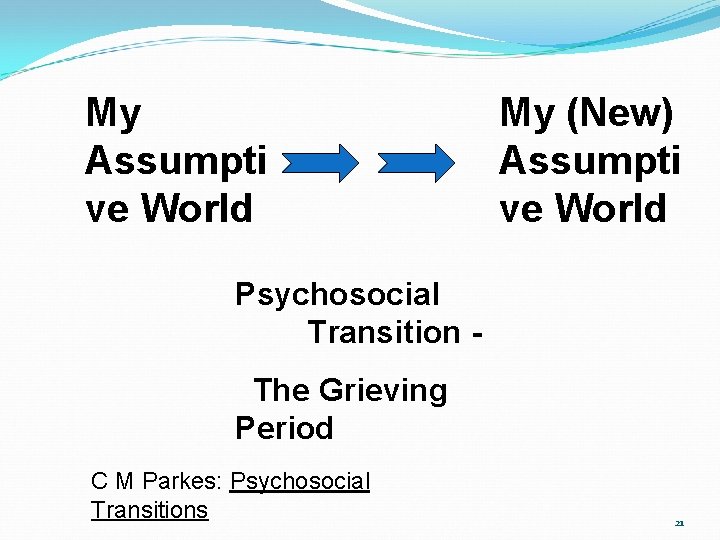
My Assumpti ve World My (New) Assumpti ve World Psychosocial Transition The Grieving Period C M Parkes: Psychosocial Transitions 21
Assumptive Worlds & Psychosocial Transitions (C M Parkes) MY ASSUMPTIVE WORLD What was predictable is no longer predictable The nature of the loss will determine the intensity of the grief reaction PSYCHOSOCIAL TRANSITION equates to THE GRIEVING PROCESS NEED – TO MOVE TO A NEW ASSUMPTIVE WORLD. 22
How to help? Relationship that is: Warm Empathic Respectful Non- judgemental Honest Transparent 23
“When we honestly ask ourselves which person in our lives mean the most to us, we often find that it is those who instead of giving much advice, solutions or cures, have chosen rather to share our pain and touch our wounds with a gentle and tender hand. The friend who can be silent in a moment of despair or confusion who can stay with us in an hour of grief and bereavement, who can tolerate not knowing, not curing, not healing, and face with us our powerlessness, that is the friend who cares. ” Henri Nouwen ‘Out of the Solitude’ 24
Prayer of St Francis Lord make me an instrument of your peace, Where there is hatred let me sow love. Where there is injury, pardon. Where there is doubt, faith. Where there is despair, hope. Where there is darkness, light. And where there is sadness, joy. O divine master grant that I may not so much seek to be consoled as to console; to be understood as to understand; To be loved as to love For it is in giving that we receiveit is in pardoning that we are pardoned. And it's in dying that we are born to eternal life. Amen 25
Thank you glassock@bigpond. net. au 26