
Chandra Science Highlight NGC 4649 A New Way
- Slides: 1
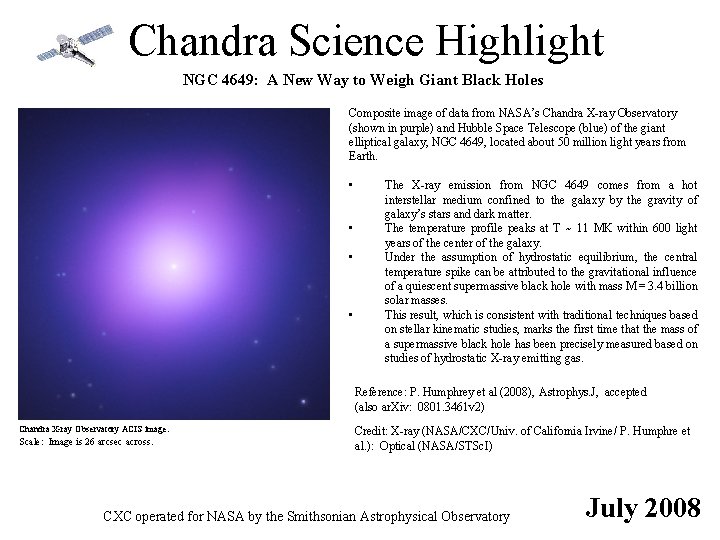
Chandra Science Highlight NGC 4649: A New Way to Weigh Giant Black Holes Composite image of data from NASA’s Chandra X-ray Observatory (shown in purple) and Hubble Space Telescope (blue) of the giant elliptical galaxy, NGC 4649, located about 50 million light years from Earth. • • The X-ray emission from NGC 4649 comes from a hot interstellar medium confined to the galaxy by the gravity of galaxy’s stars and dark matter. The temperature profile peaks at T ~ 11 MK within 600 light years of the center of the galaxy. Under the assumption of hydrostatic equilibrium, the central temperature spike can be attributed to the gravitational influence of a quiescent supermassive black hole with mass M = 3. 4 billion solar masses. This result, which is consistent with traditional techniques based on stellar kinematic studies, marks the first time that the mass of a supermassive black hole has been precisely measured based on studies of hydrostatic X-ray emitting gas. Reference: P. Humphrey et al (2008), Astrophys. J, accepted (also ar. Xiv: 0801. 3461 v 2) Chandra X-ray Observatory ACIS image. Scale: Image is 26 arcsec across. Credit: X-ray (NASA/CXC/Univ. of California Irvine/ P. Humphre et al. ): Optical (NASA/STSc. I) CXC operated for NASA by the Smithsonian Astrophysical Observatory July 2008