
Chandlers Living History The Visible Hand of Vertical
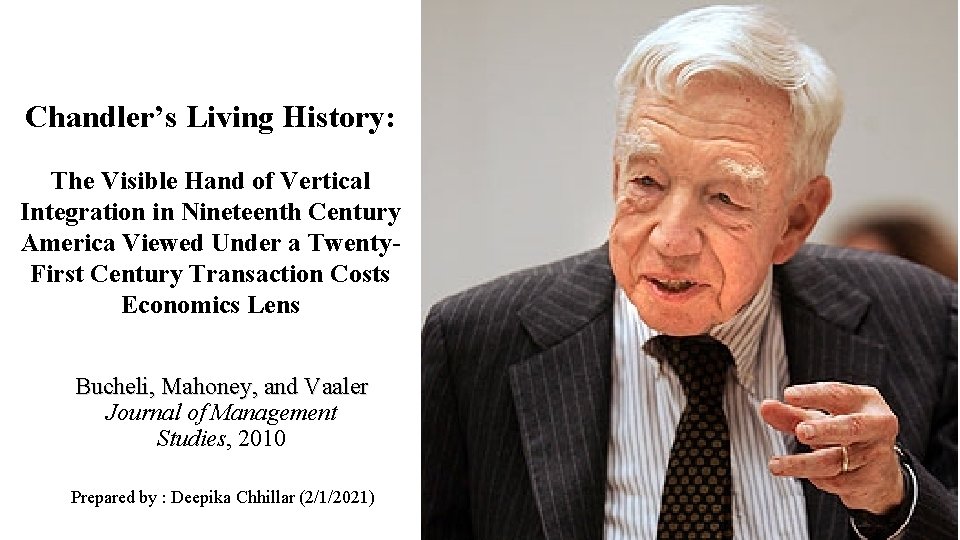
Chandler’s Living History: The Visible Hand of Vertical Integration in Nineteenth Century America Viewed Under a Twenty. First Century Transaction Costs Economics Lens Bucheli, Mahoney, and Vaaler Journal of Management Studies, 2010 Prepared by : Deepika Chhillar (2/1/2021)
Alfred Chandler (1918 -2007) • Founded a discipline – Business History -- almost single handedly • Pulitzer Prize winner (History) for his work, The Visible Hand The Managerial Revolution in American Business (1977) • Professor of Business History at Harvard Business School since 1970

Alfred Chandler’s (related) masterpieces 1. 2. Strategy and Structure, 1962 a. Established organizational form as a predictor of success b. Drew relations between economic efficiency and internal organization The Visible Hand, 1977 a. 3. “Processes of production and distribution” as a predictor of organizational success Scale and Scope, 1990 a. With both 2 & 3 -> Established a new discipline - compelling narratives about the evolution of business organization over the past 150 years, drawing from social sciences - economics, sociology, management, and organization studies.
Central Ideas of the Article Applies TC theory to explain historical phenomenon in the American history • “The primary normative aim of this perspective is to define the circumstances when internalization is more cost-efficient than leaving transactions in the market. ” • Vertical integration was a result of organizations striving to reduce transaction costs • Could the insights from the Visible Hand predict new organizational forms – Integration/De-integration?

TCE meets. Visible Hand • Adds theoretical nuance to Chandler’s “Visible Hand” • Review and analyse, in transaction costs terms, a particular change in organizational form of American business Why TCE? “We regard deductive economic theorizing as complementary and reinforcing to Chandler’s (1977) relatively more inductive theory-building approach, and for this purpose, we use The Visible Hand to critically review the organizational evolution of American business in the nineteenth and early twentieth centuries viewed under a single theoretical lens, namely transaction costs economics” Points of departure: ‘The basic difference between myself and Williamson is that for him the transaction is the basic unit of analysis. For me it is the firm and its specific physical and human assets. ” “If the firm is the unit of analysis, instead of the transaction, then the specific nature of the firm’s facilities and skills becomes the most significant factor in determining what will be done in the firm and what will be done in the market”
TCE - Definitions • By transaction costs we mean the costs of producing and overseeing the exchange of goods and services over time. • By transaction costs theory, we mean an analytical perspective for evaluating alternative regimes for such production and exchange transactions based on their prospective costs.
Four main parts of article • I – The putting-out and the inside-contracting systems How and why these systems worked well with small business organizations producing low-cost goods with few technological inputs and little standardization • II – The rise of vertically-integrated firms How and why many American businesses from 1840 to 1920 discarded the putting-out and inside-contracting systems in favour of larger and increasingly vertically integrated organizational forms. • III – Uses transaction costs logic to analyse more broadly differing rates of change from invisible hand-based (Smith, 1776) to visible hand-based business organization from 1840 to 1920. • IV - Parallels between Chandler’s historical analysis and transaction costs theories and leading theorists. Conclusion - When and where we might expect vertical integration strategies in emerging industries of the twenty-first century.
Putting Out System • A means of sub-contracting work • Prevalent 1790 s to 1840 s • Owners supplied raw materials to producers or makers • Collected and distributed the finished product themselves • Fit the times (pre-innovation) • Decentralized and market-based, rather than centralized and bureaucratic • Disadvantages • Difficult to monitor>shirking> high transaction costs • Piece-rate system inhibited the development of high quality
Inside - Contracting System • Widely used in England especially in metal fabrication & machine tool production • In comparison to the Putting Out systems the Inside Contracting system solved the problem of moral hazard by incorporating another layer of personnel – With major assets being controlled/shared by the owner/s • However, this led to further problems • Information asymmetry between owners and contractors - improvisations hidden • Property rights issues – damage to property • An employee (rather than contract worker) relationship would provide greater security to workers asked to invest more in specialized training with factory equipment and procedures. It would more likely put them in a ‘zone of acceptance’ (Simon, 1947) regarding asset specific investments
Discussion • Overall demise of these two primitive systems - While some types of transaction costs were minimized, new ones ensued. • Why do we still see the putting out and inside-contractor model in parts of the world?
The Rise Of Vertically-Integrated (VI) Firms • 1840 s marked the beginning of organizational innovation (e. g. , telegraph, in American business -- Rapid changes in production, distribution, and overall administration • Paralleled reduced costs of information acquisition (communication) and transportation • Owners could now look beyond local – if they were willing to internalize • Independent distributors were likely to become increasingly less knowledgeable, less well-trained, and less interested in selling and servicing complex products compared to employee sales agents
Discussion • Is TCE the best available explanation? Other alternative explanations? • _B_? • Water and later steam power sources were fueled by discovery of new coal seams and enabled utilization of massive iron ore, lumber, and related natural resources. • Singer’s Sewing machine revolutionizing tailoring/apparel industry and pioneered the development of mass distribution channels • Chandler maintained that “Singer’s economic advantage followed from travelling this path of organizational innovation”
The Rise Of Vertically-Integrated (VI) Firms – Meat Packing and Fruit Businesses • Not all vertical integration involved complex products. • Perishable goods like meats and fruits might be ‘generic’ but still required vertical integration for reasons related to transaction costs. • Meat-packing and fruit businesses in the late nineteenth and twentieth centuries illustrate this point. • The banana business encountered more difficulties than the meat-packing industry for at least three reasons, • Bananas cannot be produced in the continental United States, they cannot be frozen, they spoil very quickly. • With limited alternative uses, an investment in a refrigeration car entailed high asset specificity. • Railroads that built these cars would be in a weak bargaining position with meatpackers to provide sufficient volumes of meat to utilize fully this expensive equipment.
Selective nature of VI in 19 th century American Business • These coordination problems were largely solved only with the establishment of the United Fruit Company in 1899 • Older processes of production and distribution based on some mix of contract workers, independent wholesalers, and/or independent retailers continued in many industries. • For these goods, market-based regimes worked quite well • E. g. , cereals, soups, drugs, liquor etc.
Linking Chandler to TC Yesterday and Today • TC principles that help explain Chandlerian vertical integration are the same principles needed to understand contemporary vertical de-integration • Role of IT - 1. Low(er) search cost - asset specificity and small-numbers bargaining problems have been reduced in many industries in which IT can allow firms to ‘quickconnect’ with several potential suppliers and mitigate small-numbers bargaining 2. Sunk costs in IT systems - even when small-numbers bargaining persists, relationship-specific IT systems (such as those employed by consumer goods giant Procter & Gamble and retail giant Walmart) provide mutual sunk cost commitments that enable electronic integration to mitigate hold-up problems 3. Standardized and Improved Measurement technology - IT and standardized interfaces with exchange partners and suppliers reduce the non-separability problems of measuring individual productivity inputs from team production as well as the measurement of output quality
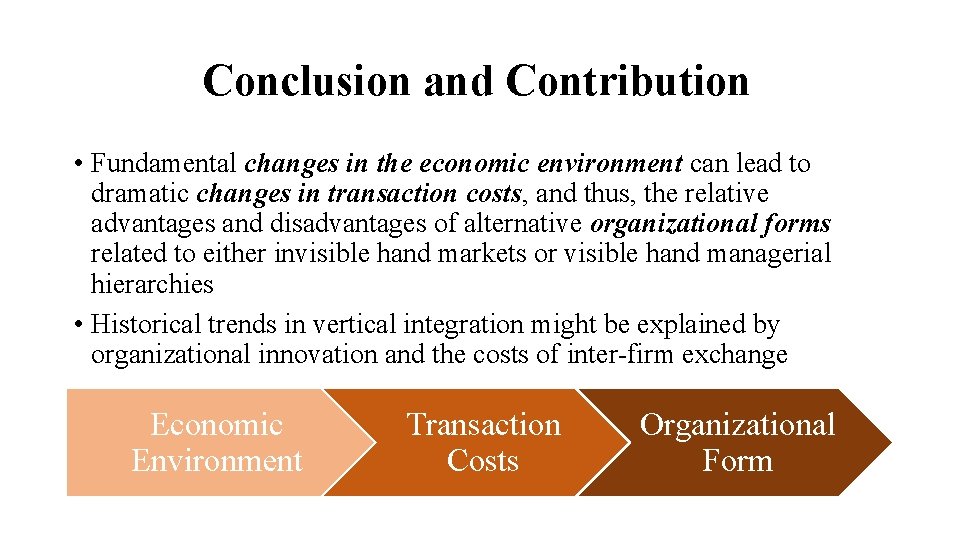
Conclusion and Contribution • Fundamental changes in the economic environment can lead to dramatic changes in transaction costs, and thus, the relative advantages and disadvantages of alternative organizational forms related to either invisible hand markets or visible hand managerial hierarchies • Historical trends in vertical integration might be explained by organizational innovation and the costs of inter-firm exchange Economic Environment Transaction Costs Organizational Form
- Slides: 16