
CHANDLER A New Technology for Surfacelevel Reactor Neutrino

- Slides: 58
CHANDLER: A New Technology for Surface-level Reactor Neutrino Detection Jonathan Link Center for Neutrino Physics, Virginia Tech IHEP Beijing Seminar December 16, 2016 Center for Neutrino Physics
Talk Outline • Motivation ‒ Why do we need better reactor neutrino detectors? • Technological Foundations ‒ Where do these ideas come from? • The CHANDLER Technology ‒ The basics idea • Detector R&D ‒ What we have learned so far • CHANDLER and So. Lid ‒ A sterile neutrino search Jonathan Link Center for Neutrino Physics
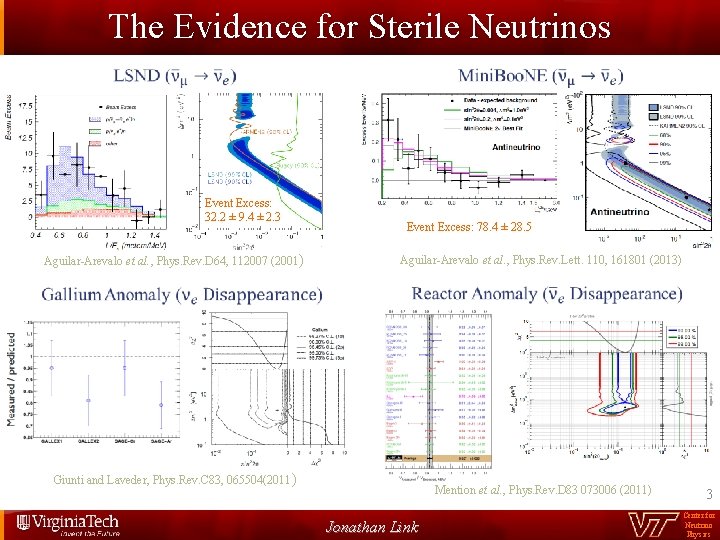
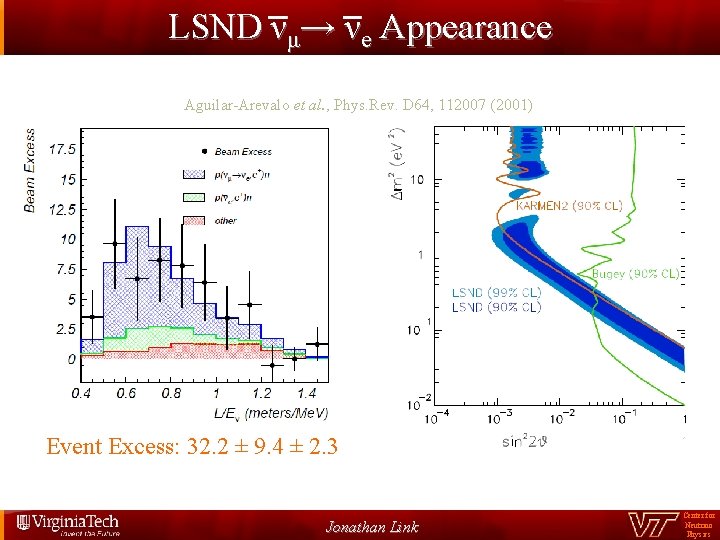
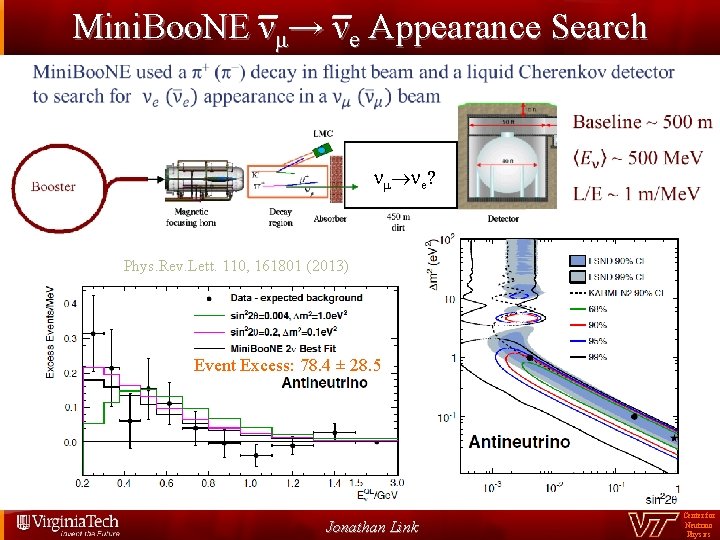
The Evidence for Sterile Neutrinos Event Excess: 32. 2 ± 9. 4 ± 2. 3 Aguilar-Arevalo et al. , Phys. Rev. D 64, 112007 (2001) Event Excess: 78. 4 ± 28. 5 Aguilar-Arevalo et al. , Phys. Rev. Lett. 110, 161801 (2013) Giunti and Laveder, Phys. Rev. C 83, 065504(2011 ) Mention et al. , Phys. Rev. D 83 073006 (2011) Jonathan Link 3 Center for Neutrino Physics
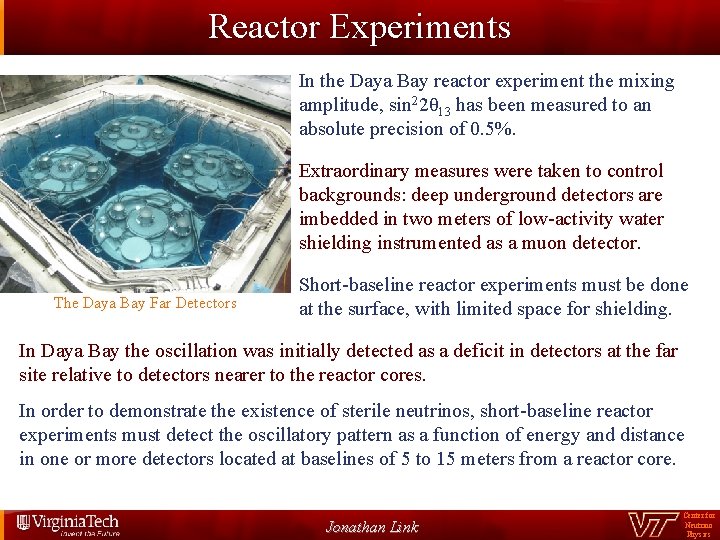
Reactor Experiments In the Daya Bay reactor experiment the mixing amplitude, sin 22θ 13 has been measured to an absolute precision of 0. 5%. Extraordinary measures were taken to control backgrounds: deep underground detectors are imbedded in two meters of low-activity water shielding instrumented as a muon detector. The Daya Bay Far Detectors Short-baseline reactor experiments must be done at the surface, with limited space for shielding. In Daya Bay the oscillation was initially detected as a deficit in detectors at the far site relative to detectors nearer to the reactor cores. In order to demonstrate the existence of sterile neutrinos, short-baseline reactor experiments must detect the oscillatory pattern as a function of energy and distance in one or more detectors located at baselines of 5 to 15 meters from a reactor core. Jonathan Link Center for Neutrino Physics
Keys to a Short-Baseline Reactor Experiment 1. Sensitivity to the higher Δm 2 range (2 e. V 2 and above) requires a compact reactor core and good energy resolution. 2. Relatively small detectors require careful consideration of isotope used for neutron capture and tagging. Jonathan Link Center for Neutrino Physics
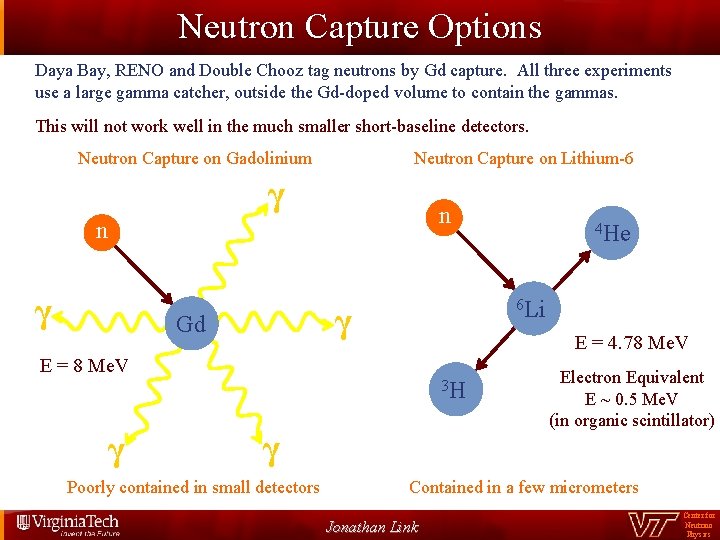
Neutron Capture Options Daya Bay, RENO and Double Chooz tag neutrons by Gd capture. All three experiments use a large gamma catcher, outside the Gd-doped volume to contain the gammas. This will not work well in the much smaller short-baseline detectors. Neutron Capture on Gadolinium Neutron Capture on Lithium-6 γ n n γ 6 Li γ Gd E = 4. 78 Me. V E = 8 Me. V 3 H γ γ Poorly contained in small detectors 4 He Electron Equivalent E ~ 0. 5 Me. V (in organic scintillator) Contained in a few micrometers Jonathan Link Center for Neutrino Physics
Keys to a Short-Baseline Reactor Experiment 1. Sensitivity to the higher Δm 2 range (2 e. V 2 and above) requires a compact reactor core and good energy resolution. 2. Relatively small detectors require careful consideration of isotope used for neutron capture and tagging. 3. Backgrounds, particularly from random coincidences are the most significant challenge. Random coincident backgrounds can be reduced by: a. Reducing background rates (shielding) b. Improving signal pattern recognition, and c. Tightening coincidence criteria in space and time Jonathan Link Center for Neutrino Physics
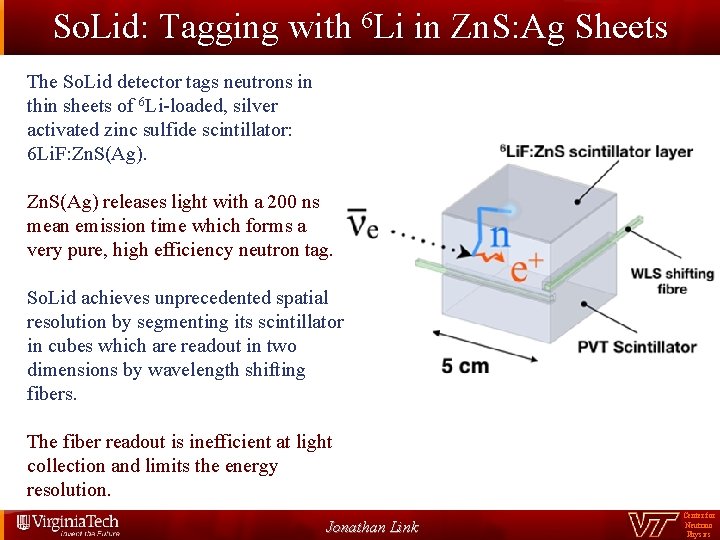
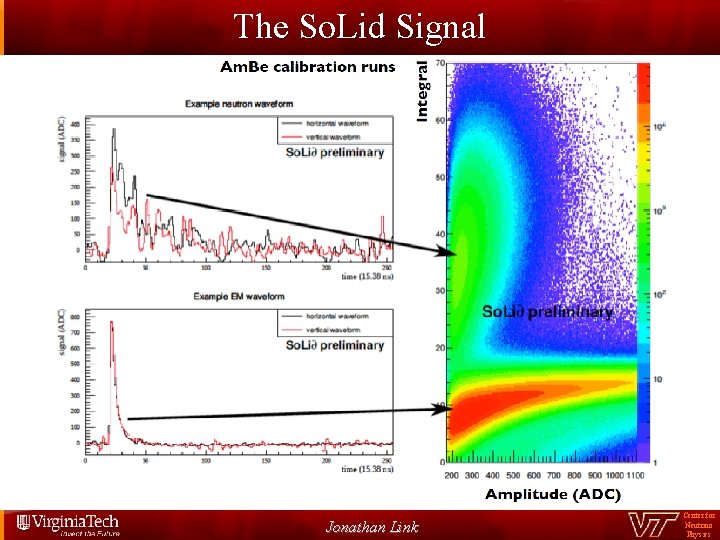
So. Lid: Tagging with 6 Li in Zn. S: Ag Sheets The So. Lid detector tags neutrons in thin sheets of 6 Li-loaded, silver activated zinc sulfide scintillator: 6 Li. F: Zn. S(Ag) releases light with a 200 ns mean emission time which forms a very pure, high efficiency neutron tag. So. Lid achieves unprecedented spatial resolution by segmenting its scintillator in cubes which are readout in two dimensions by wavelength shifting fibers. The fiber readout is inefficient at light collection and limits the energy resolution. Jonathan Link Center for Neutrino Physics
The So. Lid Signal Jonathan Link Center for Neutrino Physics
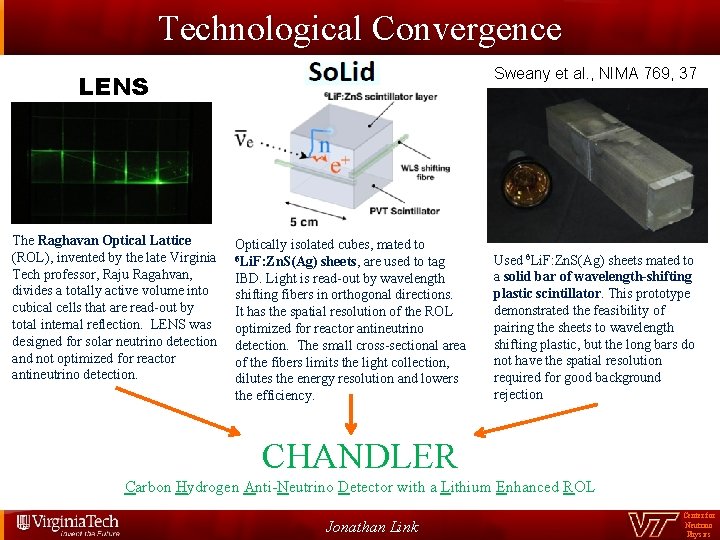
Technological Convergence Sweany et al. , NIMA 769, 37 LENS The Raghavan Optical Lattice (ROL), invented by the late Virginia Tech professor, Raju Ragahvan, divides a totally active volume into cubical cells that are read-out by total internal reflection. LENS was designed for solar neutrino detection and not optimized for reactor antineutrino detection. Optically isolated cubes, mated to 6 Li. F: Zn. S(Ag) sheets, are used to tag IBD. Light is read-out by wavelength shifting fibers in orthogonal directions. It has the spatial resolution of the ROL optimized for reactor antineutrino detection. The small cross-sectional area of the fibers limits the light collection, dilutes the energy resolution and lowers the efficiency. Used 6 Li. F: Zn. S(Ag) sheets mated to a solid bar of wavelength-shifting plastic scintillator. This prototype demonstrated the feasibility of pairing the sheets to wavelength shifting plastic, but the long bars do not have the spatial resolution required for good background rejection CHANDLER Carbon Hydrogen Anti-Neutrino Detector with a Lithium Enhanced ROL Jonathan Link Center for Neutrino Physics
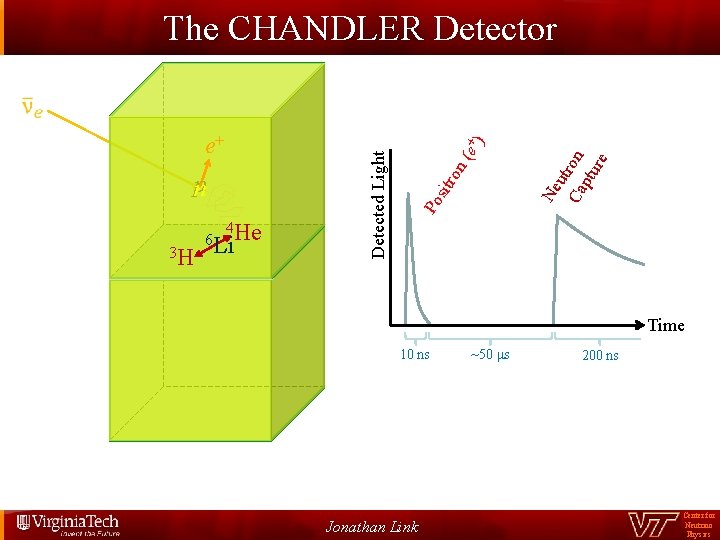
3 H 4 6 Li. He Ne utr Ca on ptu re (e + ) sit ron pn Po e+ Detected Light The CHANDLER Detector Time 10 ns Jonathan Link ~50 μs 200 ns Center for Neutrino Physics
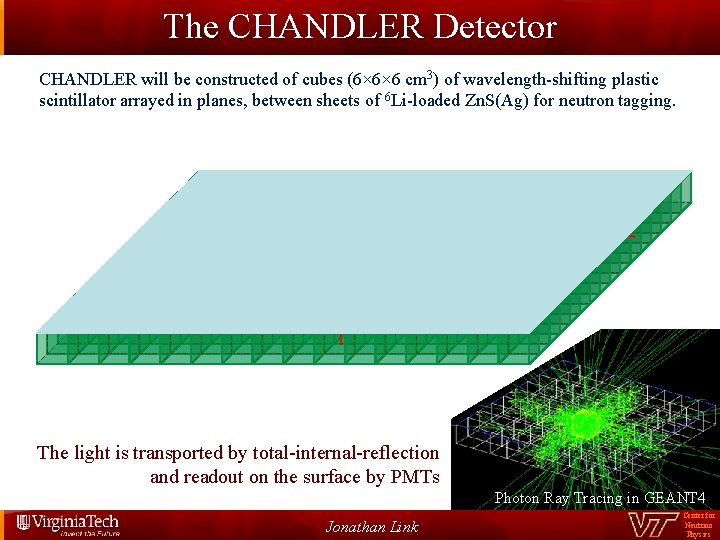
The CHANDLER Detector CHANDLER will be constructed of cubes (6× 6× 6 cm 3) of wavelength-shifting plastic scintillator arrayed in planes, between sheets of 6 Li-loaded Zn. S(Ag) for neutron tagging. The light is transported by total-internal-reflection and readout on the surface by PMTs Photon Ray Tracing in GEANT 4 Jonathan Link Center for Neutrino Physics
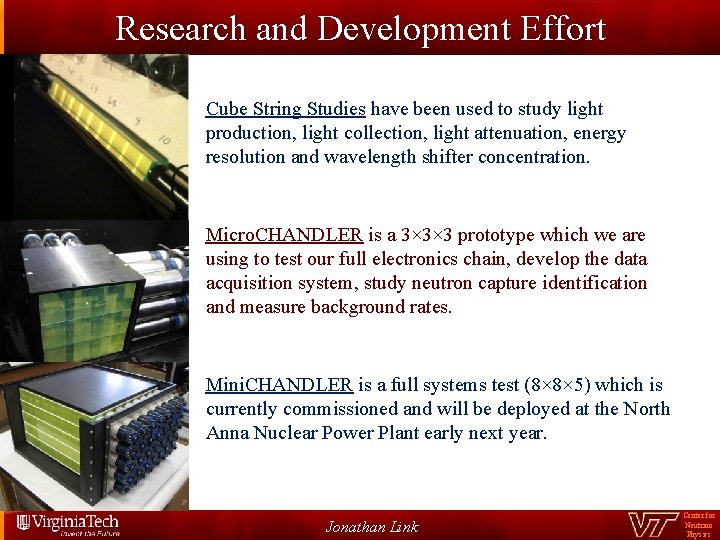
Research and Development Effort Cube String Studies have been used to study light production, light collection, light attenuation, energy resolution and wavelength shifter concentration. Micro. CHANDLER is a 3× 3× 3 prototype which we are using to test our full electronics chain, develop the data acquisition system, study neutron capture identification and measure background rates. Mini. CHANDLER is a full systems test (8× 8× 5) which is currently commissioned and will be deployed at the North Anna Nuclear Power Plant early next year. Jonathan Link Center for Neutrino Physics
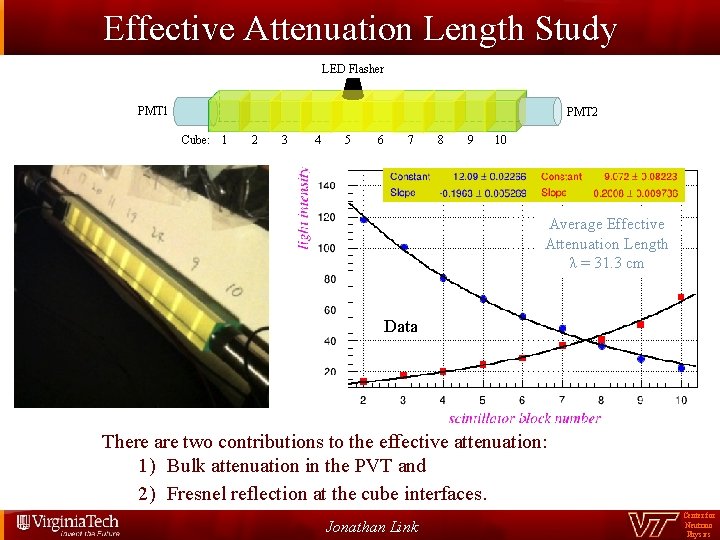
Effective Attenuation Length Study LED Flasher PMT 1 PMT 2 Cube: 1 2 3 4 5 6 7 8 9 10 Average Effective Attenuation Length λ = 31. 3 cm Data There are two contributions to the effective attenuation: 1) Bulk attenuation in the PVT and 2) Fresnel reflection at the cube interfaces. Jonathan Link Center for Neutrino Physics
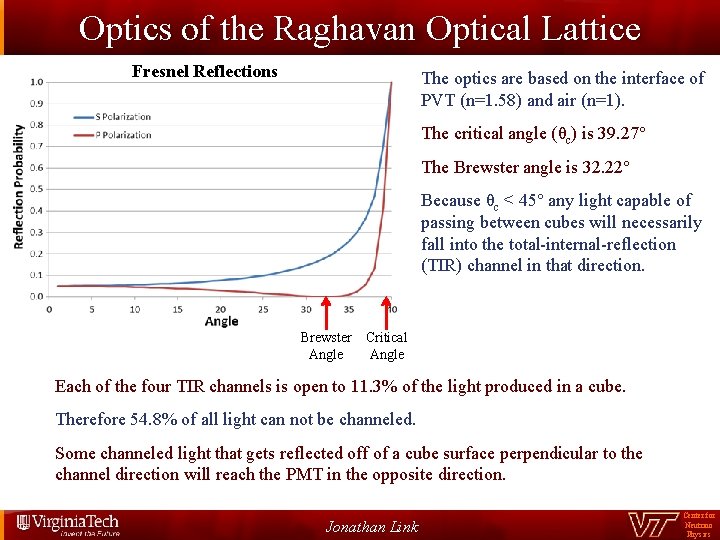
Optics of the Raghavan Optical Lattice Fresnel Reflections The optics are based on the interface of PVT (n=1. 58) and air (n=1). The critical angle (θc) is 39. 27° The Brewster angle is 32. 22° Because θc < 45° any light capable of passing between cubes will necessarily fall into the total-internal-reflection (TIR) channel in that direction. Brewster Angle Critical Angle Each of the four TIR channels is open to 11. 3% of the light produced in a cube. Therefore 54. 8% of all light can not be channeled. Some channeled light that gets reflected off of a cube surface perpendicular to the channel direction will reach the PMT in the opposite direction. Jonathan Link Center for Neutrino Physics
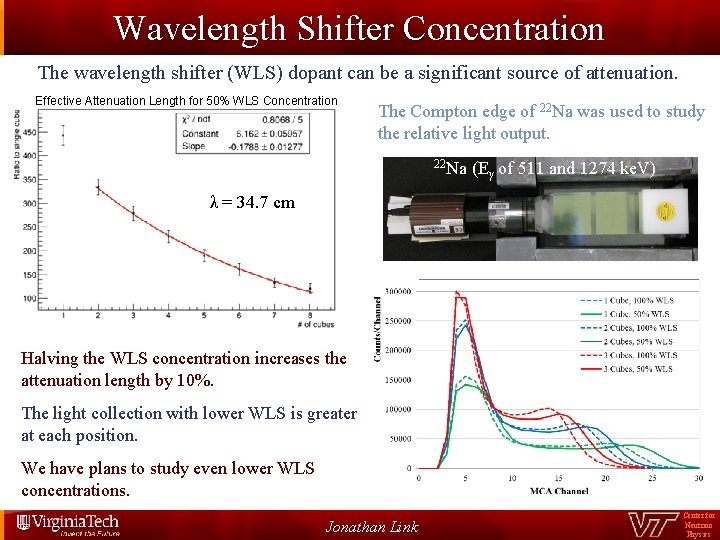
Wavelength Shifter Concentration The wavelength shifter (WLS) dopant can be a significant source of attenuation. Effective Attenuation Length for 50% WLS Concentration The Compton edge of 22 Na was used to study the relative light output. 22 Na (Eγ of 511 and 1274 ke. V) λ = 34. 7 cm Halving the WLS concentration increases the attenuation length by 10%. The light collection with lower WLS is greater at each position. We have plans to study even lower WLS concentrations. Jonathan Link Center for Neutrino Physics
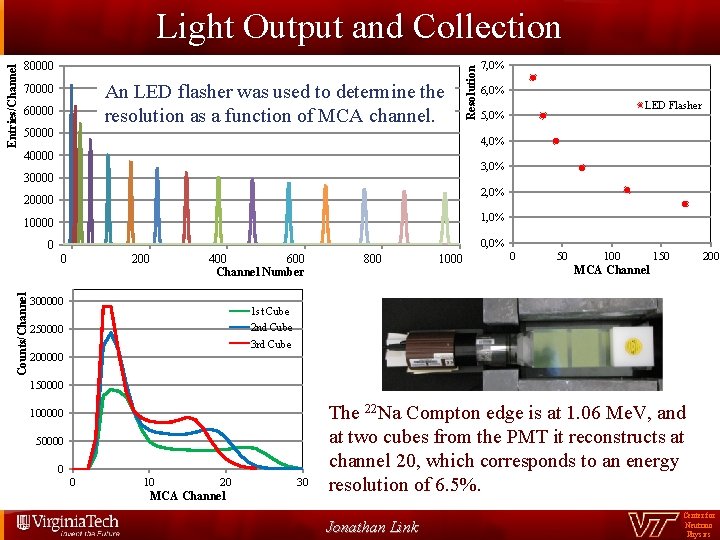
80000 An LED flasher was used to determine the resolution as a function of MCA channel. 70000 60000 50000 Resolution Entries/Channel Light Output and Collection 7, 0% 6, 0% 40000 3, 0% 30000 2, 0% 20000 1, 0% 0 0, 0% 0 Counts/Channel LED Flasher 5, 0% 200 400 600 Channel Number 300000 800 1000 0 50 100 150 200 MCA Channel 1 st Cube 2 nd Cube 3 rd Cube 250000 200000 150000 100000 50000 0 0 10 20 MCA Channel 30 The 22 Na Compton edge is at 1. 06 Me. V, and at two cubes from the PMT it reconstructs at channel 20, which corresponds to an energy resolution of 6. 5%. Jonathan Link Center for Neutrino Physics
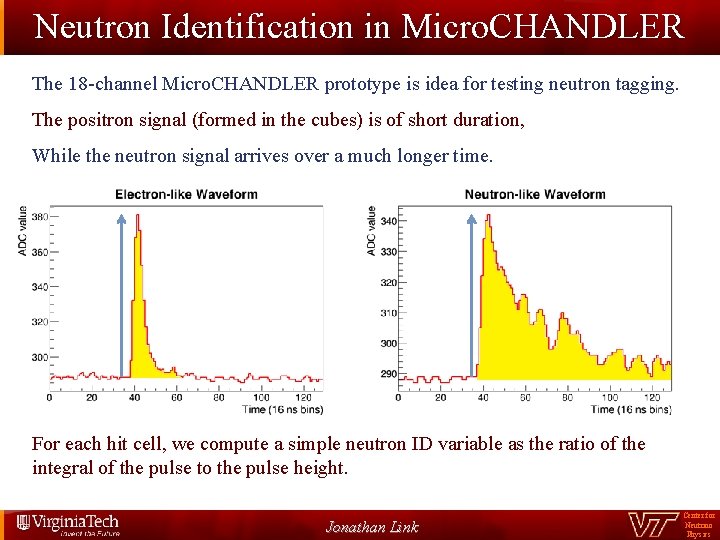
Neutron Identification in Micro. CHANDLER The 18 -channel Micro. CHANDLER prototype is idea for testing neutron tagging. The positron signal (formed in the cubes) is of short duration, While the neutron signal arrives over a much longer time. For each hit cell, we compute a simple neutron ID variable as the ratio of the integral of the pulse to the pulse height. Jonathan Link Center for Neutrino Physics
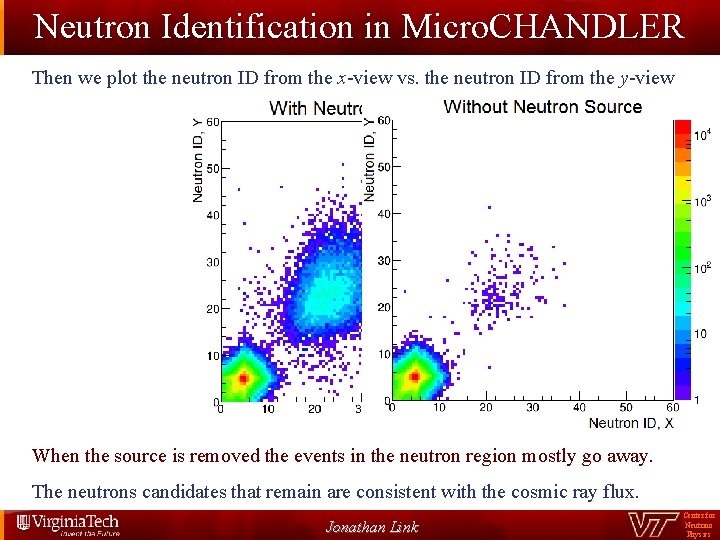
Neutron Identification in Micro. CHANDLER Then we plot the neutron ID from the x-view vs. the neutron ID from the y-view When the source is removed the events in the neutron region mostly go away. The neutrons candidates that remain are consistent with the cosmic ray flux. Jonathan Link Center for Neutrino Physics
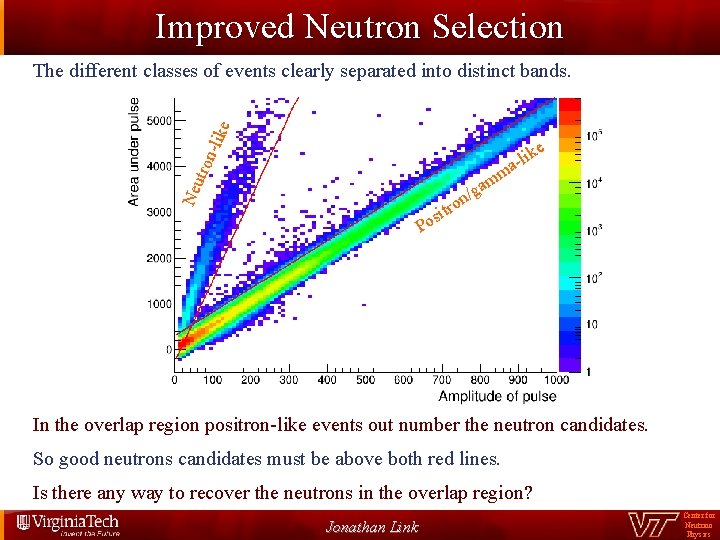
Improved Neutron Selection tron -lik e The different classes of events clearly separated into distinct bands. e Neu ik l a n tro i s o mm a /g P In the overlap region positron-like events out number the neutron candidates. So good neutrons candidates must be above both red lines. Is there any way to recover the neutrons in the overlap region? Jonathan Link Center for Neutrino Physics
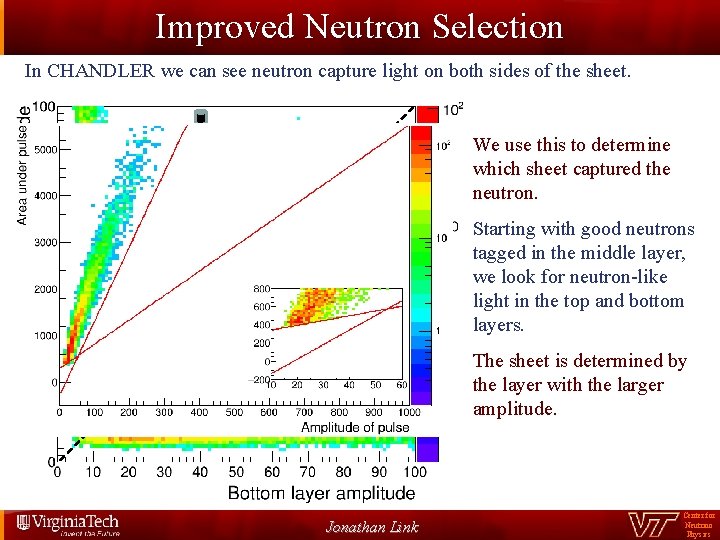
Improved Neutron Selection In CHANDLER we can see neutron capture light on both sides of the sheet. We use this to determine which sheet captured the neutron. Neutron Source Starting with good neutrons tagged in the middle layer, we look for neutron-like light in the top and bottom layers. The sheet is determined by the layer with the larger amplitude. Jonathan Link Center for Neutrino Physics
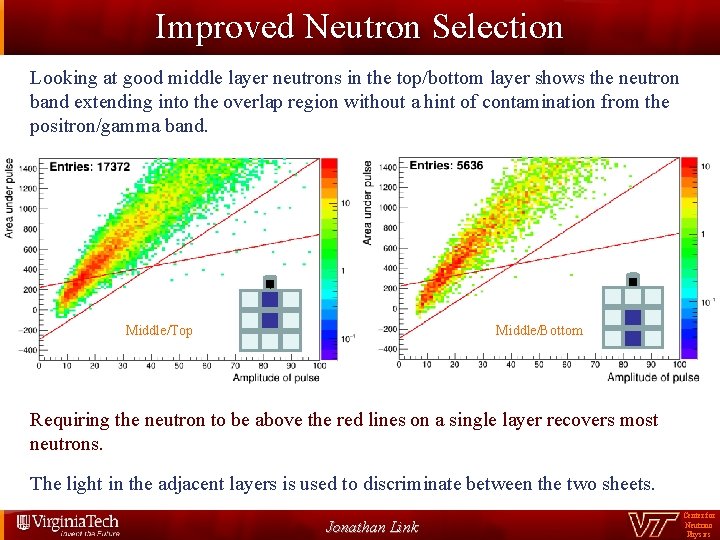
Improved Neutron Selection Looking at good middle layer neutrons in the top/bottom layer shows the neutron band extending into the overlap region without a hint of contamination from the positron/gamma band. Middle/Bottom Middle/Top Requiring the neutron to be above the red lines on a single layer recovers most neutrons. The light in the adjacent layers is used to discriminate between the two sheets. Jonathan Link Center for Neutrino Physics
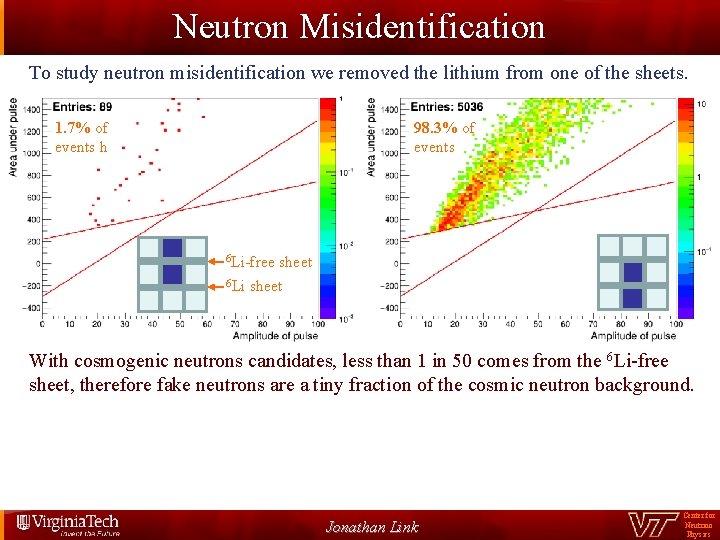
Neutron Misidentification To study neutron misidentification we removed the lithium from one of the sheets. 1. 7% of events h 98. 3% of events 6 Li-free 6 Li sheet With cosmogenic neutrons candidates, less than 1 in 50 comes from the 6 Li-free sheet, therefore fake neutrons are a tiny fraction of the cosmic neutron background. Jonathan Link Center for Neutrino Physics
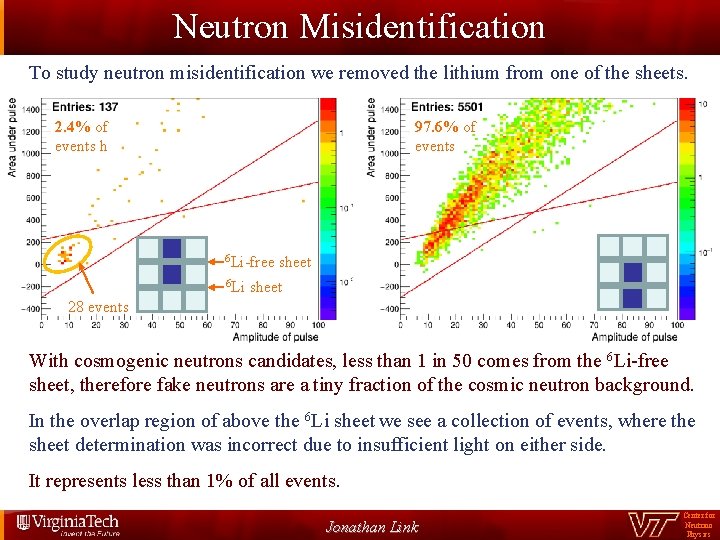
Neutron Misidentification To study neutron misidentification we removed the lithium from one of the sheets. 2. 4% of 1. 6% events h 97. 6% of 89. 3% events 6 Li-free 6 Li sheet 6 Li-free sheet 6 Li sheet 28 events With cosmogenic neutrons candidates, less than 1 in 50 comes from the 6 Li-free sheet, therefore fake neutrons are a tiny fraction of the cosmic neutron background. In the overlap region of above the 6 Li sheet we see a collection of events, where the sheet determination was incorrect due to insufficient light on either side. It represents less than 1% of all events. Jonathan Link Center for Neutrino Physics
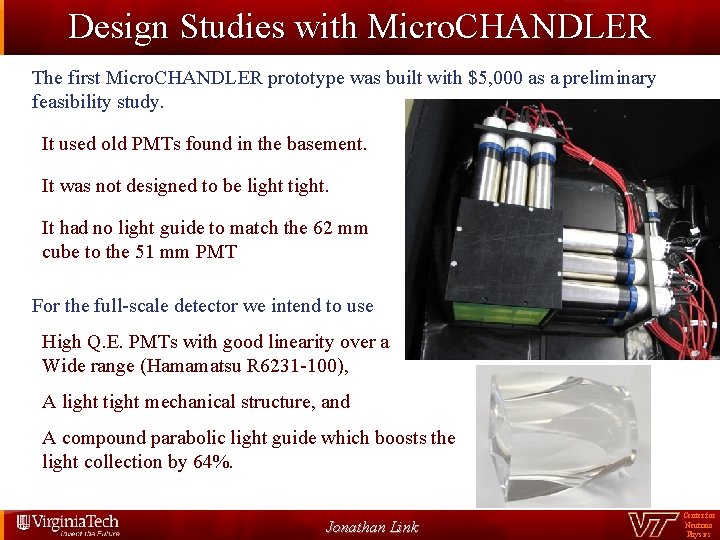
Design Studies with Micro. CHANDLER The first Micro. CHANDLER prototype was built with $5, 000 as a preliminary feasibility study. It used old PMTs found in the basement. It was not designed to be light tight. It had no light guide to match the 62 mm cube to the 51 mm PMT For the full-scale detector we intend to use High Q. E. PMTs with good linearity over a Wide range (Hamamatsu R 6231 -100), A light tight mechanical structure, and A compound parabolic light guide which boosts the light collection by 64%. Jonathan Link Center for Neutrino Physics
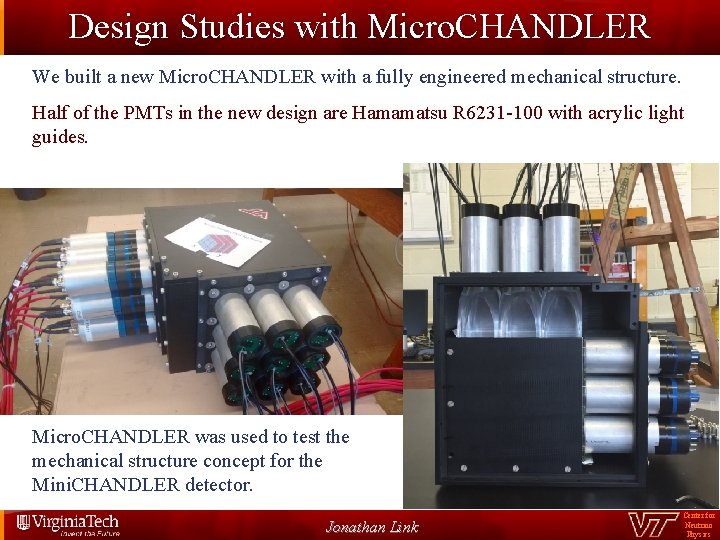
Design Studies with Micro. CHANDLER We built a new Micro. CHANDLER with a fully engineered mechanical structure. Half of the PMTs in the new design are Hamamatsu R 6231 -100 with acrylic light guides. Micro. CHANDLER was used to test the mechanical structure concept for the Mini. CHANDLER detector. Jonathan Link Center for Neutrino Physics
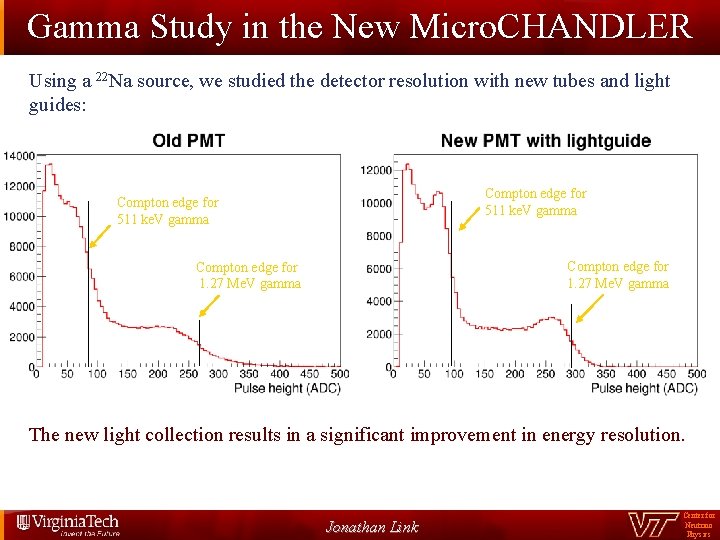
Gamma Study in the New Micro. CHANDLER Using a 22 Na source, we studied the detector resolution with new tubes and light guides: Compton edge for 511 ke. V gamma Compton edge for 1. 27 Me. V gamma The new light collection results in a significant improvement in energy resolution. Jonathan Link Center for Neutrino Physics
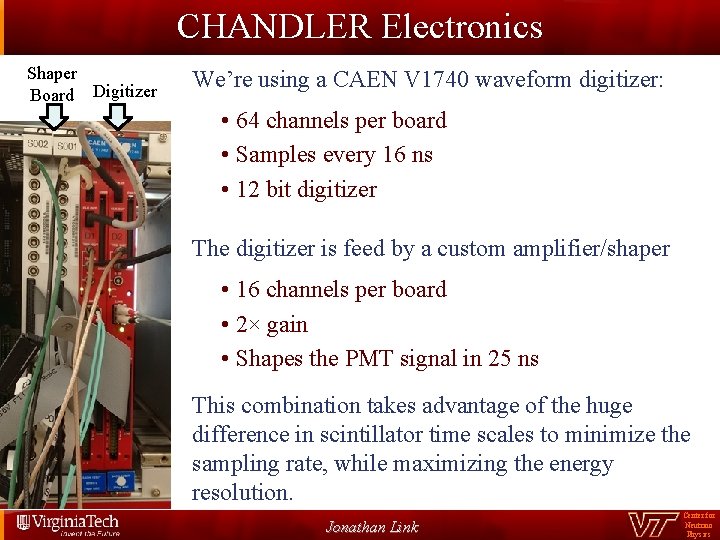
CHANDLER Electronics Shaper Board Digitizer We’re using a CAEN V 1740 waveform digitizer: • 64 channels per board • Samples every 16 ns • 12 bit digitizer The digitizer is feed by a custom amplifier/shaper • 16 channels per board • 2× gain • Shapes the PMT signal in 25 ns This combination takes advantage of the huge difference in scintillator time scales to minimize the sampling rate, while maximizing the energy resolution. Jonathan Link Center for Neutrino Physics
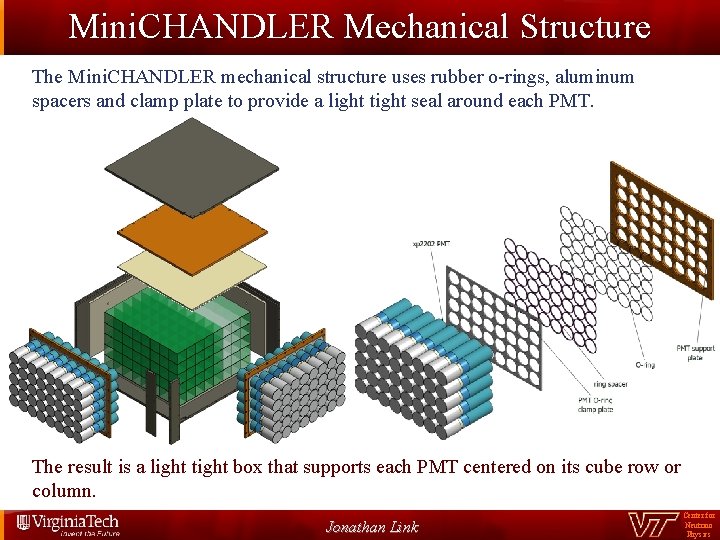
Mini. CHANDLER Mechanical Structure The Mini. CHANDLER mechanical structure uses rubber o-rings, aluminum spacers and clamp plate to provide a light tight seal around each PMT. The result is a light tight box that supports each PMT centered on its cube row or column. Jonathan Link Center for Neutrino Physics
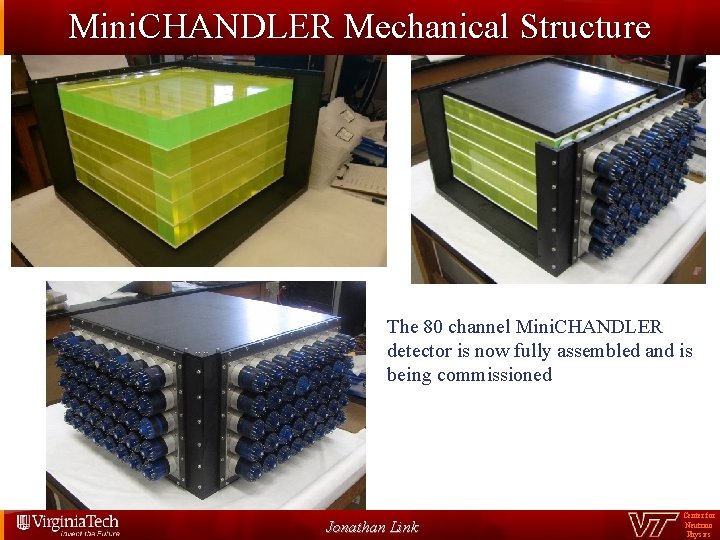
Mini. CHANDLER Mechanical Structure The 80 channel Mini. CHANDLER detector is now fully assembled and is being commissioned Jonathan Link Center for Neutrino Physics
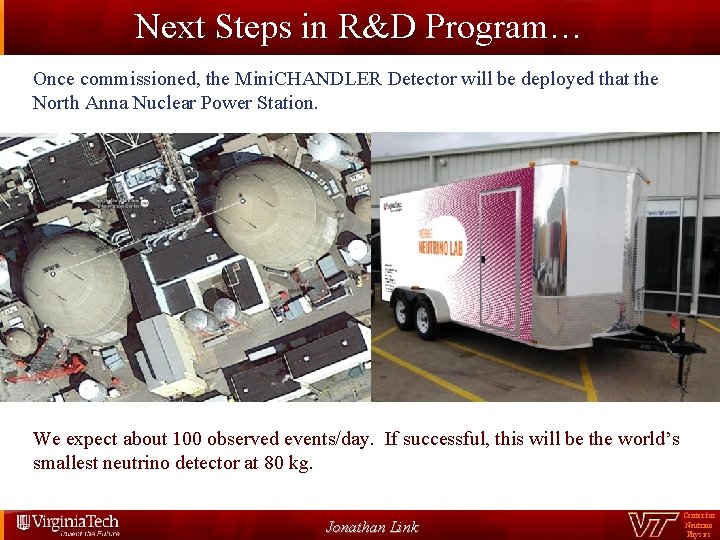
Next Steps in R&D Program… Once commissioned, the Mini. CHANDLER Detector will be deployed that the North Anna Nuclear Power Station. We expect about 100 observed events/day. If successful, this will be the world’s smallest neutrino detector at 80 kg. Jonathan Link Center for Neutrino Physics
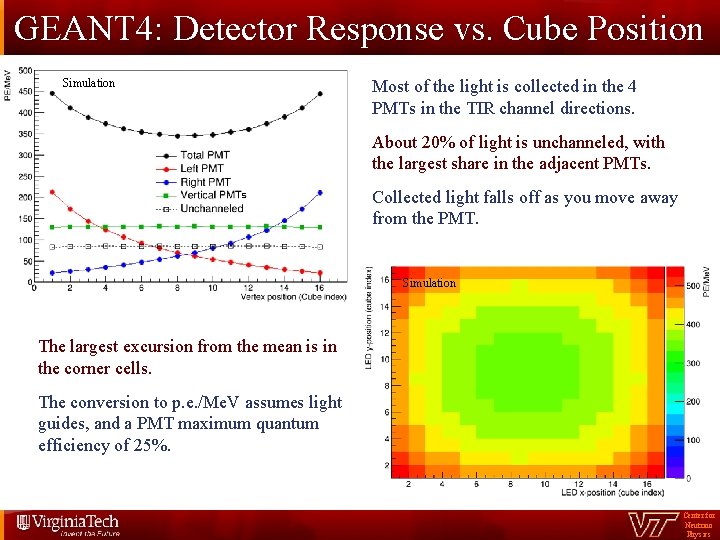
GEANT 4: Detector Response vs. Cube Position Simulation Most of the light is collected in the 4 PMTs in the TIR channel directions. About 20% of light is unchanneled, with the largest share in the adjacent PMTs. Collected light falls off as you move away from the PMT. Simulation The largest excursion from the mean is in the corner cells. The conversion to p. e. /Me. V assumes light guides, and a PMT maximum quantum efficiency of 25%. Center for Neutrino Physics
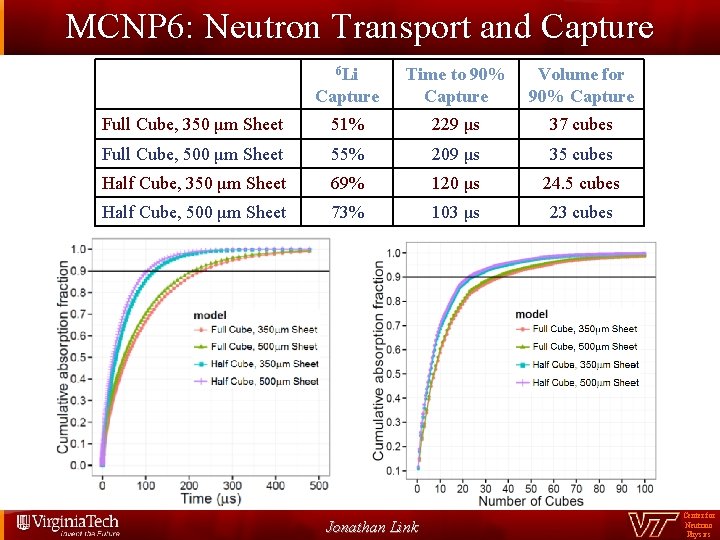
MCNP 6: Neutron Transport and Capture 6 Li Capture Time to 90% Capture Volume for 90% Capture Full Cube, 350 μm Sheet 51% 229 μs 37 cubes Full Cube, 500 μm Sheet 55% 209 μs 35 cubes Half Cube, 350 μm Sheet 69% 120 μs 24. 5 cubes Half Cube, 500 μm Sheet 73% 103 μs 23 cubes Jonathan Link Center for Neutrino Physics
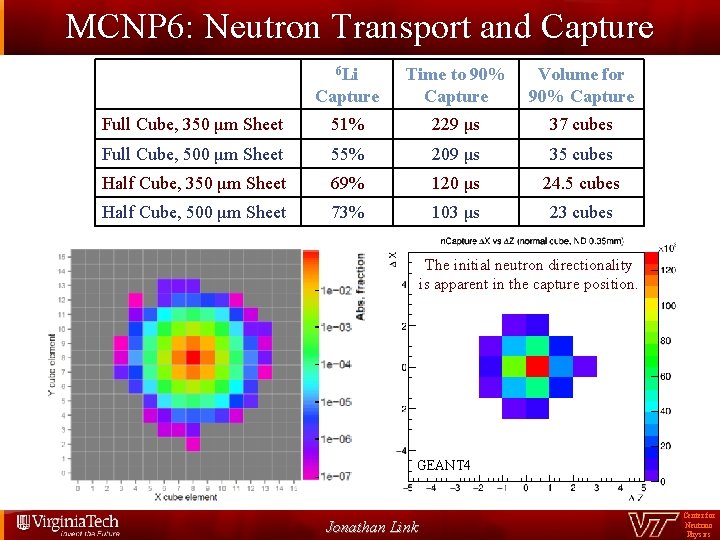
MCNP 6: Neutron Transport and Capture 6 Li Capture Time to 90% Capture Volume for 90% Capture Full Cube, 350 μm Sheet 51% 229 μs 37 cubes Full Cube, 500 μm Sheet 55% 209 μs 35 cubes Half Cube, 350 μm Sheet 69% 120 μs 24. 5 cubes Half Cube, 500 μm Sheet 73% 103 μs 23 cubes The initial neutron directionality is apparent in the capture position. GEANT 4 Jonathan Link Center for Neutrino Physics
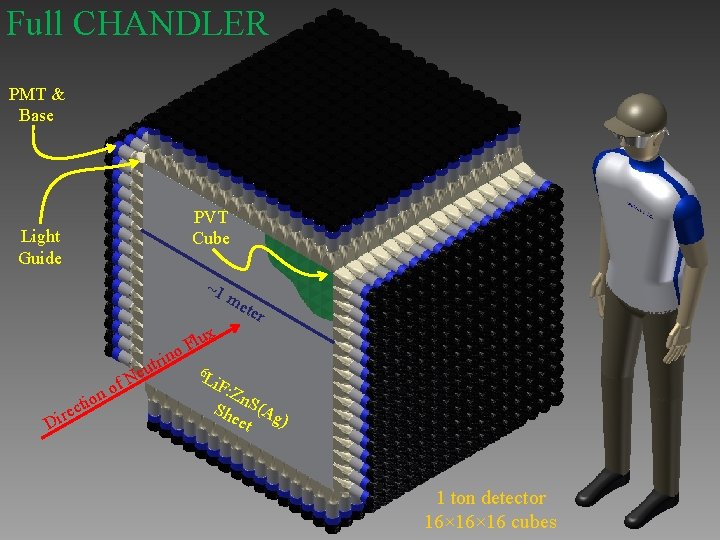
Full CHANDLER PMT & Base PVT Cube Light Guide ~1 no D tio c e ir f. N r eut in lux F o me ter 6 Li. F : Zn Sh S(Ag eet ) 1 ton detector 16× 16 cubes Center for Neutrino Physics
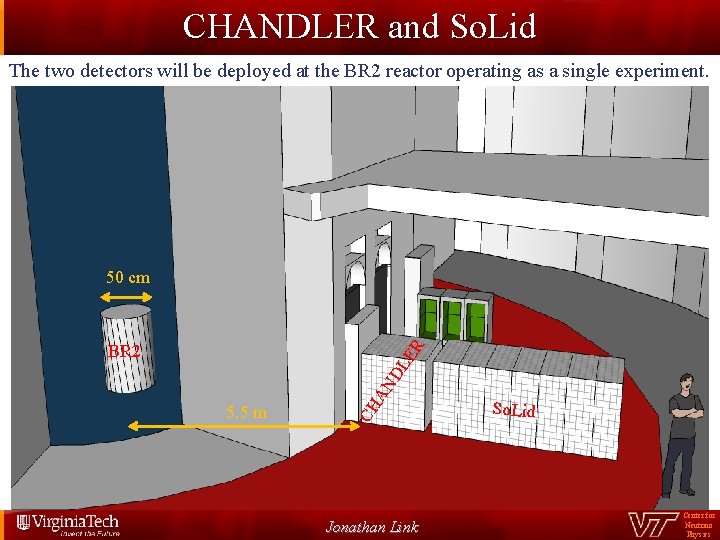
CHANDLER and So. Lid The two detectors will be deployed at the BR 2 reactor operating as a single experiment. 50 cm CH 5. 5 m AN DL ER BR 2 Jonathan Link So. Lid Center for Neutrino Physics
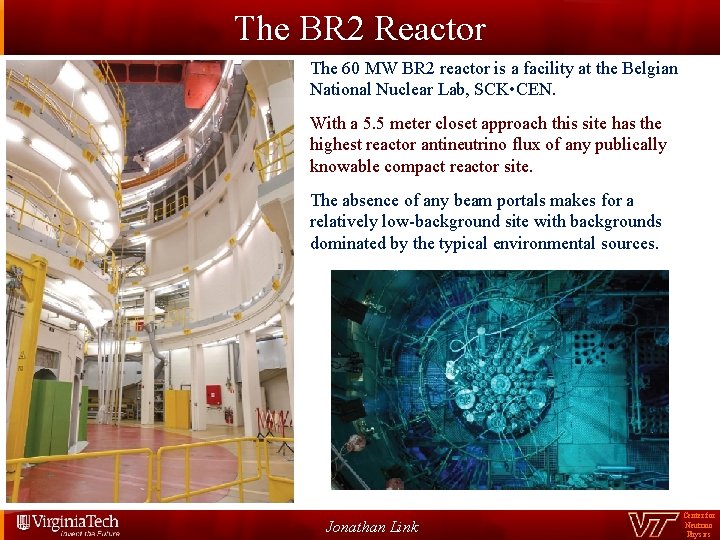
The BR 2 Reactor The 60 MW BR 2 reactor is a facility at the Belgian National Nuclear Lab, SCK • CEN. With a 5. 5 meter closet approach this site has the highest reactor antineutrino flux of any publically knowable compact reactor site. The absence of any beam portals makes for a relatively low-background site with backgrounds dominated by the typical environmental sources. Jonathan Link Center for Neutrino Physics
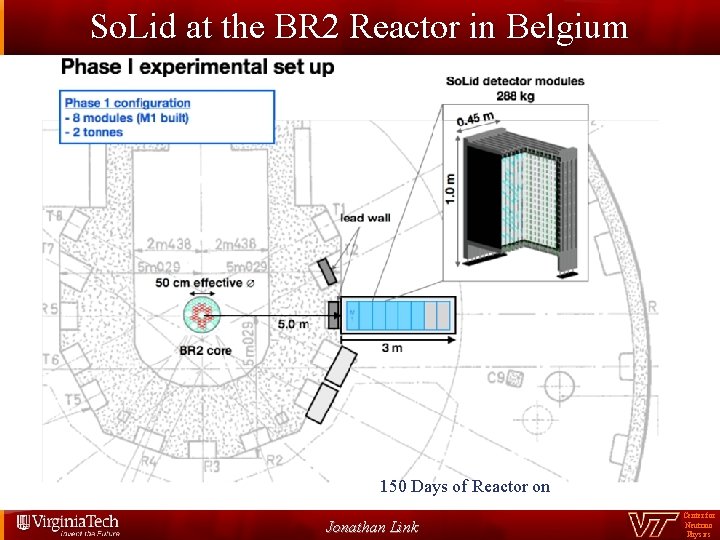
So. Lid at the BR 2 Reactor in Belgium 150 Days of Reactor on Jonathan Link Center for Neutrino Physics
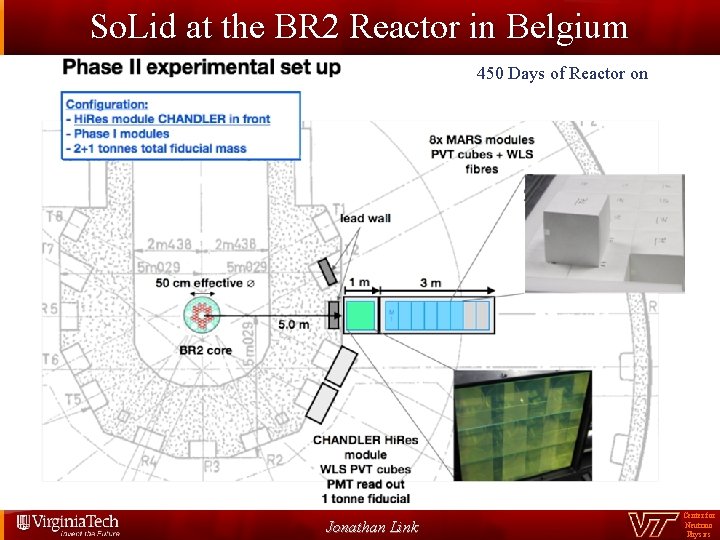
So. Lid at the BR 2 Reactor in Belgium 450 Days of Reactor on Jonathan Link Center for Neutrino Physics
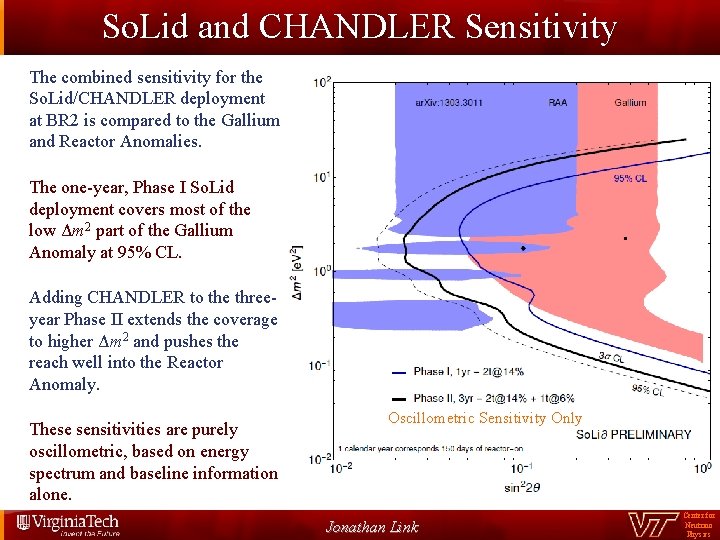
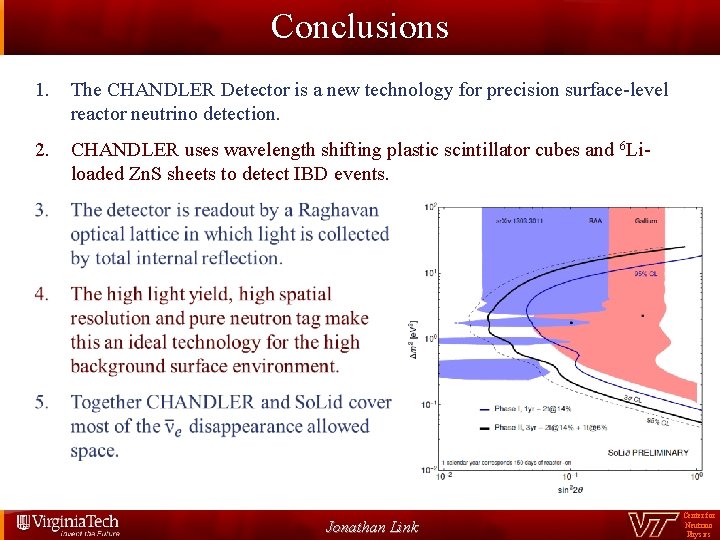
So. Lid and CHANDLER Sensitivity The combined sensitivity for the So. Lid/CHANDLER deployment at BR 2 is compared to the Gallium and Reactor Anomalies. The one-year, Phase I So. Lid deployment covers most of the low Δm 2 part of the Gallium Anomaly at 95% CL. Adding CHANDLER to the threeyear Phase II extends the coverage to higher Δm 2 and pushes the reach well into the Reactor Anomaly. These sensitivities are purely oscillometric, based on energy spectrum and baseline information alone. Oscillometric Sensitivity Only Jonathan Link Center for Neutrino Physics
Conclusions 1. The CHANDLER Detector is a new technology for precision surface-level reactor neutrino detection. 2. CHANDLER uses wavelength shifting plastic scintillator cubes and 6 Liloaded Zn. S sheets to detect IBD events. Jonathan Link Center for Neutrino Physics
Jonathan Link Center for Neutrino Physics
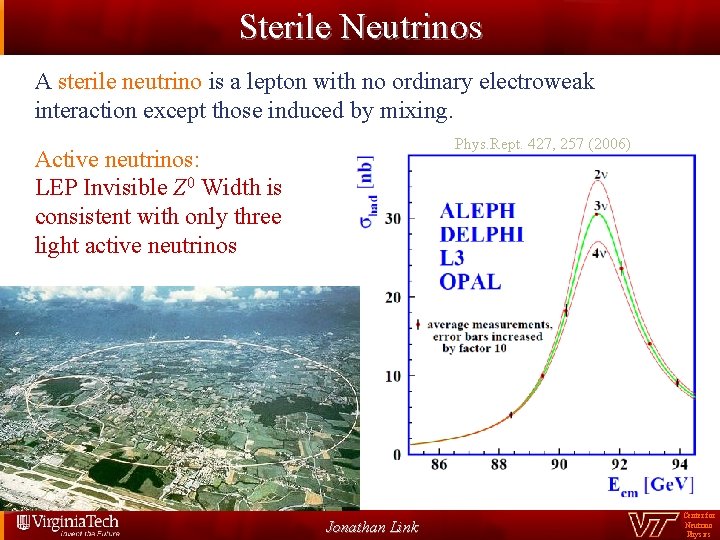
Sterile Neutrinos A sterile neutrino is a lepton with no ordinary electroweak interaction except those induced by mixing. Phys. Rept. 427, 257 (2006) Active neutrinos: LEP Invisible Z 0 Width is consistent with only three light active neutrinos Jonathan Link Center for Neutrino Physics
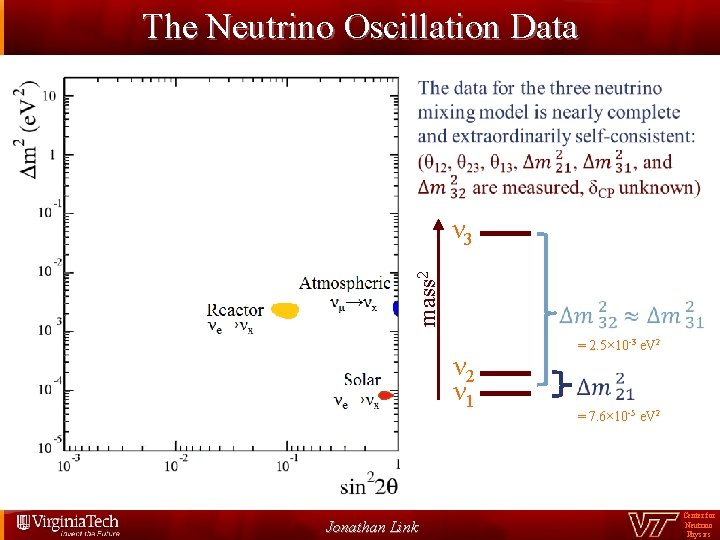
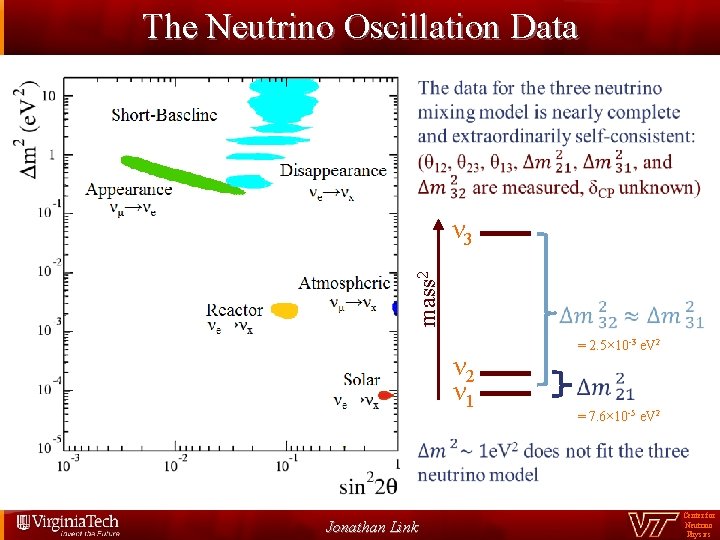
The Neutrino Oscillation Data mass 2 ν 3 ν 2 ν 1 Jonathan Link = 2. 5× 10 -3 e. V 2 = 7. 6× 10 -5 e. V 2 Center for Neutrino Physics
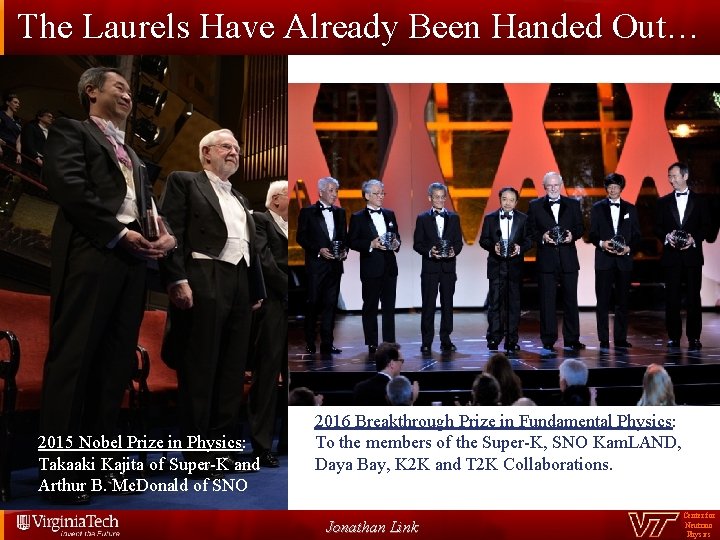
The Laurels Have Already Been Handed Out… 2015 Nobel Prize in Physics: Takaaki Kajita of Super-K and Arthur B. Mc. Donald of SNO 2016 Breakthrough Prize in Fundamental Physics: To the members of the Super-K, SNO Kam. LAND, Daya Bay, K 2 K and T 2 K Collaborations. Jonathan Link Center for Neutrino Physics
The Neutrino Oscillation Data mass 2 ν 3 ν 2 ν 1 Jonathan Link = 2. 5× 10 -3 e. V 2 = 7. 6× 10 -5 e. V 2 Center for Neutrino Physics
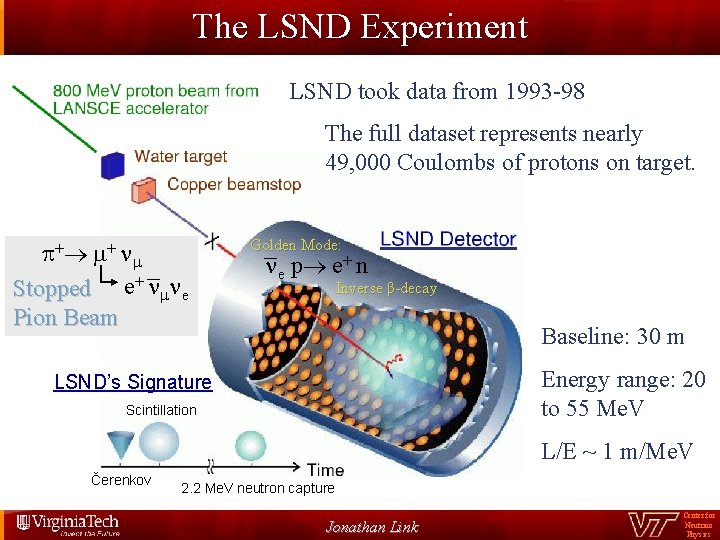
The LSND Experiment LSND took data from 1993 -98 The full dataset represents nearly 49, 000 Coulombs of protons on target. p + m+ n m Stopped e+ nmne Pion Beam Golden Mode: ne p e+ n Inverse β-decay Baseline: 30 m Energy range: 20 to 55 Me. V LSND’s Signature Scintillation L/E ~ 1 m/Me. V Čerenkov 2. 2 Me. V neutron capture Jonathan Link Center for Neutrino Physics
LSND νμ→ νe Appearance Aguilar-Arevalo et al. , Phys. Rev. D 64, 112007 (2001) Event Excess: 32. 2 ± 9. 4 ± 2. 3 Jonathan Link Center for Neutrino Physics
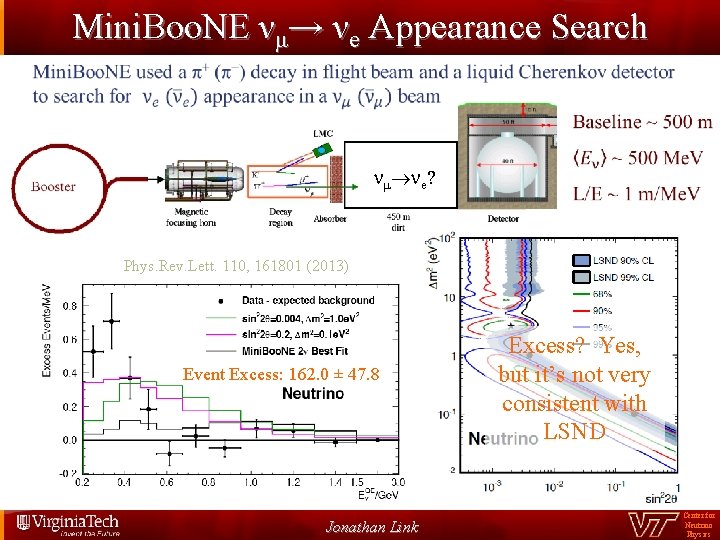
Mini. Boo. NE νμ→ νe Appearance Search nm ne? Phys. Rev. Lett. 110, 161801 (2013) Event Excess: 78. 4 ± 28. 5 Jonathan Link Center for Neutrino Physics
Mini. Boo. NE νμ→ νe Appearance Search nm ne? Phys. Rev. Lett. 110, 161801 (2013) Event Excess: 162. 0 ± 47. 8 Jonathan Link Excess? Yes, but it’s not very consistent with LSND Center for Neutrino Physics
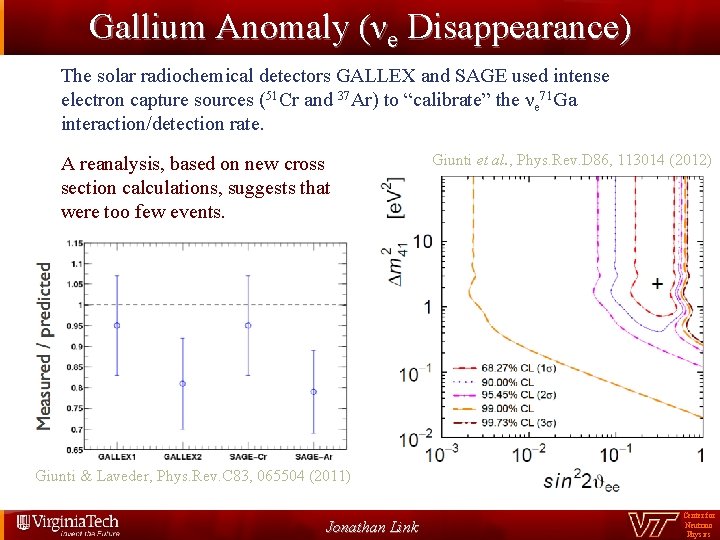
Gallium Anomaly (νe Disappearance) The solar radiochemical detectors GALLEX and SAGE used intense electron capture sources (51 Cr and 37 Ar) to “calibrate” the νe 71 Ga interaction/detection rate. A reanalysis, based on new cross section calculations, suggests that were too few events. Giunti et al. , Phys. Rev. D 86, 113014 (2012) Giunti & Laveder, Phys. Rev. C 83, 065504 (2011) Jonathan Link Center for Neutrino Physics
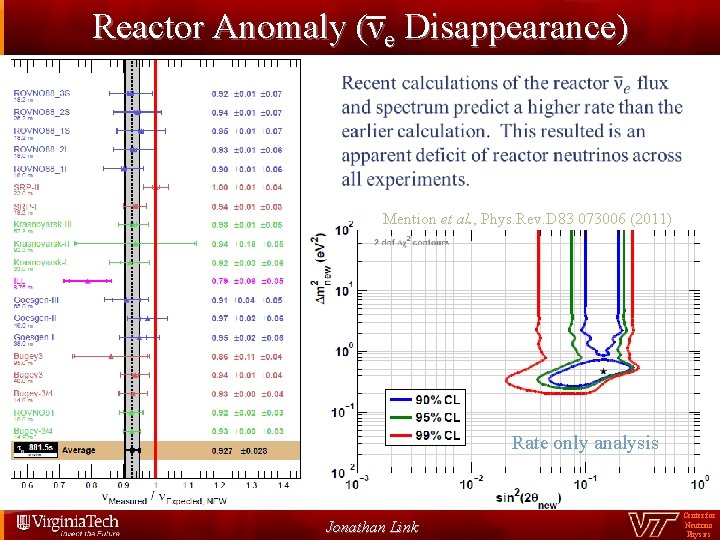
Reactor Anomaly (νe Disappearance) Mention et al. , Phys. Rev. D 83 073006 (2011) Rate only analysis Jonathan Link Center for Neutrino Physics
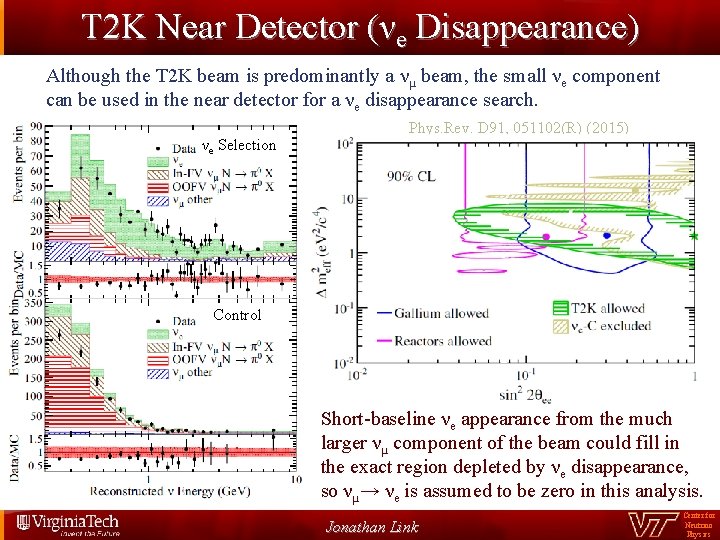
T 2 K Near Detector (νe Disappearance) Although the T 2 K beam is predominantly a νμ beam, the small νe component can be used in the near detector for a νe disappearance search. νe Selection Phys. Rev. D 91, 051102(R) (2015) Control Short-baseline νe appearance from the much larger νμ component of the beam could fill in the exact region depleted by νe disappearance, so νμ→ νe is assumed to be zero in this analysis. Jonathan Link Center for Neutrino Physics
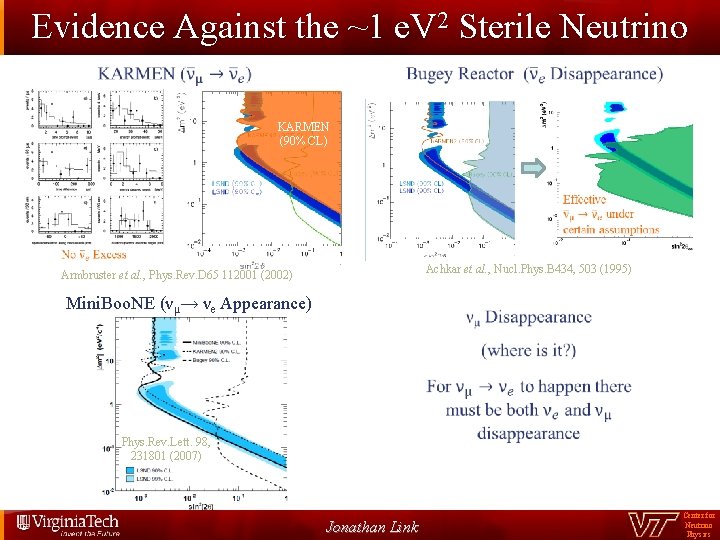
Evidence Against the ~1 e. V 2 Sterile Neutrino KARMEN (90% CL) Achkar et al. , Nucl. Phys. B 434, 503 (1995) Armbruster et al. , Phys. Rev. D 65 112001 (2002) Mini. Boo. NE (νμ→ νe Appearance) Phys. Rev. Lett. 98, 231801 (2007) Jonathan Link Center for Neutrino Physics
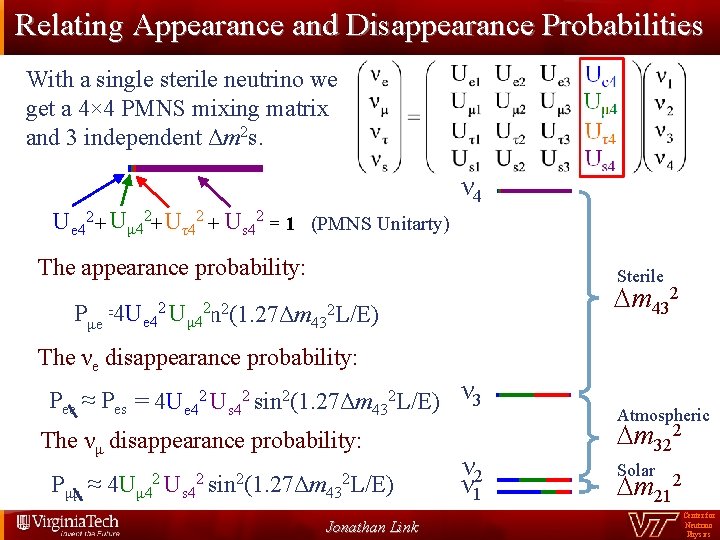
Relating Appearance and Disappearance Probabilities With a single sterile neutrino we get a 4× 4 PMNS mixing matrix and 3 independent Δm 2 s. ν 4 Ue 42 + Uμ 42+ Uτ42 + Us 42 = 1 (PMNS Unitarty) The appearance probability: Sterile Dm 432 22 U 2 2 Pμe =4 Usin (1. 27Δm 432 L/E) e 4 2θ μ 4 The νe disappearance probability: 2 P 2 sin 2(1. 27Δm 2 L/E) ν 3 = Pes + + Pee ≈ =P 4 U U eμ e 4 eτs 4 43 The νμ disappearance probability: Pμμ ≈ 4 Uμ 42 Us 42 sin 2(1. 27Δm 432 L/E) Jonathan Link ν 2 ν 1 Atmospheric Dm 322 Solar Dm 212 Center for Neutrino Physics
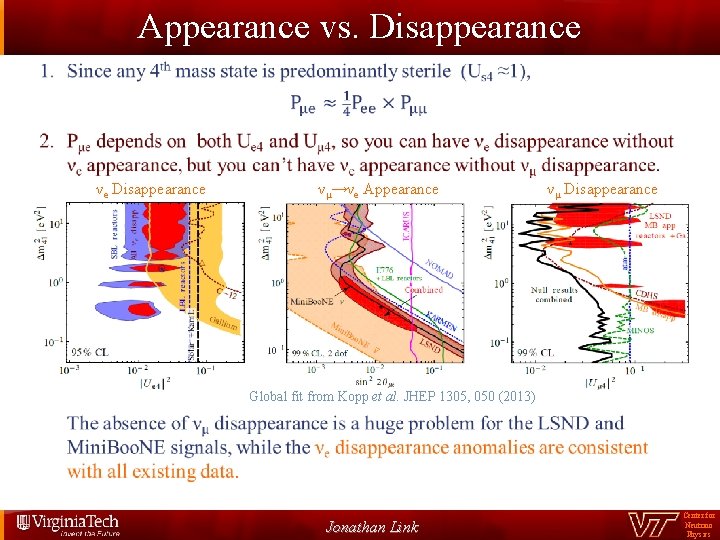
Appearance vs. Disappearance νe Disappearance νμ→νe Appearance νμ Disappearance Global fit from Kopp et al. JHEP 1305, 050 (2013) Jonathan Link Center for Neutrino Physics
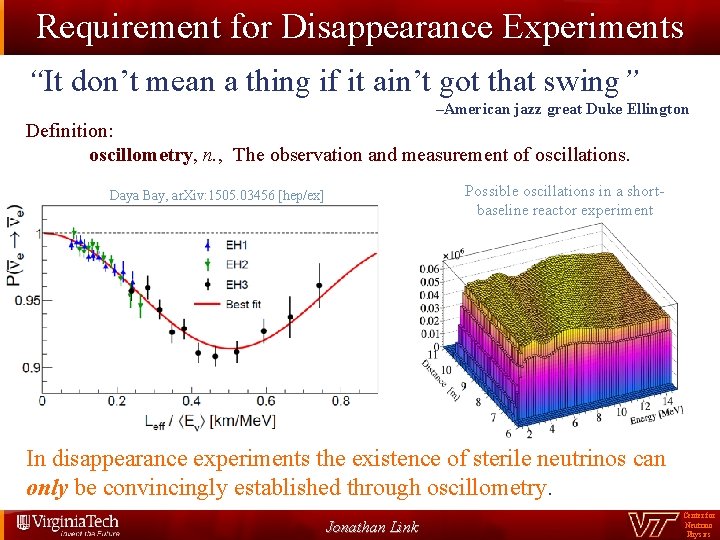
Requirement for Disappearance Experiments “It don’t mean a thing if it ain’t got that swing” –American jazz great Duke Ellington Definition: oscillometry, n. , The observation and measurement of oscillations. Possible oscillations in a shortbaseline reactor experiment Daya Bay, ar. Xiv: 1505. 03456 [hep/ex] In disappearance experiments the existence of sterile neutrinos can only be convincingly established through oscillometry. Jonathan Link Center for Neutrino Physics
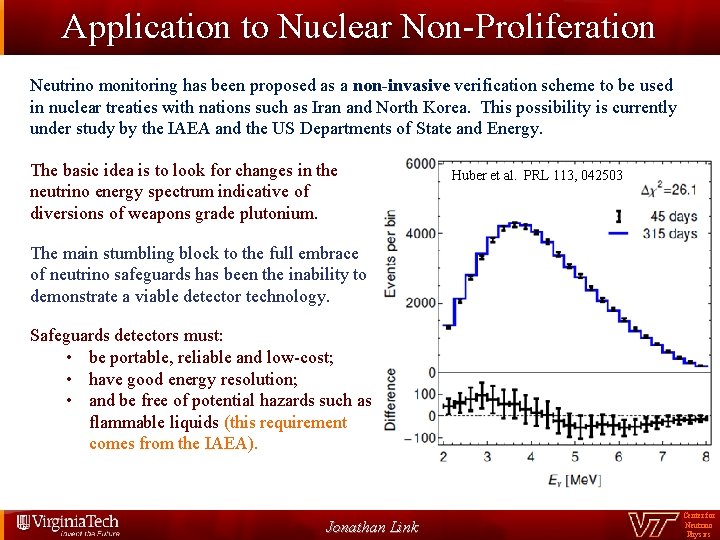
Application to Nuclear Non-Proliferation Neutrino monitoring has been proposed as a non-invasive verification scheme to be used in nuclear treaties with nations such as Iran and North Korea. This possibility is currently under study by the IAEA and the US Departments of State and Energy. The basic idea is to look for changes in the neutrino energy spectrum indicative of diversions of weapons grade plutonium. Huber et al. PRL 113, 042503 The main stumbling block to the full embrace of neutrino safeguards has been the inability to demonstrate a viable detector technology. Safeguards detectors must: • be portable, reliable and low-cost; • have good energy resolution; • and be free of potential hazards such as flammable liquids (this requirement comes from the IAEA). Jonathan Link Center for Neutrino Physics