
CHAMPLAIN THE FATHER OF NEW FRANCE The beginning
CHAMPLAIN: THE FATHER OF NEW FRANCE The beginning of the French Regime
ECONOMIC REASONS FOR NEW FRANCE • France's main interest in North America was economic • As long as the fisheries were the most lucrative resources and after the failures of Cartier, France lost interest in N. America • In the l 600's the demand for furs changes this, causing the king of France to renew his interest in N. America • Due to his lack of funding he made a deal with merchants for Monopoly trading rights in return for
FIRST ATTEMPT AT SETTLEMENT • The first to receive trading rights to the Atlantic region in Canada was Pierre du Gua de Monts • He was given these rights in return for a promise to settle 60 men a year for 10 years • In 1604 de Monts and 78 colonists (one of which was Champlain) wintered on an island near the border of Maine • The winter defeated this attempt with 35 men dying of scurvy • He then moved the remainder of his men and new colonists to the Annapolis valley • This settlement was named Port Royal
CHAMPLAIN AND THE 100 ASSOCIATES • In 1608 Champlain went to France and convinced the aristocracy to invest in North America • He convinced them that the settlement would pay dividends through a NW passage to the Orient and Mineral discoveries • Due to his efforts a new monopoly was created with Champlain as its lieutenant • Champlain learned from the first trial that he needed a more central location and Amerindian aid if he was to succeed • He created his settlement where modern day Quebec City resides and called it L’Habitation

CHAMPLAIN IS KNOWN AS THE FATHER OF NEW FRANCE • Champlain during his life explored and Mapped much of the St. Lawrence area • Although Champlain was never the official Governor of the colony he was responsible for civil administration, enforcing the King's law, and overseeing relationships with Amerindians • He also invested a lot of money into the settlement and convinced people in France to do the same
COLONIAL CANADA • A colony is a land which is settled and ruled by another country • During the time of Champlain there were 2 views of colonization
VIEW 1: TRADING COLONY • The first view was that colonies were only there to enrich the home or mother country (mercantilism) • They did not believe in building a society but in exploiting the resources of the new land • This was the idea shared by the companies given monopolies in North America and the Kings of France, Portugal and Spain • Since the Companies saw Canada as a source of furs they did not want settlements as they would chase away fur bearing animals and compete with securing the resource • Thus, they only wanted a small number of outposts which could be run by a minimal amount of people
VIEW 2: SETTLEMENT COLONY • Other people including the religious orders wanted a colony which was settled and developed in as close a copy of the home country as was possible • This model of colonization called for as many farmers, merchants, priests, soldiers and administrators as possible • They wanted the colony to be as successful as possible
HISTORICAL RESULT • France followed the first path while Britain followed the second • France created several outposts along the St. Lawrence and named these areas New France • The British created 13 colonies which consisted of many towns and villages • The British gained much wealth because they were able to collect many taxes and had a larger work force to exploit natural resources • In 1663 the King takes direct control of New France to change it into a settlement colony
WHAT IS MERCANTILISM? • Mercantilism was an economic policy, popular in the 17 th and 18 th centuries in Europe • stated that a country's wealth and power was best served through the accumulation of gold and silver and raw materials. • Because most nations did not have a natural abundance of such precious metals, the best way to acquire them was through trade. • This meant striving for a favorable trade balance, that is, a surplus of exports over imports. Foreign states would then have to pay for imports in gold or silver. • State action, an essential feature of the mercantile system, was used to accomplish its purposes - to sell more than it bought to accumulate gold bullion and raw materials.
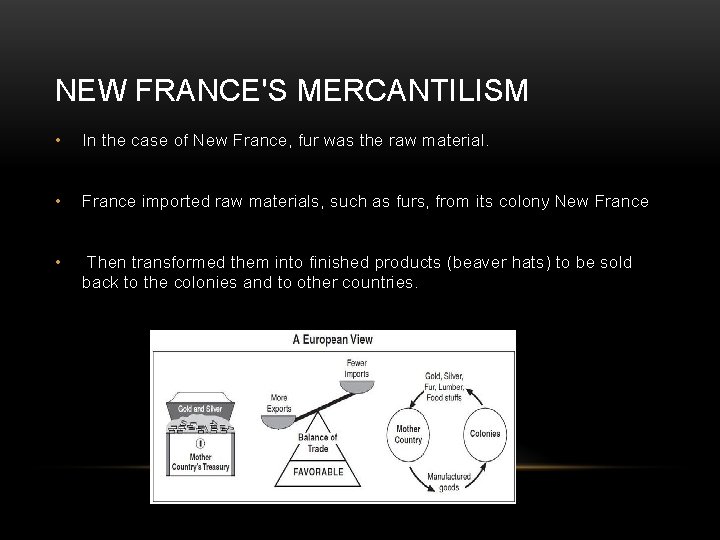
NEW FRANCE'S MERCANTILISM • In the case of New France, fur was the raw material. • France imported raw materials, such as furs, from its colony New France • Then transformed them into finished products (beaver hats) to be sold back to the colonies and to other countries.
CONSEQUENCES OF MERCANTILISM ON NEW FRANCE • New France became a trading colony whose main economic role was to supply furs to the mother country and to purchase manufactured products from the mother country. • This limited the types of Companies that could be run here and kept New France dependent on France • Furs account for more than 70% of the colony's exports and the fur trade is directly responsible for the large expansion of territory
- Slides: 12