
Championing Smart and Sustainable Solid Waste Management in
Championing Smart and Sustainable Solid Waste Management in MMR Landfill Waste Pollution and Control 1 09. 01. 2020
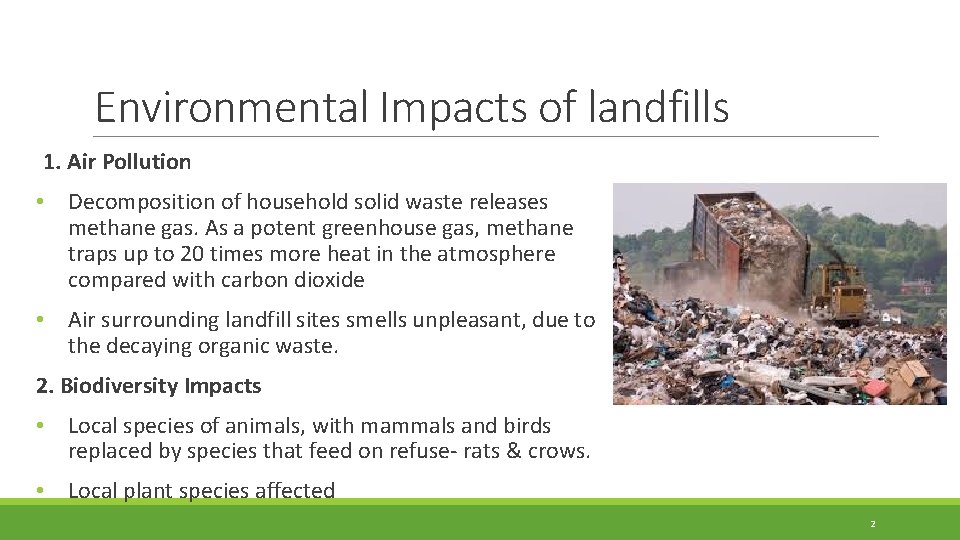
Environmental Impacts of landfills 1. Air Pollution • Decomposition of household solid waste releases methane gas. As a potent greenhouse gas, methane traps up to 20 times more heat in the atmosphere compared with carbon dioxide • Air surrounding landfill sites smells unpleasant, due to the decaying organic waste. 2. Biodiversity Impacts • Local species of animals, with mammals and birds replaced by species that feed on refuse- rats & crows. • Local plant species affected 2
Environmental Impacts of landfills 3. Groundwater Pollution • As rain falls on landfill sites, organic and inorganic constituents dissolve, forming highly toxic chemicals leaching into groundwater. • Water that rinses through these chemicals collects at the base of the landfill and usually contains high levels of toxic metals, ammonia, toxic organic compounds and pathogens. • This can result in serious contamination of the local groundwater. Even more dangers, this mixture usually creates a high biological oxygen demand, meaning it can quickly de-oxygenate water. 3
Environmental Impacts of landfills 4. Soil Fertility Effects • Mixture of toxic substances and decaying organic material can impact the soil quality of the areas surrounding a landfill site. • This can compound the effects on biodiversity as local vegetation may cease to grow and be permanently altered. 5. Visual and Health Impacts • Impact on natural landscape: they stink, they are trashy looking and a become a bacteria breeding ground. The smell, traffic, noise and vermin that accompany landfills can lower house prices 4
Environmental Acts / Rules related with Waste Management � The Hazardous & Other Wastes (M&TM) Rules, 2016. � The Solid Waste Management Rules, 2016. � The E-Waste (Management) Rules, 2016. � The Plastic Waste Management Rules 2016. � The Construction and Demolition Waste Management Rules, 2016. � The Bio-Medical Waste Management Rules, 2016 5
Regulations related to waste • Solid waste and plastic waste in India regulated by Solid Waste Management Rules, 2016 and Plastic Waste Management Rules, 2016 • Responsibilities of each stakeholder such as generator, local bodies, Urban local bodies, plastic producers etc. is well-defined in these rules • Solid waste- Duties are being fixed on waste generators to segregate waste at source in three bin system bio degradable, non-bio degradable & domestic hazardous waste. • Plastic waste- Extended Producer Responsibility on the plastic producers/ brand owners for management of their plastic waste introduced 6
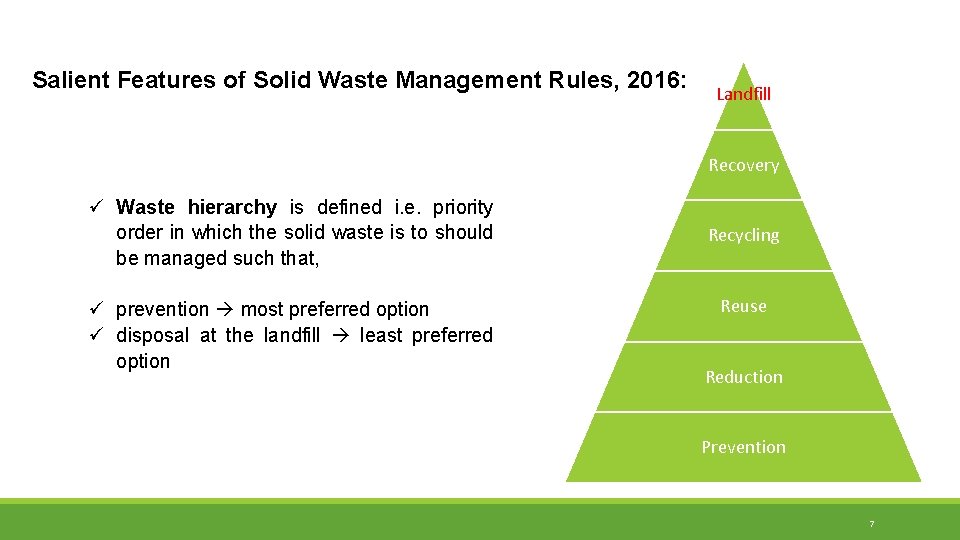
Salient Features of Solid Waste Management Rules, 2016: Landfill Recovery ü Waste hierarchy is defined i. e. priority order in which the solid waste is to should be managed such that, ü prevention most preferred option ü disposal at the landfill least preferred option Recycling Reuse Reduction Prevention 7

Salient Features of Solid Waste Management Rules, 2016 wrt landfilling • Urban Development Authorities While preparing State policy and strategy on solid waste management, follow waste hierarchy to ensure minimisation of waste going to the landfill and minimise impact of solid waste on human health and environment; • Local Authorities • • Stop land filling or dumping of mixed waste after timeline specified for setting up and operationalization of sanitary landfill is over Allow only non-usable, non-recyclable, non-biodegradable, non-combustible and non-reactive inert waste and pre-processing rejects and residues from waste processing facilities to go to sanitary landfill and the sanitary landfill sites shall meet the specifications 8
Salient Features of Solid Waste Management Rules, 2016 wrt landfilling • The Rules have specified specifications for sanitary landfills • Criteria for site selection, facilities at the site, operation of landfills and scientific closure • Criteria for pollution prevention, water quality and ambient air quality monitoring 9

Sanitary Landfills • Sanitary landfills are sites where waste is isolated from the environment until it is safe. • It is considered when it has completely degraded biologically, chemically and physically. • Full or partial hydrogeological isolation • Formal engineering preparations • Permanent control • Planned waste emplacement and covering 10
CPCB guidelines for disposal of Legacy waste • Guidelines published by CPCB in February 2019 • Treatment & disposal can be done by • • Bio-remediation Bio-mining • Excavation of old dumped waste and make windrow of legacy waste, thereafter stabilization of waste through bio-remediation • Screening of stabilized waste to recover valuable resources (organic fines, bricks, plastic, metal, cloth etc. ) • Costs for operation and maintenance 400 -700 Rs/ m 3 onsite (capital cost extra) 11
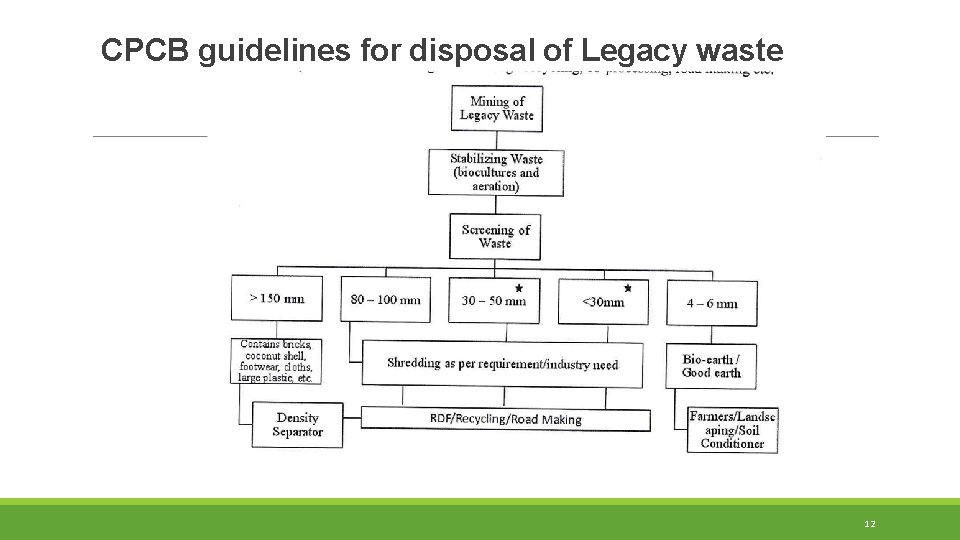
CPCB guidelines for disposal of Legacy waste 12
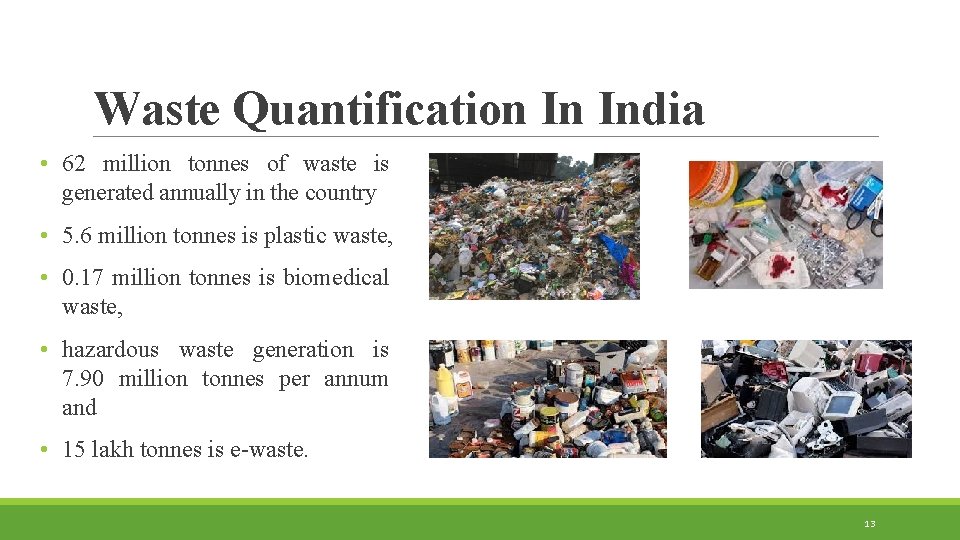
Waste Quantification In India • 62 million tonnes of waste is generated annually in the country • 5. 6 million tonnes is plastic waste, • 0. 17 million tonnes is biomedical waste, • hazardous waste generation is 7. 90 million tonnes per annum and • 15 lakh tonnes is e-waste. 13
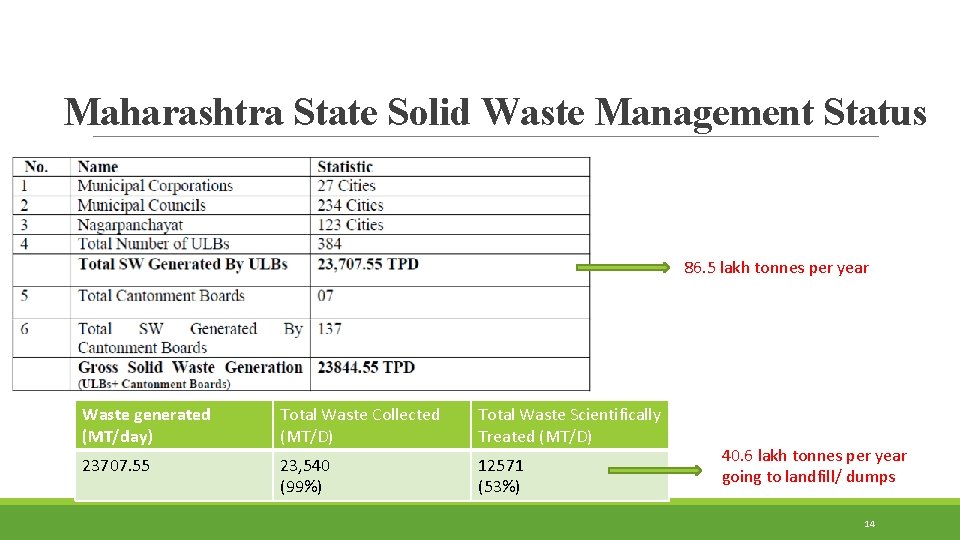
Maharashtra State Solid Waste Management Status 86. 5 lakh tonnes per year Waste generated (MT/day) Total Waste Collected (MT/D) Total Waste Scientifically Treated (MT/D) 23707. 55 23, 540 (99%) 12571 (53%) 40. 6 lakh tonnes per year going to landfill/ dumps 14
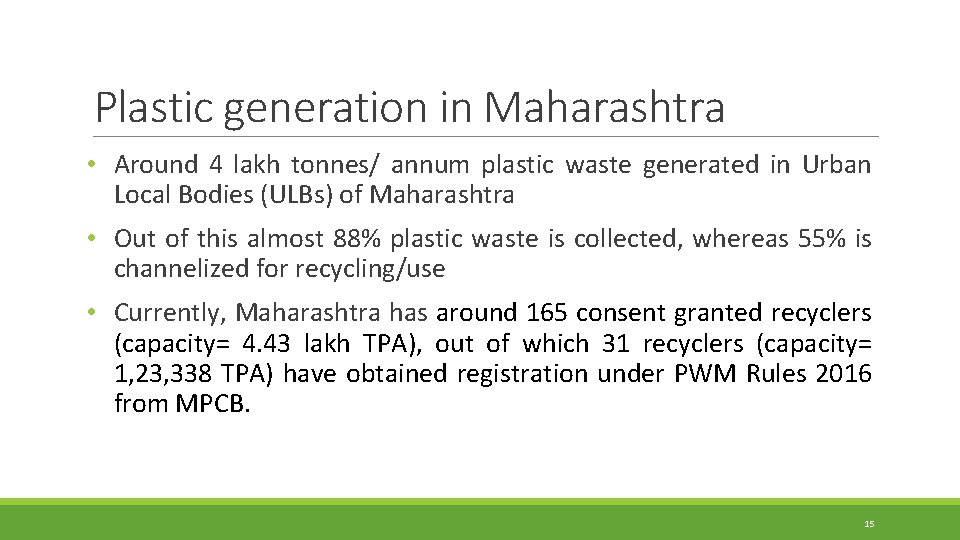
Plastic generation in Maharashtra • Around 4 lakh tonnes/ annum plastic waste generated in Urban Local Bodies (ULBs) of Maharashtra • Out of this almost 88% plastic waste is collected, whereas 55% is channelized for recycling/use • Currently, Maharashtra has around 165 consent granted recyclers (capacity= 4. 43 lakh TPA), out of which 31 recyclers (capacity= 1, 23, 338 TPA) have obtained registration under PWM Rules 2016 from MPCB. 15
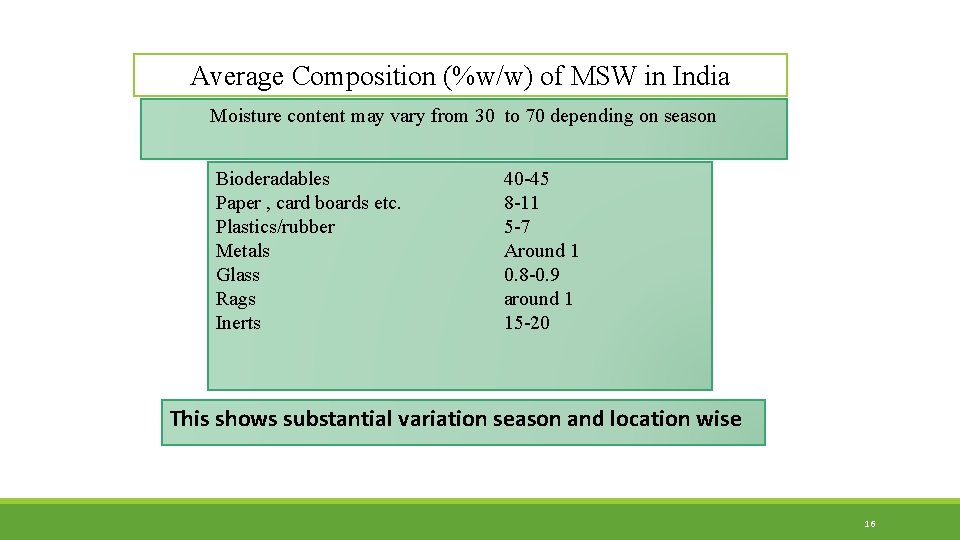
Average Composition (%w/w) of MSW in India Moisture content may vary from 30 to 70 depending on season Bioderadables Paper , card boards etc. Plastics/rubber Metals Glass Rags Inerts 40 -45 8 -11 5 -7 Around 1 0. 8 -0. 9 around 1 15 -20 This shows substantial variation season and location wise 16
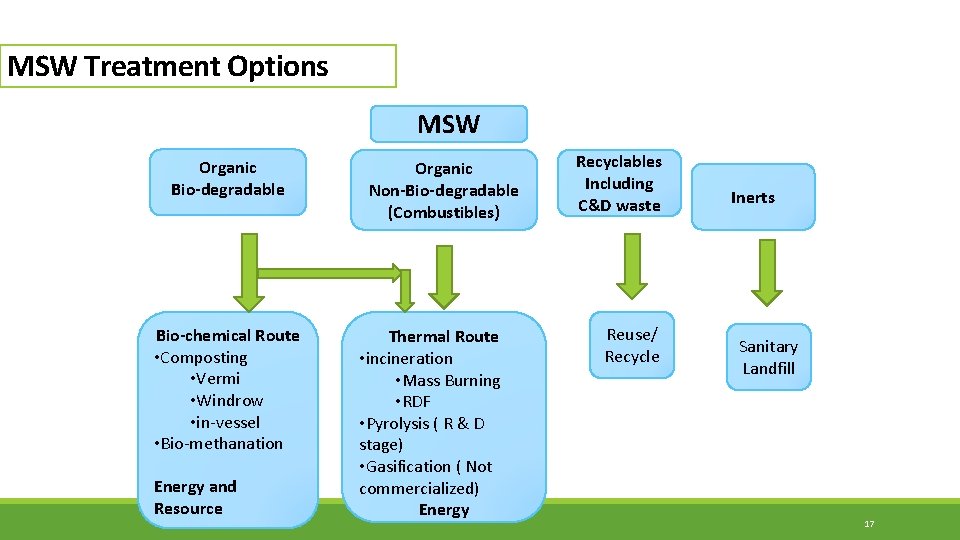
MSW Treatment Options MSW Organic Bio-degradable Bio-chemical Route • Composting • Vermi • Windrow • in-vessel • Bio-methanation Energy and Resource Organic Non-Bio-degradable (Combustibles) Thermal Route • incineration • Mass Burning • RDF • Pyrolysis ( R & D stage) • Gasification ( Not commercialized) Energy Recyclables Including C&D waste Reuse/ Recycle Inerts Sanitary Landfill 17
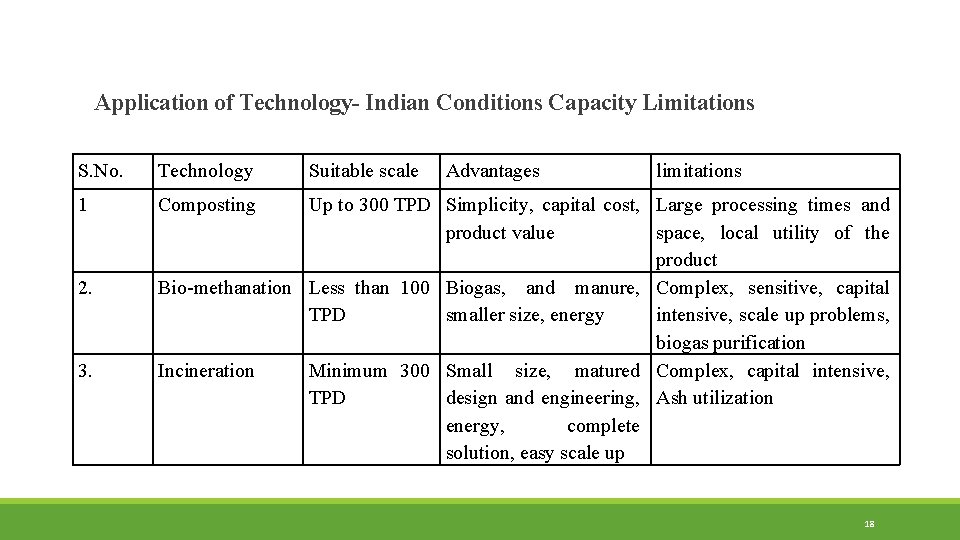
Application of Technology- Indian Conditions Capacity Limitations S. No. Technology 1 Composting 2. 3. Suitable scale Advantages limitations Up to 300 TPD Simplicity, capital cost, Large processing times and product value space, local utility of the product Bio-methanation Less than 100 Biogas, and manure, Complex, sensitive, capital TPD smaller size, energy intensive, scale up problems, biogas purification Incineration Minimum 300 Small size, matured Complex, capital intensive, TPD design and engineering, Ash utilization energy, complete solution, easy scale up 18
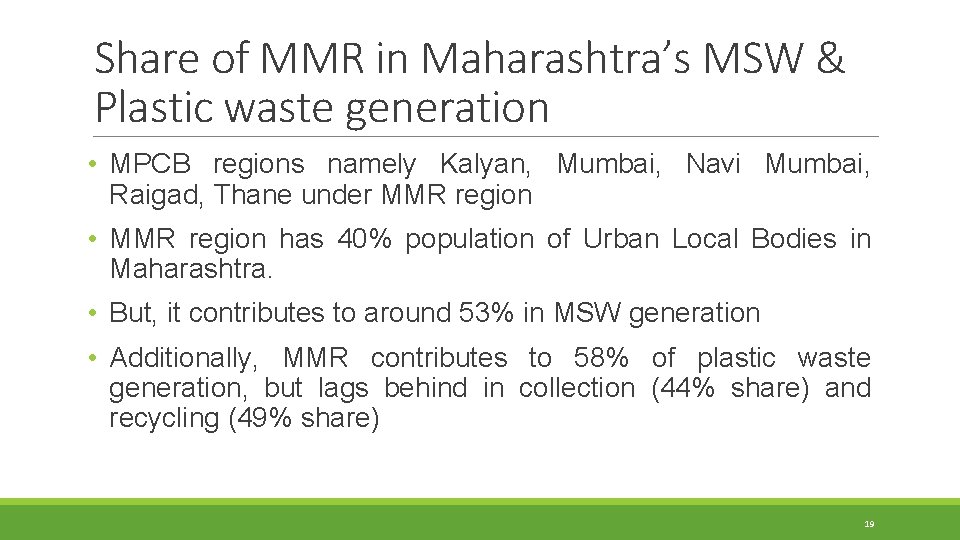
Share of MMR in Maharashtra’s MSW & Plastic waste generation • MPCB regions namely Kalyan, Mumbai, Navi Mumbai, Raigad, Thane under MMR region • MMR region has 40% population of Urban Local Bodies in Maharashtra. • But, it contributes to around 53% in MSW generation • Additionally, MMR contributes to 58% of plastic waste generation, but lags behind in collection (44% share) and recycling (49% share) 19
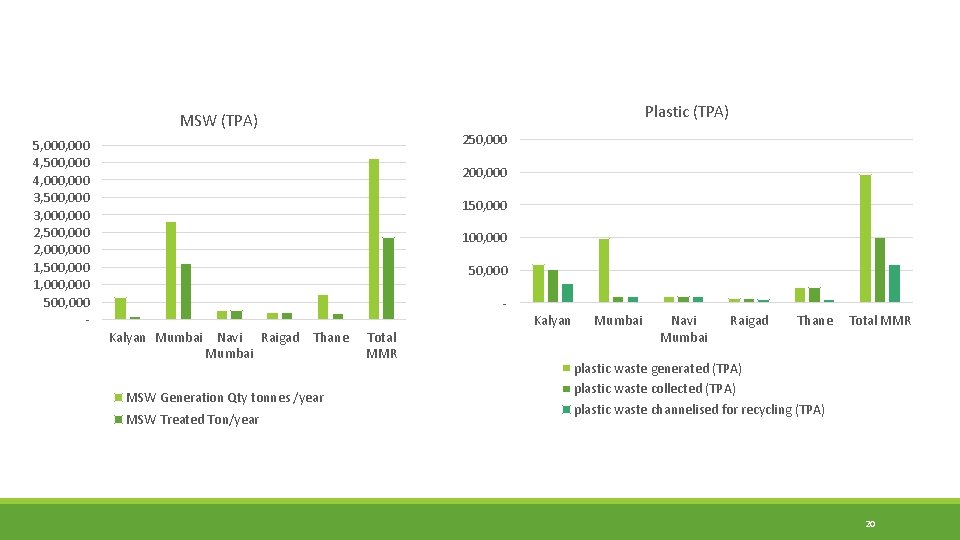
Plastic (TPA) MSW (TPA) 250, 000 5, 000 4, 500, 000 4, 000 3, 500, 000 3, 000 2, 500, 000 2, 000 1, 500, 000 1, 000 500, 000 - 200, 000 150, 000 100, 000 50, 000 Kalyan Mumbai Navi Raigad Mumbai Thane MSW Generation Qty tonnes /year MSW Treated Ton/year Total MMR Kalyan Mumbai Navi Mumbai Raigad Thane Total MMR plastic waste generated (TPA) plastic waste collected (TPA) plastic waste channelised for recycling (TPA) 20
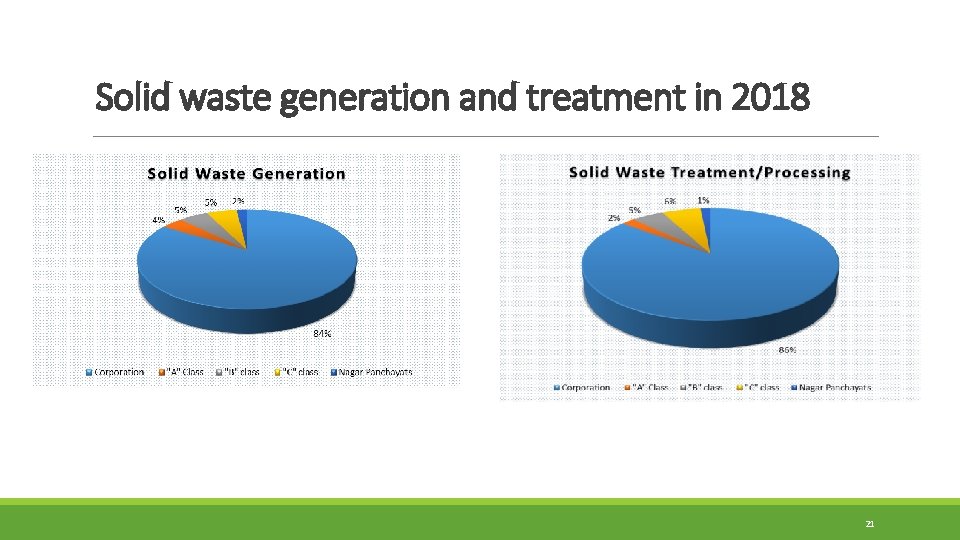
Solid waste generation and treatment in 2018 21
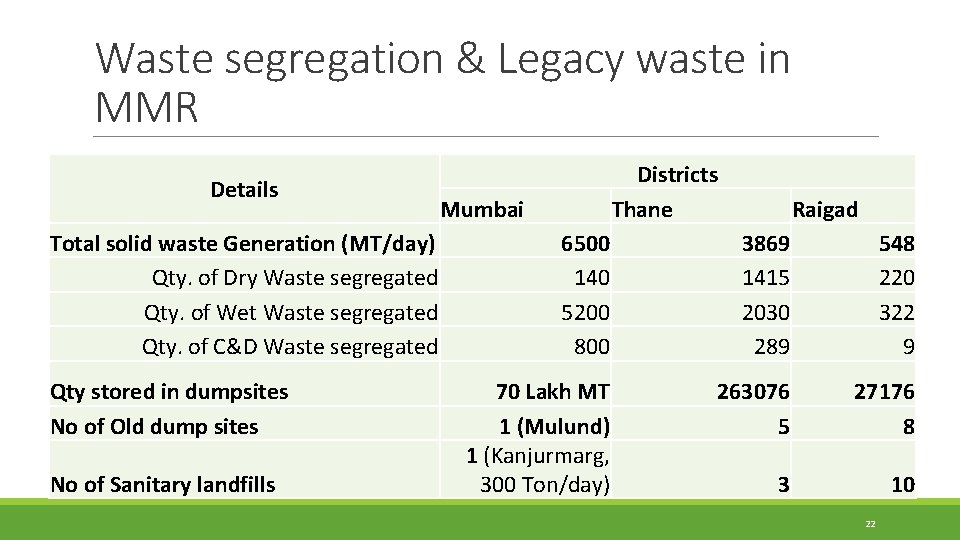
Waste segregation & Legacy waste in MMR Details Total solid waste Generation (MT/day) Qty. of Dry Waste segregated Qty. of Wet Waste segregated Qty. of C&D Waste segregated Qty stored in dumpsites No of Old dump sites No of Sanitary landfills Districts Thane Mumbai Raigad 6500 140 5200 800 3869 1415 2030 289 548 220 322 9 70 Lakh MT 1 (Mulund) 1 (Kanjurmarg, 300 Ton/day) 263076 5 27176 8 3 10 22
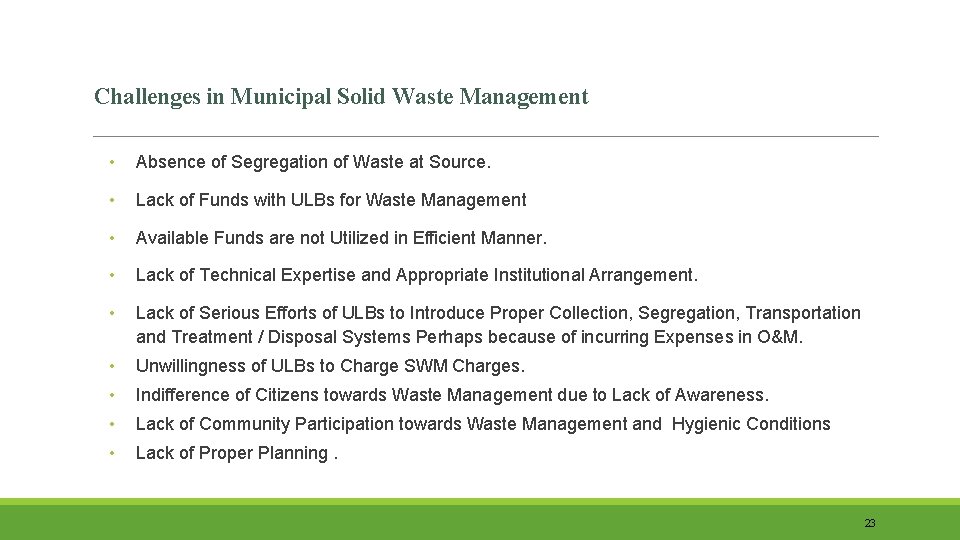
Challenges in Municipal Solid Waste Management • Absence of Segregation of Waste at Source. • Lack of Funds with ULBs for Waste Management • Available Funds are not Utilized in Efficient Manner. • Lack of Technical Expertise and Appropriate Institutional Arrangement. • Lack of Serious Efforts of ULBs to Introduce Proper Collection, Segregation, Transportation and Treatment / Disposal Systems Perhaps because of incurring Expenses in O&M. • Unwillingness of ULBs to Charge SWM Charges. • Indifference of Citizens towards Waste Management due to Lack of Awareness. • Lack of Community Participation towards Waste Management and Hygienic Conditions • Lack of Proper Planning. 23
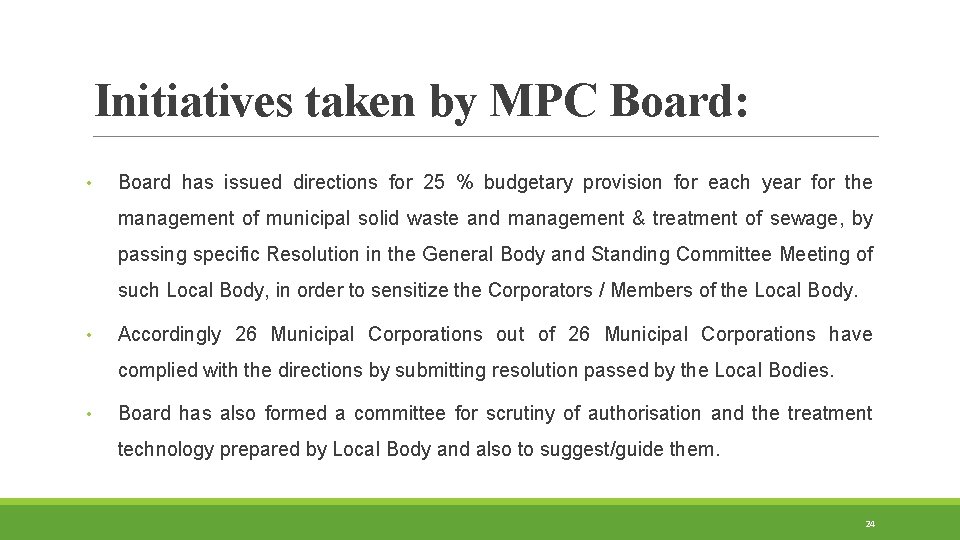
Initiatives taken by MPC Board: • Board has issued directions for 25 % budgetary provision for each year for the management of municipal solid waste and management & treatment of sewage, by passing specific Resolution in the General Body and Standing Committee Meeting of such Local Body, in order to sensitize the Corporators / Members of the Local Body. • Accordingly 26 Municipal Corporations out of 26 Municipal Corporations have complied with the directions by submitting resolution passed by the Local Bodies. • Board has also formed a committee for scrutiny of authorisation and the treatment technology prepared by Local Body and also to suggest/guide them. 24
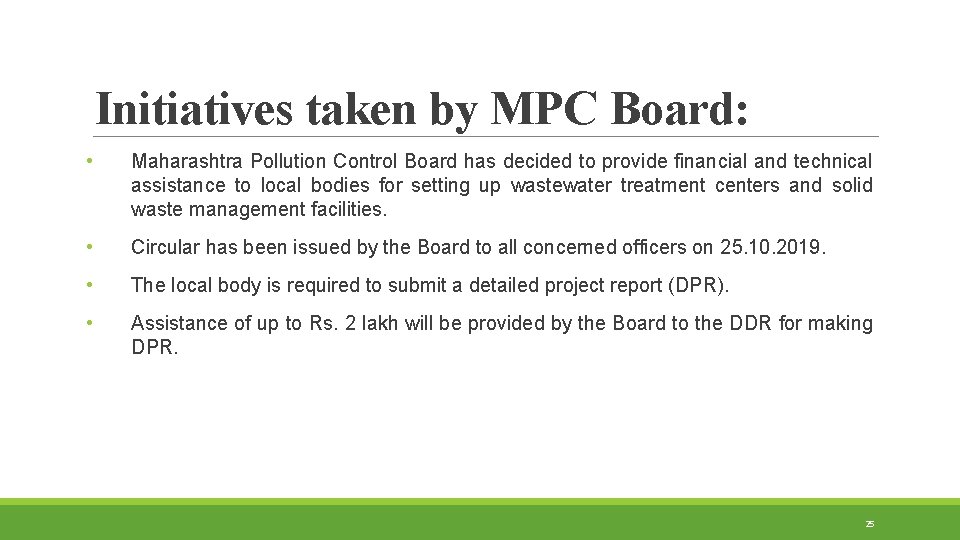
Initiatives taken by MPC Board: • Maharashtra Pollution Control Board has decided to provide financial and technical assistance to local bodies for setting up wastewater treatment centers and solid waste management facilities. • Circular has been issued by the Board to all concerned officers on 25. 10. 2019. • The local body is required to submit a detailed project report (DPR). • Assistance of up to Rs. 2 lakh will be provided by the Board to the DDR for making DPR. 25
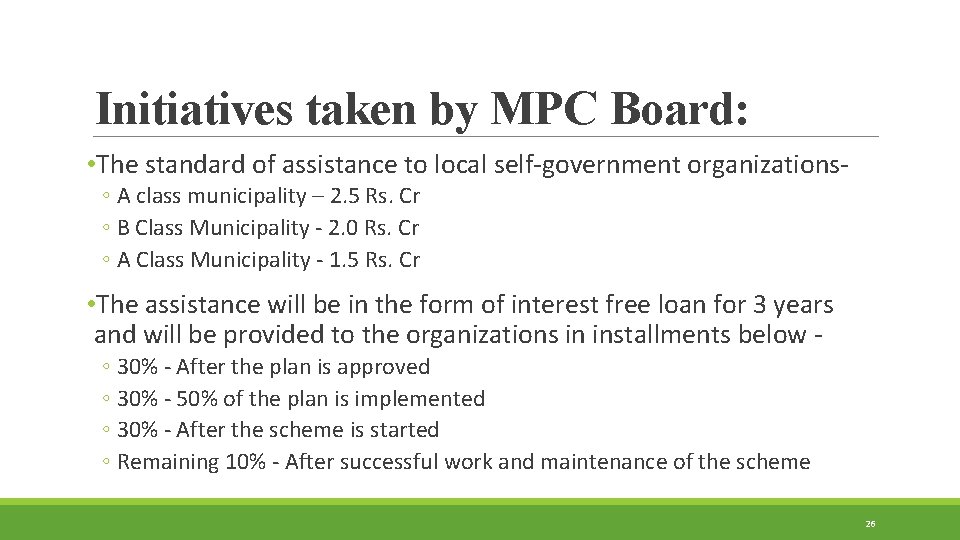
Initiatives taken by MPC Board: • The standard of assistance to local self-government organizations◦ A class municipality – 2. 5 Rs. Cr ◦ B Class Municipality - 2. 0 Rs. Cr ◦ A Class Municipality - 1. 5 Rs. Cr • The assistance will be in the form of interest free loan for 3 years and will be provided to the organizations in installments below ◦ 30% - After the plan is approved ◦ 30% - 50% of the plan is implemented ◦ 30% - After the scheme is started ◦ Remaining 10% - After successful work and maintenance of the scheme 26
Initiatives taken by MPC Board: • DPR prepared for all 384 ULBs by UDD for SWM management and have earmarked 2584 Rs. Cr. on the MPCB directions • Legacy waste which is MSW dumped since last many years • • • 2. 38 lakh tons legacy waste is present in Maharashtra Mumbai and Pune Regions with highest quantity of legacy waste Processing of legacy waste sites has started in Mumbai & Pune 27
Positive Implications of Plastic Rules, 2016 and MH Plastic Notification, 2018 • These 2 regulations have helped to improve plastic waste management in the state, thereby reducing plastic waste going into the land fill sites • As of now, almost 406 plastic industries have been issued closure directions by MPCB due to non-compliance with 2018 Notification • Fine of Rs. 6. 25 Cr collected in joint action with urban local bodies; banned plastic items of around 1200 tonnes seized from shops & plastic industries • Most of the EPR are planned to be implemented through PROs due to lack of experience of plastic industries in plastic waste management • PRO’s collection centers at different locations in Maharashtra 28
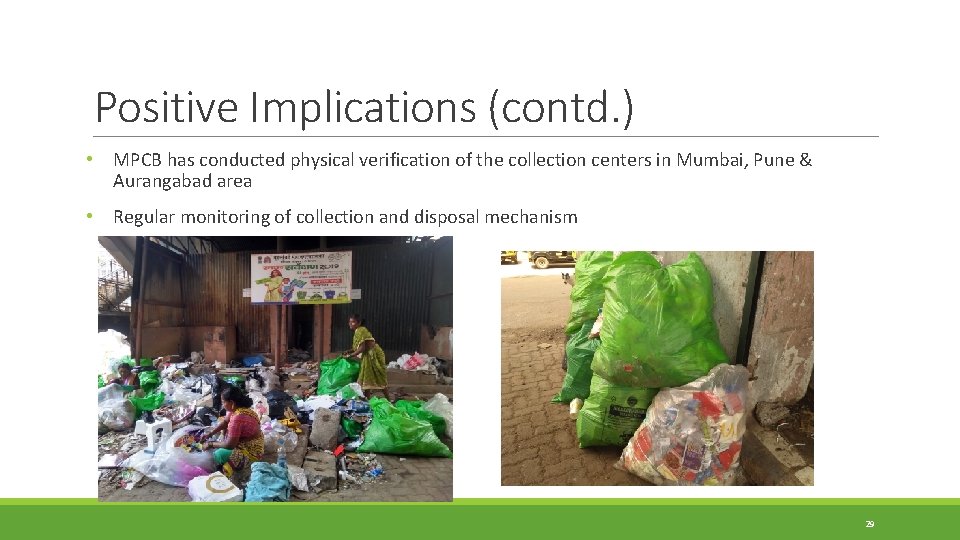
Positive Implications (contd. ) • MPCB has conducted physical verification of the collection centers in Mumbai, Pune & Aurangabad area • Regular monitoring of collection and disposal mechanism 29
Plastic waste recycling in Maharashtra • The plastic recyclers convert the plastic waste into plastic granules or flakes or fuels for further reuse in manufacturing of plastic products • The installed capacity of 24 plastic recyclers registered with MPCB= 1, 16, 381 Tonnes per annum as of September 2019. • Recycled plastic quantity through these recyclers in year FY 2017 -18 was 8, 850 Tonnes, whereas 27, 463 Tonnes were recycled in FY 2018 -19. • PROs, which are working for EPR implementation of plastic producers, have collected and processed almost 27, 000 tonnes of plastic • • 13500 tonnes for recycling of plastic 12400 tonnes as fuel in cement factories. 30
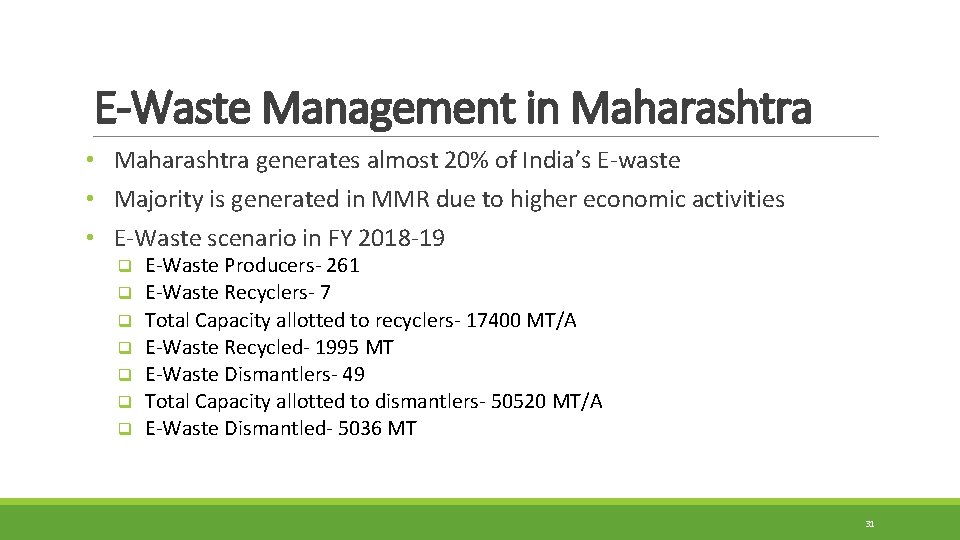
E-Waste Management in Maharashtra • Maharashtra generates almost 20% of India’s E-waste • Majority is generated in MMR due to higher economic activities • E-Waste scenario in FY 2018 -19 q q q q E-Waste Producers- 261 E-Waste Recyclers- 7 Total Capacity allotted to recyclers- 17400 MT/A E-Waste Recycled- 1995 MT E-Waste Dismantlers- 49 Total Capacity allotted to dismantlers- 50520 MT/A E-Waste Dismantled- 5036 MT 31
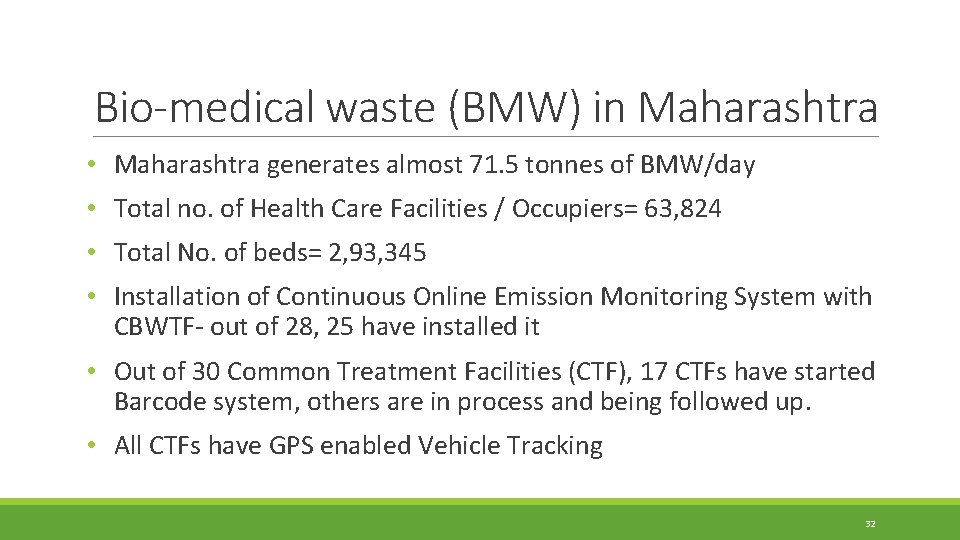
Bio-medical waste (BMW) in Maharashtra • Maharashtra generates almost 71. 5 tonnes of BMW/day • Total no. of Health Care Facilities / Occupiers= 63, 824 • Total No. of beds= 2, 93, 345 • Installation of Continuous Online Emission Monitoring System with CBWTF- out of 28, 25 have installed it • Out of 30 Common Treatment Facilities (CTF), 17 CTFs have started Barcode system, others are in process and being followed up. • All CTFs have GPS enabled Vehicle Tracking 32
Thank You… 33
- Slides: 33