
Chalmers University of Technology Lecture 4 Ideal cycles





- Slides: 16
Chalmers University of Technology Lecture 4 • Ideal cycles III – Reheat cycle – Intercool cycle • The WR 21 engine • Polytropic efficiencies • Exercise – Problem 2. 1, Problem from 2003 exam and Problem 2. 9
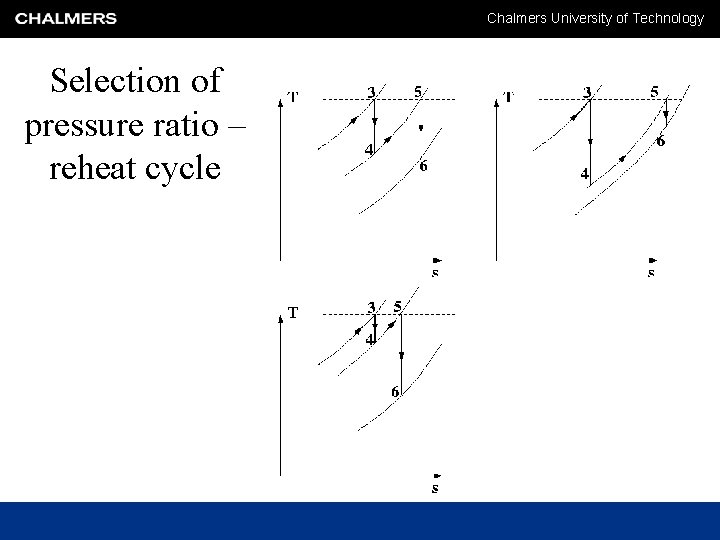
Chalmers University of Technology Reheat cycle/Reheat with heat exchanger • Split expansion into a high pressure and a low pressure step and reheat in between
Chalmers University of Technology Selection of pressure ratio – reheat cycle
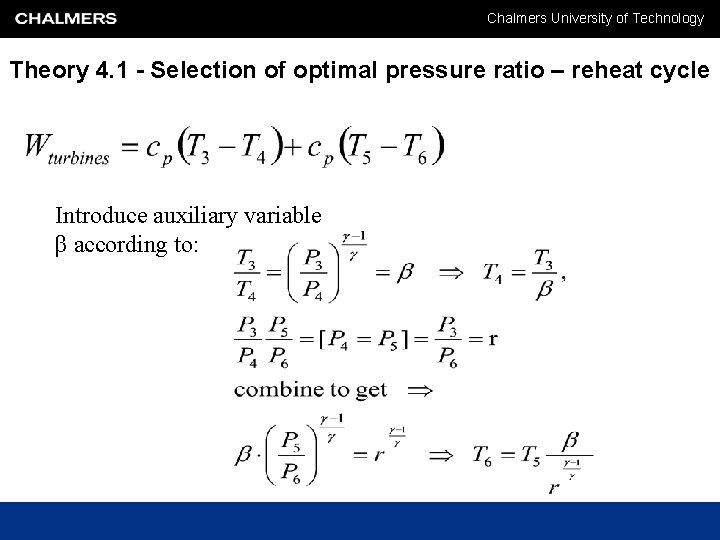
Chalmers University of Technology Theory 4. 1 - Selection of optimal pressure ratio – reheat cycle Introduce auxiliary variable β according to:
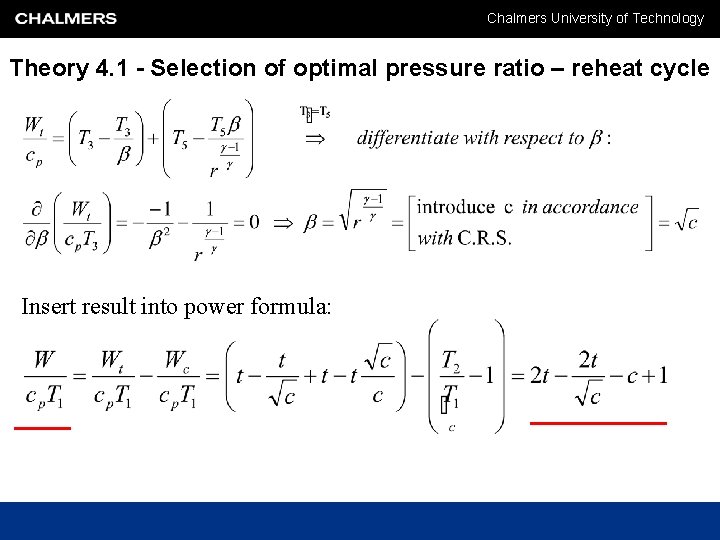
Chalmers University of Technology Theory 4. 1 - Selection of optimal pressure ratio – reheat cycle Insert result into power formula:
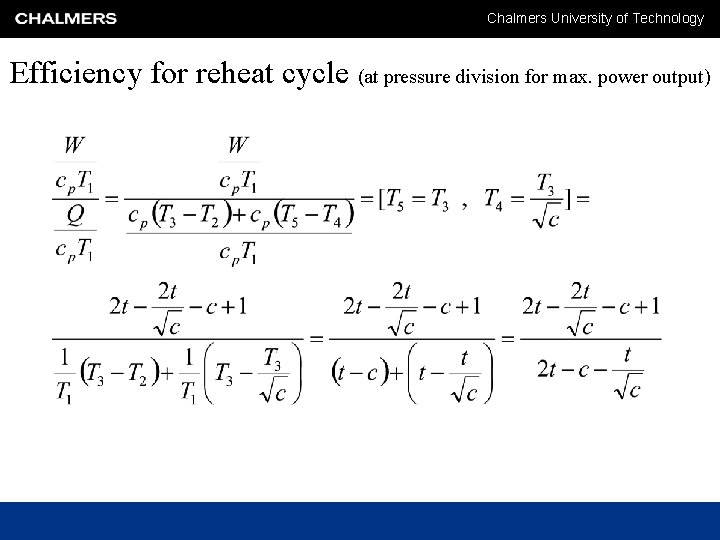
Chalmers University of Technology Efficiency for reheat cycle (at pressure division for max. power output)
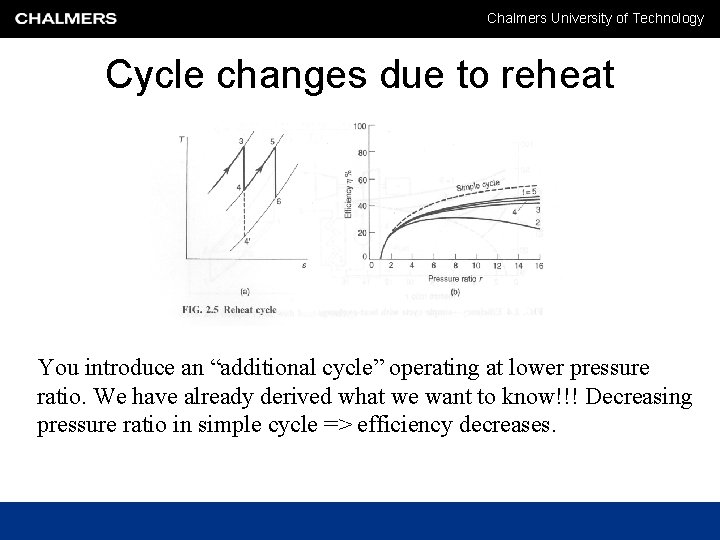
Chalmers University of Technology Cycle changes due to reheat You introduce an “additional cycle” operating at lower pressure ratio. We have already derived what we want to know!!! Decreasing pressure ratio in simple cycle => efficiency decreases.
Chalmers University of Technology Reheat/reheat with heat exchange compared to single cycle • Simple reheat – Power output increases – Decrease in efficiency (added cycle is worse than underlying cycle, since simple cycle efficiency decreases with pressure ratio) Simple cycle • Reheat with heat exchange – Power output increases – Increase in efficiency. Heat is added at a higher average temperature and removed at a lower temperature than in simple cycle. See figure to the right. Reheat with heat exchange
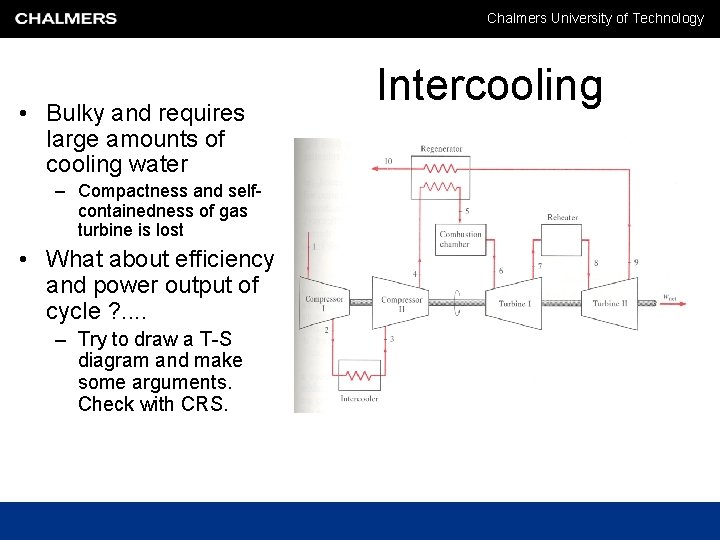
Chalmers University of Technology • Bulky and requires large amounts of cooling water – Compactness and selfcontainedness of gas turbine is lost • What about efficiency and power output of cycle ? . . – Try to draw a T-S diagram and make some arguments. Check with CRS. Intercooling
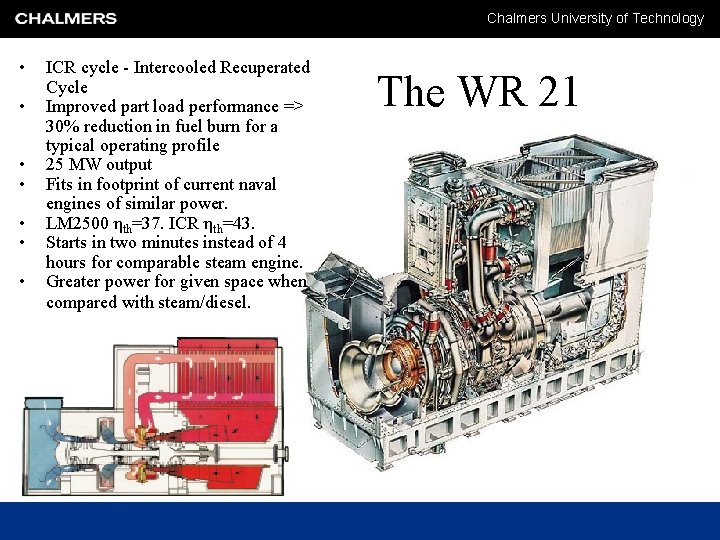
Chalmers University of Technology • • ICR cycle - Intercooled Recuperated Cycle Improved part load performance => 30% reduction in fuel burn for a typical operating profile 25 MW output Fits in footprint of current naval engines of similar power. LM 2500 ηth=37. ICR ηth=43. Starts in two minutes instead of 4 hours for comparable steam engine. Greater power for given space when compared with steam/diesel. The WR 21
Chalmers University of Technology The WR 21
Chalmers University of Technology Polytropic efficiencies - motivation • If we study multistage designs the isentropic efficiency for high pressure compressors tend to be lower than for low pressure compressors. Why? • Assume ηs (stage efficiency) constant, the overall temperature rise ΔT is obtained by:
Chalmers University of Technology Polytropic efficiency - motivation But: Thus, the total efficiency is always less than the stage efficiency. Preheat effect: as you go through the stages you move to the right in the T-s diagram. Isobars diverge in that direction!
Chalmers University of Technology Polytropic efficiency – “preheat independence” • Define the polytropic efficiency (differential stage efficiency) as: We have (second revision question – lecture 1 – before integrating): (1) + (2) produces:
Chalmers University of Technology Polytropic efficiency – “preheat independence” Similarly for a turbine: First guess for preliminary design work Polytropic efficiencies are useful for preliminary design, when many compressor concepts with different pressure ratios may be evaluated for a given application.
Chalmers University of Technology Learning goals • Know how to show (by arguments or T-S diagrams) how the efficiency of the reheat cycle with and without heat exchanges in comparison with the simple cycle (ideal case) • Be able to derive the optimal pressure division in ideal reheat cycles • Be familiar with the polytropic efficiency concept and state reasonable loss levels for turbine and compressors