
Challenging Mathematics Education for Future Change Transition of
- Slides: 60
Challenging Mathematics Education for Future Change: Transition of Problem Solving in Korean National Curriculum The 6 th ICER & APEC Lesson Study Khon Kaen, Thailand September 15, 2013 Hee-chan Lew Korea National University of Education
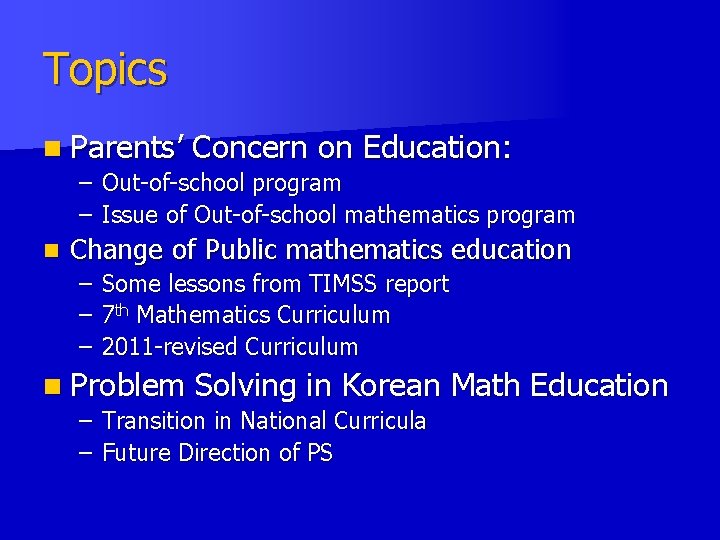
Topics n Parents’ – – n Concern on Education: Out-of-school program Issue of Out-of-school mathematics program Change of Public mathematics education – – – Some lessons from TIMSS report 7 th Mathematics Curriculum 2011 -revised Curriculum n Problem Solving in Korean Math Education – Transition in National Curricula – Future Direction of PS
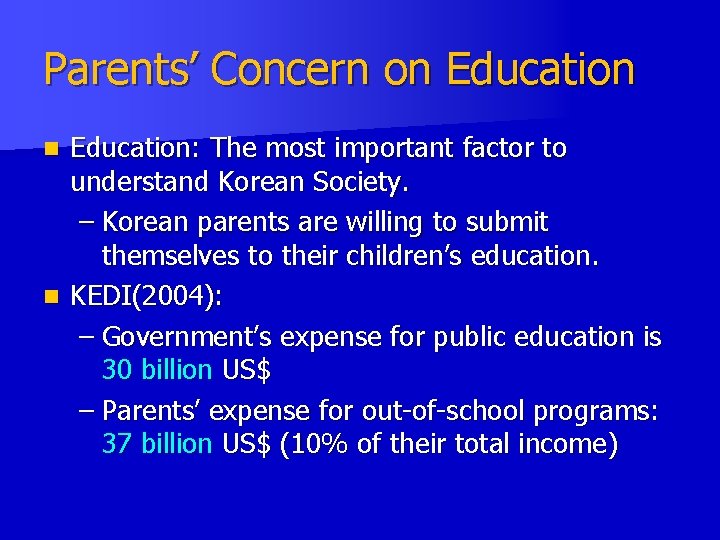
Parents’ Concern on Education: The most important factor to understand Korean Society. – Korean parents are willing to submit themselves to their children’s education. n KEDI(2004): – Government’s expense for public education is 30 billion US$ – Parents’ expense for out-of-school programs: 37 billion US$ (10% of their total income) n
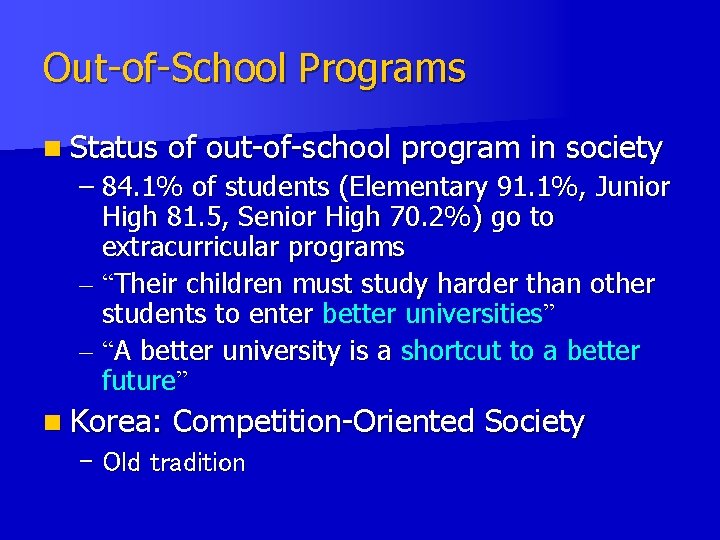
Out-of-School Programs n Status of out-of-school program in society – 84. 1% of students (Elementary 91. 1%, Junior High 81. 5, Senior High 70. 2%) go to extracurricular programs – “Their children must study harder than other students to enter better universities” – “A better university is a shortcut to a better future” n Korea: Competition-Oriented Society – Old tradition
Examination Tradition In 958 , Korea accepted from China the formal examination system to select government officials, which was kept over 950 years. n At that time, the society was strictly stratified into three classes and the lower classes were not even able to apply to the state examination; n Only the upper classes were able to take the examination required for becoming a highranked officer, while the middle classes were only eligible to take the examination required for becoming skill-oriented mid-rank bureaucrats n
Examination Tradition Persons who want to become middle level technical officials had to take mathematics. n To pass the mathematics examination students were required to have learned many Chinese classics including "Chui-chang Suan Shu"(Nine Chapters on Mathematical Art) for 7 -9 years in the national schools. n But , the mid-level officials taught their children the books at home to help their children to pass the exam for transmitting their social status. n
Issue of out-of-school mathematics program Techniques vs. Abilities n 70 -90 % of students study mathematics 1 -2 hours almost every day after school n Problem is that they learn skills and knowledge only rather than cultivating problem solving abilities of higher level. n They learn techniques to select correct answers in various objective tests.
Results n We worry that this kind of out-of-school studies seems to be one of the main reasons of Korean students’ high achievement but low level of mathematics attitude in TIMSS and PISA.
Change of Public Mathematics Education n TIMSS Report n TIMSS issued in 1996 and 1997 provided an opportunity for Korean Society to reflect on the weak educational environment for teachers, institutions as well as students, despite of Korean students' very proud achievement.
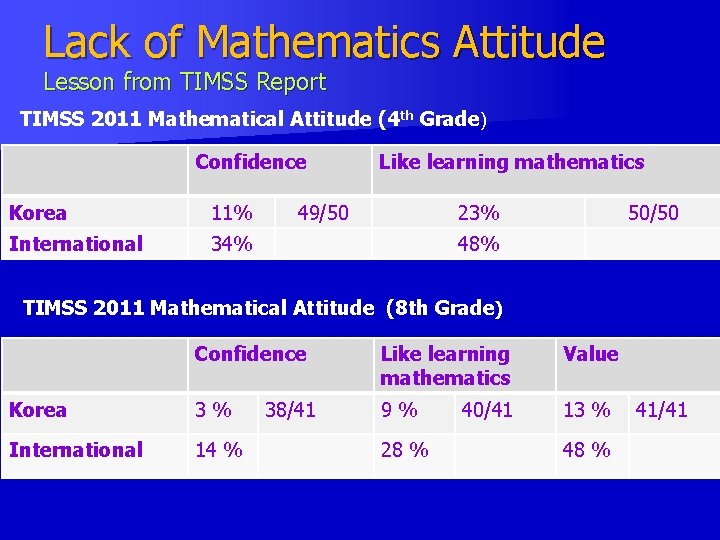
Affective Characteristics: Lesson from TIMSS Report n Korean students' affective characteristics was not friendly to mathematics compared with other countries. n In the case of the 8 th grade, Korea was one of the lowest countries in the confidence and interest levels. n This result is also being repeated in the current TIMSS and PISA test.
Lack of Mathematics Attitude Lesson from TIMSS Report TIMSS 2011 Mathematical Attitude (4 th Grade) Confidence Korea 11% International 34% Like learning mathematics 49/50 23% 50/50 48% TIMSS 2011 Mathematical Attitude (8 th Grade) Confidence Like learning mathematics Value Korea 3% 9% 13 % International 14 % 38/41 28 % 40/41 48 % 41/41
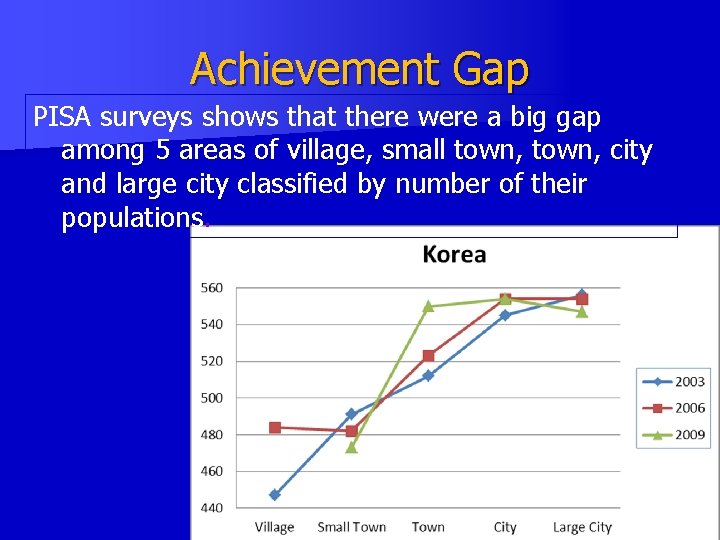
Achievement Difference: Lesson from TIMSS Report n There is a significant difference in the achievement level between male and female, and city and rural area – A serious problem with respect to an equal opportunity in mathematics education. – Traditional custom guides girls not to go to the mathematical fields. – Generally rural area, compared with city area, has an educationally uncompetitive environment.
Achievement Gap PISA surveys shows that there were a big gap among 5 areas of village, small town, city and large city classified by number of their populations.
Educational Environment: Lesson from TIMSS Report n n Korean math teachers were very negative in using computer and calculator in their classes. Whole class activities under teachers' control is the first consideration in organizing classes Teachers seem not to understand well the reason why problem solving should be emphasized in mathematics education Korean students were familiar with an objective test.
Change of Public Math Education after TIMSS n There were many changes after TIMSS − We were proud of our students but, we thought that even good achievement students have no meaning from learning mathematics − 7 th National Curriculum issued on December 1997 focusing on students’ problem solving abilities − Spontaneous School Reform Movement by teachers in the late of 1990 s for Open Education, Performance Assessment, Computer use in classroom
The 7 th curriculum n Issued in Dec 31 1997 to reflect: – Reform movement of mathematics education throughout the world, particularly of USA – Reconsideration of learning methods and contents school mathematics had emphasized for a long time – Lessons from TIMSS report – National goals for the construction of an advanced civilized society
Nature: practical mathematics new curriculum emphasized practical mathematics such as n The – problem solving – application n It contrasts sharply with the 3 rd curriculum issued in 1973 which emphasized mathematical knowledge as theoretical aspect
2007 and 2011 -revised curriculum After 7 th curriculum, we had two times curriculum revision in 2007 and 2011. n These two revision made big changes in the teaching sequence of concepts, but there was no big difference in the spirit of curricular application. n Only difference: The current curriculum was revised in August of 2011 with the aim of nurturing students’ mathematical creativity and sound personalities. n
Problem Solving in Korean Math Education Transition in Curriculum n n 1 st Curriculum 1 st curriculum issued in 1955 emphasized practical problem solving in real life under the influence of the American pragmatism and Dewey's educational philosophy. Dewey’s position on mathematics education: Mathematics education has to encourage students to construct instrumental knowledge by solving problems in the relation with ordinary life which is a main matter of concern of students
1 st Curriculum Textbooks based on 1 st curriculum was organized by “Life Unit Chapter”, which means that each chapter consists of subject of life like zoo, palace, reconstruction of country, public health. n The goal is for students to get various mathematical skills as conditions of being an efficient human in life and to cultivate ability and habit to contribute to society by using mathematics. n In the 1 st curriculum, “problem solving” means problem solving in real life. n
1 st Curriculum n The curriculum emphasized that in each chapter, students have to: – Collect some information to solve the problem. – Transform the collected information by calculating or drawing a graph or a table or a figure. – Review the result – Explain why their methods right.
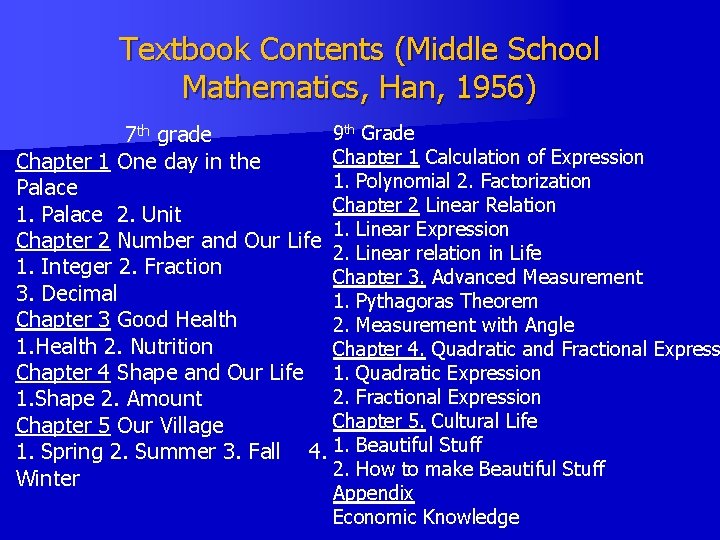
Textbook Contents (Middle School Mathematics, Han, 1956) 9 th Grade 7 th grade Chapter 1 Calculation of Expression Chapter 1 One day in the 1. Polynomial 2. Factorization Palace Chapter 2 Linear Relation 1. Palace 2. Unit 1. Linear Expression Chapter 2 Number and Our Life 2. Linear relation in Life 1. Integer 2. Fraction Chapter 3. Advanced Measurement 3. Decimal 1. Pythagoras Theorem Chapter 3 Good Health 2. Measurement with Angle 1. Health 2. Nutrition Chapter 4. Quadratic and Fractional Express Chapter 4 Shape and Our Life 1. Quadratic Expression 2. Fractional Expression 1. Shape 2. Amount Chapter 5. Cultural Life Chapter 5 Our Village 1. Spring 2. Summer 3. Fall 4. 1. Beautiful Stuff 2. How to make Beautiful Stuff Winter Appendix Economic Knowledge
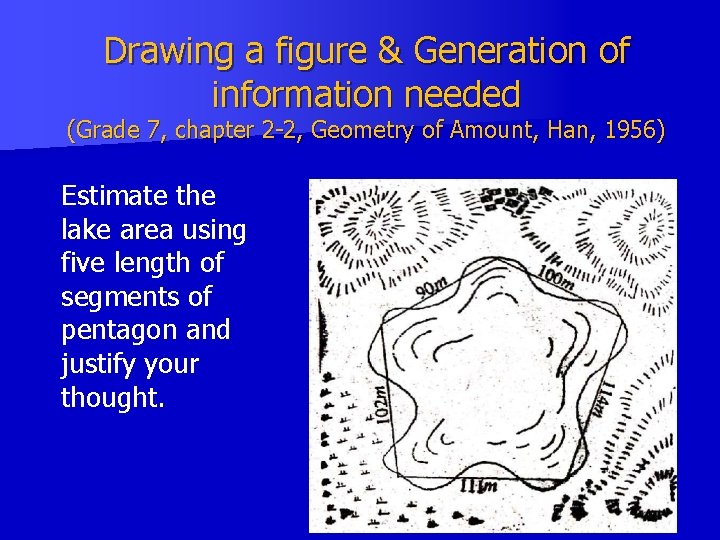
Drawing a figure & Generation of information needed (Grade 7, chapter 2 -2, Geometry of Amount, Han, 1956) Estimate the lake area using five length of segments of pentagon and justify your thought.
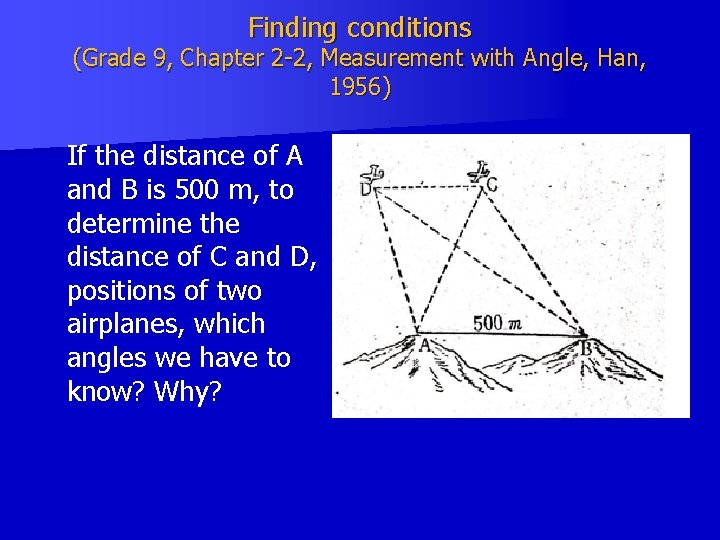
Finding conditions (Grade 9, Chapter 2 -2, Measurement with Angle, Han, 1956) If the distance of A and B is 500 m, to determine the distance of C and D, positions of two airplanes, which angles we have to know? Why?
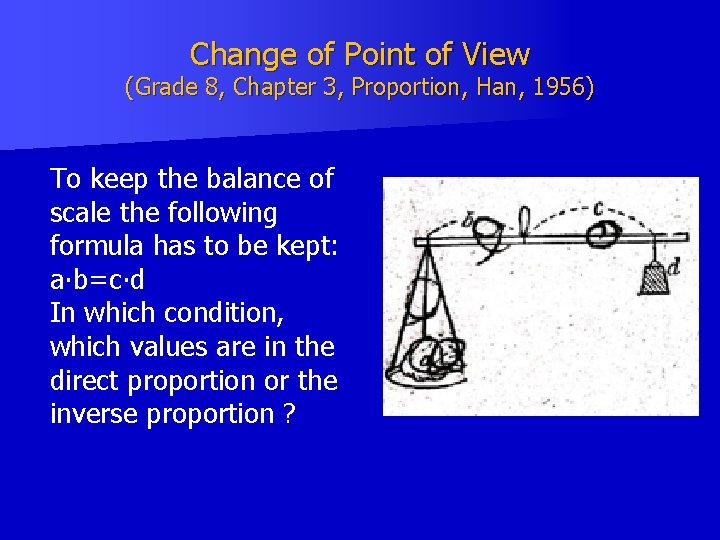
Change of Point of View (Grade 8, Chapter 3, Proportion, Han, 1956) To keep the balance of scale the following formula has to be kept: a∙b=c∙d In which condition, which values are in the direct proportion or the inverse proportion ?
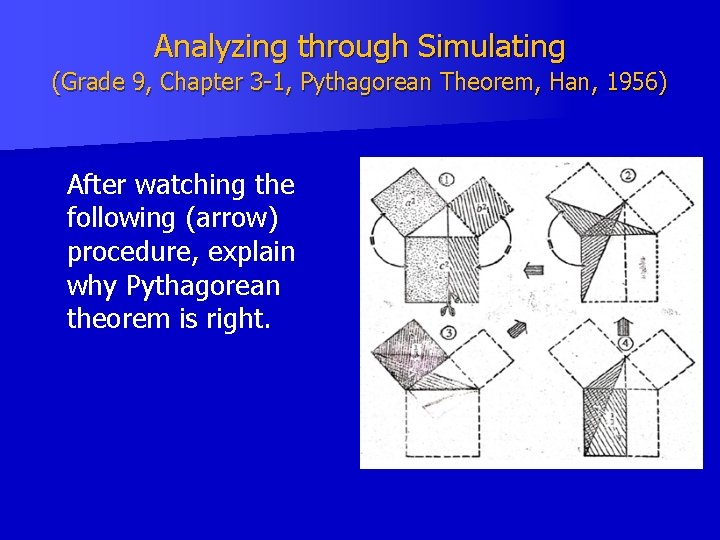
Analyzing through Simulating (Grade 9, Chapter 3 -1, Pythagorean Theorem, Han, 1956) After watching the following (arrow) procedure, explain why Pythagorean theorem is right.
1 st Curriculum n However, real situation in the schools at that time was different: – because of lack of good teachers to guide students’ problem solving heuristics well to embody the spirit of the curriculum and of systematic sequence of mathematical knowledge. – Furthermore, the college entrance examination was not practically oriented.
2 nd & 3 rd Curriculum As a reaction of the 1 st curriculum, 2 nd curriculum (1963) was changed totally to emphasize more formal and systematical mathematics. n 3 rd curriculum (1973) accepted the new mathematics movement totally, emphasizing set theory language, mathematical structures and logical rigoreness n The theoretical mathematics reached to the highest points in these two curriculum revision. n
2 nd & 3 rd Curriculum In the 2 nd and 3 rd curriculum, problem solving means problem solving of difficult mathematics problems with a couple of mathematical concepts. n In the textbooks, there were many problems which can be solved by making an expression and transforming the expression. n These kinds of problems might not be interesting to students and do not give a chance for students to consider heuristics to solve. n
4 th Curriculum n The 4 th curriculum issued in 1980 carefully reviewed the 3 rd curriculum and removed some too difficult contents. n It emphasized basic skills rather than rigorous concepts and difficult problem solving with complex concepts, which was influenced from the Back-to basics movement of USA. n The nature of PS was not changed.
5 th Curriculum The 5 th curriculum which was a partial revision of the 4 th curriculum emphasized problem solving, mathematical activities and attitudes of students. n Elementary school mathematics textbooks of grades 1 -6 included units titled "various problems", emphasizing various problem solving strategies like simplification, logical reasoning, making a figure, working backwards etc. n
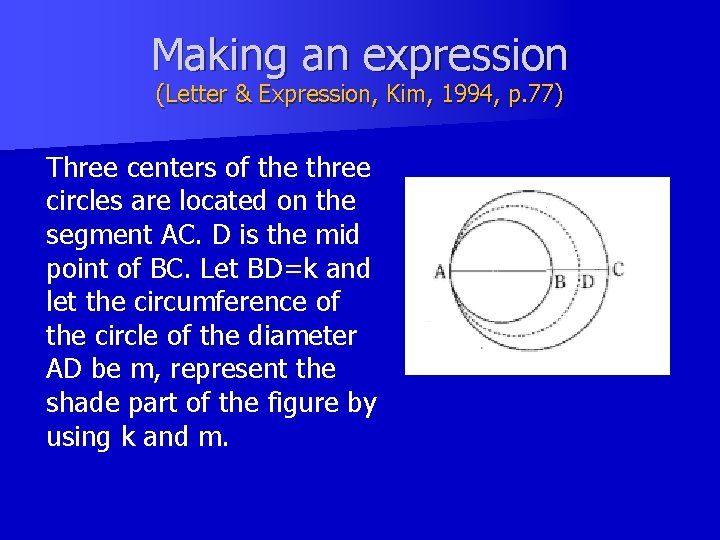
Making an expression (Letter & Expression, Kim, 1994, p. 77) Three centers of the three circles are located on the segment AC. D is the mid point of BC. Let BD=k and let the circumference of the circle of the diameter AD be m, represent the shade part of the figure by using k and m.
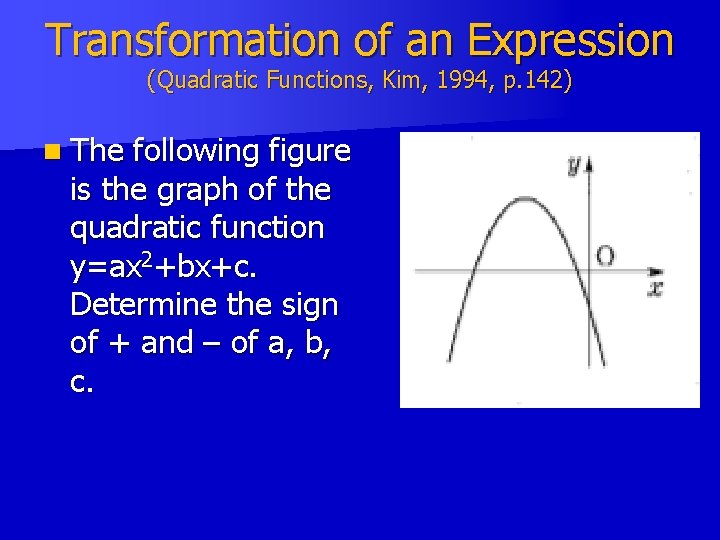
Transformation of an Expression (Quadratic Functions, Kim, 1994, p. 142) n The following figure is the graph of the quadratic function y=ax 2+bx+c. Determine the sign of + and – of a, b, c.
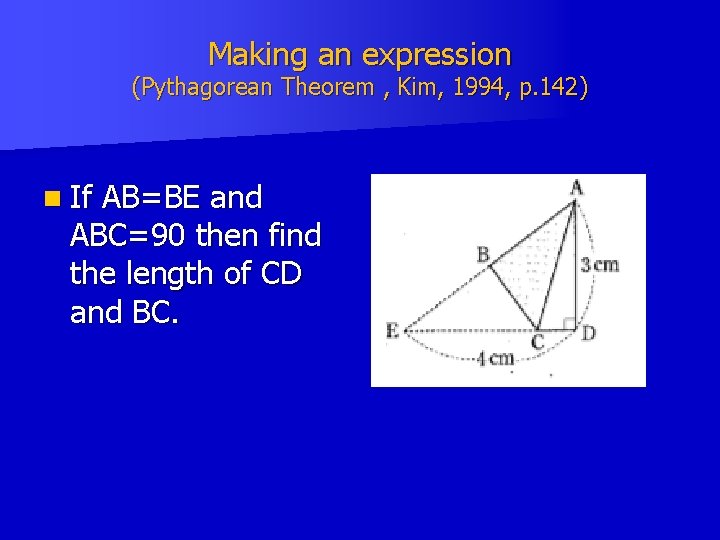
Making an expression (Pythagorean Theorem , Kim, 1994, p. 142) n If AB=BE and ABC=90 then find the length of CD and BC.
6 th Curriculum n In the 5 th curriculum, at the secondary schools, problem solving strategies were not introduced to accept PS gradually from elementary schools. n The 6 th curriculum emphasized problem solving even more. n In the secondary school, problem solving was introduced.
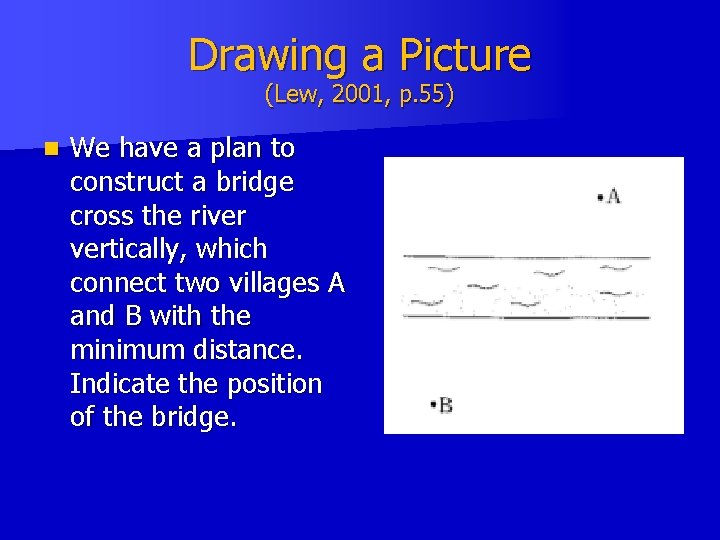
Drawing a Picture (Lew, 2001, p. 55) n We have a plan to construct a bridge cross the river vertically, which connect two villages A and B with the minimum distance. Indicate the position of the bridge.
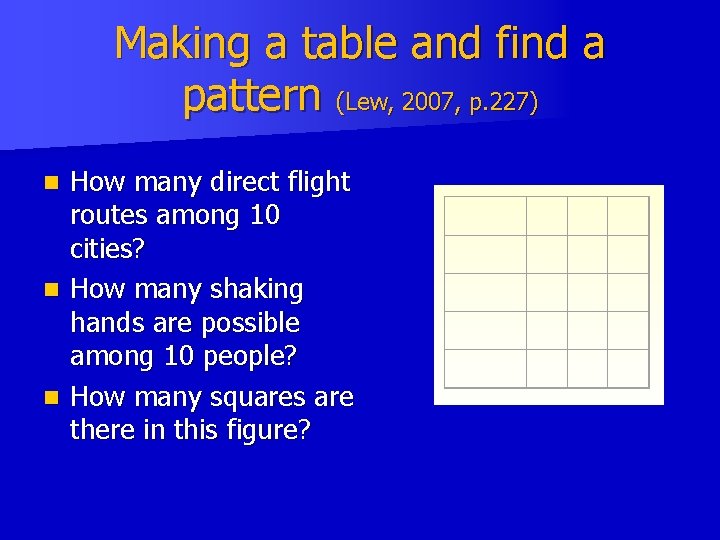
Making a table and find a pattern (Lew, 2007, p. 227) How many direct flight routes among 10 cities? n How many shaking hands are possible among 10 people? n How many squares are there in this figure? n
7 th Curriculum n The ultimate goal of the 7 th mathematics curriculum is to cultivate students with a creative and autonomous mind by achieving the following three main aims (MOE, 1997): n First, to understand basic mathematical concepts and principles through concrete experiences using various manipulative and by using daily life phenomena related with mathematics;
7 th Curriculum second, to foster mathematics problem solving abilities through the solving of various problems posed within and without mathematics; n third, to keep a positive attitude about mathematics and mathematics learning by emphasizing a connection between mathematics and the real world. n
7 th curriculum n Mathematical power should be emphasized by the following methods in their classrooms: - to focus on students' understanding of a problem and the problem-solving process as well as its results; - to focus on student's abilities to think and solve problems in a flexible, diverse and creative fashion;
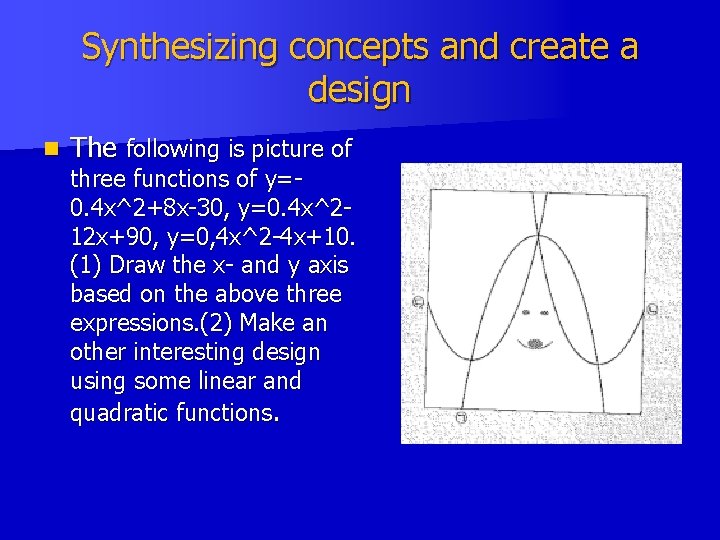
Synthesizing concepts and create a design n The following is picture of three functions of y=0. 4 x^2+8 x-30, y=0. 4 x^212 x+90, y=0, 4 x^2 -4 x+10. (1) Draw the x- and y axis based on the above three expressions. (2) Make an other interesting design using some linear and quadratic functions.
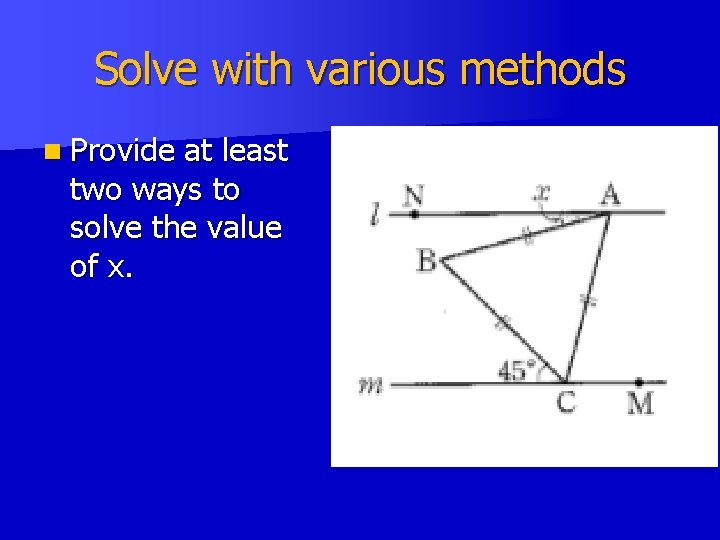
Solve with various methods n Provide at least two ways to solve the value of x.
2007 & 2011 revised curriculum n There was only a few change of 7 th Curriculum in the perspective of Problem Solving: We extend PS to Guessing, Reasoning and Communication.
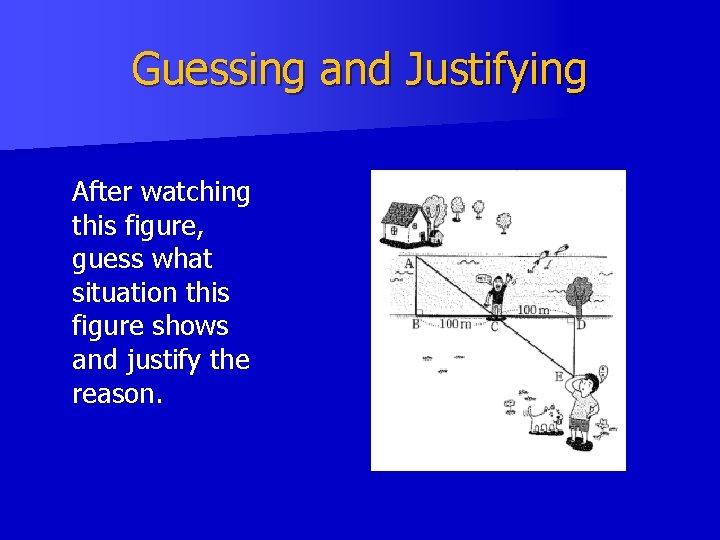
Guessing and Justifying After watching this figure, guess what situation this figure shows and justify the reason.
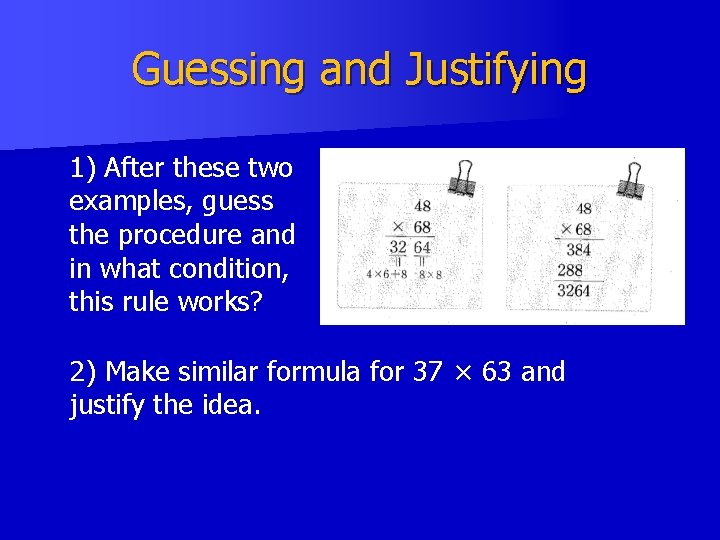
Guessing and Justifying 1) After these two examples, guess the procedure and in what condition, this rule works? 2) Make similar formula for 37 × 63 and justify the idea.
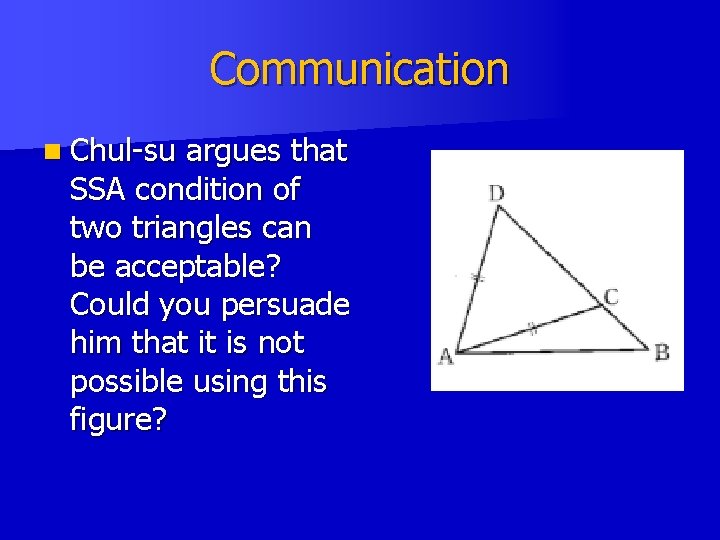
Communication n Chul-su argues that SSA condition of two triangles can be acceptable? Could you persuade him that it is not possible using this figure?
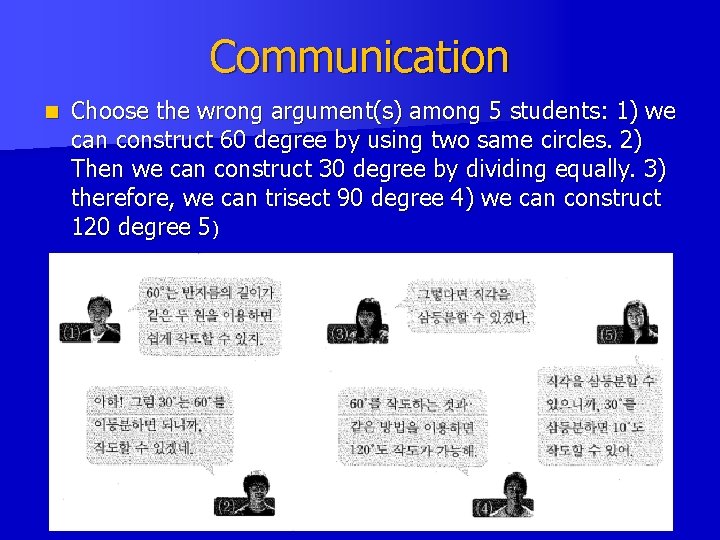
Communication n Choose the wrong argument(s) among 5 students: 1) we can construct 60 degree by using two same circles. 2) Then we can construct 30 degree by dividing equally. 3) therefore, we can trisect 90 degree 4) we can construct 120 degree 5)
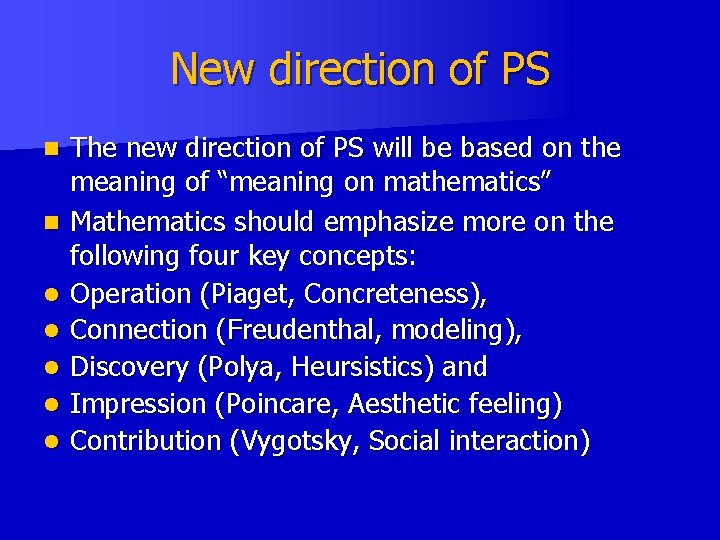
New direction of PS n n l l l The new direction of PS will be based on the meaning of “meaning on mathematics” Mathematics should emphasize more on the following four key concepts: Operation (Piaget, Concreteness), Connection (Freudenthal, modeling), Discovery (Polya, Heursistics) and Impression (Poincare, Aesthetic feeling) Contribution (Vygotsky, Social interaction)
Swimming Pool Situation n n A swimming pool: 50 m X 21 m X 1. 8 m Manager use chlorine so that bacteria do not increase in further number. The amount of chlorine needs to be controlled to maintain 0. 4~0. 6 ppm(mg/L or g/t). It should be noted that the chlorine put into the water is disappeared by 5% everyday and also the disappeared amount of water is refilled fully.
Modelling: Swimming Pool Situation 1. If manager puts in 1040 g at first and then puts in 52 g of chlorine everyday, what concentration could be maintained? If initial amount was changed to 850 g, 1100 g, 1300 g respectively, then how would amount and concentration change? n 2. When initial amount of chlorine is 1040 g, and amount of chlorine put in everyday is 40 g, 60 g, how would amount and concentration of the chlorine change? In addition, discuss what kind of changes would occur when the initial amount of chlorine is changed and explain reasons to such consequences. n
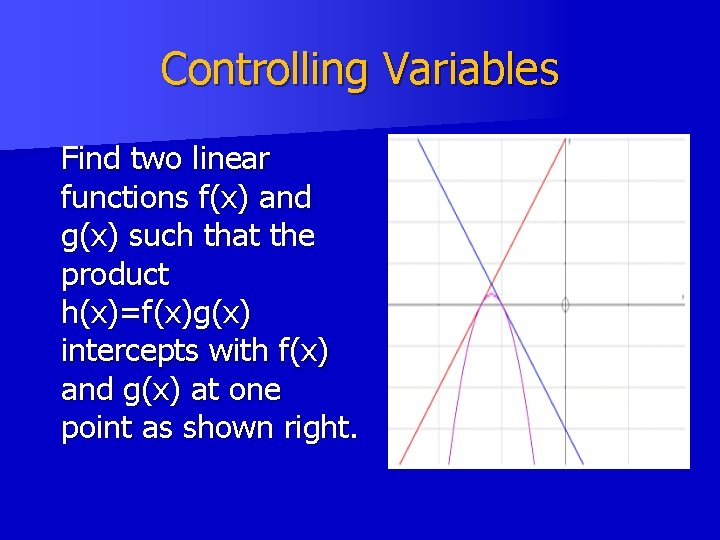
Controlling Variables Find two linear functions f(x) and g(x) such that the product h(x)=f(x)g(x) intercepts with f(x) and g(x) at one point as shown right.
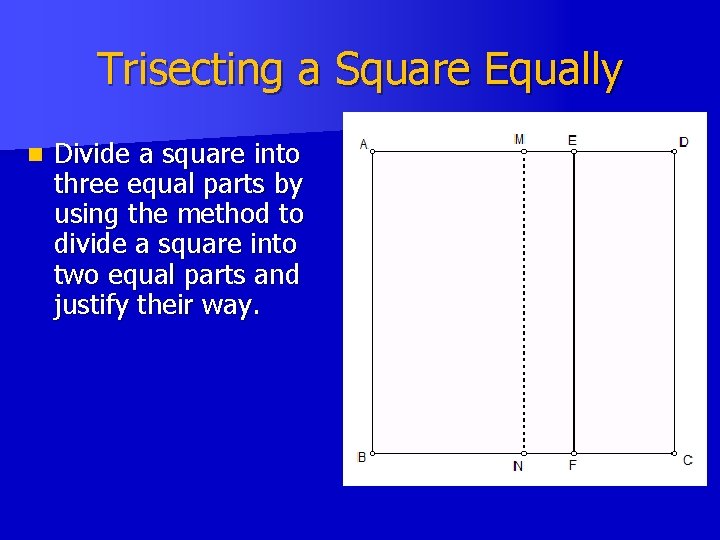
Trisecting a Square Equally n Divide a square into three equal parts by using the method to divide a square into two equal parts and justify their way.
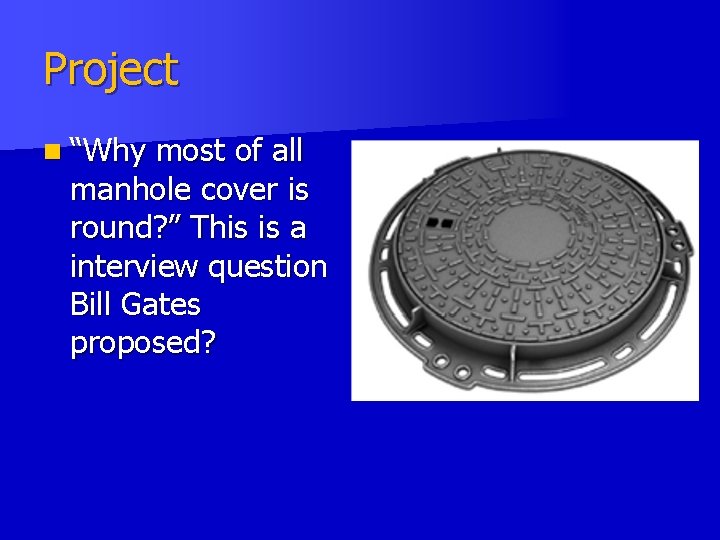
Project n “Why most of all manhole cover is round? ” This is a interview question Bill Gates proposed?
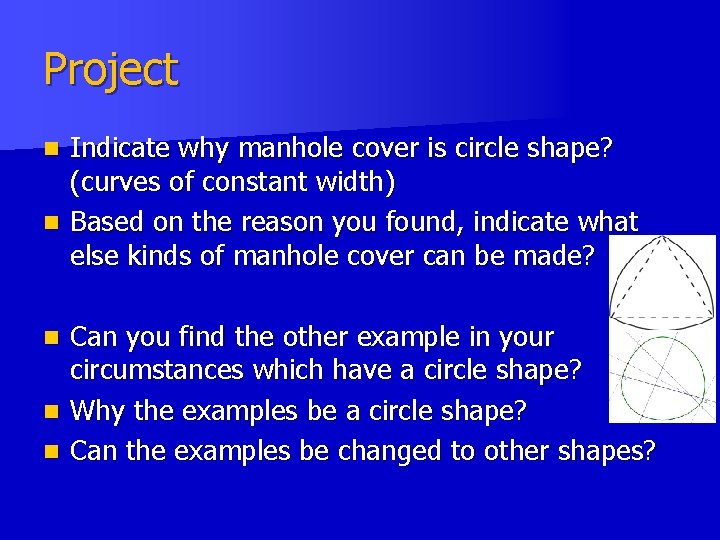
Project Indicate why manhole cover is circle shape? (curves of constant width) n Based on the reason you found, indicate what else kinds of manhole cover can be made? n n Can you find the other example in your circumstances which have a circle shape? Why the examples be a circle shape? Can the examples be changed to other shapes?
Ship Trace n Guess the trace of ship which sails under the condition that the segments to connect the current positions of ship and leaving point A and arriving point B respectively keep the angle of 90 degree.
Aesthetic Appreciation n What does Pythagorean theorem mean? n Pythagorean theorem is believed as one of the most Valuable and beautiful theorems. Do you agree the opinion? Why? n If Pythagorean theorem does not exist, what happened in the history of mankind?
Conclusion n This talk has summarized the change of mathematics education and particularly, the change made in Korea after TIMSS. – The main focus is on the practical mathematics like problem solving and application. n The current national goal is to construct a highly developed country in the near future. – Practical Mathematics to focus problem solving and application is a tool for propelling the development of science and for solving quantitative and qualitative problems faced on people in their lives.
Conclusion n What is a target? n More students have to leave school with having ability and confidence in problem solving and application. n The main purpose of mathematics education is to develop students’ creative intuition and to improve their problem solving ability.
Conclusion n To achieve this, mathematics education should be changed – – n from abstract to concrete, theoretical to practical, speculative to experimental, and fragmentary to connected. This is because – – abstract makes mathematics difficult, theoretical makes it blind, speculative makes it boring, and fragmentary makes it meaningless.
Conclusion n To do so, teachers, textbooks, classroom environment, mathematics society and MOE support students’ activities.