
Challenging Conversations Training Jenni Kotting Ph D Communications
- Slides: 19
Challenging Conversations Training Jenni Kotting, Ph. D, Communications Consultant 10/2/2020
“May we remember that if love isn’t central to our movements not many will be able to stay and not many will want to join, including ourselves. ” - Chani Nicholas
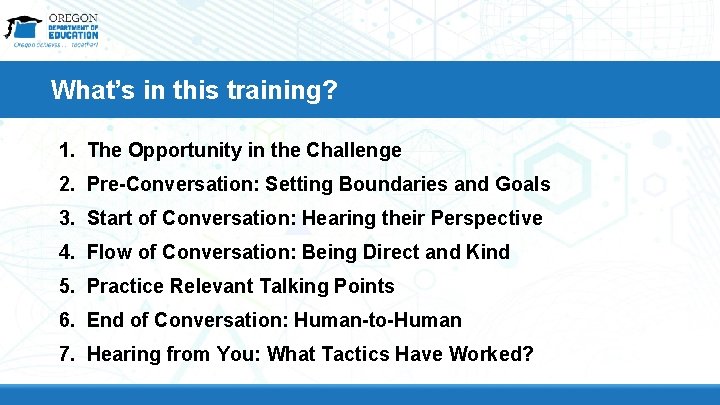
What’s in this training? 1. The Opportunity in the Challenge 2. Pre-Conversation: Setting Boundaries and Goals 3. Start of Conversation: Hearing their Perspective 4. Flow of Conversation: Being Direct and Kind 5. Practice Relevant Talking Points 6. End of Conversation: Human-to-Human 7. Hearing from You: What Tactics Have Worked?
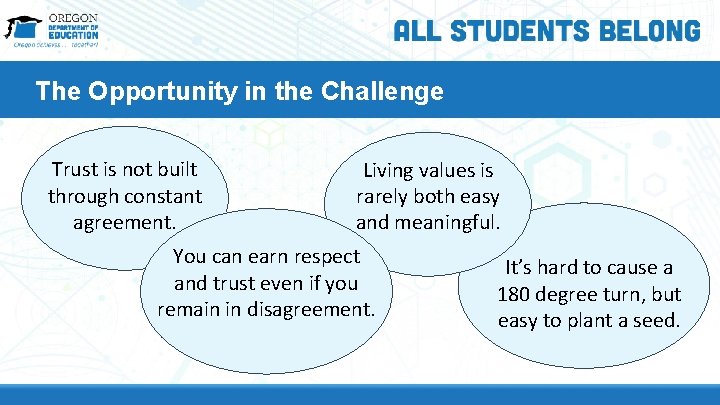
The Opportunity in the Challenge Trust is not built through constant agreement. Living values is rarely both easy and meaningful. You can earn respect and trust even if you remain in disagreement. It’s hard to cause a 180 degree turn, but easy to plant a seed.
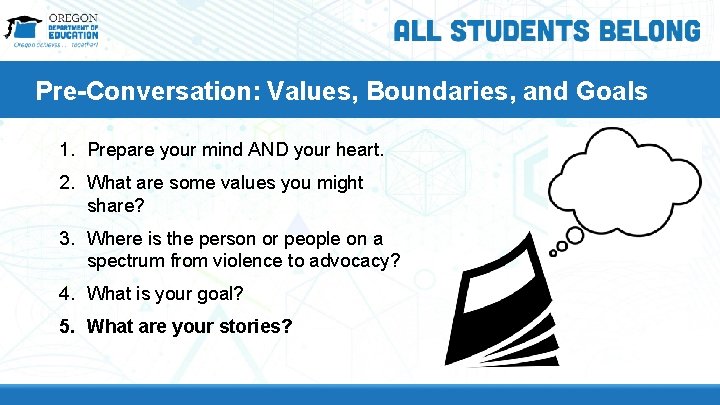
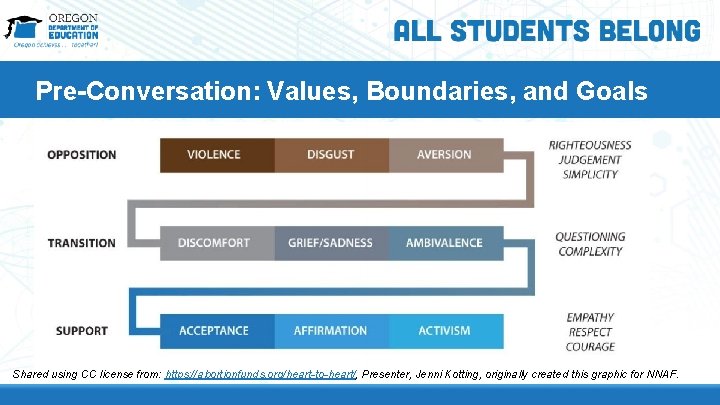
Pre-Conversation: Values, Boundaries, and Goals 1. Prepare your mind AND your heart. 2. What are some values you might share? 3. Where is the person or people on a spectrum from violence to advocacy? 4. What is your goal? 5. What are your stories?
What is your story? What unique information do you have?
Pre-Conversation: Values, Boundaries, and Goals Shared using CC license from: https: //abortionfunds. org/heart-to-heart/, Presenter, Jenni Kotting, originally created this graphic for NNAF.
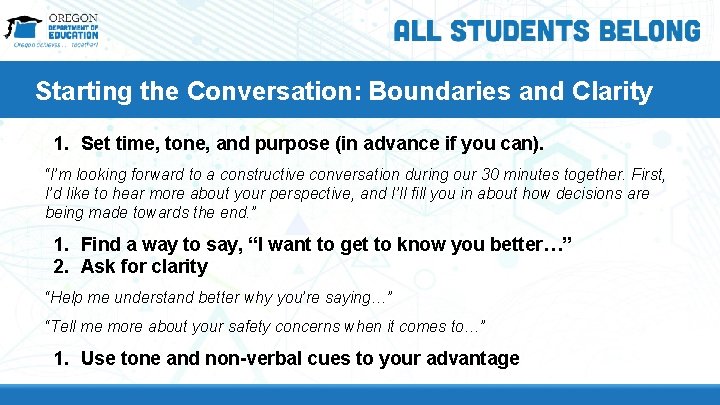
Starting the Conversation: Boundaries and Clarity 1. Set time, tone, and purpose (in advance if you can). “I’m looking forward to a constructive conversation during our 30 minutes together. First, I’d like to hear more about your perspective, and I’ll fill you in about how decisions are being made towards the end. ” 1. Find a way to say, “I want to get to know you better…” 2. Ask for clarity “Help me understand better why you’re saying…” “Tell me more about your safety concerns when it comes to…” 1. Use tone and non-verbal cues to your advantage
Flow of Conversation: Speaking Truth & Sharing Values 1. 2. 3. 4. 5. 6. Charm and disarm. Be direct and be Kind. Persuade instead of convince. Focus on storytelling. Get personal rather than generalize. Regulate before you communicate.
GENERAL Black Lives Matter means that a Black person’s life or a Black student’s life is just as valuable as anyone else’s life. And Black students need to know they matter in our classrooms, just like all other students. All students belong.
PERSONAL I’ve had conversations with people who have lots of different perspectives. When I’ve talked to people who wear Black Lives Matter t-shirts, they want Black students to know they matter in our classrooms, just like all other students. They want to make sure all students belong.
Talking Points for Clarity on Policy about Hate Symbols 1. The policy came about because students asked for the state to prohibit three hate symbols in schools and establish procedures for addressing bias incidents. I think the policy is important because of what I’ve seen happening… 2. My goal is to get to the underlying roots that drive students to use hate speech and symbols. We can have conversations like this one. We can make sure our curriculum speaks to the history of different symbols, including the history of Black Lives Matter as a declaration that’s always been about increasing understanding, tolerance, and love, not hate. [Tell a story about something great a teacher or student has done…]
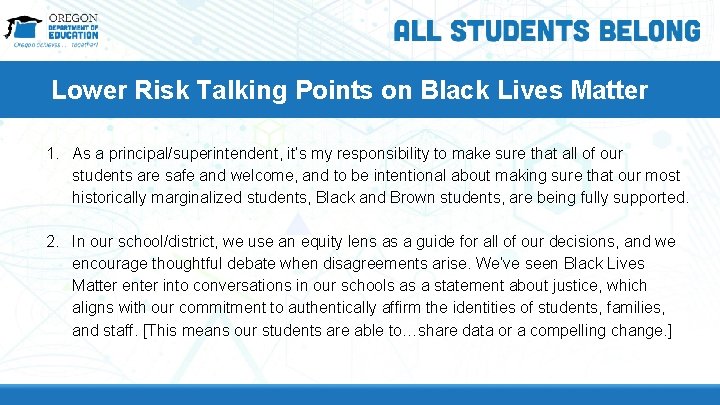
Lower Risk Talking Points on Black Lives Matter 1. As a principal/superintendent, it’s my responsibility to make sure that all of our students are safe and welcome, and to be intentional about making sure that our most historically marginalized students, Black and Brown students, are being fully supported. 2. In our school/district, we use an equity lens as a guide for all of our decisions, and we encourage thoughtful debate when disagreements arise. We’ve seen Black Lives Matter enter into conversations in our schools as a statement about justice, which aligns with our commitment to authentically affirm the identities of students, families, and staff. [This means our students are able to…share data or a compelling change. ]
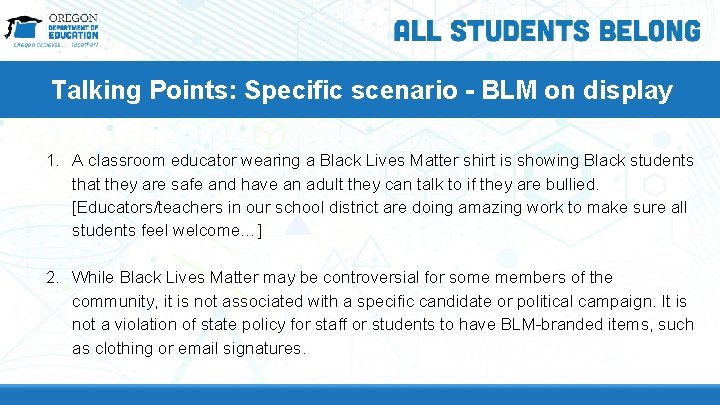
Talking Points: Specific scenario - BLM on display 1. A classroom educator wearing a Black Lives Matter shirt is showing Black students that they are safe and have an adult they can talk to if they are bullied. [Educators/teachers in our school district are doing amazing work to make sure all students feel welcome…] 2. While Black Lives Matter may be controversial for some members of the community, it is not associated with a specific candidate or political campaign. It is not a violation of state policy for staff or students to have BLM-branded items, such as clothing or email signatures.
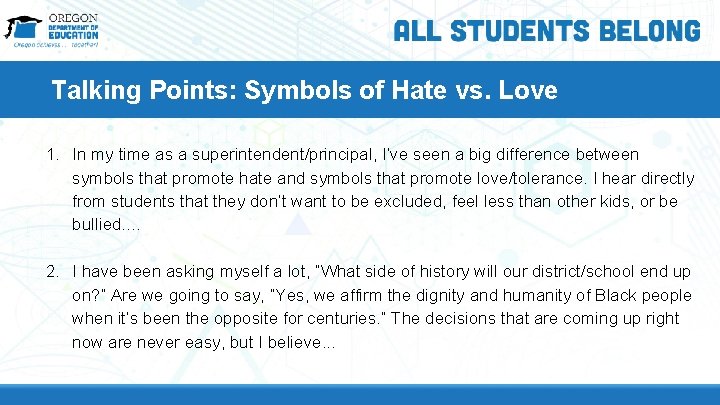
Talking Points: Symbols of Hate vs. Love 1. In my time as a superintendent/principal, I’ve seen a big difference between symbols that promote hate and symbols that promote love/tolerance. I hear directly from students that they don’t want to be excluded, feel less than other kids, or be bullied. . 2. I have been asking myself a lot, “What side of history will our district/school end up on? ” Are we going to say, “Yes, we affirm the dignity and humanity of Black people when it’s been the opposite for centuries. ” The decisions that are coming up right now are never easy, but I believe. . .
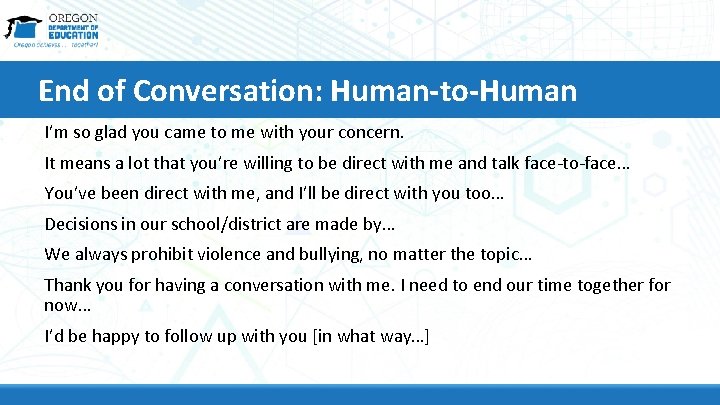
End of Conversation: Human-to-Human I’m so glad you came to me with your concern. It means a lot that you’re willing to be direct with me and talk face-to-face. . . You’ve been direct with me, and I’ll be direct with you too… Decisions in our school/district are made by… We always prohibit violence and bullying, no matter the topic… Thank you for having a conversation with me. I need to end our time together for now. . . I’d be happy to follow up with you [in what way…]
“May we remember that if love isn’t central to our movements not many will be able to stay and not many will want to join, including ourselves. ” - Chani Nicholas
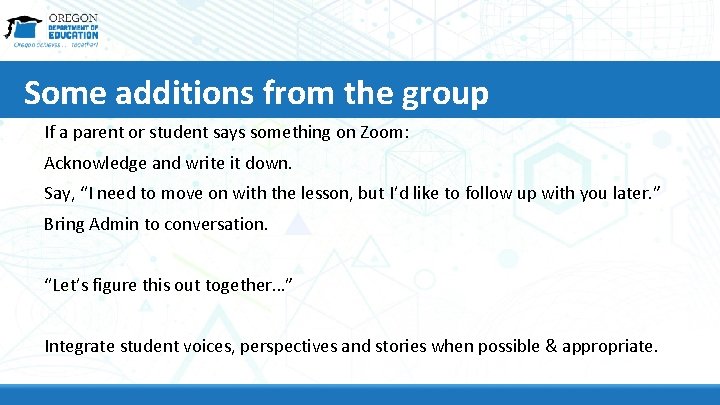
Some additions from the group If a parent or student says something on Zoom: Acknowledge and write it down. Say, “I need to move on with the lesson, but I’d like to follow up with you later. ” Bring Admin to conversation. “Let’s figure this out together…” Integrate student voices, perspectives and stories when possible & appropriate.
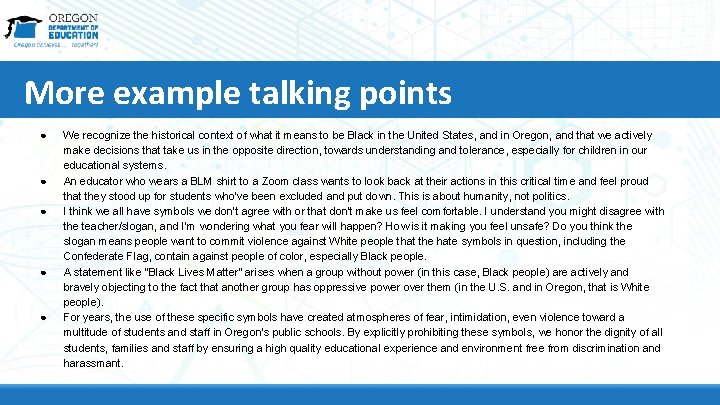
More example talking points ● ● ● We recognize the historical context of what it means to be Black in the United States, and in Oregon, and that we actively make decisions that take us in the opposite direction, towards understanding and tolerance, especially for children in our educational systems. An educator who wears a BLM shirt to a Zoom class wants to look back at their actions in this critical time and feel proud that they stood up for students who’ve been excluded and put down. This is about humanity, not politics. I think we all have symbols we don’t agree with or that don’t make us feel comfortable. I understand you might disagree with the teacher/slogan, and I’m wondering what you fear will happen? How is it making you feel unsafe? Do you think the slogan means people want to commit violence against White people that the hate symbols in question, including the Confederate Flag, contain against people of color, especially Black people. A statement like “Black Lives Matter” arises when a group without power (in this case, Black people) are actively and bravely objecting to the fact that another group has oppressive power over them (in the U. S. and in Oregon, that is White people). For years, the use of these specific symbols have created atmospheres of fear, intimidation, even violence toward a multitude of students and staff in Oregon’s public schools. By explicitly prohibiting these symbols, we honor the dignity of all students, families and staff by ensuring a high quality educational experience and environment free from discrimination and harassmant.