
Challenges to the Kerygma Historicity of Acts Relevance
- Slides: 11
Challenges to the Kerygma • • Historicity of Acts Relevance for today Bultmann’s understanding of the kerygma Gnosticism
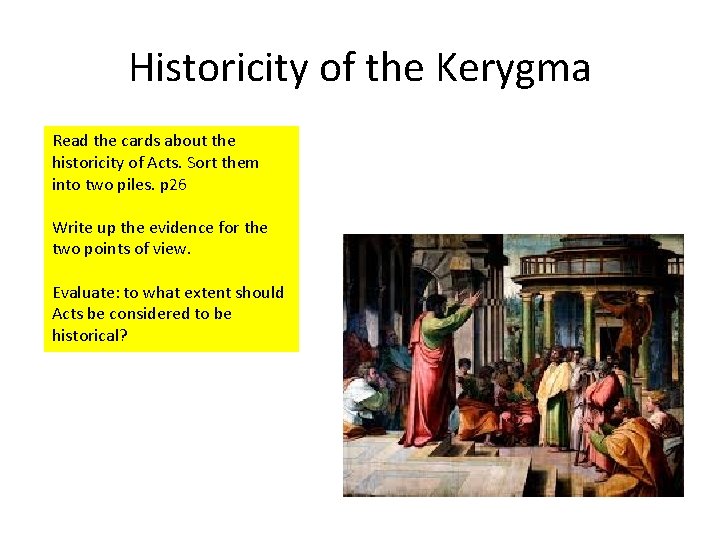
Historicity of the Kerygma Read the cards about the historicity of Acts. Sort them into two piles. p 26 Write up the evidence for the two points of view. Evaluate: to what extent should Acts be considered to be historical?
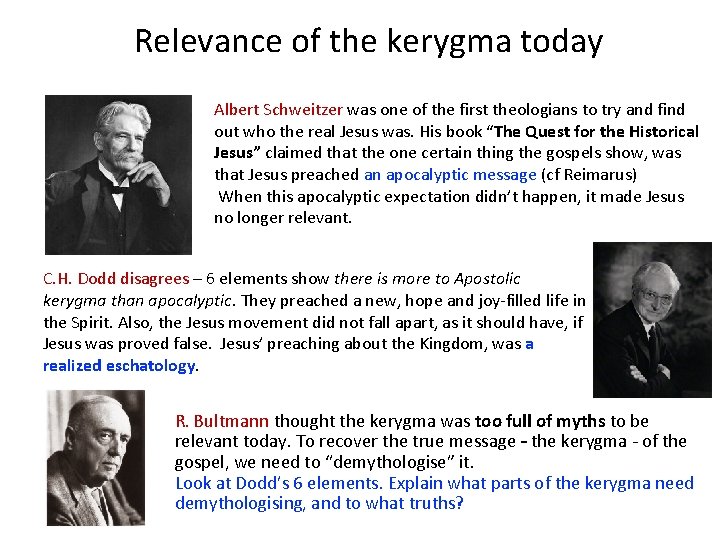
Relevance of the kerygma today Albert Schweitzer was one of the first theologians to try and find out who the real Jesus was. His book “The Quest for the Historical Jesus” claimed that the one certain thing the gospels show, was that Jesus preached an apocalyptic message (cf Reimarus) When this apocalyptic expectation didn’t happen, it made Jesus no longer relevant. C. H. Dodd disagrees – 6 elements show there is more to Apostolic kerygma than apocalyptic. They preached a new, hope and joy-filled life in the Spirit. Also, the Jesus movement did not fall apart, as it should have, if Jesus was proved false. Jesus’ preaching about the Kingdom, was a realized eschatology. R. Bultmann thought the kerygma was too full of myths to be relevant today. To recover the true message – the kerygma - of the gospel, we need to “demythologise” it. Look at Dodd’s 6 elements. Explain what parts of the kerygma need demythologising, and to what truths?
Bultmann’s 3 options when confronted by mythological language: 1. believe the myths literally (nonsense, for scientific age) 2. remove mythological sections, to leave ethical teachings. Leaves dry religion – with no power or joy in it 3. extract the kerygma: the truths that myth expresses, and their power to transform human life Bultmann opts for no. 3, to make the kerygma more existential – a message that can provoke an encounter with the believer, moving them to faith. • • No to miracles, apocalyptic view – difficult for modern minds to accept. No to the “historical Jesus” of Schweitzer - historical facts don’t bring to faith – only the meaning that they have, can. Yes to the Apostolic kerygma for its power to express what a relationship with Christ means. That is why the “myths” have to be removed – to uncover this meaning. Yes to realized eschatology – the ‘breaking in’ of God’s kingdom here and now, in the lives of individual believers. Bultmann is essentially an eschatological theologian. A personal decision - the Apostles’ preaching “cut [their hearers] to the heart” , moving them to repent and to seek baptism. For Bultmann, this is exactly what the kerygma should do – it should confront people with the power, and the truth of Christ so as to provoke a response: the decision to change one’s life and embrace faith in Christ.
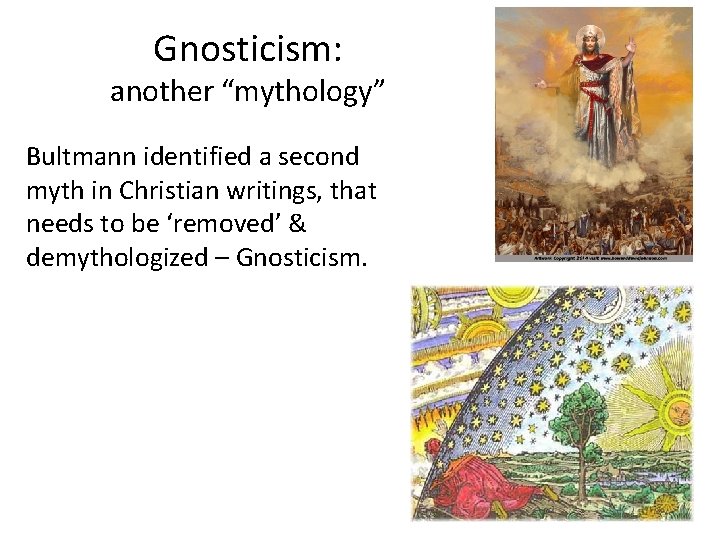
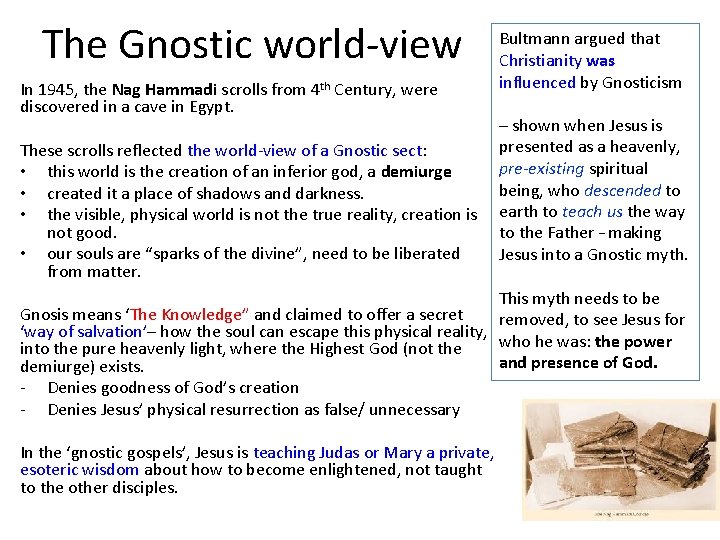
Gnosticism: another “mythology” Bultmann identified a second myth in Christian writings, that needs to be ‘removed’ & demythologized – Gnosticism.
The Gnostic world-view In 1945, the Nag Hammadi scrolls from 4 th Century, were discovered in a cave in Egypt. These scrolls reflected the world-view of a Gnostic sect: • this world is the creation of an inferior god, a demiurge • created it a place of shadows and darkness. • the visible, physical world is not the true reality, creation is not good. • our souls are “sparks of the divine”, need to be liberated from matter. Bultmann argued that Christianity was influenced by Gnosticism – shown when Jesus is presented as a heavenly, pre-existing spiritual being, who descended to earth to teach us the way to the Father – making Jesus into a Gnostic myth. This myth needs to be Gnosis means ‘The Knowledge” and claimed to offer a secret removed, to see Jesus for ‘way of salvation’– how the soul can escape this physical reality, who he was: the power into the pure heavenly light, where the Highest God (not the and presence of God. demiurge) exists. - Denies goodness of God’s creation - Denies Jesus’ physical resurrection as false/ unnecessary In the ‘gnostic gospels’, Jesus is teaching Judas or Mary a private, esoteric wisdom about how to become enlightened, not taught to the other disciples.
Bultmann’s Kerygma • Kerygma is a power, to move to people to personal faith • Removal of Apocalyptic and Gnostic myths Challenges to Bultmann: • kerygma has to be based on some facts! • if it is not based on the historical Jesus, how is it Christian? • “existential truths” could be found outside of Christianity • Demythologising just creates a new ‘myth’ for modern people: a personal and individualistic message, about personal conversion and faith.
Examine Bultmann’s view of the kerygma Evaluate Bultmann’s view of the kerygma
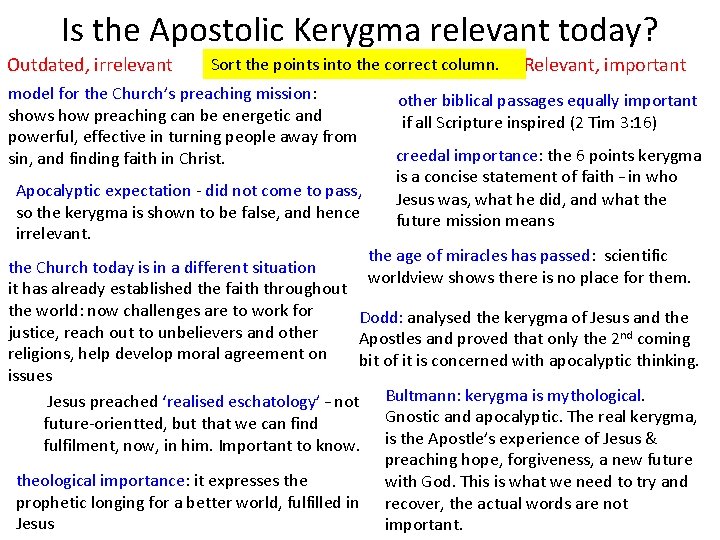
Is the Apostolic Kerygma relevant today? Outdated, irrelevant Sort the points into the correct column. model for the Church’s preaching mission: shows how preaching can be energetic and powerful, effective in turning people away from sin, and finding faith in Christ. Apocalyptic expectation - did not come to pass, so the kerygma is shown to be false, and hence irrelevant. Relevant, important other biblical passages equally important if all Scripture inspired (2 Tim 3: 16) creedal importance: the 6 points kerygma is a concise statement of faith – in who Jesus was, what he did, and what the future mission means the age of miracles has passed: scientific the Church today is in a different situation worldview shows there is no place for them. it has already established the faith throughout the world: now challenges are to work for Dodd: analysed the kerygma of Jesus and the justice, reach out to unbelievers and other Apostles and proved that only the 2 nd coming religions, help develop moral agreement on bit of it is concerned with apocalyptic thinking. issues Jesus preached ‘realised eschatology’ – not Bultmann: kerygma is mythological. Gnostic and apocalyptic. The real kerygma, future-orientted, but that we can find fulfilment, now, in him. Important to know. is the Apostle’s experience of Jesus & preaching hope, forgiveness, a new future theological importance: it expresses the with God. This is what we need to try and prophetic longing for a better world, fulfilled in recover, the actual words are not Jesus important.
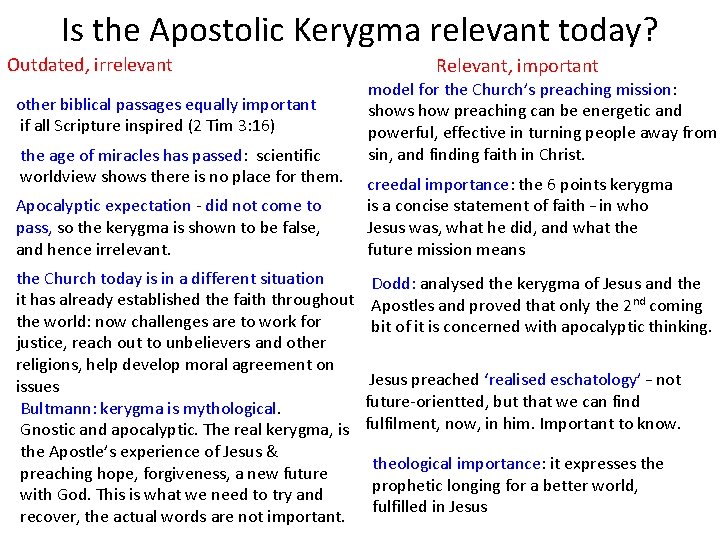
Is the Apostolic Kerygma relevant today? Outdated, irrelevant other biblical passages equally important if all Scripture inspired (2 Tim 3: 16) the age of miracles has passed: scientific worldview shows there is no place for them. Apocalyptic expectation - did not come to pass, so the kerygma is shown to be false, and hence irrelevant. the Church today is in a different situation it has already established the faith throughout the world: now challenges are to work for justice, reach out to unbelievers and other religions, help develop moral agreement on issues Bultmann: kerygma is mythological. Gnostic and apocalyptic. The real kerygma, is the Apostle’s experience of Jesus & preaching hope, forgiveness, a new future with God. This is what we need to try and recover, the actual words are not important. Relevant, important model for the Church’s preaching mission: shows how preaching can be energetic and powerful, effective in turning people away from sin, and finding faith in Christ. creedal importance: the 6 points kerygma is a concise statement of faith – in who Jesus was, what he did, and what the future mission means Dodd: analysed the kerygma of Jesus and the Apostles and proved that only the 2 nd coming bit of it is concerned with apocalyptic thinking. Jesus preached ‘realised eschatology’ – not future-orientted, but that we can find fulfilment, now, in him. Important to know. theological importance: it expresses the prophetic longing for a better world, fulfilled in Jesus
Is the Book of Acts historically reliable? Outdated, irrelevant Relevant, important Is the Apostolic Kerygma relevant today? Is Bultmann’s understanding of the kerygma Christian?