
Challenges The topological status of the magnetosphere open
![Ogino’s code, NBZ, [Ogino and Walker, 1984] • Cusp reconnection • Closed magnetosphere](https://slidetodoc.com/presentation_image_h/194587b57c65d3e1fc19a9f96c2cf906/image-6.jpg "Ogino’s code, NBZ, [Ogino and Walker, 1984] • Cusp reconnection • Closed magnetosphere")
![Rice Model, NBZ [Usadi et al. , 1993] • Cusp merging • Closed magnetosphere](https://slidetodoc.com/presentation_image_h/194587b57c65d3e1fc19a9f96c2cf906/image-7.jpg "Rice Model, NBZ [Usadi et al. , 1993] • Cusp merging • Closed magnetosphere")
![Raeder’s Model, NBZ [Raeder et al. , 1995] • Cusp reconnection • Tail reconnection](https://slidetodoc.com/presentation_image_h/194587b57c65d3e1fc19a9f96c2cf906/image-9.jpg "Raeder’s Model, NBZ [Raeder et al. , 1995] • Cusp reconnection • Tail reconnection")
![Ogino’s code, NBZ, [Bargatze et al. , 1999] • Cusp reconnection • Closed magnetosphere](https://slidetodoc.com/presentation_image_h/194587b57c65d3e1fc19a9f96c2cf906/image-10.jpg "Ogino’s code, NBZ, [Bargatze et al. , 1999] • Cusp reconnection • Closed magnetosphere")
![Superposition Of Magnetic Field Model/Method [Siscoe] • B=BIMF + Bdipole • Separatrix surfaces are](https://slidetodoc.com/presentation_image_h/194587b57c65d3e1fc19a9f96c2cf906/image-11.jpg "Superposition Of Magnetic Field Model/Method [Siscoe] • B=BIMF + Bdipole • Separatrix surfaces are")
![Watanabe et al. , [2005]; NBZ with Dipole Tilt • Two possible sequences •](https://slidetodoc.com/presentation_image_h/194587b57c65d3e1fc19a9f96c2cf906/image-12.jpg "Watanabe et al. , [2005]; NBZ with Dipole Tilt • Two possible sequences •")
![Watanabe et al. [2005]; NBZ with Dipole Tilt • Just inside northern openclosed boundary,](https://slidetodoc.com/presentation_image_h/194587b57c65d3e1fc19a9f96c2cf906/image-13.jpg "Watanabe et al. [2005]; NBZ with Dipole Tilt • Just inside northern openclosed boundary,")
![Watanabe et al. [2005]; NBZ with Dipole Tilt • Just inside southern openclosed boundary,](https://slidetodoc.com/presentation_image_h/194587b57c65d3e1fc19a9f96c2cf906/image-14.jpg "Watanabe et al. [2005]; NBZ with Dipole Tilt • Just inside southern openclosed boundary,")
![Watanabe et al. [2005]; NBZ with Dipole Tilt • Fieldaligned flows from the ionosphere](https://slidetodoc.com/presentation_image_h/194587b57c65d3e1fc19a9f96c2cf906/image-15.jpg "Watanabe et al. [2005]; NBZ with Dipole Tilt • Fieldaligned flows from the ionosphere")
![Raeder’s Model, NBZ [Raeder et al. , 1995] • Cusp reconnection • Tail reconnection](https://slidetodoc.com/presentation_image_h/194587b57c65d3e1fc19a9f96c2cf906/image-16.jpg "Raeder’s Model, NBZ [Raeder et al. , 1995] • Cusp reconnection • Tail reconnection")
- Slides: 25
Challenges • The topological status of the magnetosphere: open or closed? • Driver(s) of ionospheric sunward flow • Source(s) of NBZ currents • Key problem: are “viscous cells” driven by viscosity?
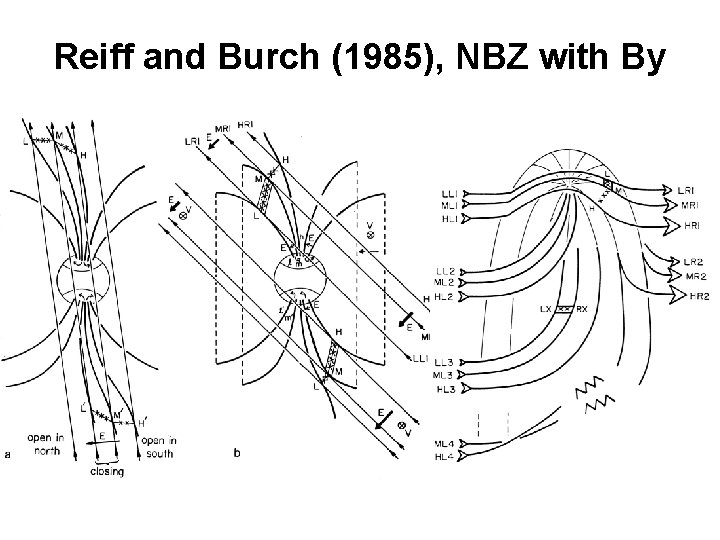
Reiff and Burch (1985), NBZ with By
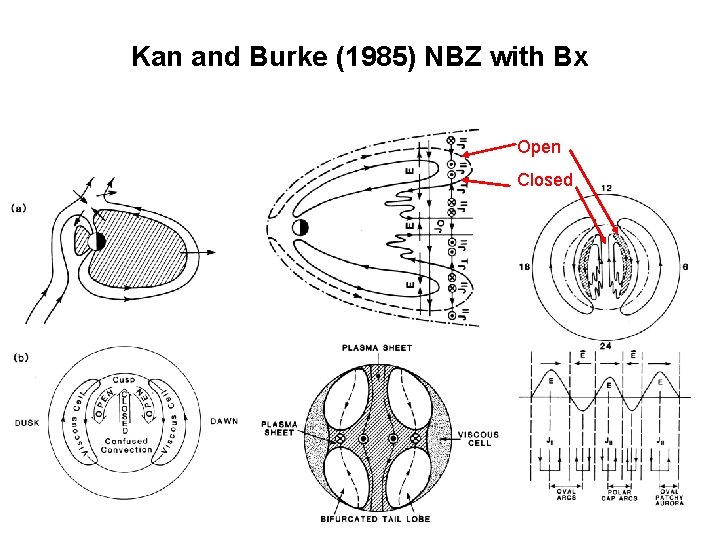
Kan and Burke (1985) NBZ with Bx Open Closed
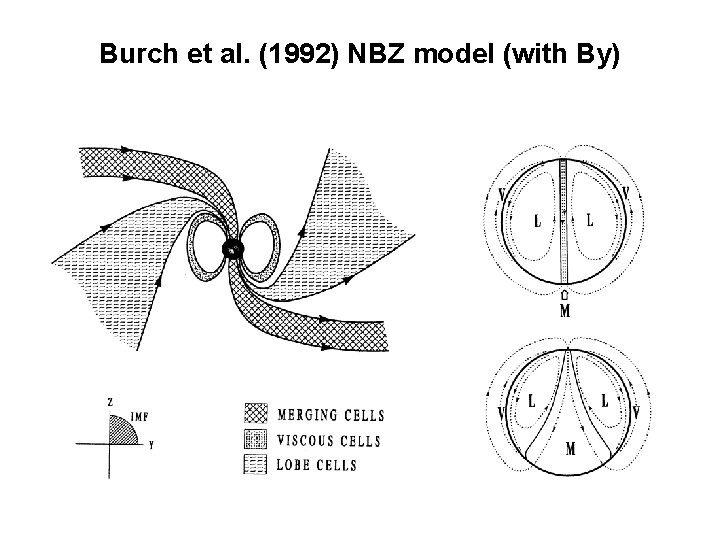
Burch et al. (1992) NBZ model (with By)
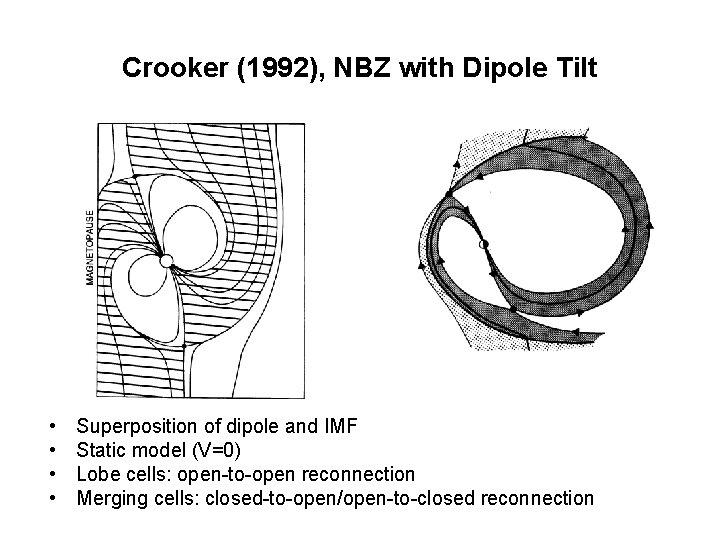
Crooker (1992), NBZ with Dipole Tilt • • Superposition of dipole and IMF Static model (V=0) Lobe cells: open-to-open reconnection Merging cells: closed-to-open/open-to-closed reconnection
Ogino’s code, NBZ, [Ogino and Walker, 1984] • Cusp reconnection • Closed magnetosphere
Rice Model, NBZ [Usadi et al. , 1993] • Cusp merging • Closed magnetosphere • Shorter tail for large IMF magnitude
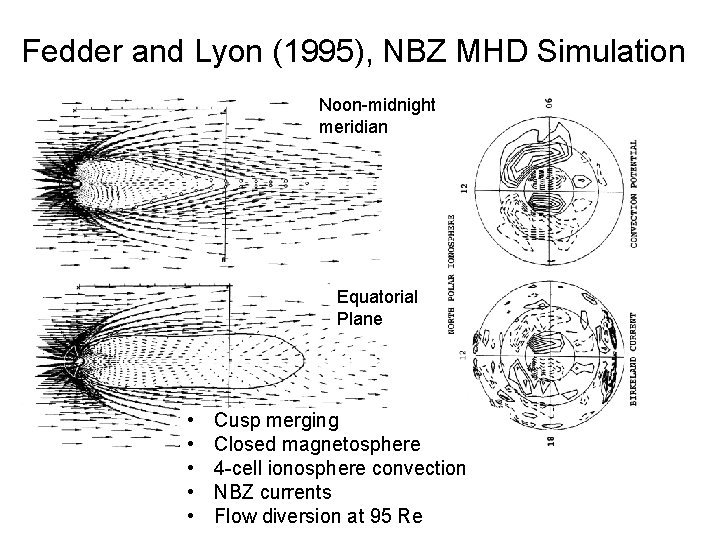
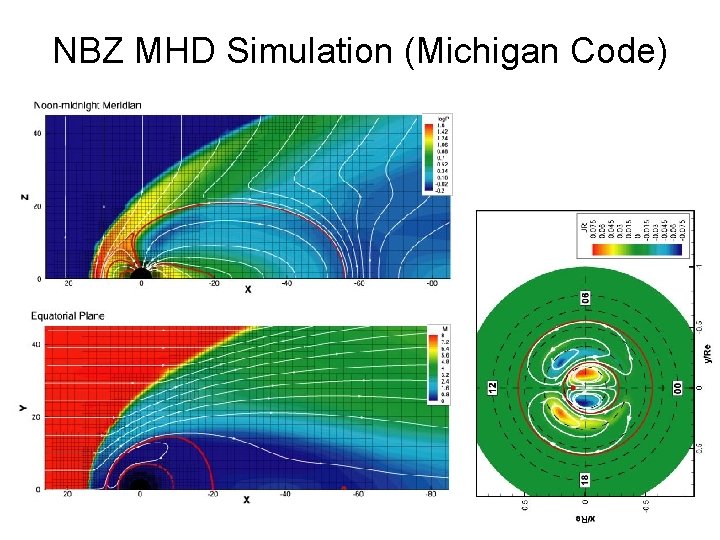
Fedder and Lyon (1995), NBZ MHD Simulation Noon-midnight meridian Equatorial Plane • • • Cusp merging Closed magnetosphere 4 -cell ionosphere convection NBZ currents Flow diversion at 95 Re
Raeder’s Model, NBZ [Raeder et al. , 1995] • Cusp reconnection • Tail reconnection • Open tail • No ionospheric convection is shown
Ogino’s code, NBZ, [Bargatze et al. , 1999] • Cusp reconnection • Closed magnetosphere
Superposition Of Magnetic Field Model/Method [Siscoe] • B=BIMF + Bdipole • Separatrix surfaces are found, separating regions of different topologies. • Two null points are identified. Field lines on the separatrix surfaces converge to or diverge from these two points. • Separator lines are founded, that connect the two nulls.
Watanabe et al. , [2005]; NBZ with Dipole Tilt • Two possible sequences • In each case, reconnection takes place at different times in the two hemispheres
Watanabe et al. [2005]; NBZ with Dipole Tilt • Just inside northern openclosed boundary, field lines converge to a single point in the other hemisphere • This is impossible if the field lines are moving
Watanabe et al. [2005]; NBZ with Dipole Tilt • Just inside southern openclosed boundary, field lines converge to a single point in the other hemisphere • Can this be possible?
Watanabe et al. [2005]; NBZ with Dipole Tilt • Fieldaligned flows from the ionosphere • The inner boundary condition (Dirichlet) does not allow fieldaligned flow
Raeder’s Model, NBZ [Raeder et al. , 1995] • Cusp reconnection • Tail reconnection • Open tail • No ionospheric convection is shown
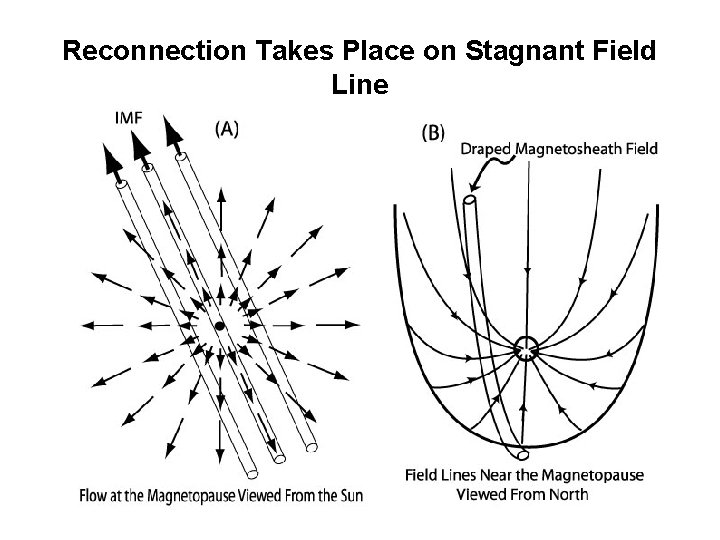
Reconnection Takes Place on Stagnant Field Line
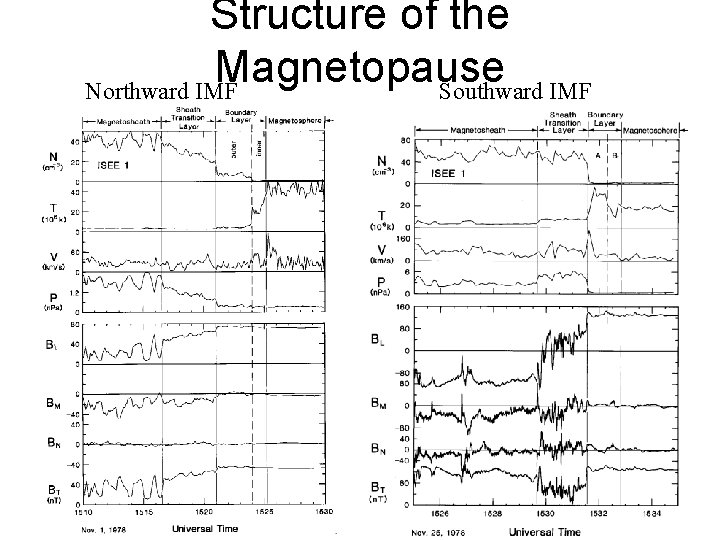
Structure of the Magnetopause Northward IMF Southward IMF
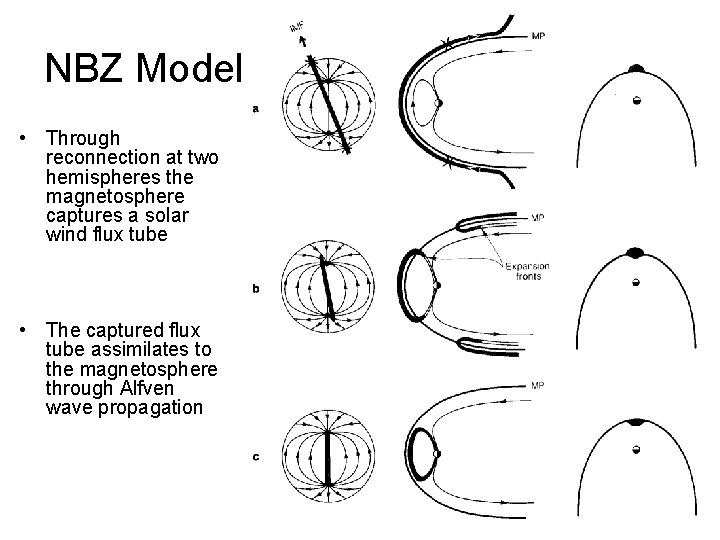
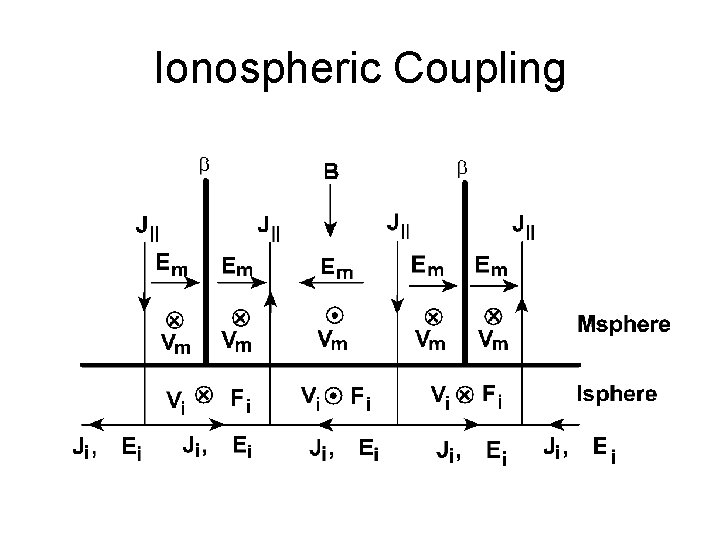
NBZ Model • Through reconnection at two hemispheres the magnetosphere captures a solar wind flux tube • The captured flux tube assimilates to the magnetosphere through Alfven wave propagation
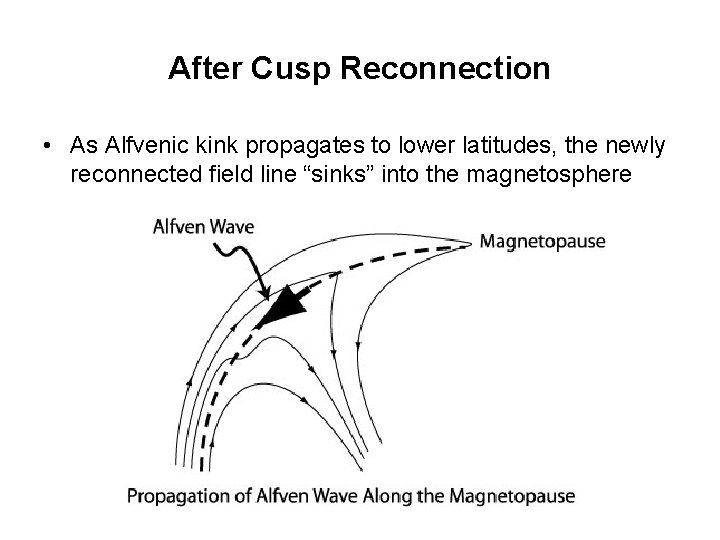
After Cusp Reconnection • As Alfvenic kink propagates to lower latitudes, the newly reconnected field line “sinks” into the magnetosphere
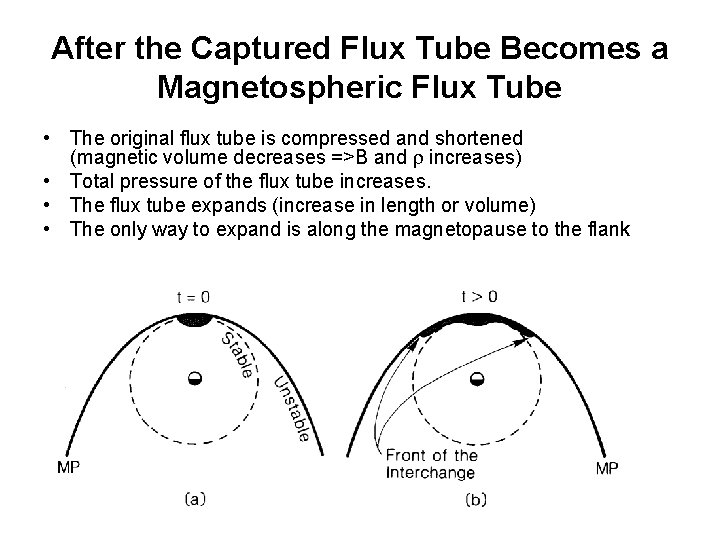
After the Captured Flux Tube Becomes a Magnetospheric Flux Tube • The original flux tube is compressed and shortened (magnetic volume decreases =>B and increases) • Total pressure of the flux tube increases. • The flux tube expands (increase in length or volume) • The only way to expand is along the magnetopause to the flank
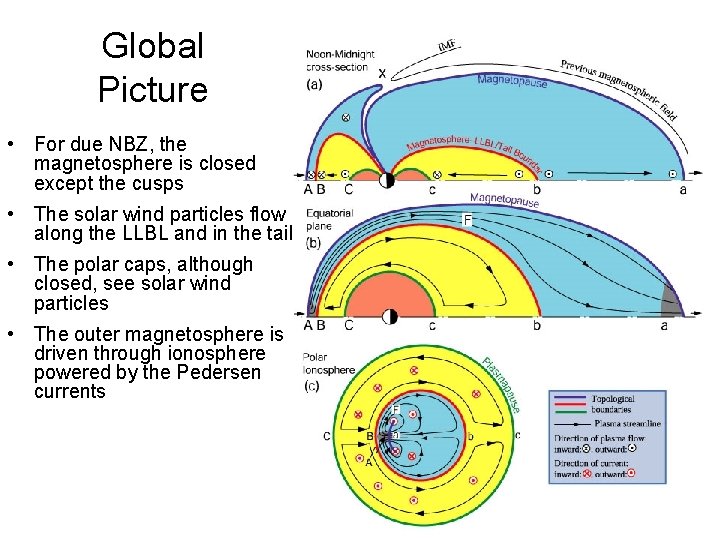
Global Picture • For due NBZ, the magnetosphere is closed except the cusps • The solar wind particles flow along the LLBL and in the tail • The polar caps, although closed, see solar wind particles • The outer magnetosphere is driven through ionosphere powered by the Pedersen currents
Ionospheric Coupling
NBZ MHD Simulation (Michigan Code)
Conclusions • With better and better computer simulation models, the knowledge of modeling becomes more and more important in order to safeguard the simulation model and to understand interpret correctly the simulation results. • Modeling links observation, knowledge, and predictions for remote regions in space with physical laws. • It provides top level qualitative physical understanding of a problem or a simulation result. • There are principles in how to perform modeling, but few people apply them to constraining their models or interpretations. • It is time for more people to know the principles and guidelines of modeling.