
Challenges of Ultrasound Probe Technology in the 21
“Challenges of Ultrasound Probe Technology in the 21 st Century” How to better diagnose ultrasound probe issues in today’s ever-changing environment.
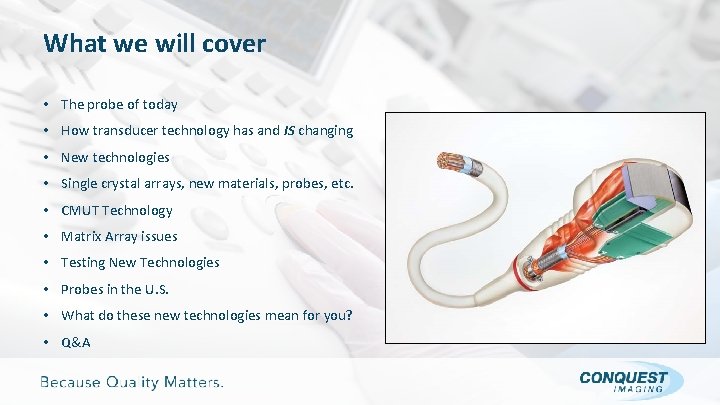
What we will cover • The probe of today • How transducer technology has and IS changing • New technologies • Single crystal arrays, new materials, probes, etc. • CMUT Technology • Matrix Array issues • Testing New Technologies • Probes in the U. S. • What do these new technologies mean for you? • Q&A
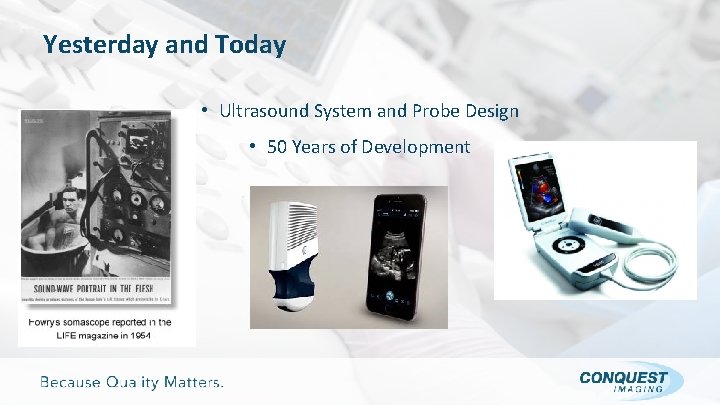
Yesterday and Today • Ultrasound System and Probe Design • 50 Years of Development
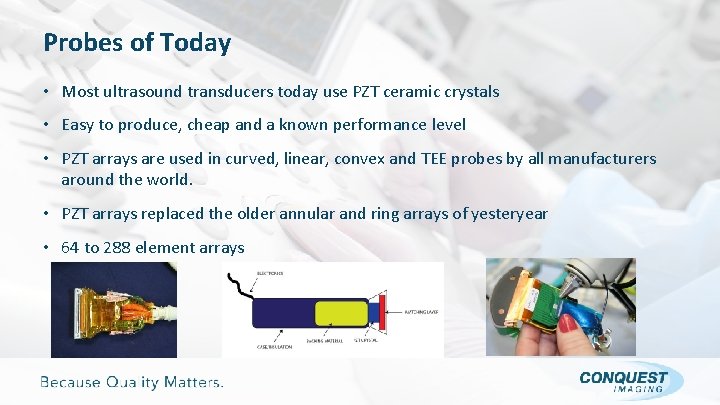
Probes of Today • Most ultrasound transducers today use PZT ceramic crystals • Easy to produce, cheap and a known performance level • PZT arrays are used in curved, linear, convex and TEE probes by all manufacturers around the world. • PZT arrays replaced the older annular and ring arrays of yesteryear • 64 to 288 element arrays
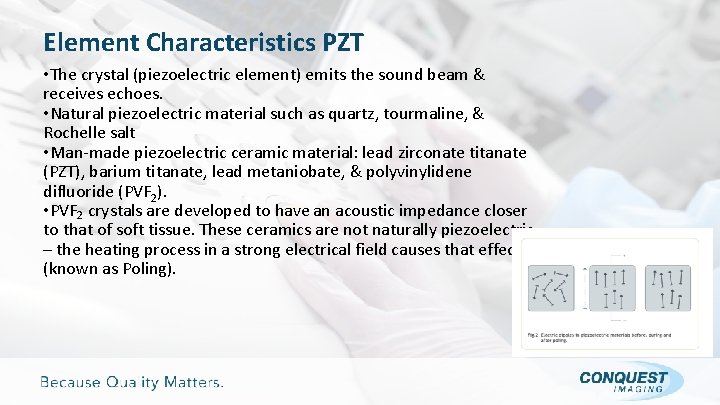
Element Characteristics PZT • The crystal (piezoelectric element) emits the sound beam & receives echoes. • Natural piezoelectric material such as quartz, tourmaline, & Rochelle salt • Man-made piezoelectric ceramic material: lead zirconate titanate (PZT), barium titanate, lead metaniobate, & polyvinylidene difluoride (PVF 2). • PVF 2 crystals are developed to have an acoustic impedance closer to that of soft tissue. These ceramics are not naturally piezoelectric – the heating process in a strong electrical field causes that effect (known as Poling).
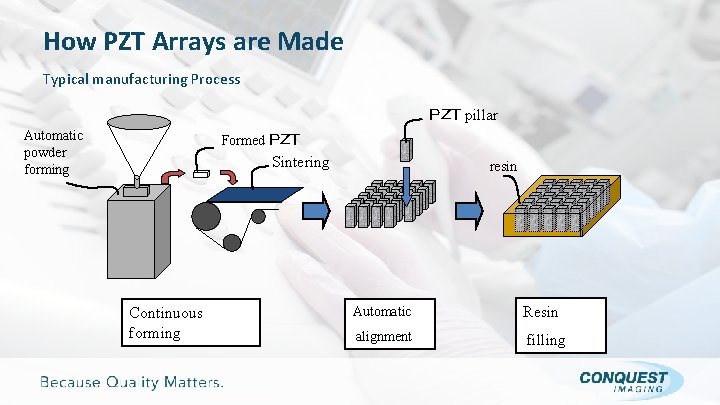
How PZT Arrays are Made Typical manufacturing Process PZT pillar Automatic powder forming Formed PZT Sintering Continuous forming resin Automatic Resin alignment filling
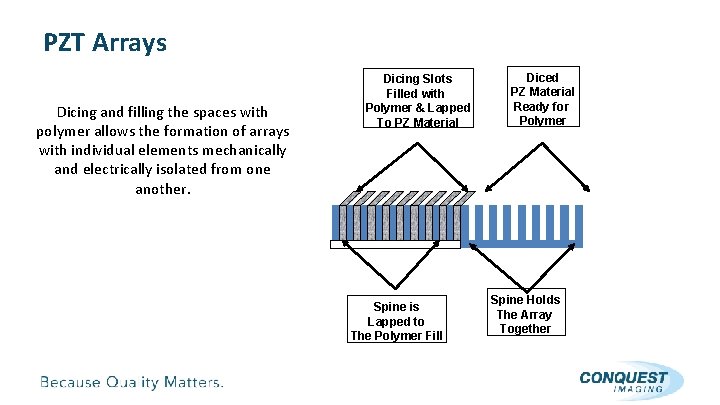
PZT Arrays Dicing and filling the spaces with polymer allows the formation of arrays with individual elements mechanically and electrically isolated from one another. Dicing Slots Filled with Polymer & Lapped To PZ Material Spine is Lapped to The Polymer Fill Diced PZ Material Ready for Polymer Spine Holds The Array Together
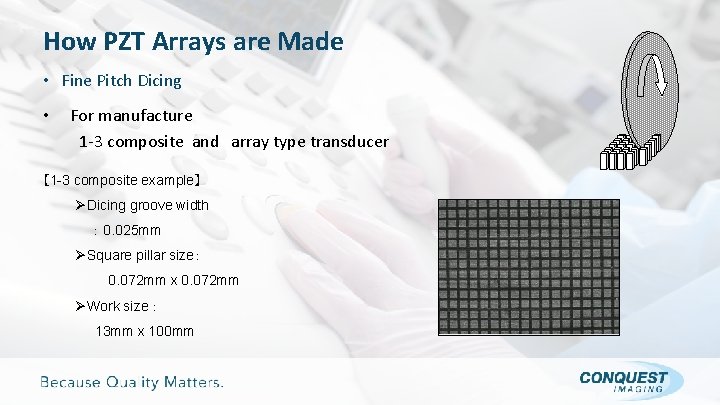
How PZT Arrays are Made • Fine Pitch Dicing • For manufacture 1 -3 composite and array type transducer 【 1 -3 composite example】 ØDicing groove width : 0. 025 mm ØSquare pillar size: 0. 072 mm x 0. 072 mm ØWork size: 13 mm x 100 mm
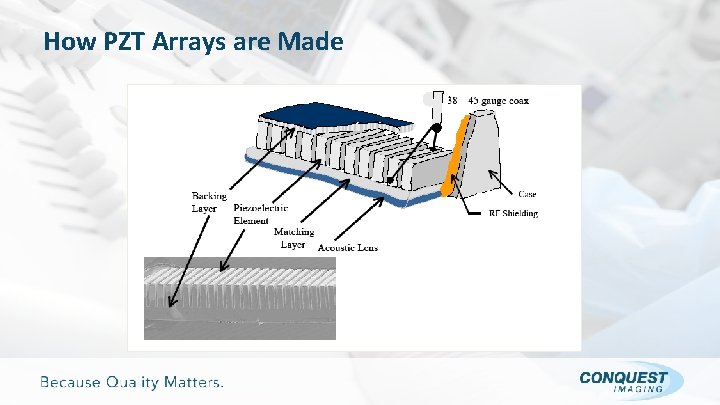
How PZT Arrays are Made
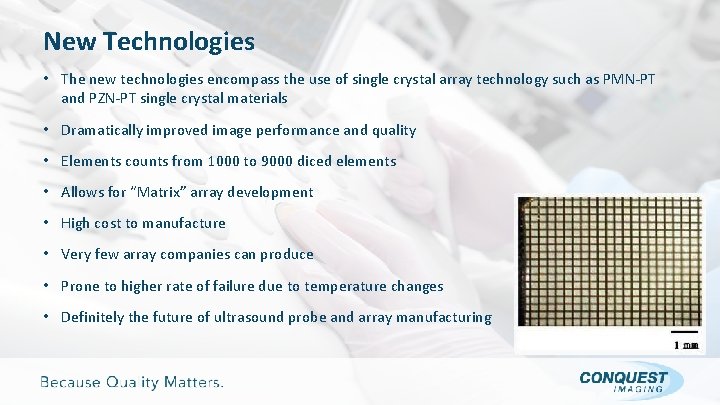
New Technologies • The new technologies encompass the use of single crystal array technology such as PMN-PT and PZN-PT single crystal materials • Dramatically improved image performance and quality • Elements counts from 1000 to 9000 diced elements • Allows for “Matrix” array development • High cost to manufacture • Very few array companies can produce • Prone to higher rate of failure due to temperature changes • Definitely the future of ultrasound probe and array manufacturing
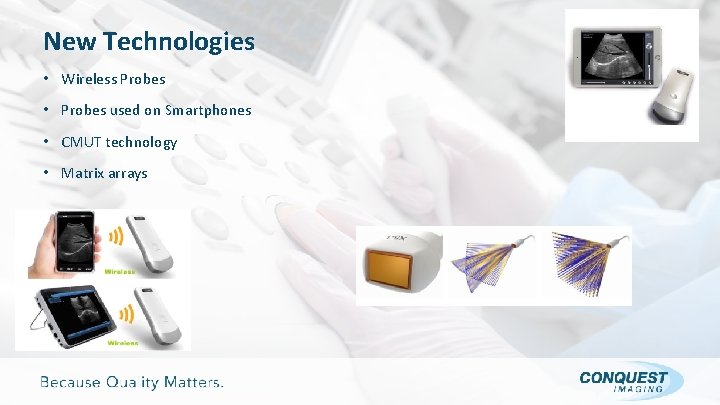
New Technologies • Wireless Probes • Probes used on Smartphones • CMUT technology • Matrix arrays
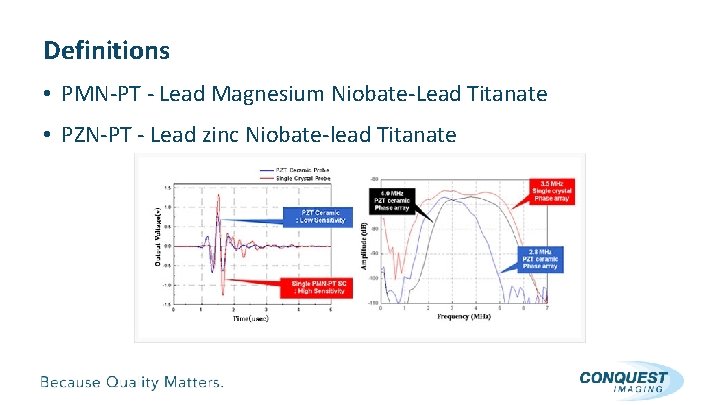
Definitions • PMN-PT - Lead Magnesium Niobate-Lead Titanate • PZN-PT - Lead zinc Niobate-lead Titanate
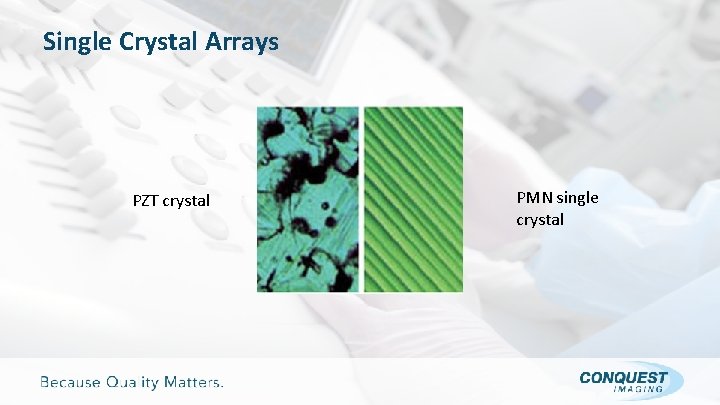
Single Crystal Arrays PZT crystal PMN single crystal
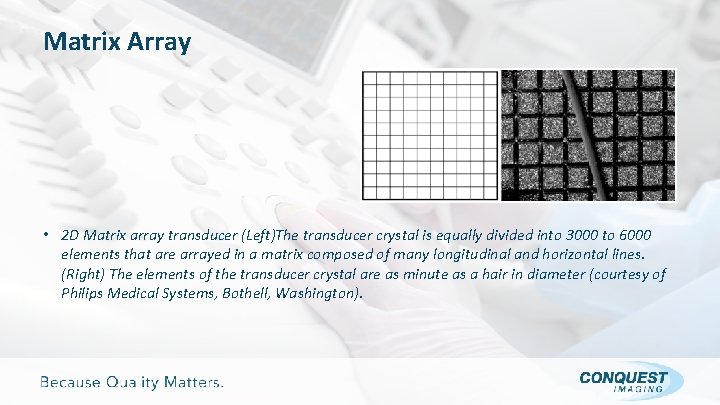
Matrix Array • 2 D Matrix array transducer (Left)The transducer crystal is equally divided into 3000 to 6000 elements that are arrayed in a matrix composed of many longitudinal and horizontal lines. (Right) The elements of the transducer crystal are as minute as a hair in diameter (courtesy of Philips Medical Systems, Bothell, Washington).
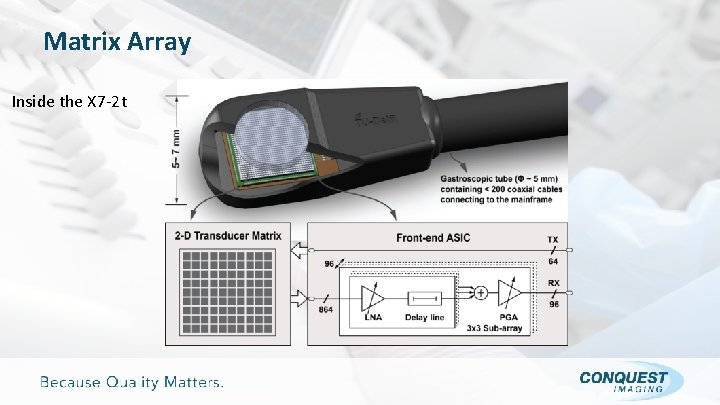
Matrix Array Inside the X 7 -2 t
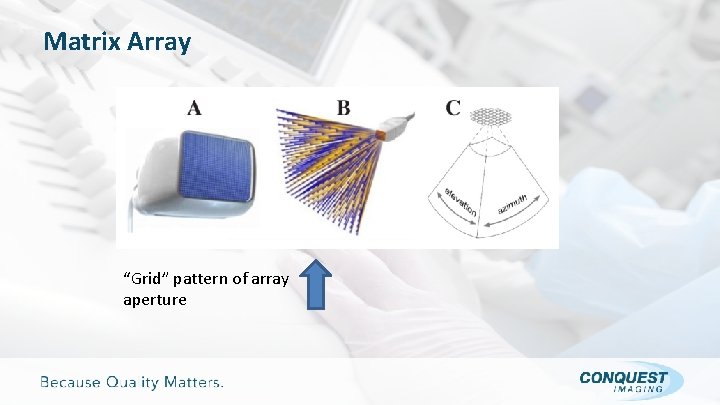
Matrix Array “Grid” pattern of array aperture
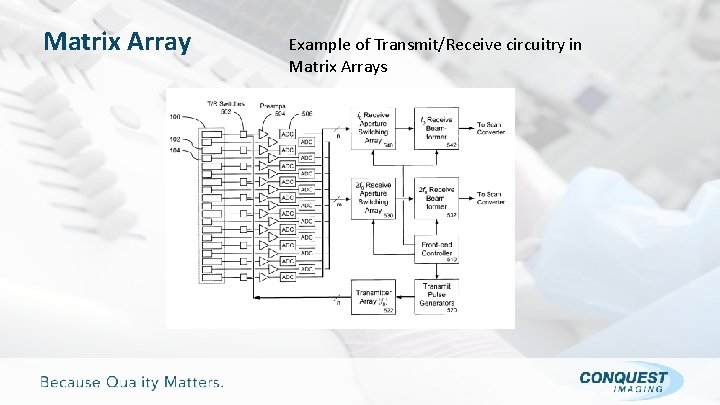
Matrix Array Example of Transmit/Receive circuitry in Matrix Arrays
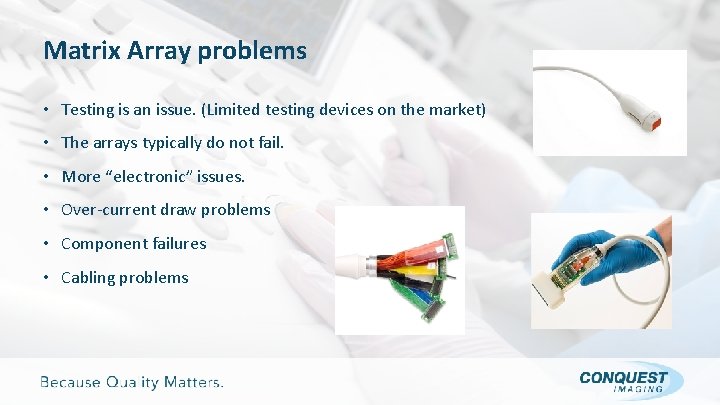
Matrix Array problems • Testing is an issue. (Limited testing devices on the market) • The arrays typically do not fail. • More “electronic” issues. • Over-current draw problems • Component failures • Cabling problems
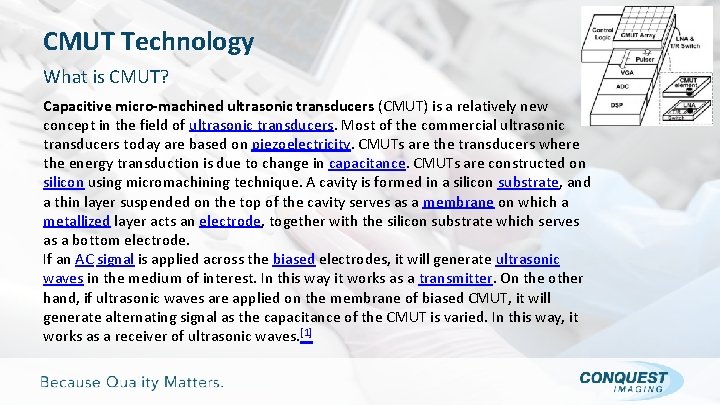
CMUT Technology What is CMUT? Capacitive micro-machined ultrasonic transducers (CMUT) is a relatively new concept in the field of ultrasonic transducers. Most of the commercial ultrasonic transducers today are based on piezoelectricity. CMUTs are the transducers where the energy transduction is due to change in capacitance. CMUTs are constructed on silicon using micromachining technique. A cavity is formed in a silicon substrate, and a thin layer suspended on the top of the cavity serves as a membrane on which a metallized layer acts an electrode, together with the silicon substrate which serves as a bottom electrode. If an AC signal is applied across the biased electrodes, it will generate ultrasonic waves in the medium of interest. In this way it works as a transmitter. On the other hand, if ultrasonic waves are applied on the membrane of biased CMUT, it will generate alternating signal as the capacitance of the CMUT is varied. In this way, it works as a receiver of ultrasonic waves. [1]
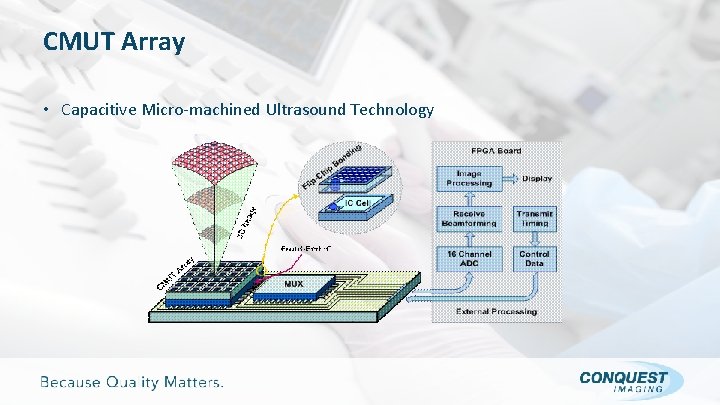
CMUT Array • Capacitive Micro-machined Ultrasound Technology
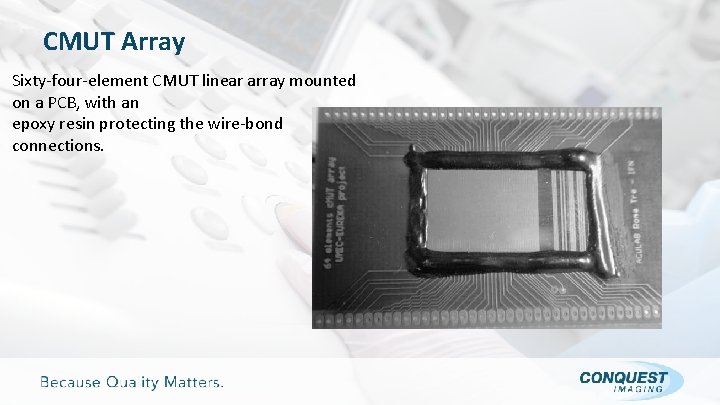
CMUT Array Sixty-four-element CMUT linear array mounted on a PCB, with an epoxy resin protecting the wire-bond connections.
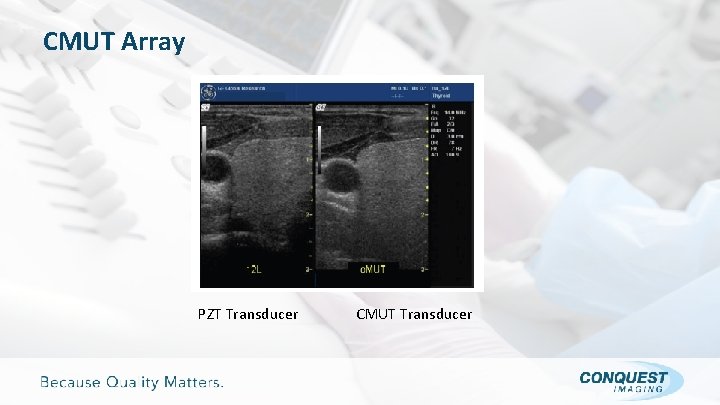
CMUT Array PZT Transducer CMUT Transducer
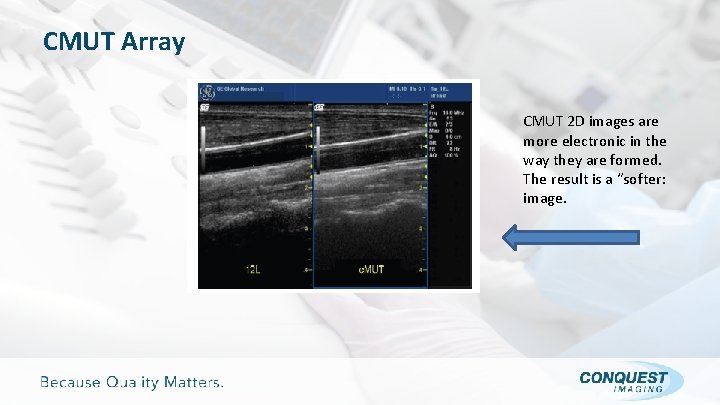
CMUT Array CMUT 2 D images are more electronic in the way they are formed. The result is a “softer: image.
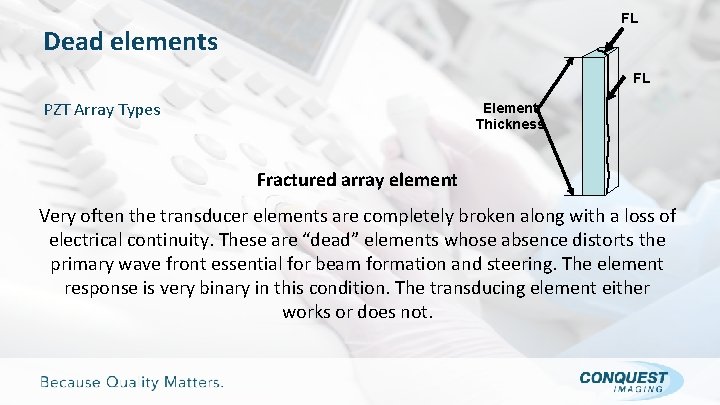
FL Dead elements FL PZT Array Types Element Thickness Fractured array element Very often the transducer elements are completely broken along with a loss of electrical continuity. These are “dead” elements whose absence distorts the primary wave front essential for beam formation and steering. The element response is very binary in this condition. The transducing element either works or does not.
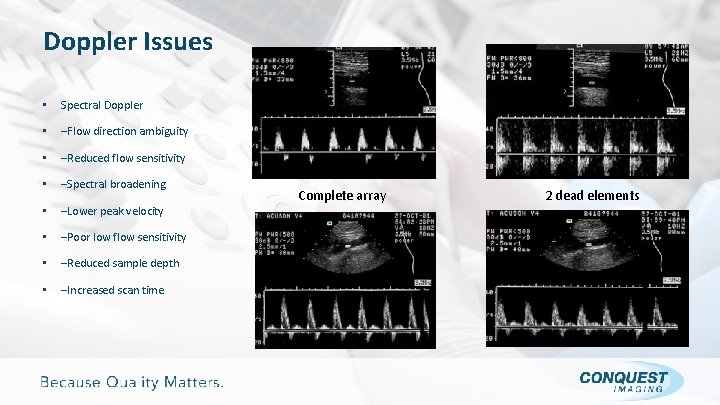
Doppler Issues • Spectral Doppler • –Flow direction ambiguity • –Reduced flow sensitivity • –Spectral broadening • –Lower peak velocity • –Poor low flow sensitivity • –Reduced sample depth • –Increased scan time Complete array 2 dead elements

Testing Today’s Probes • “If it cannot be tested properly, how can it be repaired properly? ”
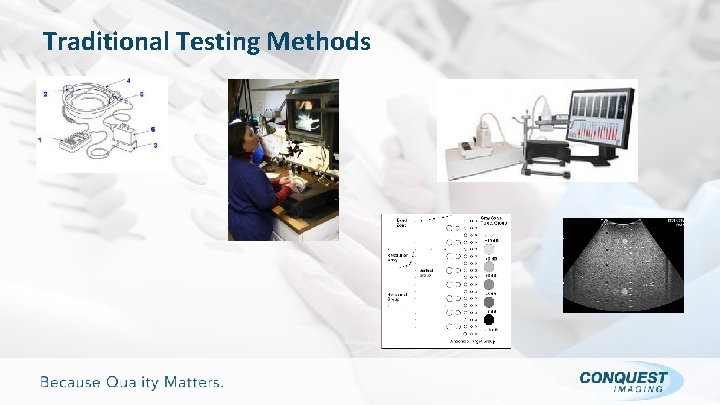
Traditional Testing Methods
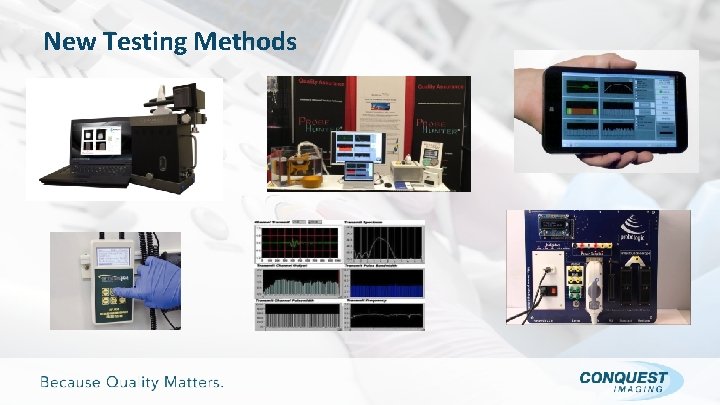
New Testing Methods
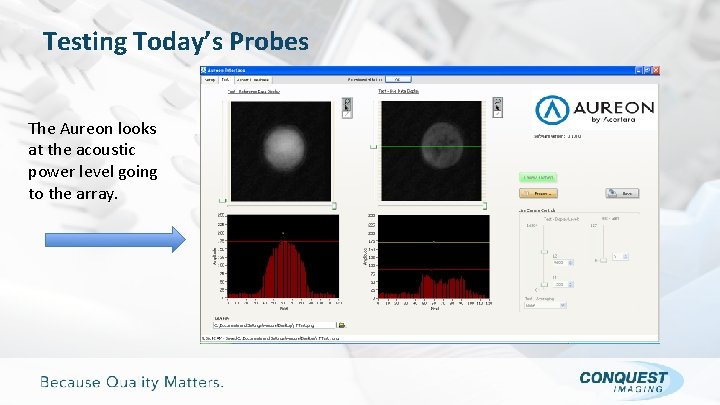
Testing Today’s Probes The Aureon looks at the acoustic power level going to the array.
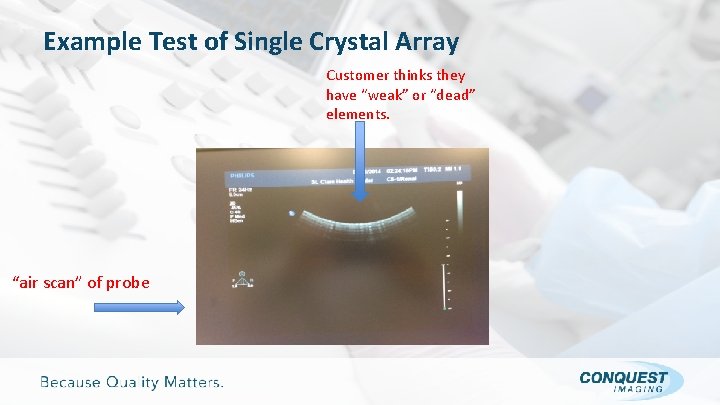
Example Test of Single Crystal Array Customer thinks they have “weak” or “dead” elements. “air scan” of probe
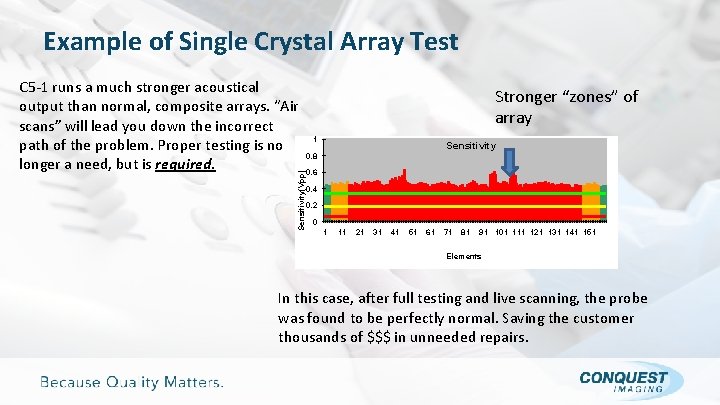
Example of Single Crystal Array Test Sensitivity(Vpp) C 5 -1 runs a much stronger acoustical output than normal, composite arrays. “Air scans” will lead you down the incorrect path of the problem. Proper testing is no longer a need, but is required. Stronger “zones” of array 1 Sensitivity 0. 8 0. 6 0. 4 0. 2 0 1 11 21 31 41 51 61 71 81 91 101 111 121 131 141 151 Elements In this case, after full testing and live scanning, the probe was found to be perfectly normal. Saving the customer thousands of $$$ in unneeded repairs.
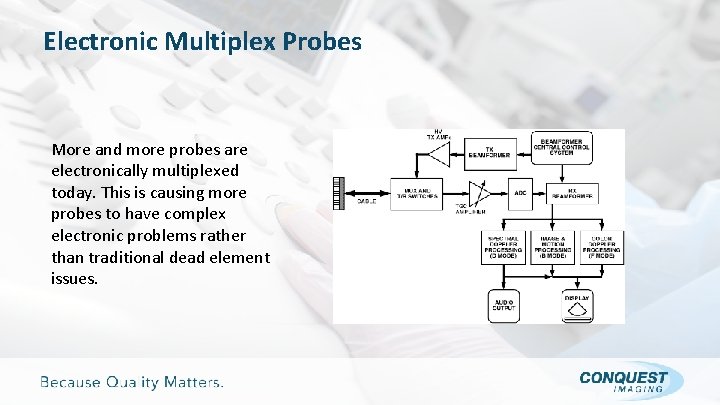
Electronic Multiplex Probes More and more probes are electronically multiplexed today. This is causing more probes to have complex electronic problems rather than traditional dead element issues.
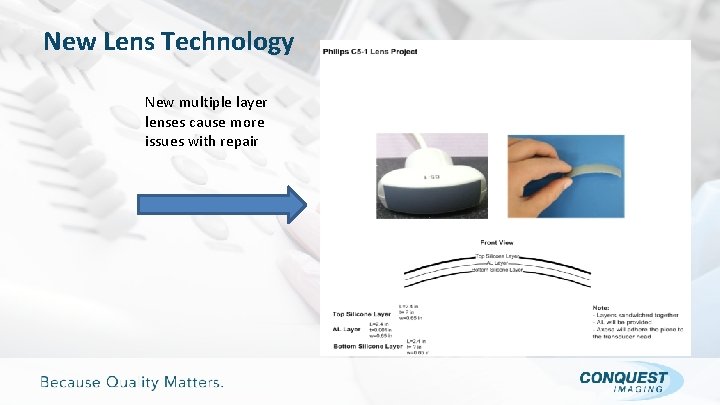
New Lens Technology New multiple layer lenses cause more issues with repair
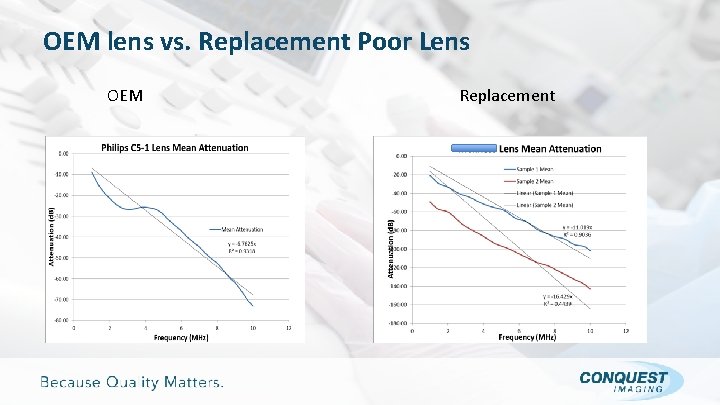
OEM lens vs. Replacement Poor Lens OEM Replacement
What do these new technologies mean to you? • Ultrasound probes continue to become more complex • What used to look like dead elements on PZT arrays can now be: • Electronic problems • De-polarized elements • Multiplexer problems • Programming issues • Probes continue to be costly • Try to train your customers in better care of their probes • Catch problems early and repair at minor levels instead of major. • Remember the clinical outcomes of bad probes
What do these new technologies mean to you? • Early diagnosis is critical. Remove cost. Don’t just “save money” • Problems can be deceiving. Things like “air scans” can lead you down the wrong path. • More expensive exchanges. • You need to really check the “environment” of your probes. • Are they cleaned/disinfected properly? • Are they stored and placed in the proper probe holders? • Is the room temperature good and controlled?
Return On Investment (ROI) There is a real cost to the bottom-line: • Using the $221. 21 rate of Medicare fees, per study/patient: • Array replacement/exchange probe: Cost; $5000 • Number of patients required to “pay for” this repair/exchange – $5000/ $221. 21 = 22. 5 • 23 patients using the 15/patients /day model, equals 1 ½ days worth of patients to simply “pay” for the repair/exchange. • This means the hospital is not generating any revenue on this system for a day and a half. This does not include the cost of S&W, Overhead, etc.
Return On Investment (ROI) • Using a carefully developed probe plan, reducing real costs can look like this: • Using the $221. 21 rate of Medicare fees, per study/patient: • Lens replacement - $600 • Number of patients required to “pay for” this lens repair - $600/$221. 21 = 2. 7 • In this case, by repairing the probe when it was still in a “minor” repair category, the hospital is generating revenue and the “cost” for the repair is paid for on one system with approx. 3 patients. • Normal revenue per/system, per/day - $3318. 15 • After paying for minor lens repair - $2654. 52 • The net gain for the hospital is positive and the true cost minimized by managing the probes better.
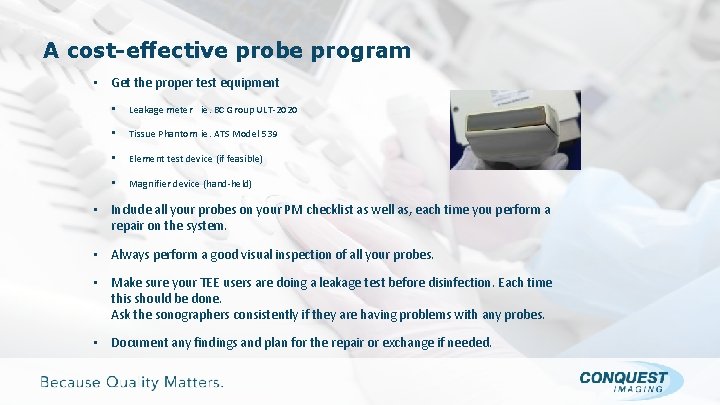
A cost-effective probe program • Get the proper test equipment • Leakage meter ie. BC Group ULT-2020 • Tissue Phantom ie. ATS Model 539 • Element test device (if feasible) • Magnifier device (hand-held) • Include all your probes on your PM checklist as well as, each time you perform a repair on the system. • Always perform a good visual inspection of all your probes. • Make sure your TEE users are doing a leakage test before disinfection. Each time this should be done. Ask the sonographers consistently if they are having problems with any probes. • Document any findings and plan for the repair or exchange if needed.
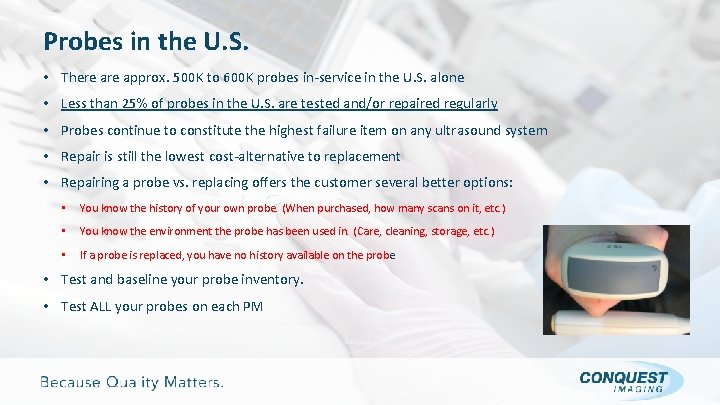
Probes in the U. S. • There approx. 500 K to 600 K probes in-service in the U. S. alone • Less than 25% of probes in the U. S. are tested and/or repaired regularly • Probes continue to constitute the highest failure item on any ultrasound system • Repair is still the lowest cost-alternative to replacement • Repairing a probe vs. replacing offers the customer several better options: • You know the history of your own probe. (When purchased, how many scans on it, etc. ) • You know the environment the probe has been used in. (Care, cleaning, storage, etc. ) • If a probe is replaced, you have no history available on the probe • Test and baseline your probe inventory. • Test ALL your probes on each PM
Q&A
- Slides: 41