
Challenges in Wireless Charging for Electric Vehicles An
![News and trends (1) May 17, 2016: [1] “SAE International Approves TIR J 2954](https://slidetodoc.com/presentation_image_h2/460ca3a89a0e03b84369d7f9e921ff98/image-2.jpg "News and trends (1) May 17, 2016: [1] “SAE International Approves TIR J 2954")
![News and trends (2) Oct 11, 2016: [1] “ 2017 Mercedes-Benz S 550 e](https://slidetodoc.com/presentation_image_h2/460ca3a89a0e03b84369d7f9e921ff98/image-3.jpg "News and trends (2) Oct 11, 2016: [1] “ 2017 Mercedes-Benz S 550 e")
![News and trends (3) Dec 8, 2016: [1] “BMW i 3 Wireless Charging Made](https://slidetodoc.com/presentation_image_h2/460ca3a89a0e03b84369d7f9e921ff98/image-4.jpg "News and trends (3) Dec 8, 2016: [1] “BMW i 3 Wireless Charging Made")
![News and trends (4) 4 Feb, 1893: [1] “On light and other high frequency](https://slidetodoc.com/presentation_image_h2/460ca3a89a0e03b84369d7f9e921ff98/image-5.jpg "News and trends (4) 4 Feb, 1893: [1] “On light and other high frequency")
![News and trends (5) 5 Sept. 13 -15, 1898: [1] “High Frequency Oscillators for](https://slidetodoc.com/presentation_image_h2/460ca3a89a0e03b84369d7f9e921ff98/image-6.jpg "News and trends (5) 5 Sept. 13 -15, 1898: [1] “High Frequency Oscillators for")
![Introduction • Some performance figures: [1] o Conductive charging − Up to 95% efficiency](https://slidetodoc.com/presentation_image_h2/460ca3a89a0e03b84369d7f9e921ff98/image-11.jpg "Introduction • Some performance figures: [1] o Conductive charging − Up to 95% efficiency")
![Range versus efficiency • Maximum efficiency heavily depends on: [1] o Distance transmitter -](https://slidetodoc.com/presentation_image_h2/460ca3a89a0e03b84369d7f9e921ff98/image-14.jpg "Range versus efficiency • Maximum efficiency heavily depends on: [1] o Distance transmitter -")
![Range versus efficiency 14 • Maximum efficiency heavily depends on: [2] o Distance transmitter](https://slidetodoc.com/presentation_image_h2/460ca3a89a0e03b84369d7f9e921ff98/image-15.jpg "Range versus efficiency 14 • Maximum efficiency heavily depends on: [2] o Distance transmitter")

- Slides: 24
Challenges in Wireless Charging for Electric Vehicles An overview Mr mudawi sorket 24 -01 -2020
News and trends (1) May 17, 2016: [1] “SAE International Approves TIR J 2954 for PH/EV Wireless Charging” “Wireless power transfer, using SAE TIR J 2954 is a game changer for PH/EVs. […] will enable consumers to simply park their vehicles [. . . ] and walk away without doing anything to charge their PH/EV. ” [1] https: //www. sae. org/news/3391/ 1
News and trends (2) Oct 11, 2016: [1] “ 2017 Mercedes-Benz S 550 e will offer wireless EV charging technology […]” “Drivers of the S 550 e equipped with the wireless charging option will simply park atop a special pad and charging will begin — no cables to manage or untangle, just “park it and charge it. ” ” [1] https: //www. qualcomm. com/news/onq/2016/10/11/2017 -mercedes-benz-s 550 e-will-offerwireless-ev-charging-technology-built-using 2
News and trends (3) Dec 8, 2016: [1] “BMW i 3 Wireless Charging Made Possible by Plugless Power” “With 7. 2 k. W of charging power over the air, the company believes that’s enough for 20 to 25 miles charged per hour. In other words, it takes no more than six hours to fully charge […]. ” [1] http: //www. autoevolution. com/news/bmw-i 3 -wireless-charging-made-possible-by-plugless -power-113549. html 3
News and trends (4) 4 Feb, 1893: [1] “On light and other high frequency phenomena” “I am becoming daily more convinced of the practicability of the scheme”, citation from Nikola Tesla’s original paper concerning wireless energy transfer. Tesla Tower (1904) intended for wireless energy transfer [1] N. Tesla, On light and other high frequency phenomena, Journal of the Franklin Institute, volume 136, issue 4, oct 1893, pp 259 -279.
News and trends (5) 5 Sept. 13 -15, 1898: [1] “High Frequency Oscillators for Electro-Therapeutic and Other Purposes” March 5, 1904: [2] “The transmission of electrical energy without wires” Inductive energy transfer [1] N. Tesla, On light and other high frequency phenomena, Journal of the Franklin Institute, volume 136, issue 4, Oct. 1893, pp 259 -279. [2] N. Tesla, The transmission of electrical energy without wires, Electrical World and Engineer, March 5, 1904. Capacitive energy transfer
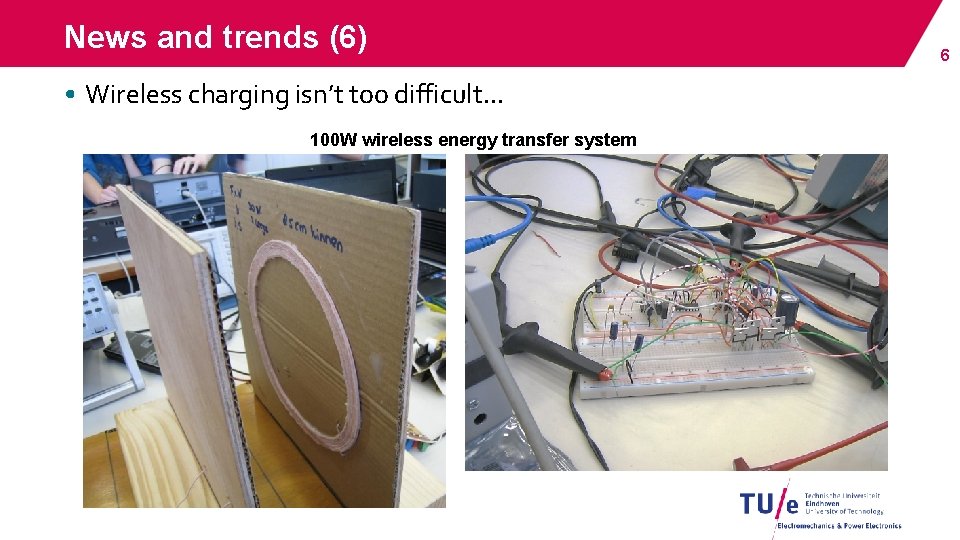
News and trends (6) • Wireless charging isn’t too difficult. . . 100 W wireless energy transfer system 6
Market of EVs and autonomous vehicles • Market outlook for autonomous vehicles in 2035: [1] o 25% market share of new car market o 12 M fully autonomous cars/year o 18 M partially autonomous cars/year o Total autonomous vehicle market: 77 billion USD [1] http: //www. bcg. com/expertise/industries/automotive/autonomous-vehicle-adoption-study. aspx 7
Introduction Why wireless charging? • Wireless charging allows self-driving EVs to recharge autonomously o “Who will plug in your self-driving car? ” • Wireless charging simplifies the use of electric vehicles o Reduces range anxiety, promoting EV adoption o Unique selling point of EVs: no more refueling Wireless charging is essential for future automotive industry 8
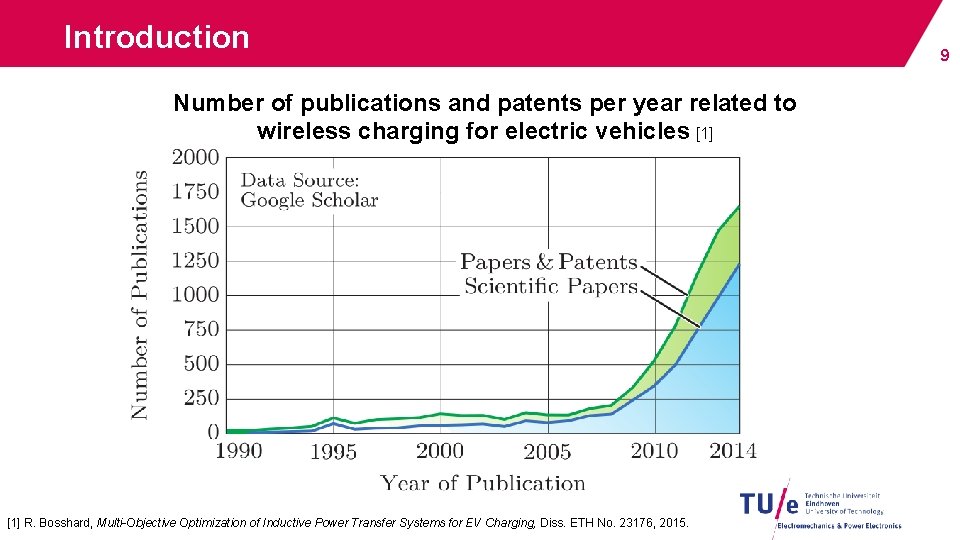
Introduction Number of publications and patents per year related to wireless charging for electric vehicles [1] R. Bosshard, Multi-Objective Optimization of Inductive Power Transfer Systems for EV Charging, Diss. ETH No. 23176, 2015. 9
Introduction • Some performance figures: [1] o Conductive charging − Up to 95% efficiency − Up to 5 k. W/dm 3 o Inductive energy transfer − Up to 95% efficiency − Up to 2. 5 k. W/dm 3 Wireless charging is a technological compromise [1] R. Bosshard, J. W. Kolar, Inductive Power Transfer for Electric Vehicle Charging – Technical Challenges and Tradeoffs, IEEE Power Electronics Magazine, pp. 22 -30, Sept. 2016 10
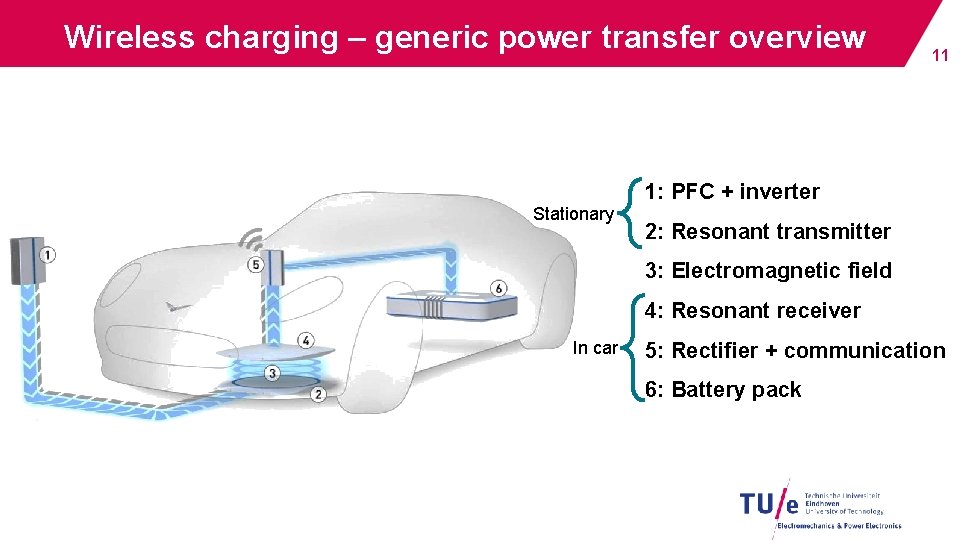
Wireless charging – generic power transfer overview Stationary 11 1: PFC + inverter 2: Resonant transmitter 3: Electromagnetic field 4: Resonant receiver In car 5: Rectifier + communication 6: Battery pack
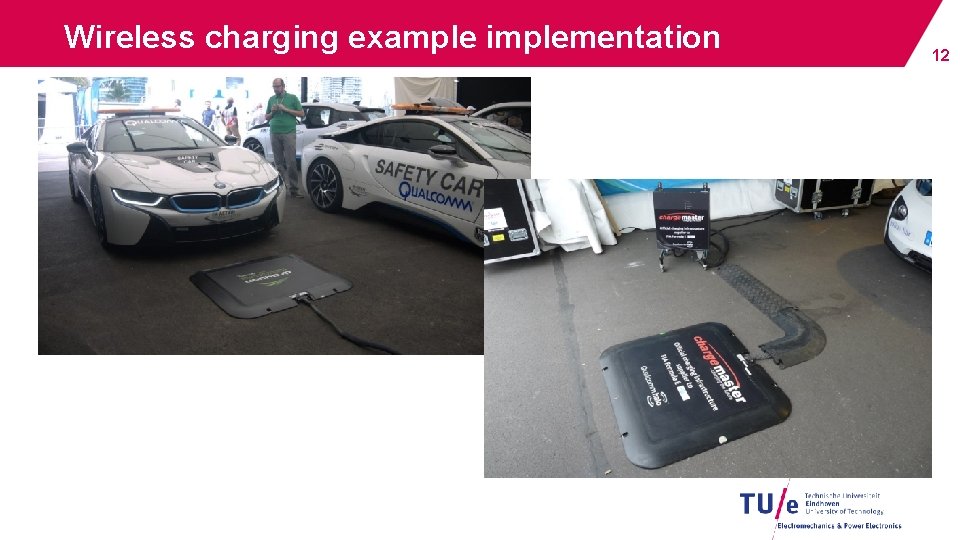
Wireless charging example implementation 12
Range versus efficiency • Maximum efficiency heavily depends on: [1] o Distance transmitter - receiver o Radii of antennae o Q-factor (resistance in system) o Misalignment transmitter - receiver • Properly designed and aligned systems can achieve >95% efficiency [1] E. Waffenschmidt, T. Staring, Limitation of inductive power transfer for consumer applications, European Conf. Power Electronics and Applications, 2009. 13 Operating point of wireless EV charger
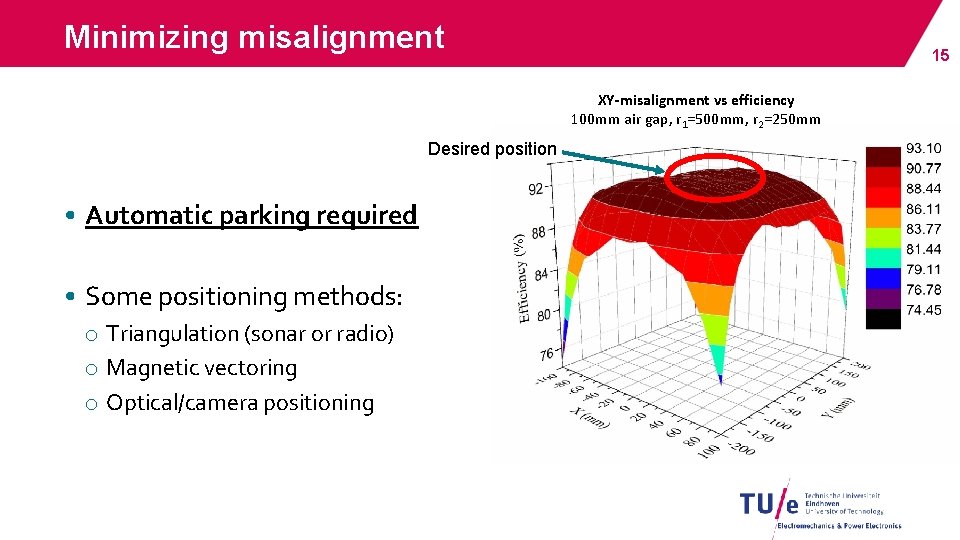
Range versus efficiency 14 • Maximum efficiency heavily depends on: [2] o Distance transmitter - receiver o Radii of antennae o Q-factor (resistance in system) o Misalignment transmitter - receiver • Properly designed and aligned systems can achieve >95% efficiency [2] Mingyu Park et al, A Study of Wireless Power Transfer Topologies for 3. 3 k. W and 6. 6 k. W Electric Vehicle Charging Infrastructure, Transportation Electrification Conf. and Expo, 2016. XY-misalignment vs efficiency 100 mm air gap, r 1=500 mm, r 2=250 mm
Minimizing misalignment 15 XY-misalignment vs efficiency 100 mm air gap, r 1=500 mm, r 2=250 mm Desired position • Automatic parking required • Some positioning methods: o Triangulation (sonar or radio) o Magnetic vectoring o Optical/camera positioning
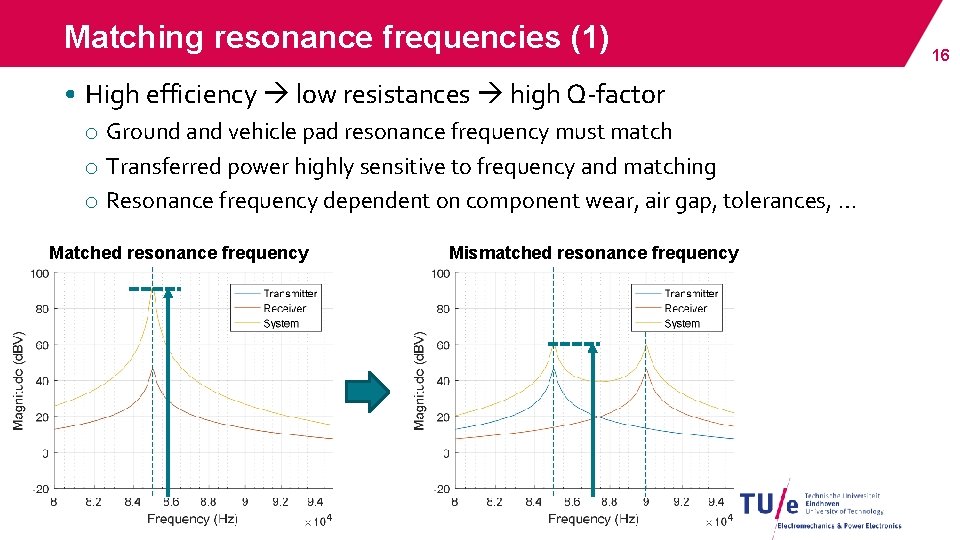
Matching resonance frequencies (1) • High efficiency low resistances high Q-factor o Ground and vehicle pad resonance frequency must match o Transferred power highly sensitive to frequency and matching o Resonance frequency dependent on component wear, air gap, tolerances, … Matched resonance frequency Mismatched resonance frequency 16
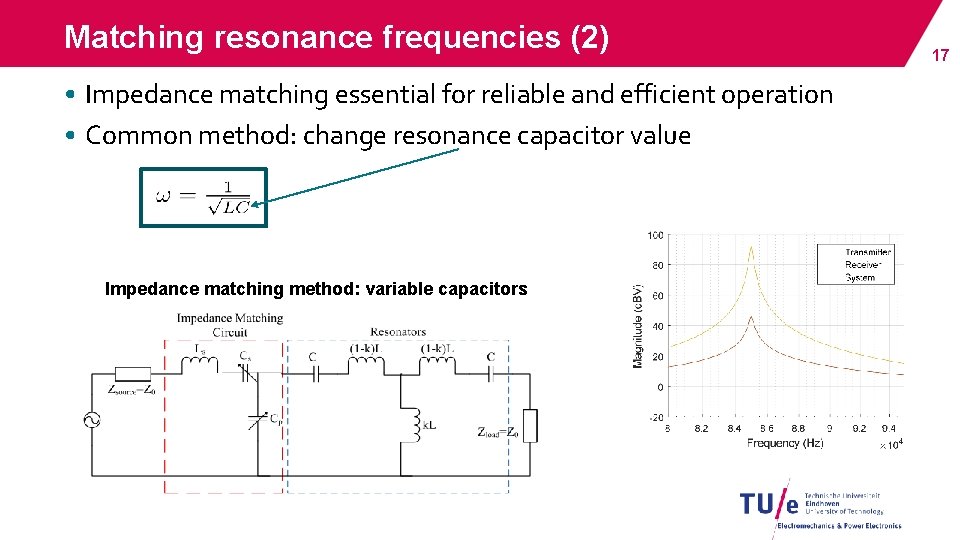
Matching resonance frequencies (2) • Impedance matching essential for reliable and efficient operation • Common method: change resonance capacitor value Impedance matching method: variable capacitors 17
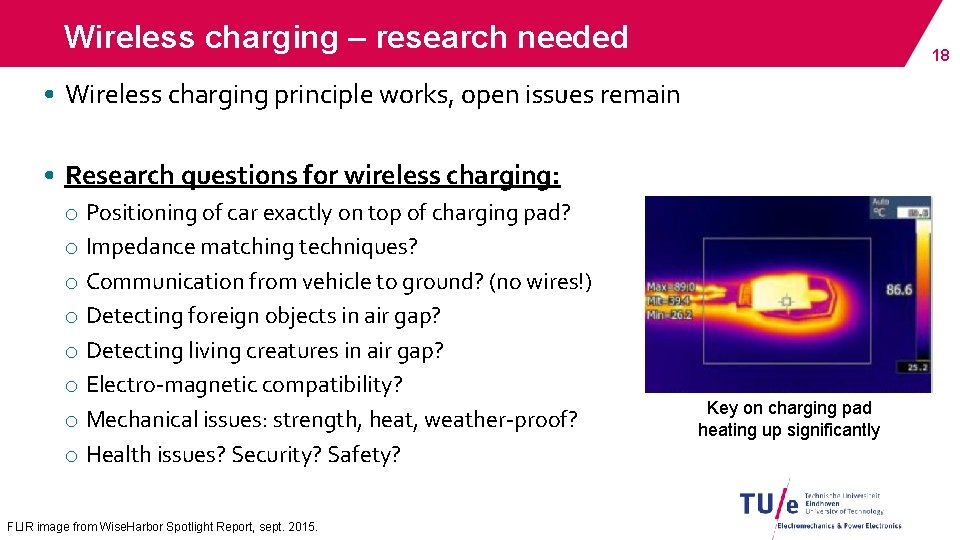
Wireless charging – research needed 18 • Wireless charging principle works, open issues remain • Research questions for wireless charging: o Positioning of car exactly on top of charging pad? o Impedance matching techniques? o Communication from vehicle to ground? (no wires!) o Detecting foreign objects in air gap? o Detecting living creatures in air gap? o Electro-magnetic compatibility? o Mechanical issues: strength, heat, weather-proof? o Health issues? Security? Safety? FLIR image from Wise. Harbor Spotlight Report, sept. 2015. Key on charging pad heating up significantly
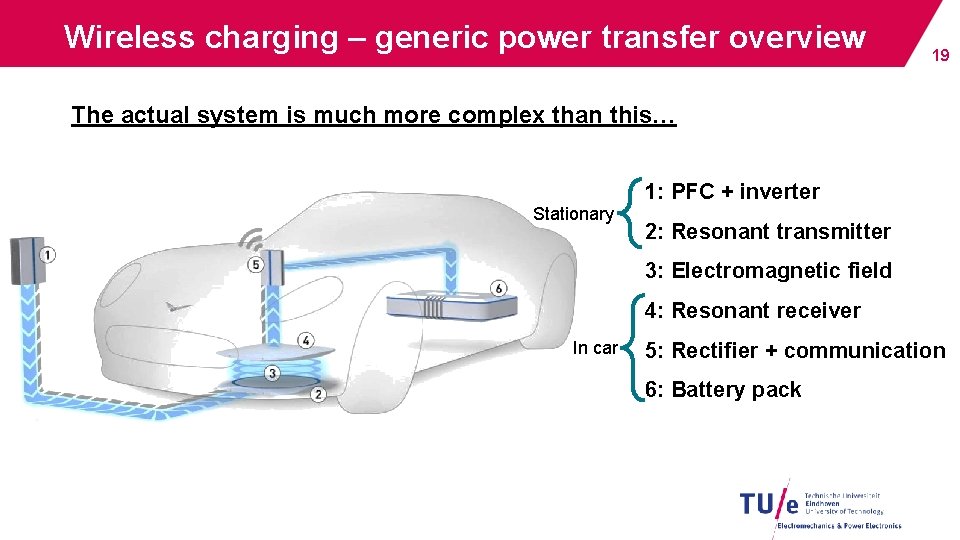
Wireless charging – generic power transfer overview 19 The actual system is much more complex than this… Stationary 1: PFC + inverter 2: Resonant transmitter 3: Electromagnetic field 4: Resonant receiver In car 5: Rectifier + communication 6: Battery pack
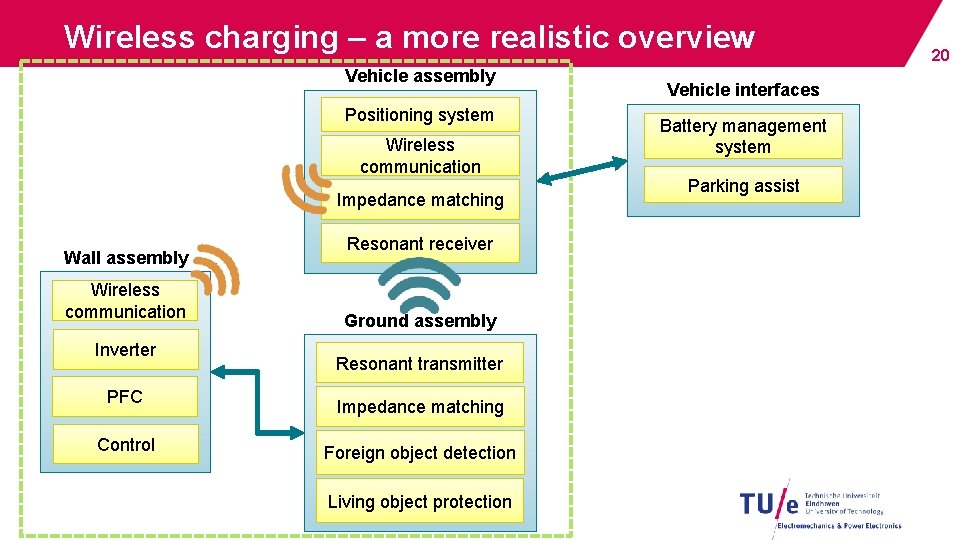
Wireless charging – a more realistic overview Vehicle assembly Positioning system Wireless communication Impedance matching Wall assembly Wireless communication Inverter PFC Control Resonant receiver Ground assembly Resonant transmitter Impedance matching Foreign object detection Living object protection Vehicle interfaces Battery management system Parking assist 20
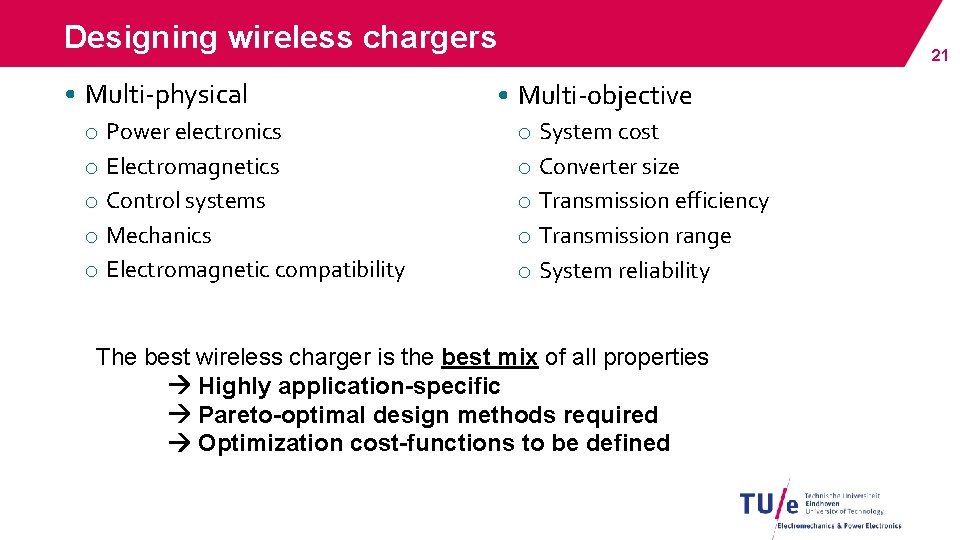
Designing wireless chargers • Multi-physical o Power electronics o Electromagnetics o Control systems o Mechanics o Electromagnetic compatibility 21 • Multi-objective o System cost o Converter size o Transmission efficiency o Transmission range o System reliability The best wireless charger is the best mix of all properties Highly application-specific Pareto-optimal design methods required Optimization cost-functions to be defined
Conclusions • Wireless energy transfer finally found its use (after > 100 years) • Efficient wireless charging is possible, as long as: o Air gap isn’t too large (+- 10 cm is possible with >90%) o Positioning is accurate (car must be parked at a few cm accurate) o Impedance matching is implemented • Still lots of research needed ing! g n e l l a h yc l e m e r t x nt, e a c i f i n g i Very s 22
23 Questions?