
Challenges in the Verification and Validation of MissionCritical
![Agile Manifesto [AM 01] Individuals and interactions Working software Over Process and tools Over](https://slidetodoc.com/presentation_image_h/9c26720ca3445b3abefd9d76636fdbc5/image-8.jpg "Agile Manifesto [AM 01] Individuals and interactions Working software Over Process and tools Over")
![Variants of Agile for Large Projects • Scaled Agile Framework (SAFe) [DL 14] –](https://slidetodoc.com/presentation_image_h/9c26720ca3445b3abefd9d76636fdbc5/image-13.jpg "Variants of Agile for Large Projects • Scaled Agile Framework (SAFe) [DL 14] –")
![References [AM 01] K. Beck, M. Beedle, A. van Bennekum, A. Cockburn, W. Cunningham,](https://slidetodoc.com/presentation_image_h/9c26720ca3445b3abefd9d76636fdbc5/image-21.jpg "References [AM 01] K. Beck, M. Beedle, A. van Bennekum, A. Cockburn, W. Cunningham,")
- Slides: 21
Challenges in the Verification and Validation of Mission-Critical Software Developed within an Agile Framework James B. Dabney, UHCL James D Arthur, Va Tech 13 December 2016 1
Overview • • • Conventional mission-critical software lifecycle Conventional V&V process Agile software development Hybrid Agile variants Adjusting V&V to hybrid Agile Conclusions 2
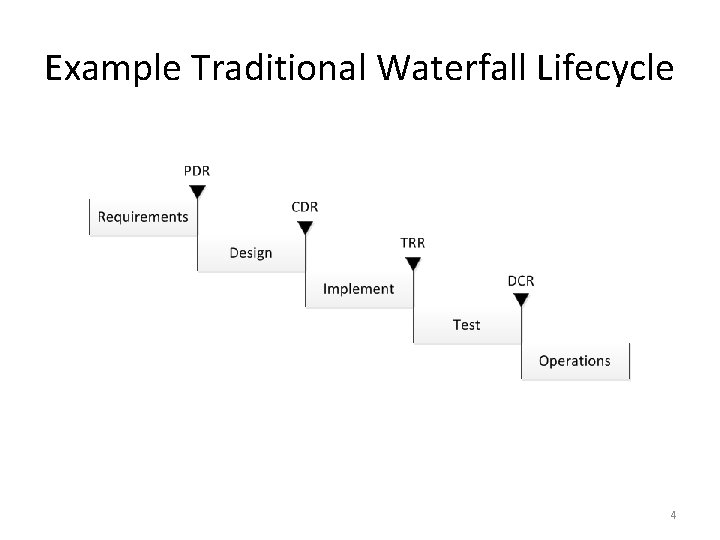
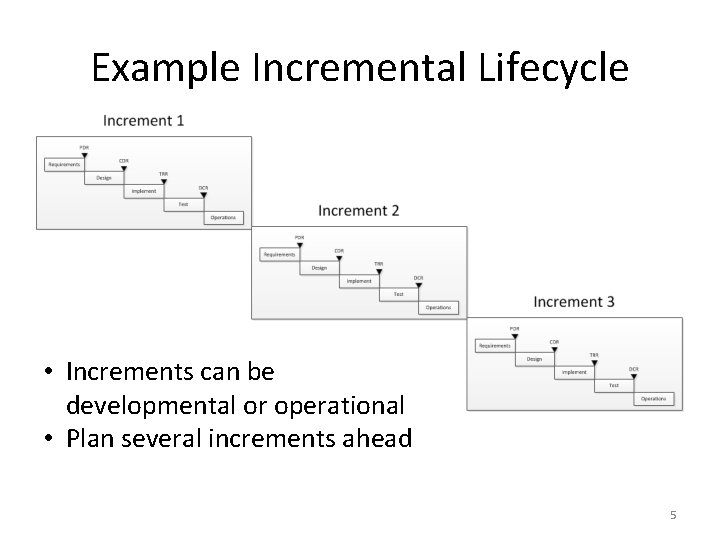
Conventional Mission-Critical Software Lifecycle • Traditional lifecycle based on waterfall model • Sequence of milestone reviews – Preliminary design review (PDR) – Critical design review (CDR) – Test readiness review (TRR) – Design certification review (DCR) • Larger projects incremental model – Planned series of waterfall lifecycles • Certification mandated by regulations (e. g. FDA, UL) 3
Example Traditional Waterfall Lifecycle 4
Example Incremental Lifecycle • Increments can be developmental or operational • Plan several increments ahead 5
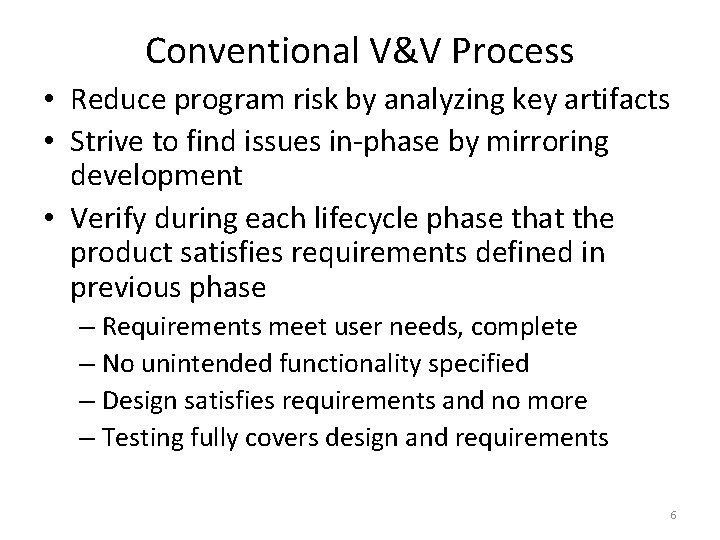
Conventional V&V Process • Reduce program risk by analyzing key artifacts • Strive to find issues in-phase by mirroring development • Verify during each lifecycle phase that the product satisfies requirements defined in previous phase – Requirements meet user needs, complete – No unintended functionality specified – Design satisfies requirements and no more – Testing fully covers design and requirements 6
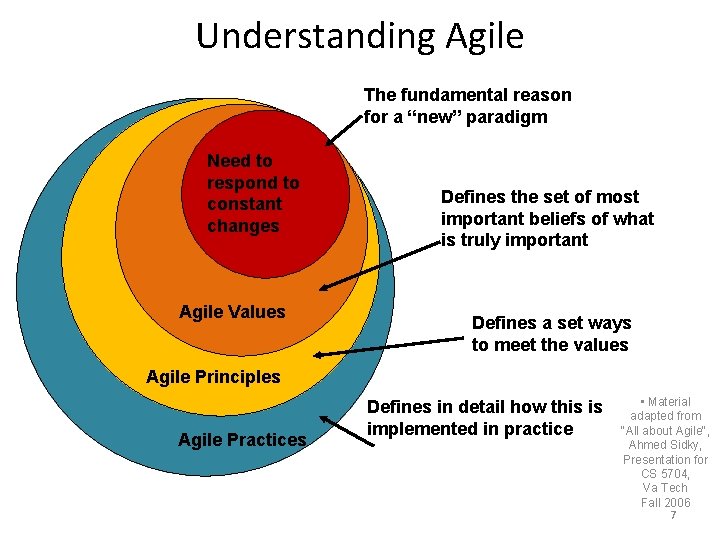
Understanding Agile The fundamental reason for a “new” paradigm Need to respond to constant changes Agile Values Defines the set of most important beliefs of what is truly important Defines a set ways to meet the values Agile Principles Agile Practices Defines in detail how this is implemented in practice • Material adapted from "All about Agile", Ahmed Sidky, Presentation for CS 5704, Va Tech Fall 2006 7
Agile Manifesto [AM 01] Individuals and interactions Working software Over Process and tools Over Comprehensive documentation Customer collaboration Responding to change Over Contract negotiation Over Following a plan Valued More Valued 8
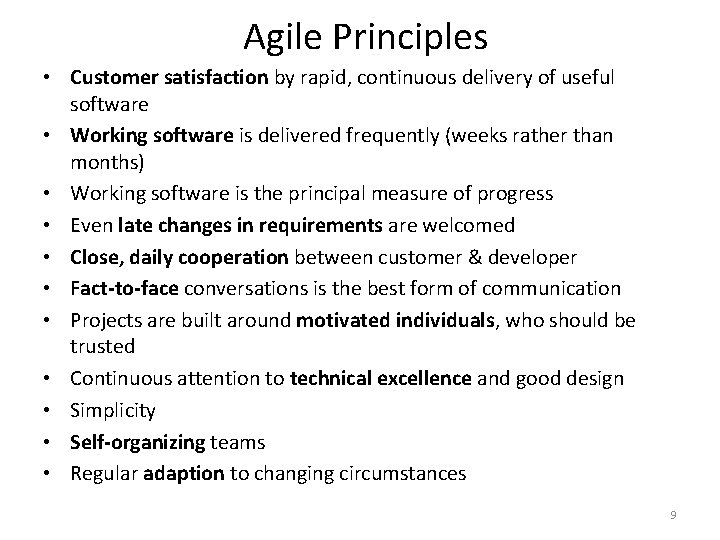
Agile Principles • Customer satisfaction by rapid, continuous delivery of useful software • Working software is delivered frequently (weeks rather than months) • Working software is the principal measure of progress • Even late changes in requirements are welcomed • Close, daily cooperation between customer & developer • Fact-to-face conversations is the best form of communication • Projects are built around motivated individuals, who should be trusted • Continuous attention to technical excellence and good design • Simplicity • Self-organizing teams • Regular adaption to changing circumstances 9
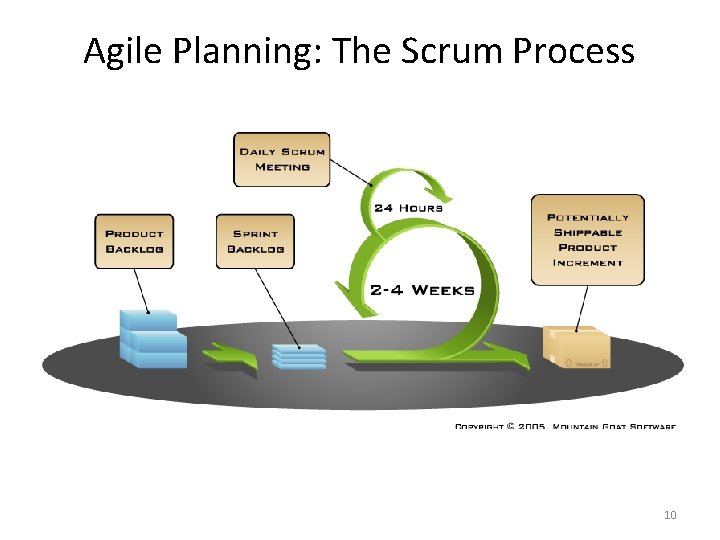
Agile Planning: The Scrum Process 10
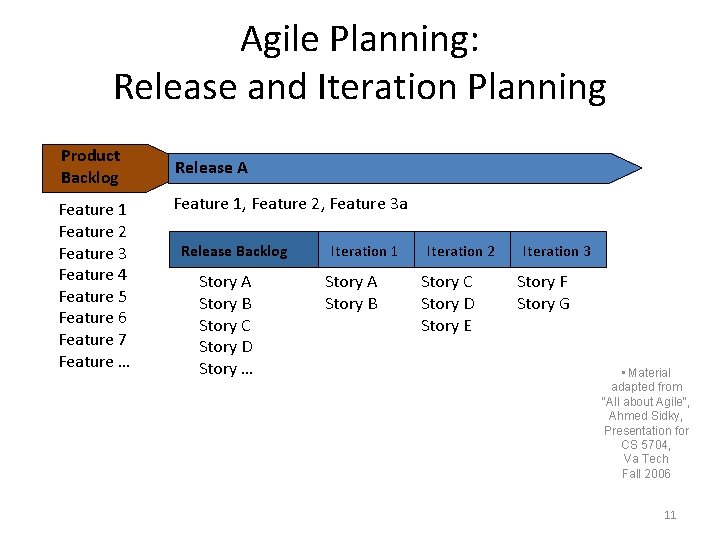
Agile Planning: Release and Iteration Planning Product Backlog Feature 1 Feature 2 Feature 3 Feature 4 Feature 5 Feature 6 Feature 7 Feature … Release A Feature 1, Feature 2, Feature 3 a Release Backlog Story A Story B Story C Story D Story … Iteration 1 Story A Story B Iteration 2 Story C Story D Story E Iteration 3 Story F Story G • Material adapted from "All about Agile", Ahmed Sidky, Presentation for CS 5704, Va Tech Fall 2006 11
Adapting Agile to Large Projects • Alistair Cockburn (one of the original agile proponents): “small projects, web projects, exploratory projects, agile is fabulous; it beats the pants off of everything else, but for NASA, no” [AM 13] • “Embedded systems have specific product requirements, e. g. safety, which are not obviously addressed by agile practices such as XP or Scrum” [EOS 14] • Key assumptions of Agile (e. g. co-located teams) are difficult to realize on large projects [TFR 02] 12
Variants of Agile for Large Projects • Scaled Agile Framework (SAFe) [DL 14] – Intended for high-assurance environments (medical) – Designed to comply with regulatory requirements (FDA) – Gaining acceptance • Incremental Commitment Model (ICM) [BL 07] – Merges concepts of classic V-verification, concurrent engineering, Agile – Intended for large mission-critical and net-centric systems 13
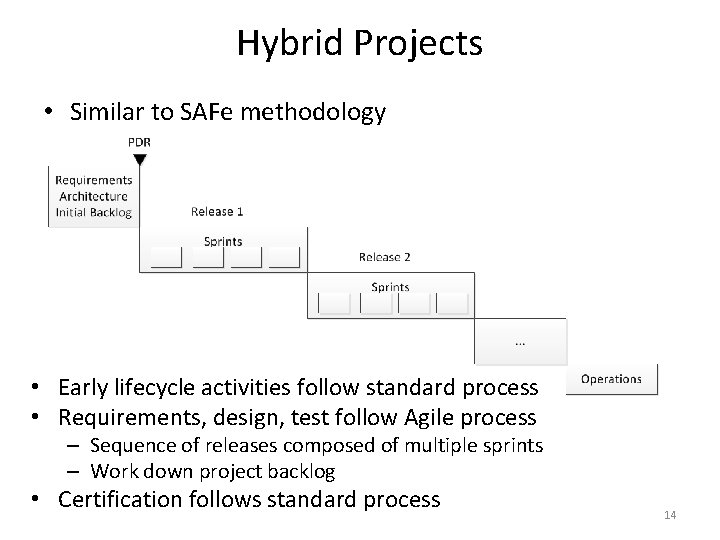
Hybrid Projects • Similar to SAFe methodology • Early lifecycle activities follow standard process • Requirements, design, test follow Agile process – Sequence of releases composed of multiple sprints – Work down project backlog • Certification follows standard process 14
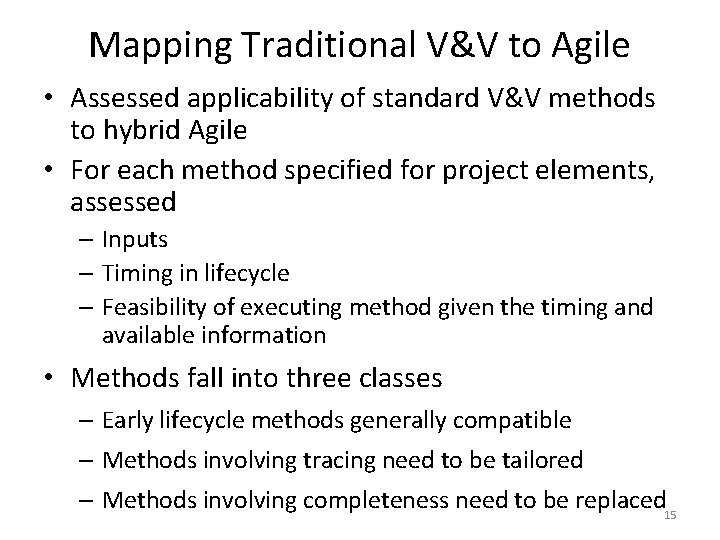
Mapping Traditional V&V to Agile • Assessed applicability of standard V&V methods to hybrid Agile • For each method specified for project elements, assessed – Inputs – Timing in lifecycle – Feasibility of executing method given the timing and available information • Methods fall into three classes – Early lifecycle methods generally compatible – Methods involving tracing need to be tailored – Methods involving completeness need to be replaced 15
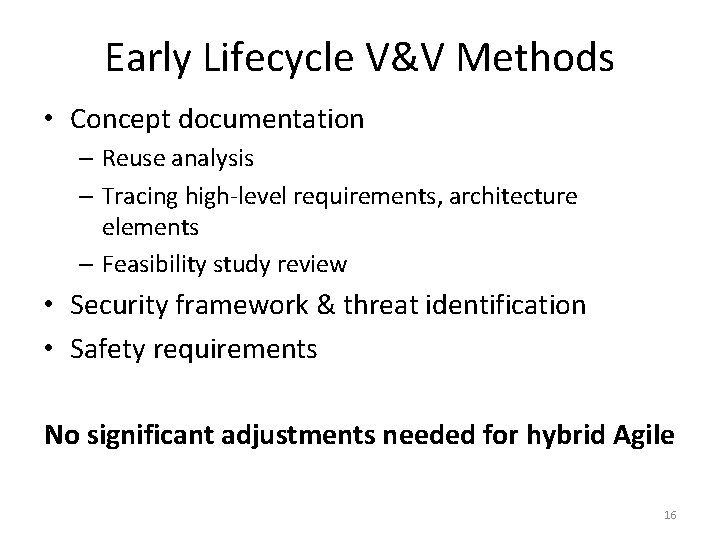
Early Lifecycle V&V Methods • Concept documentation – Reuse analysis – Tracing high-level requirements, architecture elements – Feasibility study review • Security framework & threat identification • Safety requirements No significant adjustments needed for hybrid Agile 16
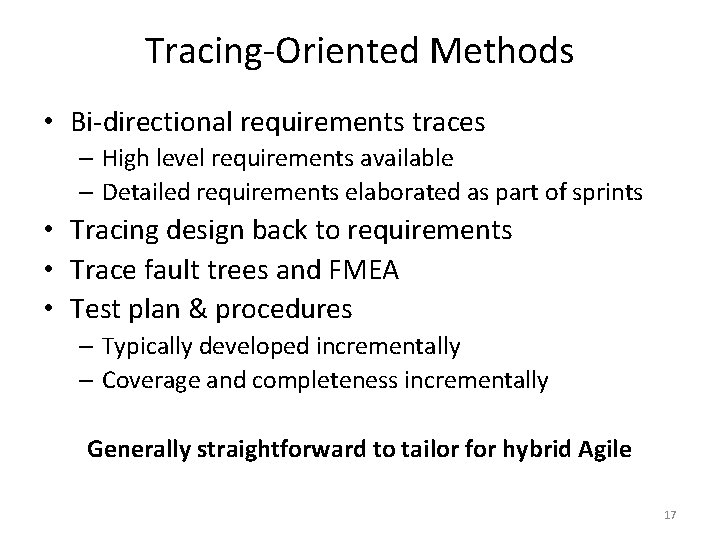
Tracing-Oriented Methods • Bi-directional requirements traces – High level requirements available – Detailed requirements elaborated as part of sprints • Tracing design back to requirements • Trace fault trees and FMEA • Test plan & procedures – Typically developed incrementally – Coverage and completeness incrementally Generally straightforward to tailor for hybrid Agile 17
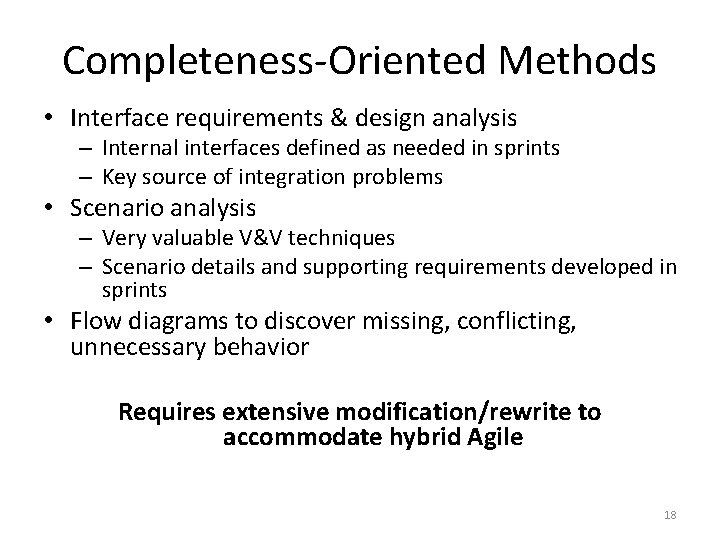
Completeness-Oriented Methods • Interface requirements & design analysis – Internal interfaces defined as needed in sprints – Key source of integration problems • Scenario analysis – Very valuable V&V techniques – Scenario details and supporting requirements developed in sprints • Flow diagrams to discover missing, conflicting, unnecessary behavior Requires extensive modification/rewrite to accommodate hybrid Agile 18
Adjusting V&V to Hybrid Agile • Project interfaces • Developing techniques to build assurance for completeness and emergent properties without linear progress of waterfall 19
Conclusions & Future Work • Pure Agile not appropriate for mission-critical or safety-critical projects • Hybrid Agile gaining acceptance – Hybrids of traditional and Agile methodologies – Retain early lifecycle activities – Agile techniques used in implementation phase – Agile projects may benefit from revised set of deliverables • V&V methodology must adapt to hybrid Agile 20
References [AM 01] K. Beck, M. Beedle, A. van Bennekum, A. Cockburn, W. Cunningham, M. Fowler, J. Grenning, J. Highsmith, A. Hunt, R. Jeffries, J. Kern, B. Marick, R. C. Martin, S. Mellor, K. Schwaber, J. Sutherland, D. Thomas “Agile Manifesto, ” http: //agilemanifesto. org/, 2001 [AM 13] A. Minkiewicz, “Applying Agile practices to space-based software systems, ” Power. Point presentation, PRICE Systems, LLC, 2013 [EOS 14] U. Eklund, H. H. Olsson, and N. J. Strom, "Industrial challenges of scaling Agile in massproduced embedded systems, " XP 2014 Workshops, Rome, Italy, 2014 [TFR 02] D. Turk, R. France, B Rumpe, "Limitations of agile software processes, " Proceedings of the Third International Conference on e. Xtreme Programming and Agile Processes in Software Engineering, Alghero, Sardinia, Italy, 2002. [DL 14] D. Leffingwell, “Agile software development with verification and validation in high assurance and regulated environments, ” Leffingwell, LLC and Rally Software Development Corporation, 2014 [BL 07] B. Boehm and J. A. Lane, "Using the incremental commitment model to integrate system acquisition, systems engineering, and software engineering, " Cross Talk: The Journal of Defense Software Engineering, October, 2007 21