
Challenges in the Late 1800 s 1865 1914
- Slides: 17
Challenges in the Late 1800 s (1865 -1914) Lesson 3 Corruption Plagues the Nation
Challenges in the Late 1800 s (1865 -1914) Lesson 3 Corruption Plagues the Nation Learning Objectives • • • Analyze the issues of weak leadership and corruption in national politics in the 1870 s through 1890 s. Discuss civil service reform in the late 1800 s. Assess the importance of economic issues in the late 1800 s.
Challenges in the Late 1800 s (1865 -1914) Lesson 3 Corruption Plagues the Nation Key Terms • • • spoils system political machines civil service Pendleton Civil Service Act gold standard fiat money
Political Power Proves Difficult to Keep While Congress enacted many major reforms during Reconstruction, it passed very few measures between 1877 and 1900. Instead, inaction and corruption were serious political issues during the Gilded Age. This raised questions of whether or not democracy could succeed in a time dominated by large and powerful industrial corporations and men of great wealth.
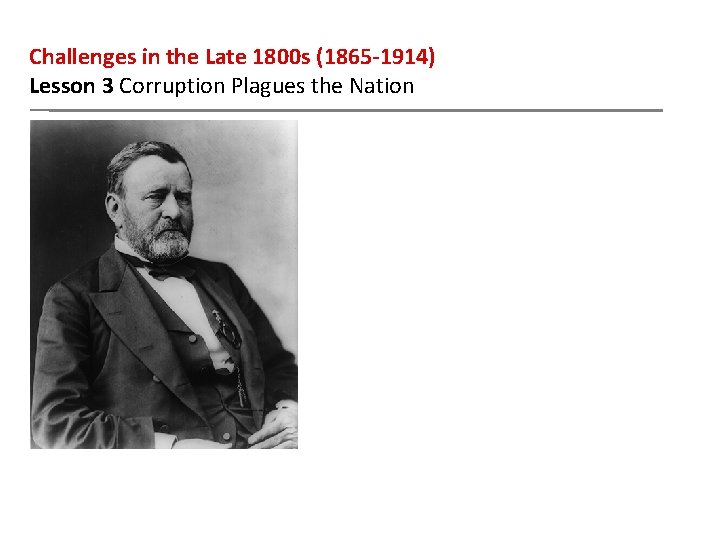
Political Power Proves Difficult to Keep • • Political Corruption Under President Grant Corruption Continues in Subsequent Administrations
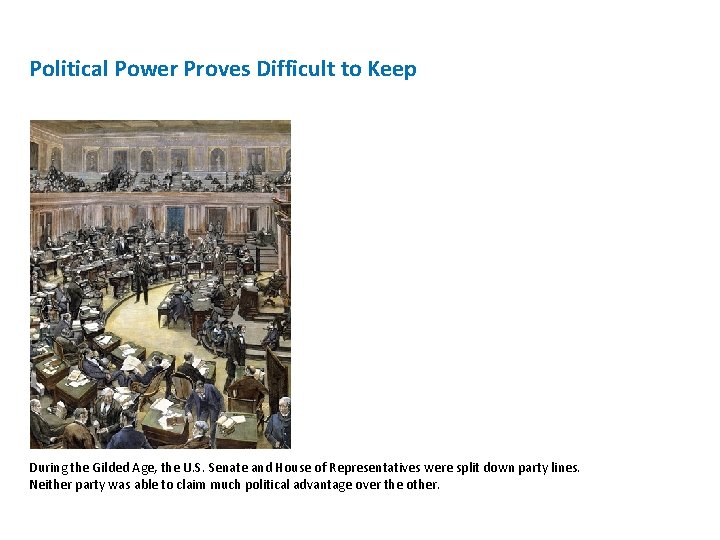
Political Power Proves Difficult to Keep During the Gilded Age, the U. S. Senate and House of Representatives were split down party lines. Neither party was able to claim much political advantage over the other.
Growth of Political Machines and Corruption Grover Cleveland’s reputation for honesty was the exception. Many government officials routinely accepted bribes. As Henry Adams, the great-grandson of John Adams, observed, “One might search the whole list of Congress, Judiciary, and Executive. . . [from] 1870 to 1895, and find little but damaged reputation. ”
Growth of Political Machines and Corruption • • Political Supporters Are Given Jobs Political Cartoons Alert the Public Civil Service Reform Efforts The Pendleton Civil Service Act
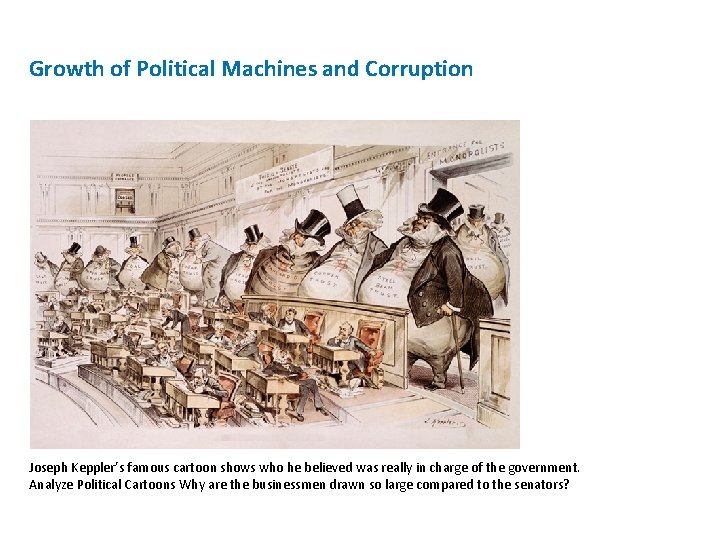
Growth of Political Machines and Corruption Joseph Keppler’s famous cartoon shows who he believed was really in charge of the government. Analyze Political Cartoons Why are the businessmen drawn so large compared to the senators?
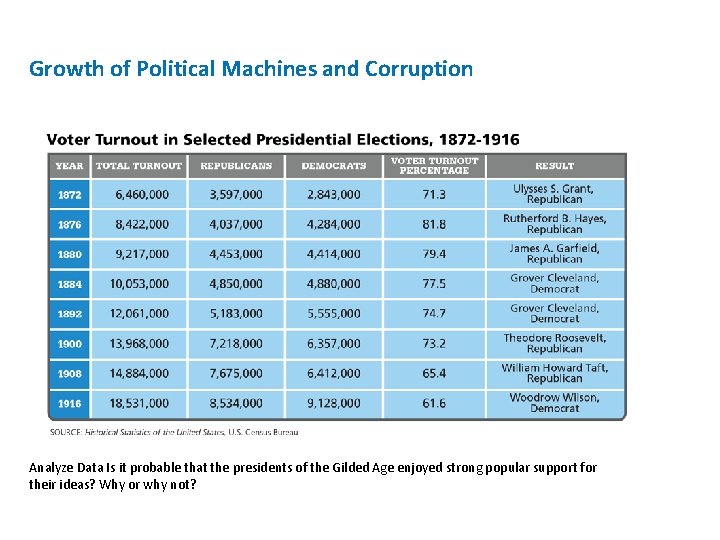
Growth of Political Machines and Corruption Analyze Data Is it probable that the presidents of the Gilded Age enjoyed strong popular support for their ideas? Why or why not?
Economic Policy Challenges Continue The public’s discontent was worsened by economic turmoil and uncertainty. In the fall of 1873, one of the nation’s most influential banks failed, apparently as a result of overextended loans to the expanding railroad industry. A wave of fear known as the Panic of 1873 spread through the financial industry and across the nation. Bank failures, job losses, and the uncertain economy added to the array of the nation's concerns. Events such as this prompted political leaders to debate the best ways to keep the economy moving forward.
Economic Policy Challenges Continue • • Americans Continue to Discuss Tariffs Different Ideas About Monetary Policy
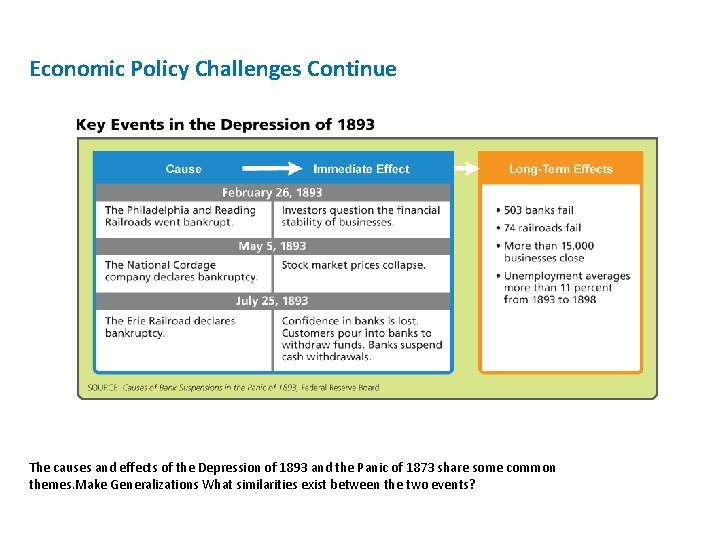
Economic Policy Challenges Continue The causes and effects of the Depression of 1893 and the Panic of 1873 share some common themes. Make Generalizations What similarities exist between the two events?
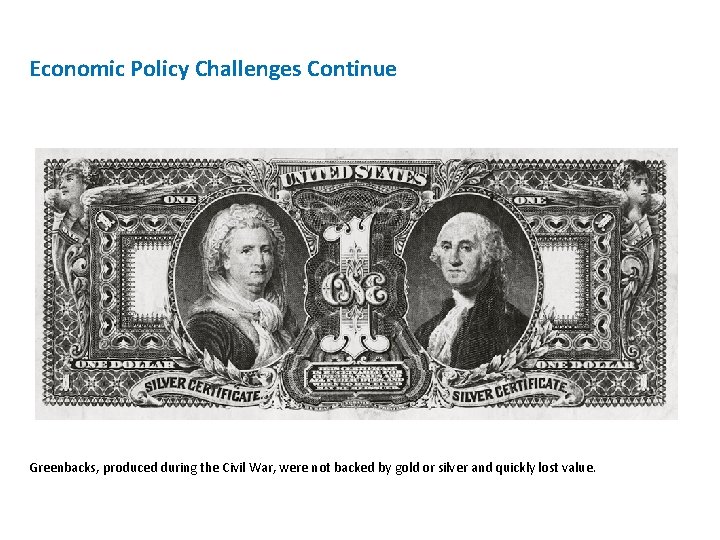
Economic Policy Challenges Continue Greenbacks, produced during the Civil War, were not backed by gold or silver and quickly lost value.
Quiz: Political Power Proves Difficult to Keep How did Grant contribute to the loss of confidence in American politicians? A. B. C. D. by removing the army from the South by stealing millions of dollars from the treasury by stealing profits from the Union Pacific Railroad by not rooting out corruption in his administration
Quiz: Growth of Political Machines and Corruption Which event brought about civil service reform? A. B. C. D. the assassination of President Garfield the arrest and escape of William Tweed the acceptance of bribes by government officials the awarding of government jobs to party workers
Quiz: Economic Policy Challenges Continue What was a central cause of the Panic of 1873? A. B. C. D. One of the nation’s most influential banks failed. The use of silver as money undermined the economy. Greenbacks caused inflation during the Civil War. High tariffs increased the costs of goods for consumers.