
Challenges in Strongly Correlated Electron Systems A Dynamical


- Slides: 16
Challenges in Strongly Correlated Electron Systems: A Dynamical Mean Field Theory Perspective Gabriel Kotliar and Center for Materials Theory & CPHT Ecole Polytechnique Palaiseau & SPHT CEA Saclay, France EPS 21 st General Conference of the Condensed matter Division and DPG Spring Meeting March 26 - 31, 2006 In Dresden, Germany $upport : NSF -DMR DOE-Basic Energy Sciences. Chaire Blaise Pascal Fondation de l’Ecole Normale.
Fermi Liquid Theory (Landau 1957) Density Functional Theory (Kohn Sham 1964) Static Mean Field Theory. Starting point for perturbation theory in the screened interactions (Hedin 1965) +[ - ] Strong Correlation Challenges Approach fails for strongly correlated systems • Fermi Liquid Parameters Non Perturbative. • Regimes where FLT Does NOT Apply. Need new concepts to replace rigid KS bands !
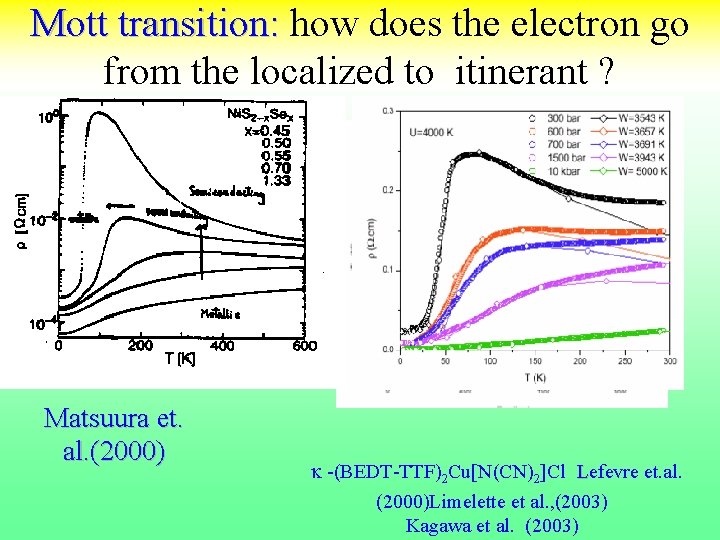
Mott transition: how does the electron go from the localized to itinerant ? Matsuura et. al. (2000) k -(BEDT-TTF)2 Cu[N(CN)2]Cl Lefevre et. al. (2000)Limelette et al. , (2003) Kagawa et al. (2003)
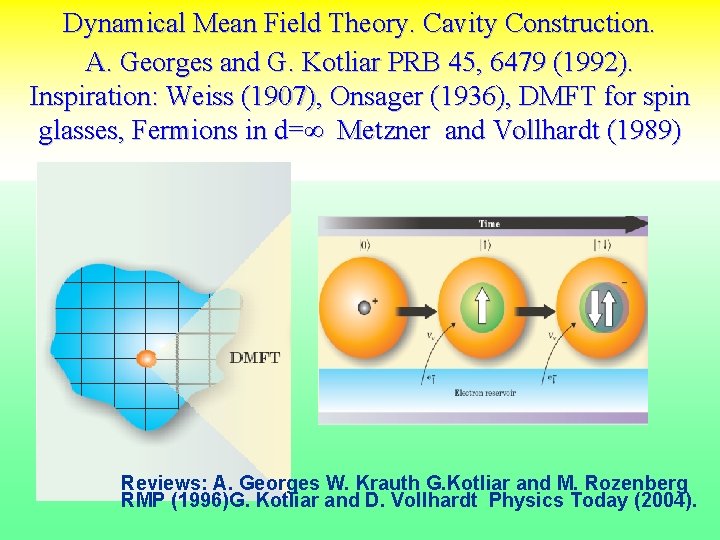
Dynamical Mean Field Theory. Cavity Construction. A. Georges and G. Kotliar PRB 45, 6479 (1992). Inspiration: Weiss (1907), Onsager (1936), DMFT for spin glasses, Fermions in d=∞ Metzner and Vollhardt (1989) Reviews: A. Georges W. Krauth G. Kotliar and M. Rozenberg RMP (1996)G. Kotliar and D. Vollhardt Physics Today (2004).
Mean-Field : Classical vs Quantum Classical case Easy!!! Quantum case Hard!!! QMC: J. Hirsch R. Fye (1986) NCA : T. Pruschke and N. Grewe (1989) PT : Yoshida and Yamada (1970) NRG: Wilson (1980) IPT: Georges Kotliar (1992). . QMC: M. Jarrell, (1992), NCA T. Pruschke D. Cox and M. Jarrell (1993), ED: Caffarel Krauth and Rozenberg (1994) Projective method: G Moeller (1995). NRG: R. Bulla et. al. PRL 83, 136 (1999) , …………………. . . • Pruschke et. al Adv. Phys. (1995) • Georges et. al RMP A. (1996) Georges, G. Kotliar (1992)
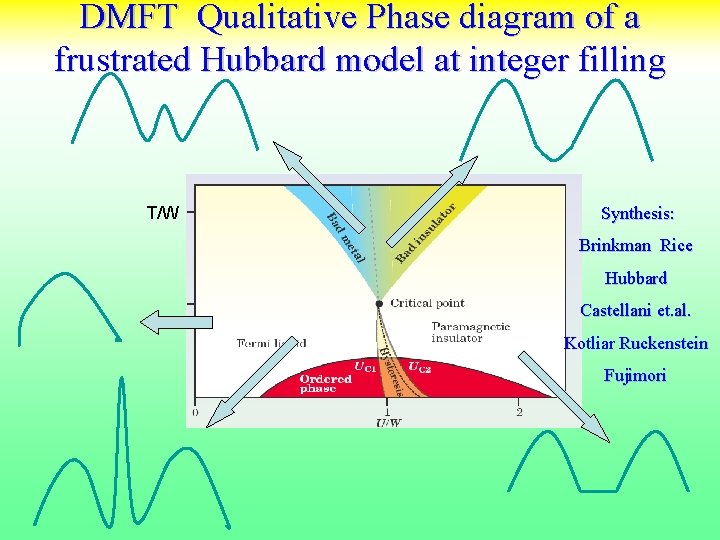
DMFT Qualitative Phase diagram of a frustrated Hubbard model at integer filling T/W Synthesis: Brinkman Rice Hubbard Castellani et. al. Kotliar Ruckenstein Fujimori
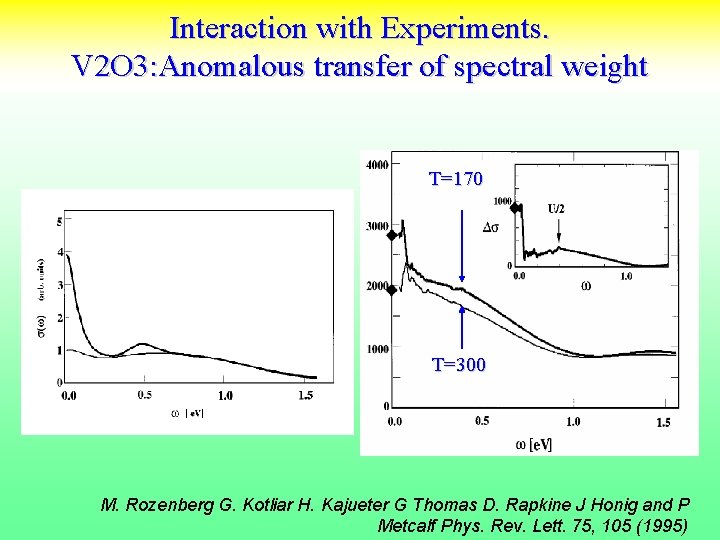
Interaction with Experiments. V 2 O 3: Anomalous transfer of spectral weight T=170 T=300 M. Rozenberg G. Kotliar H. Kajueter G Thomas D. Rapkine J Honig and P Metcalf Phys. Rev. Lett. 75, 105 (1995)
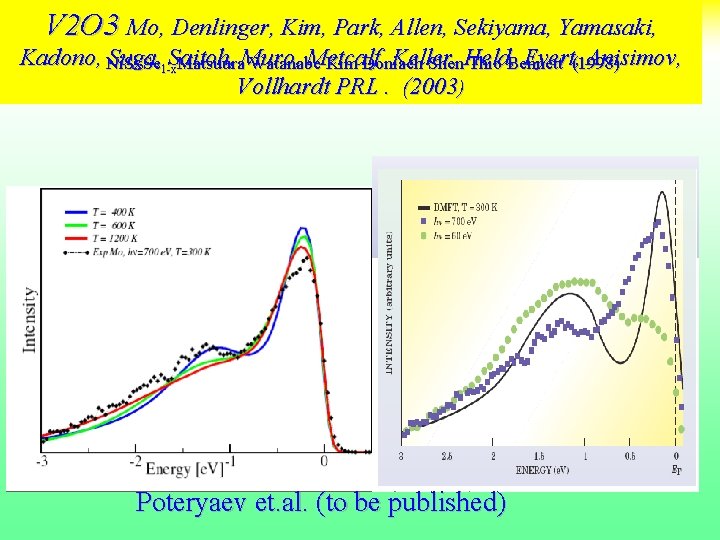
V 2 O 3 Mo, Denlinger, Kim, Park, Allen, Sekiyama , Yamasaki, Photoemission measurements and Theory. Kadono, Ni. Sx. Se Suga, 1 -x. Saitoh , Muro , Metcalf, Keller, Eyert(1998) , Anisimov, Matsuura Watanabe Kim Doniach Shen. Held, Thio Bennett Vollhardt PRL. (2003) Poteryaev et. al. (to be published)
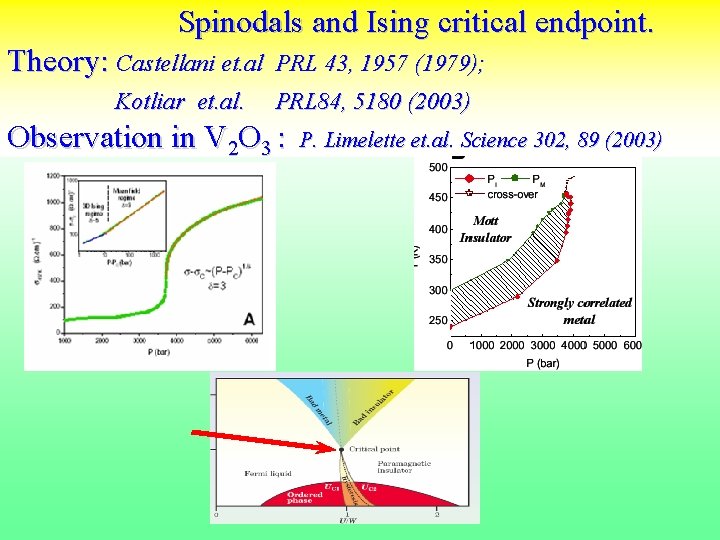
Spinodals and Ising critical endpoint. Theory: Castellani et. al Kotliar et. al. PRL 43, 1957 (1979); PRL 84, 5180 (2003) Observation in V 2 O 3 : P. Limelette et. al. Science 302, 89 (2003)
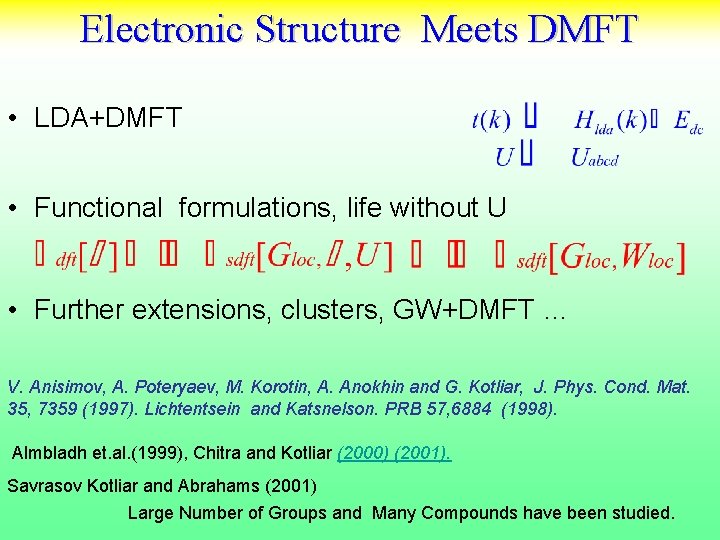
Electronic Structure Meets DMFT • LDA+DMFT • Functional formulations, life without U • Further extensions, clusters, GW+DMFT … V. Anisimov, A. Poteryaev, M. Korotin, A. Anokhin and G. Kotliar, J. Phys. Cond. Mat. 35, 7359 (1997). Lichtentsein and Katsnelson. PRB 57, 6884 (1998). Almbladh et. al. (1999), Chitra and Kotliar (2000) (2001). Savrasov Kotliar and Abrahams (2001) Large Number of Groups and Many Compounds have been studied.
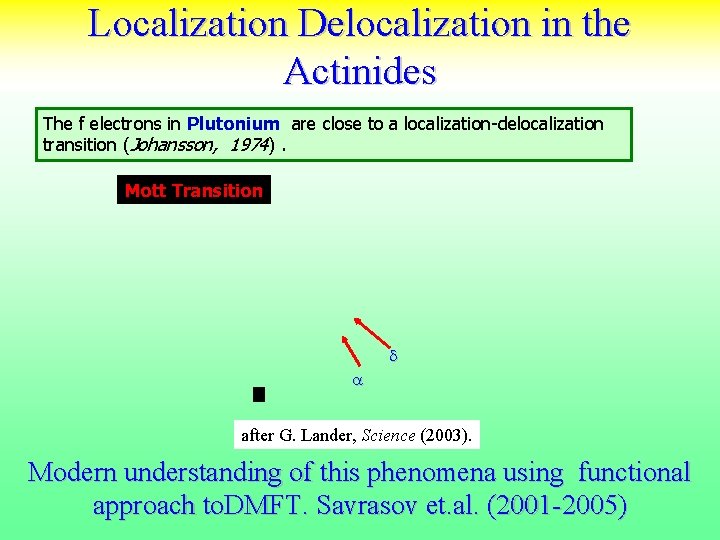
Localization Delocalization in the Actinides The f electrons in Plutonium are close to a localization-delocalization transition (Johansson, 1974). Mott Transition d a after G. Lander, Science (2003). Modern understanding of this phenomena using functional approach to. DMFT. Savrasov et. al. (2001 -2005)
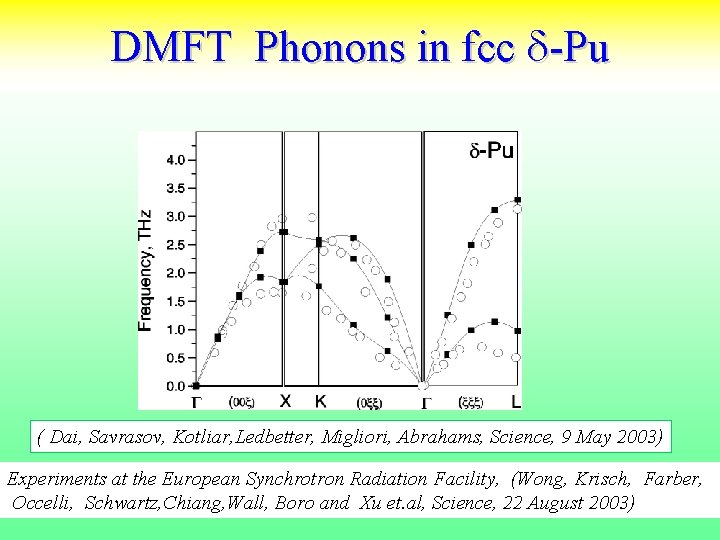
DMFT Phonons in fcc d-Pu ( Dai, Savrasov, Kotliar, Ledbetter, Migliori, Abrahams, Science, 9 May 2003) Experiments at the European Synchrotron Radiation Facility, (Wong, Krisch, Farber, Occelli, Schwartz, Chiang, Wall, Boro and Xu et. al, Science, 22 August 2003)
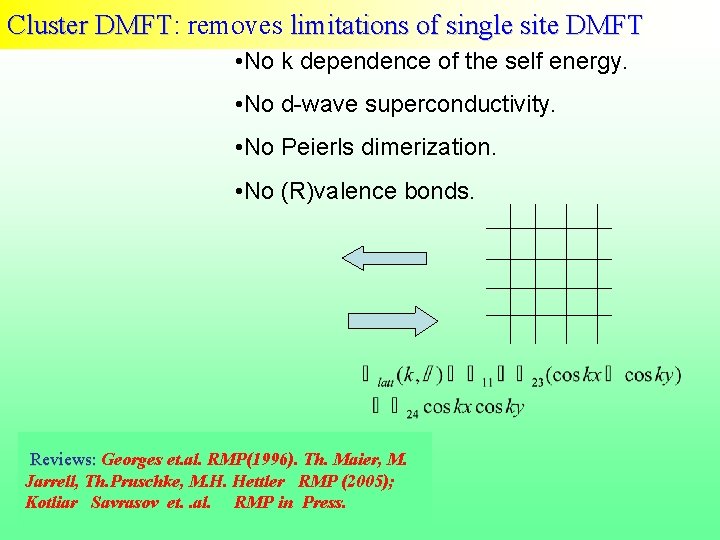
Cluster DMFT: DMFT removes limitations of single site DMFT • No k dependence of the self energy. • No d-wave superconductivity. • No Peierls dimerization. • No (R)valence bonds. Reviews: Georges et. al. RMP(1996). Th. Maier, M. Jarrell, Th. Pruschke, M. H. Hettler RMP (2005); Kotliar Savrasov et. . al. RMP in Press.
Two Site Cellular DMFT (G. . Kotliar et. al. PRL (2001)) in the 1 D Hubbard model M. Capone M. Civelli V. Kancharla C. Castellani and GK PRB 69, 195105 (2004) U/t=4.
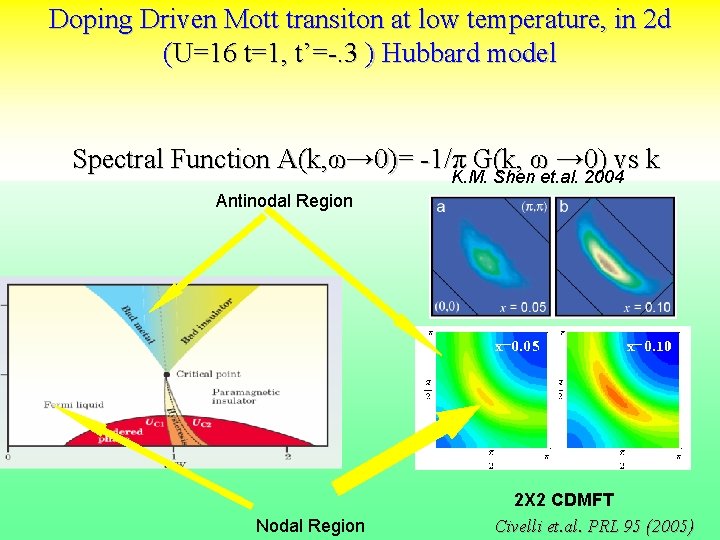
Doping Driven Mott transiton at low temperature, in 2 d (U=16 t=1, t’=-. 3 ) Hubbard model Spectral Function A(k, ω→ 0)= -1/π G(k, ω → 0) vs k K. M. Shen et. al. 2004 Antinodal Region Nodal Region 2 X 2 CDMFT Civelli et. al. PRL 95 (2005)
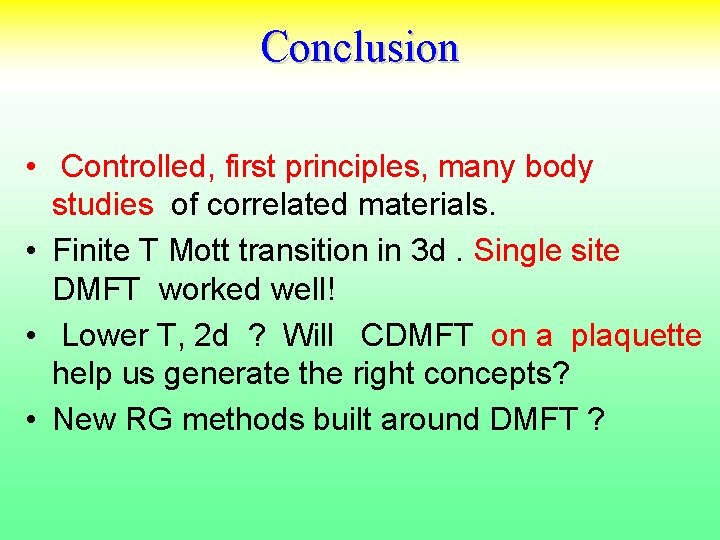
Conclusion • Controlled, first principles, many body studies of correlated materials. • Finite T Mott transition in 3 d. Single site DMFT worked well! • Lower T, 2 d ? Will CDMFT on a plaquette help us generate the right concepts? • New RG methods built around DMFT ?