
Challenges in Market and Counterparty Risk Management How



- Slides: 20
Challenges in Market and Counterparty Risk Management How to solve the critical issues? Solutions that can help. Reinhard Keider; Head of Risk Architecture and Risk Methodologies in Bank Austria ZADAR, 14 May 2011
Don´t ever try to understand everything, some things will just never make sense. 2
I guess some of you might agree with this saying. Despite this I will try to 1) Make my brief presentation understandable 2) And hopefully it make sense to you. …. so let´s start ! 3
AGENDA 4 < Part 1: Market Risk Management < Part 2: Counterparty Credit Risk < Part 3: New regulatory framework (Basel 2. 5/3)
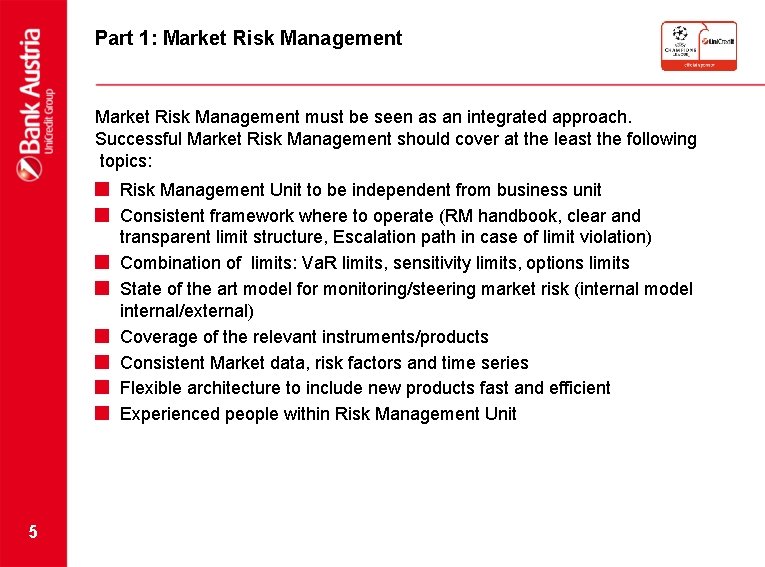
Part 1: Market Risk Management must be seen as an integrated approach. Successful Market Risk Management should cover at the least the following topics: < Risk Management Unit to be independent from business unit < Consistent framework where to operate (RM handbook, clear and < < < 5 transparent limit structure, Escalation path in case of limit violation) Combination of limits: Va. R limits, sensitivity limits, options limits State of the art model for monitoring/steering market risk (internal model internal/external) Coverage of the relevant instruments/products Consistent Market data, risk factors and time series Flexible architecture to include new products fast and efficient Experienced people within Risk Management Unit
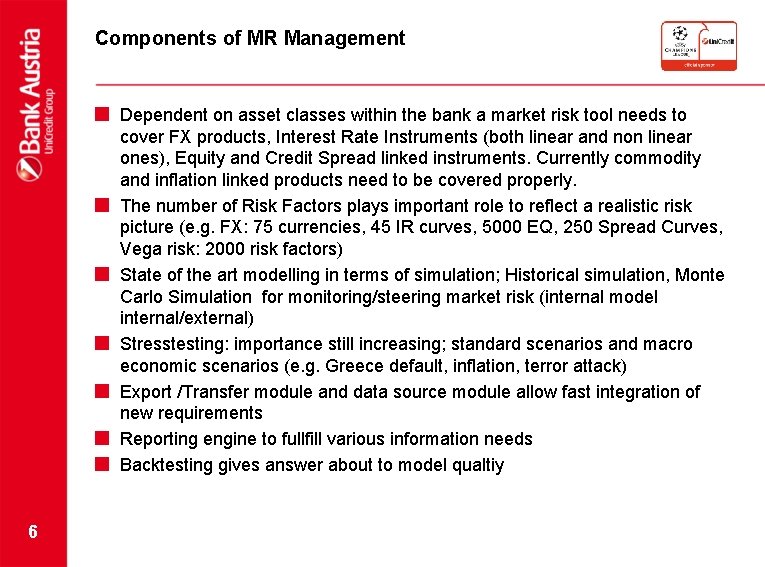
Components of MR Management < Dependent on asset classes within the bank a market risk tool needs to < < < 6 cover FX products, Interest Rate Instruments (both linear and non linear ones), Equity and Credit Spread linked instruments. Currently commodity and inflation linked products need to be covered properly. The number of Risk Factors plays important role to reflect a realistic risk picture (e. g. FX: 75 currencies, 45 IR curves, 5000 EQ, 250 Spread Curves, Vega risk: 2000 risk factors) State of the art modelling in terms of simulation; Historical simulation, Monte Carlo Simulation for monitoring/steering market risk (internal model internal/external) Stresstesting: importance still increasing; standard scenarios and macro economic scenarios (e. g. Greece default, inflation, terror attack) Export /Transfer module and data source module allow fast integration of new requirements Reporting engine to fullfill various information needs Backtesting gives answer about to model qualtiy
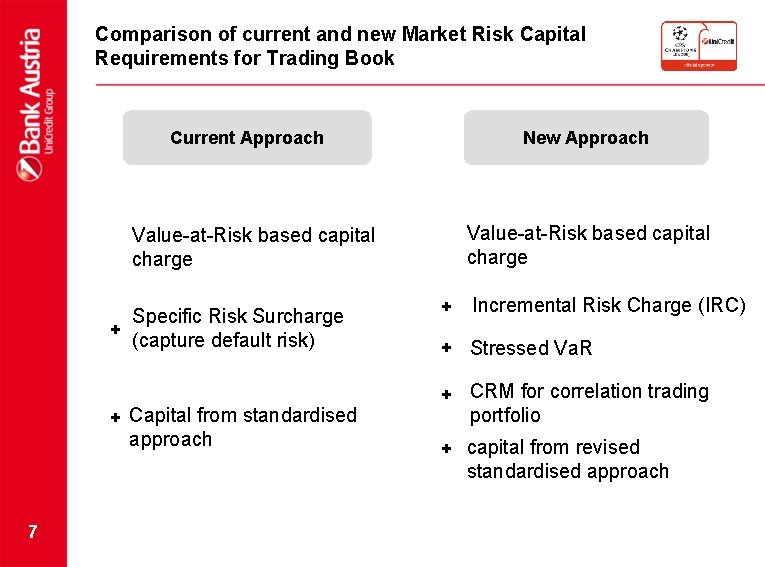
Comparison of current and new Market Risk Capital Requirements for Trading Book Current Approach New Approach Value-at-Risk based capital charge Specific Risk Surcharge + (capture default risk) + Capital from standardised approach + Incremental Risk Charge (IRC) + Stressed Va. R + CRM for correlation trading portfolio + capital from revised standardised approach 7
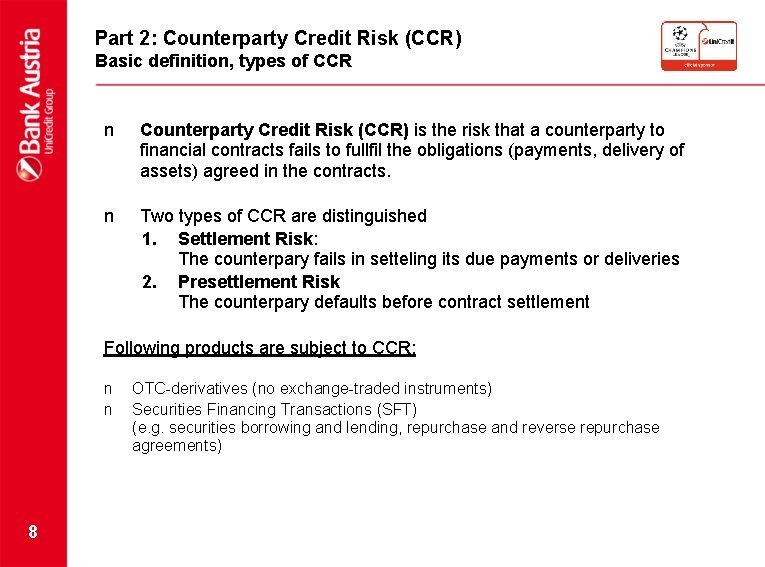
Part 2: Counterparty Credit Risk (CCR) Basic definition, types of CCR n Counterparty Credit Risk (CCR) is the risk that a counterparty to financial contracts fails to fullfil the obligations (payments, delivery of assets) agreed in the contracts. n Two types of CCR are distinguished 1. Settlement Risk: The counterpary fails in setteling its due payments or deliveries 2. Presettlement Risk The counterpary defaults before contract settlement Following products are subject to CCR: n n 8 OTC-derivatives (no exchange-traded instruments) Securities Financing Transactions (SFT) (e. g. securities borrowing and lending, repurchase and reverse repurchase agreements)
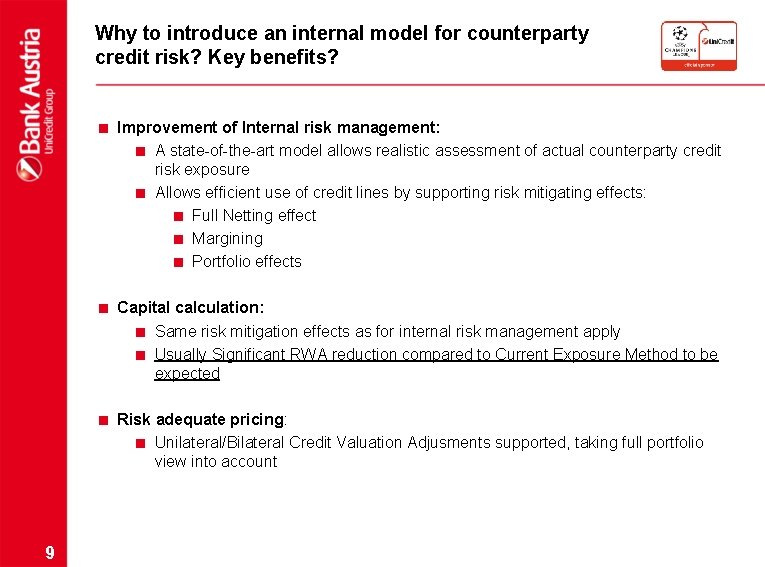
Why to introduce an internal model for counterparty credit risk? Key benefits? < Improvement of Internal risk management: < A state-of-the-art model allows realistic assessment of actual counterparty credit risk exposure < Allows efficient use of credit lines by supporting risk mitigating effects: < Full Netting effect < Margining < Portfolio effects < Capital calculation: < Same risk mitigation effects as for internal risk management apply < Usually Significant RWA reduction compared to Current Exposure Method to be expected < Risk adequate pricing: < Unilateral/Bilateral Credit Valuation Adjusments supported, taking full portfolio view into account 9
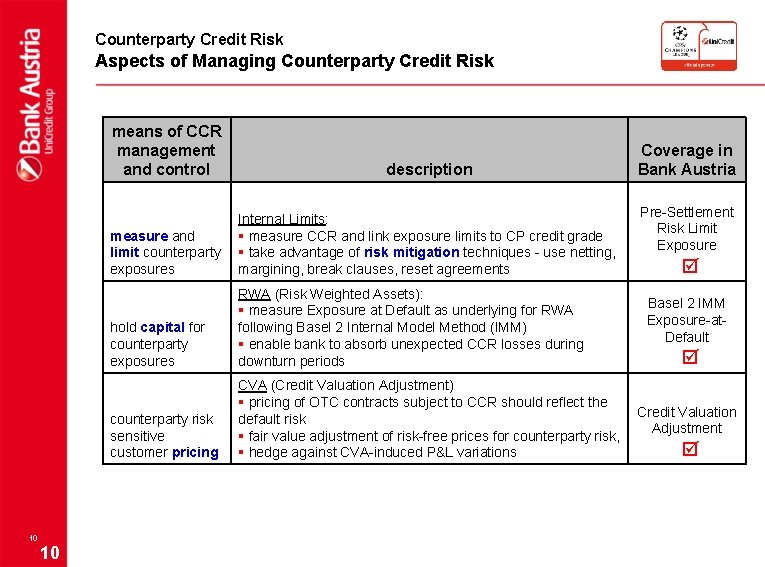
Counterparty Credit Risk Aspects of Managing Counterparty Credit Risk 10 10 means of CCR management and control description measure and limit counterparty exposures Internal Limits: § measure CCR and link exposure limits to CP credit grade § take advantage of risk mitigation techniques - use netting, margining, break clauses, reset agreements hold capital for counterparty exposures RWA (Risk Weighted Assets): § measure Exposure at Default as underlying for RWA following Basel 2 Internal Model Method (IMM) § enable bank to absorb unexpected CCR losses during downturn periods counterparty risk sensitive customer pricing CVA (Credit Valuation Adjustment) § pricing of OTC contracts subject to CCR should reflect the default risk § fair value adjustment of risk-free prices for counterparty risk, § hedge against CVA-induced P&L variations Coverage in Bank Austria Pre-Settlement Risk Limit Exposure Basel 2 IMM Exposure-at. Default Credit Valuation Adjustment
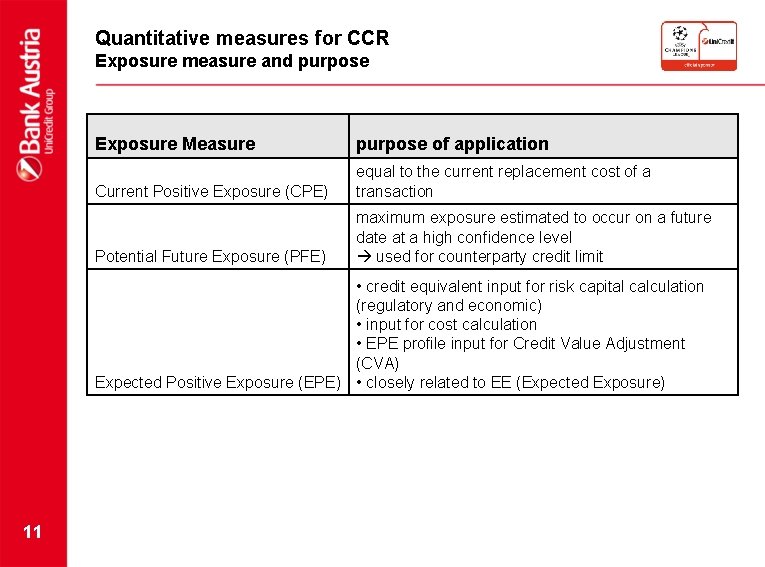
Quantitative measures for CCR Exposure measure and purpose Exposure Measure purpose of application Current Positive Exposure (CPE) equal to the current replacement cost of a transaction Potential Future Exposure (PFE) maximum exposure estimated to occur on a future date at a high confidence level used for counterparty credit limit • credit equivalent input for risk capital calculation (regulatory and economic) • input for cost calculation • EPE profile input for Credit Value Adjustment (CVA) Expected Positive Exposure (EPE) • closely related to EE (Expected Exposure) 11
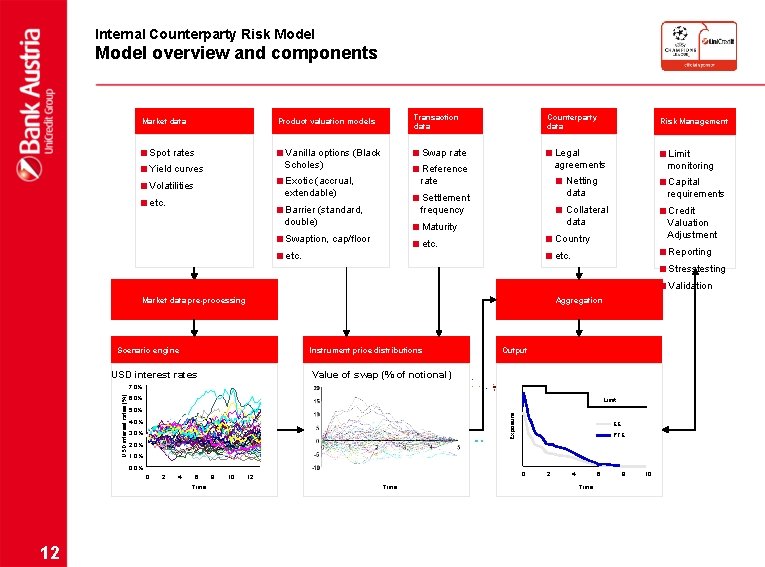
Internal Counterparty Risk Model overview and components Transaction data Product valuation models Market data <Spot rates <Vanilla options (Black Scholes) <Yield curves <Swap rate <etc. <Capital requirements < Collateral data <Country <Credit Valuation Adjustment <etc. <Reporting <Maturity <Swaption, cap/floor <etc. <Limit monitoring < Netting data <Settlement frequency <Barrier (standard, double) Risk Management <Legal agreements <Reference rate <Exotic (accrual, extendable) <Volatilities Counterparty data <Stresstesting <Validation Market data pre-processing Aggregation Scenario engine Instrument price distributions USD interest rates Output Value of swap (% of notional) 6. 0% Limit 5. 0% Exposure USD interest rates (%) 7. 0% 4. 0% 3. 0% PFE Reduction) 2. 0% 1. 0% 0 2 4 6 Time 12 EE 8 10 0 12 Time 2 4 6 Time 8 10
Part 3: Basel 2. 5 and Basel 3 Chapter Title - Chapter Section Title Challenges to the Banking industry in front of new Basel regulations 13
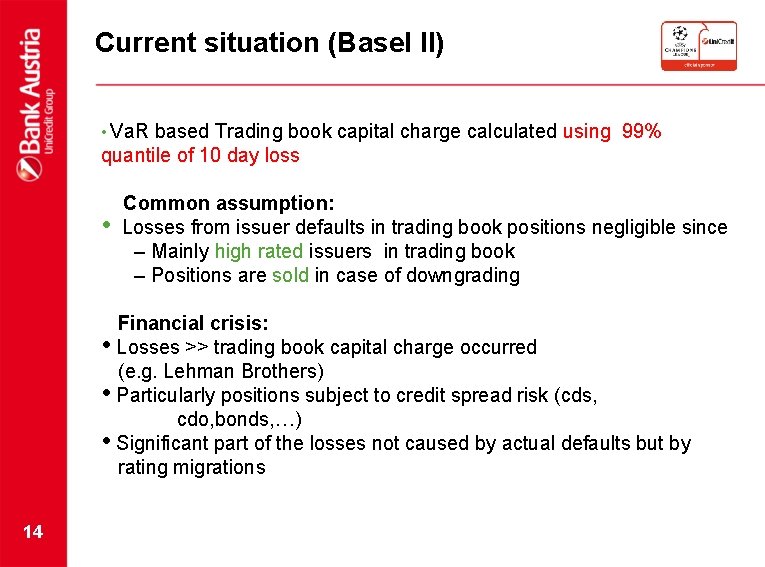
Current situation (Basel II) • Va. R based Trading book capital charge calculated using 99% quantile of 10 day loss • Common assumption: Losses from issuer defaults in trading book positions negligible since – Mainly high rated issuers in trading book – Positions are sold in case of downgrading Financial crisis: • Losses >> trading book capital charge occurred (e. g. Lehman Brothers) • Particularly positions subject to credit spread risk (cds, cdo, bonds, …) • Significant part of the losses not caused by actual defaults but by rating migrations 14
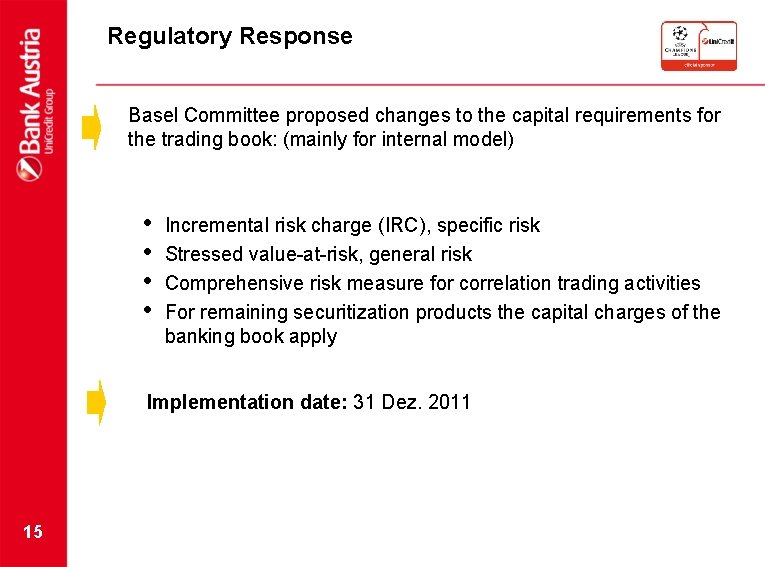
Regulatory Response Basel Committee proposed changes to the capital requirements for the trading book: (mainly for internal model) • • Incremental risk charge (IRC), specific risk Stressed value-at-risk, general risk Comprehensive risk measure for correlation trading activities For remaining securitization products the capital charges of the banking book apply Implementation date: 31 Dez. 2011 15
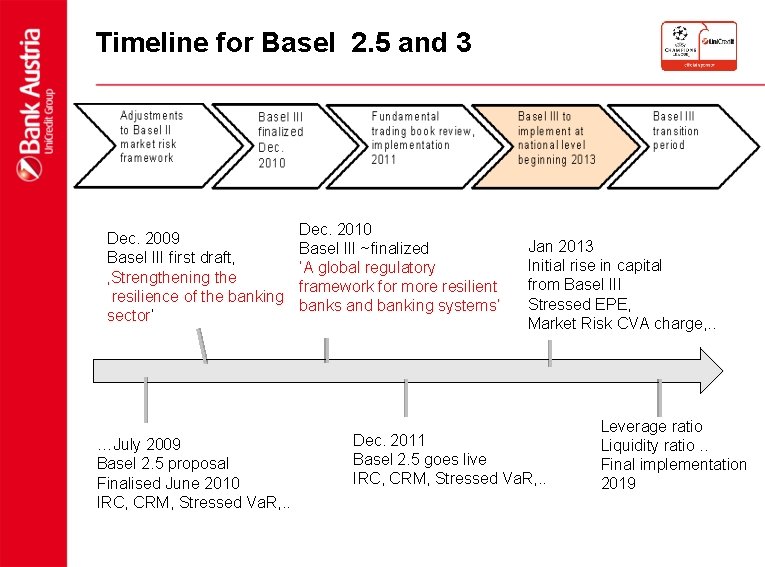
Timeline for Basel 2. 5 and 3 Dec. 2009 Basel III first draft, ‚Strengthening the resilience of the banking sector‘ …July 2009 Basel 2. 5 proposal Finalised June 2010 IRC, CRM, Stressed Va. R, . . Dec. 2010 Basel III ~finalized ‘A global regulatory framework for more resilient banks and banking systems’ Jan 2013 Initial rise in capital from Basel III Stressed EPE, Market Risk CVA charge, . . Dec. 2011 Basel 2. 5 goes live IRC, CRM, Stressed Va. R, . . Leverage ratio Liquidity ratio. . Final implementation 2019
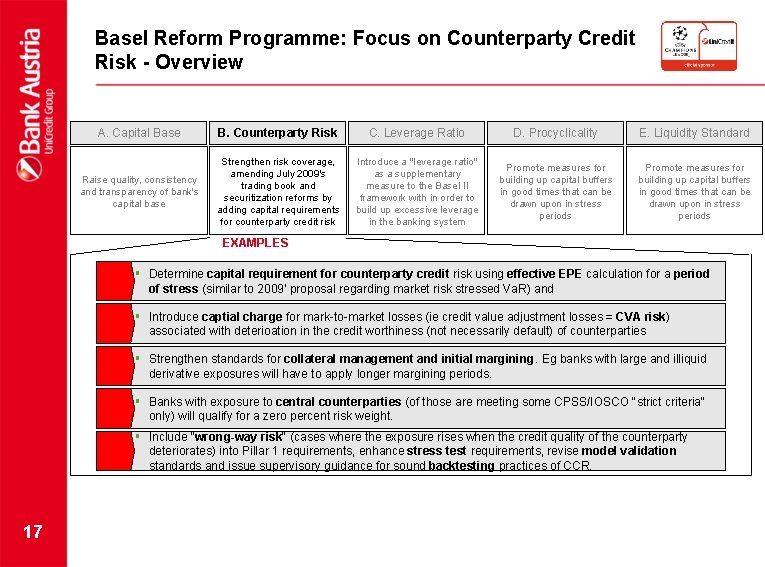
Basel Reform Programme: Focus on Counterparty Credit Risk - Overview A. Capital Base B. Counterparty Risk C. Leverage Ratio D. Procyclicality E. Liquidity Standard Raise quality, consistency and transparency of bank's capital base Strengthen risk coverage, amending July 2009's trading book and securitization reforms by adding capital requirements for counterparty credit risk Introduce a "leverage ratio" as a supplementary measure to the Basel II framework with in order to build up excessive leverage in the banking system Promote measures for building up capital buffers in good times that can be drawn upon in stress periods EXAMPLES § Determine capital requirement for counterparty credit risk using effective EPE calculation for a period of stress (similar to 2009' proposal regarding market risk stressed Va. R) and § Introduce captial charge for mark-to-market losses (ie credit value adjustment losses = CVA risk) associated with deterioation in the credit worthiness (not necessarily default) of counterparties § Strengthen standards for collateral management and initial margining. Eg banks with large and illiquid derivative exposures will have to apply longer margining periods. § Banks with exposure to central counterparties (of those are meeting some CPSS/IOSCO "strict criteria" only) will qualify for a zero percent risk weight. § Include "wrong-way risk" (cases where the exposure rises when the credit quality of the counterparty deteriorates) into Pillar 1 requirements, enhance stress test requirements, revise model validation standards and issue supervisory guidance for sound backtesting practices of CCR. 17
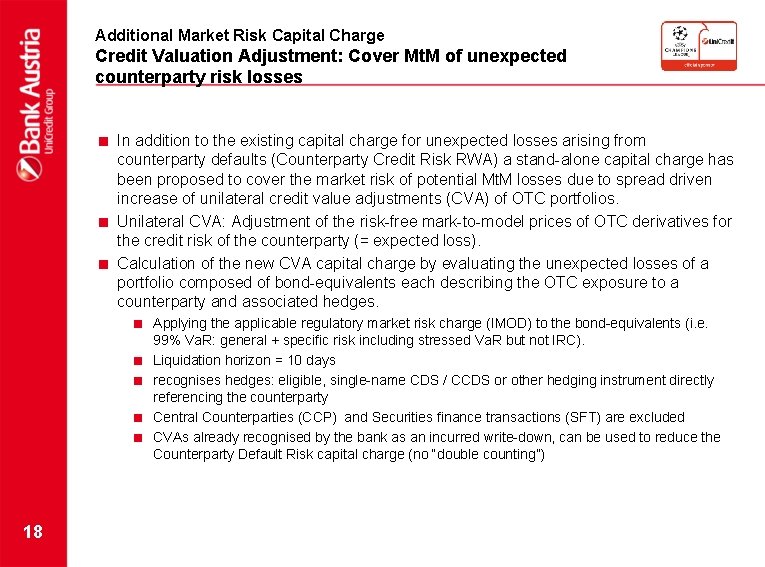
Additional Market Risk Capital Charge Credit Valuation Adjustment: Cover Mt. M of unexpected counterparty risk losses < In addition to the existing capital charge for unexpected losses arising from counterparty defaults (Counterparty Credit Risk RWA) a stand-alone capital charge has been proposed to cover the market risk of potential Mt. M losses due to spread driven increase of unilateral credit value adjustments (CVA) of OTC portfolios. < Unilateral CVA: Adjustment of the risk-free mark-to-model prices of OTC derivatives for the credit risk of the counterparty (= expected loss). < Calculation of the new CVA capital charge by evaluating the unexpected losses of a portfolio composed of bond-equivalents each describing the OTC exposure to a counterparty and associated hedges. < Applying the applicable regulatory market risk charge (IMOD) to the bond-equivalents (i. e. 99% Va. R: general + specific risk including stressed Va. R but not IRC). < Liquidation horizon = 10 days < recognises hedges: eligible, single-name CDS / CCDS or other hedging instrument directly referencing the counterparty < Central Counterparties (CCP) and Securities finance transactions (SFT) are excluded < CVAs already recognised by the bank as an incurred write-down, can be used to reduce the Counterparty Default Risk capital charge (no “double counting”) 18
Now it´s up to you to decide: 1) Was the presentation understandable ? 2) Does it make sense ? …. in any case: it is the end! 19
Many thanks for your attention ! 20