
CHALLENGES IN DESIGN MAINTENANCE OF TRACK STRUCTURE FOR


- Slides: 22
CHALLENGES IN DESIGN & MAINTENANCE OF TRACK STRUCTURE FOR MIXED TRAFFIC REGIME ON IR - Vipul Kumar, ED/Track-I - Ajay Kumar, Director/Track-II RDSO
INTRODUCTION § Operation upto 25 t axle load at 100 kmph in mixed traffic regime is being envisaged by IR. § These operations shall be on the same track having/planned for semi high speed passenger operation. § Further, some of the routes are being planned for upgradation to 200 kmph passenger operations
SEMI HIGH SPEED OPERATIONS Basic Requisites from Track 1. Much more accurate track geometry in comparison to that for 110 -120 kmph to provide at least same degree of ride comfort and stability to stocks 2. Considerable reduction in rail-weld failures ( should preferably be zero) as these may lead to devastating consequences at higher speeds Basic requirements of rolling stock Small track - vehicle interaction force/accelerations • responsible for distortion of the track geometry and effecting fatigue failures of rails and welds i. e. Track friendly design in line with international standards
UIC Leaflet 724 -R (track equipment for 25 t axle load on ballasted track) § International study and literature indicate that - Best way to decrease the deteriorating effects on track when operating with high axle load is through reduction in dynamic wheel loads § Pre-conditions for reducing dynamic wheel loads include: - Good track geometry quality Adapted speed Good wheel quality Track friendly vehicle design § However, there are limitations as regards to maintenance of good track geometry and good wheel quality. § So, the track friendly vehicle design becomes most important factor
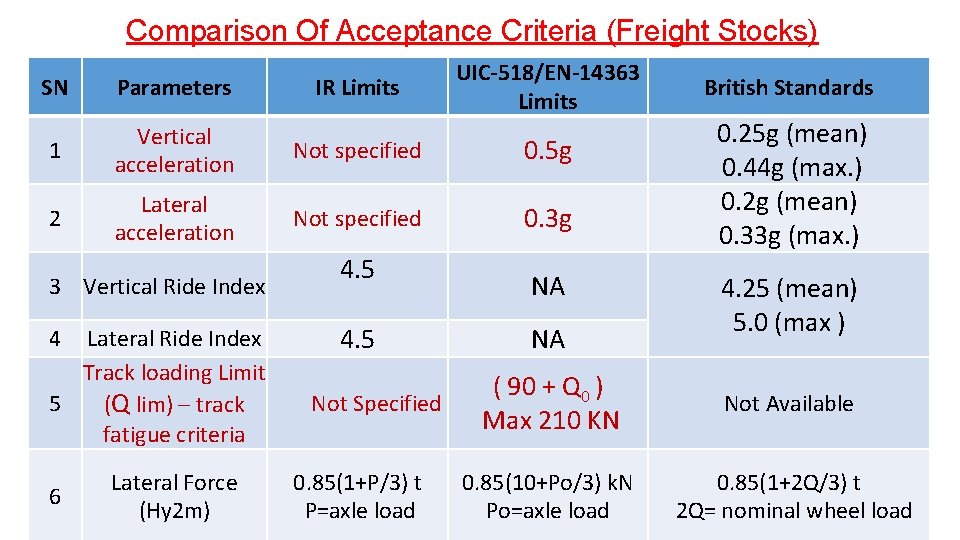
REQUIREMENTS FOR HEAVY AXLE LOAD WAGON § So the primary requirement for high axle load stocks to operate in mixed traffic regime is a Track friendly design - imparting low forces & accelerations on track (otherwise required level of geometry and continuity of track for semi -high speed passenger operation shall not be sustained) § Accordingly, the wagon clearance criteria needs to be based on following parameters as done internationally - Track loading limit (track fatigue criteria), limiting dynamic wheel load as specified by UIC - Acceleration limits - Lateral force limits
Comparison Of Acceptance Criteria (Freight Stocks) Parameters 1 Vertical acceleration Not specified 0. 5 g 2 Lateral acceleration Not specified 0. 3 g 3 Vertical Ride Index 4 Lateral Ride Index Track loading Limit 5 (Q lim) – track fatigue criteria 6 Lateral Force (Hy 2 m) IR Limits UIC-518/EN-14363 Limits SN 4. 5 Not Specified 0. 85(1+P/3) t P=axle load NA NA British Standards 0. 25 g (mean) 0. 44 g (max. ) 0. 2 g (mean) 0. 33 g (max. ) 4. 25 (mean) 5. 0 (max ) ( 90 + Q 0 ) Max 210 KN Not Available 0. 85(10+Po/3) k. N Po=axle load 0. 85(1+2 Q/3) t 2 Q= nominal wheel load
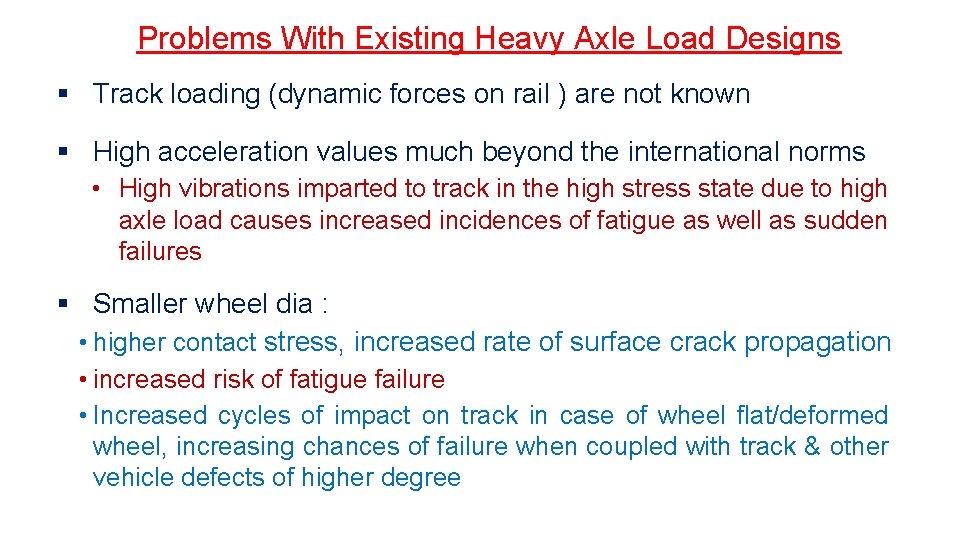
Problems With Existing Heavy Axle Load Designs § Track loading (dynamic forces on rail ) are not known § High acceleration values much beyond the international norms • High vibrations imparted to track in the high stress state due to high axle load causes increased incidences of fatigue as well as sudden failures § Smaller wheel dia : • higher contact stress, increased rate of surface crack propagation • increased risk of fatigue failure • Increased cycles of impact on track in case of wheel flat/deformed wheel, increasing chances of failure when coupled with track & other vehicle defects of higher degree
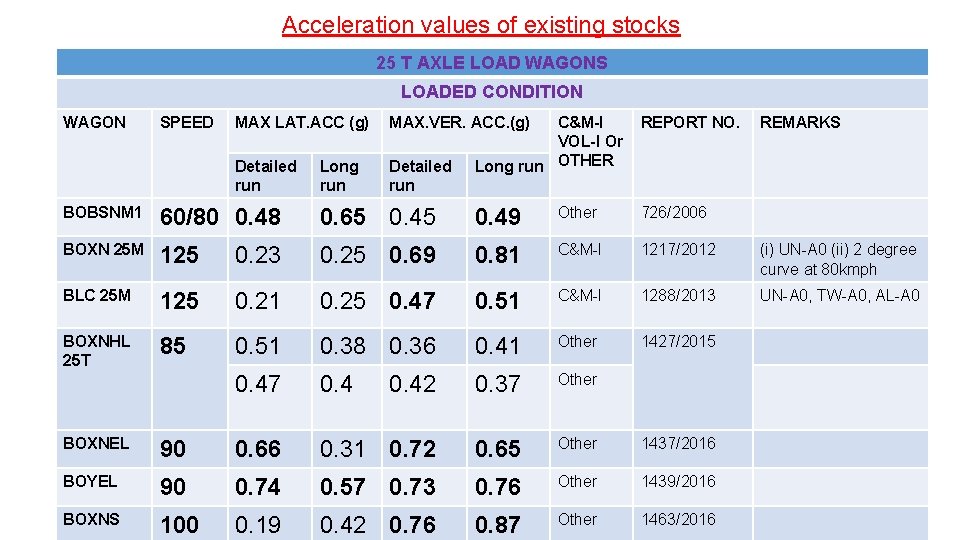
Acceleration values of existing stocks 25 T AXLE LOAD WAGONS LOADED CONDITION WAGON SPEED MAX LAT. ACC (g) MAX. VER. ACC. (g) Detailed run Long run C&M-I VOL-I Or Long run OTHER REPORT NO. REMARKS BOBSNM 1 60/80 0. 48 0. 65 0. 49 Other 726/2006 BOXN 25 M 125 0. 23 0. 25 0. 69 0. 81 C&M-I 1217/2012 (i) UN-A 0 (ii) 2 degree curve at 80 kmph BLC 25 M 125 0. 21 0. 25 0. 47 0. 51 C&M-I 1288/2013 UN-A 0, TW-A 0, AL-A 0 BOXNHL 25 T 85 0. 51 0. 38 0. 36 0. 41 Other 1427/2015 0. 47 0. 42 0. 37 Other BOXNEL 90 0. 66 0. 31 0. 72 0. 65 Other 1437/2016 BOYEL 90 0. 74 0. 57 0. 73 0. 76 Other 1439/2016 BOXNS 100 0. 19 0. 42 0. 76 0. 87 Other 1463/2016
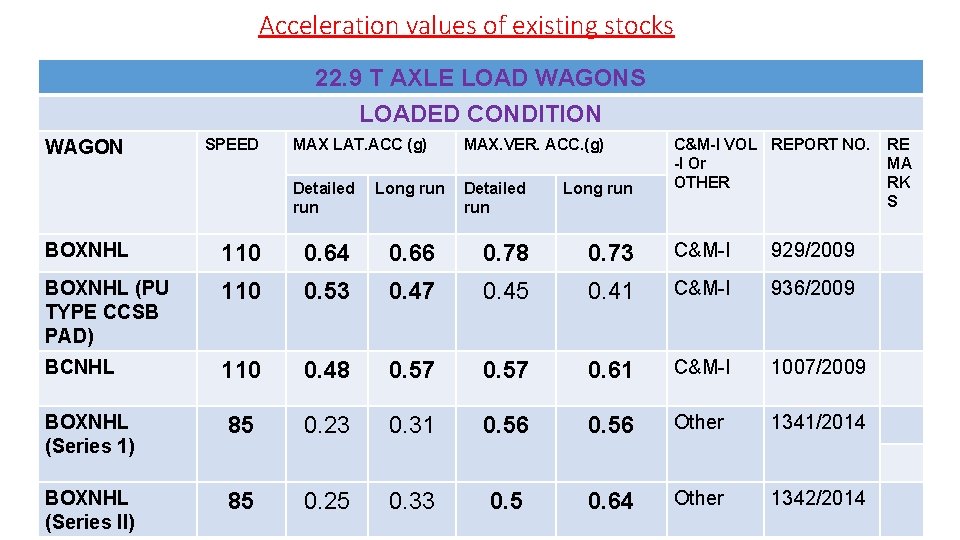
Acceleration values of existing stocks 22. 9 T AXLE LOAD WAGONS LOADED CONDITION WAGON SPEED MAX LAT. ACC (g) MAX. VER. ACC. (g) Detailed run Long run C&M-I VOL REPORT NO. -I Or OTHER BOXNHL 110 0. 64 0. 66 0. 78 0. 73 C&M-I 929/2009 BOXNHL (PU TYPE CCSB PAD) 110 0. 53 0. 47 0. 45 0. 41 C&M-I 936/2009 BCNHL 110 0. 48 0. 57 0. 61 C&M-I 1007/2009 BOXNHL (Series 1) 85 0. 23 0. 31 0. 56 Other 1341/2014 BOXNHL (Series II) 85 0. 25 0. 33 0. 5 0. 64 Other 1342/2014 RE MA RK S
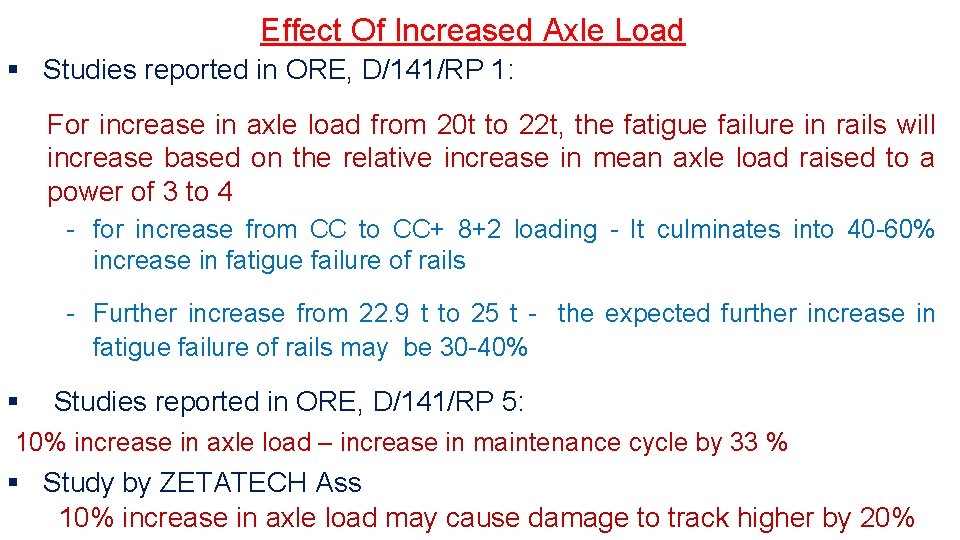
Effect Of Increased Axle Load § Studies reported in ORE, D/141/RP 1: For increase in axle load from 20 t to 22 t, the fatigue failure in rails will increase based on the relative increase in mean axle load raised to a power of 3 to 4 - for increase from CC to CC+ 8+2 loading - It culminates into 40 -60% increase in fatigue failure of rails - Further increase from 22. 9 t to 25 t - the expected further increase in fatigue failure of rails may be 30 -40% § Studies reported in ORE, D/141/RP 5: 10% increase in axle load – increase in maintenance cycle by 33 % § Study by ZETATECH Ass 10% increase in axle load may cause damage to track higher by 20%
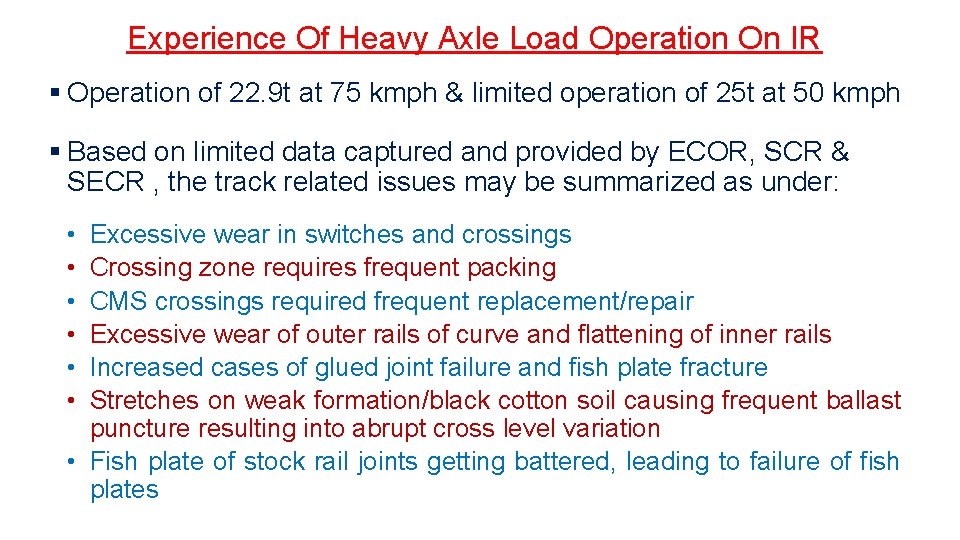
Experience Of Heavy Axle Load Operation On IR § Operation of 22. 9 t at 75 kmph & limited operation of 25 t at 50 kmph § Based on limited data captured and provided by ECOR, SCR & SECR , the track related issues may be summarized as under: • • • Excessive wear in switches and crossings Crossing zone requires frequent packing CMS crossings required frequent replacement/repair Excessive wear of outer rails of curve and flattening of inner rails Increased cases of glued joint failure and fish plate fracture Stretches on weak formation/black cotton soil causing frequent ballast puncture resulting into abrupt cross level variation • Fish plate of stock rail joints getting battered, leading to failure of fish plates
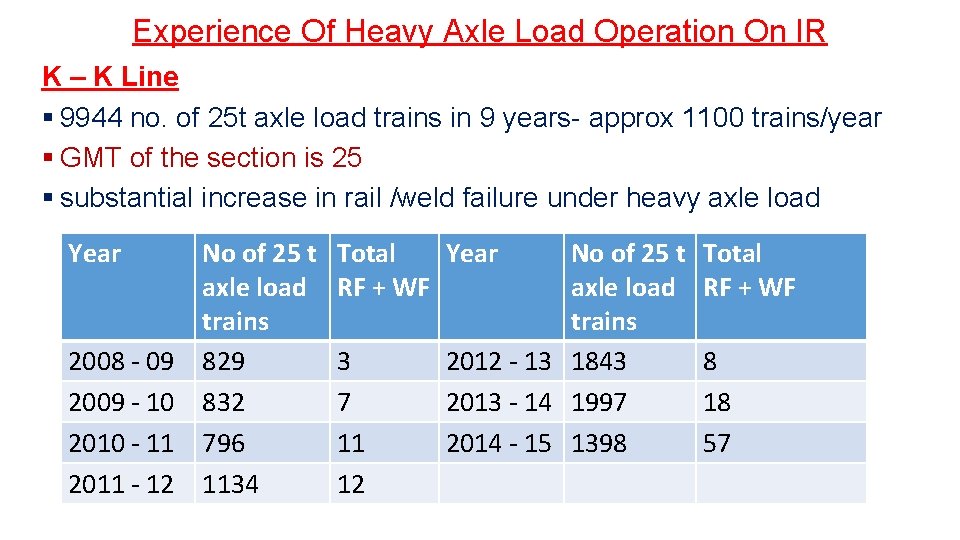
Experience Of Heavy Axle Load Operation On IR K – K Line § 9944 no. of 25 t axle load trains in 9 years- approx 1100 trains/year § GMT of the section is 25 § substantial increase in rail /weld failure under heavy axle load Year 2008 - 09 2009 - 10 2010 - 11 2011 - 12 No of 25 t axle load trains 829 832 796 1134 Total Year RF + WF No of 25 t axle load trains 2012 - 13 1843 2013 - 14 1997 2014 - 15 1398 Total RF + WF 3 7 11 12 8 18 57
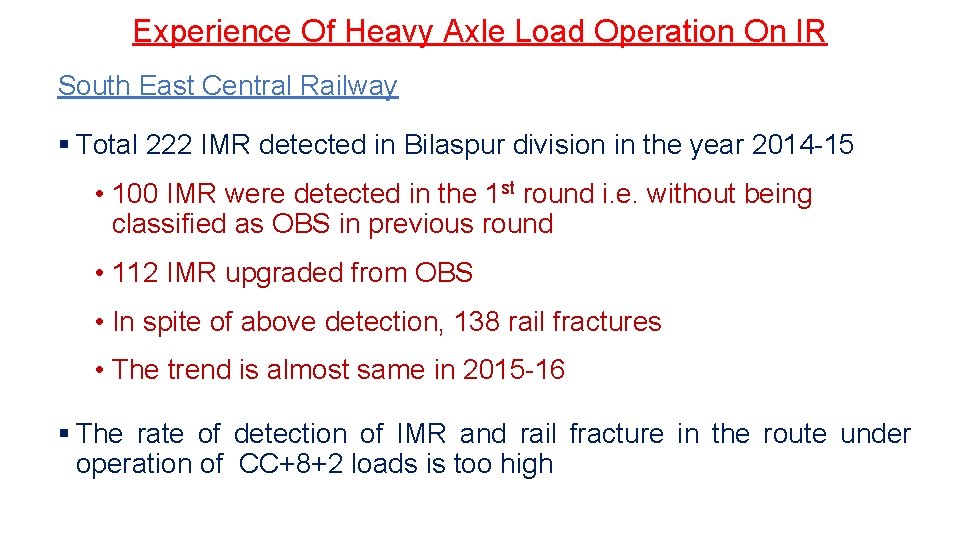
Experience Of Heavy Axle Load Operation On IR South East Central Railway § Total 222 IMR detected in Bilaspur division in the year 2014 -15 • 100 IMR were detected in the 1 st round i. e. without being classified as OBS in previous round • 112 IMR upgraded from OBS • In spite of above detection, 138 rail fractures • The trend is almost same in 2015 -16 § The rate of detection of IMR and rail fracture in the route under operation of CC+8+2 loads is too high
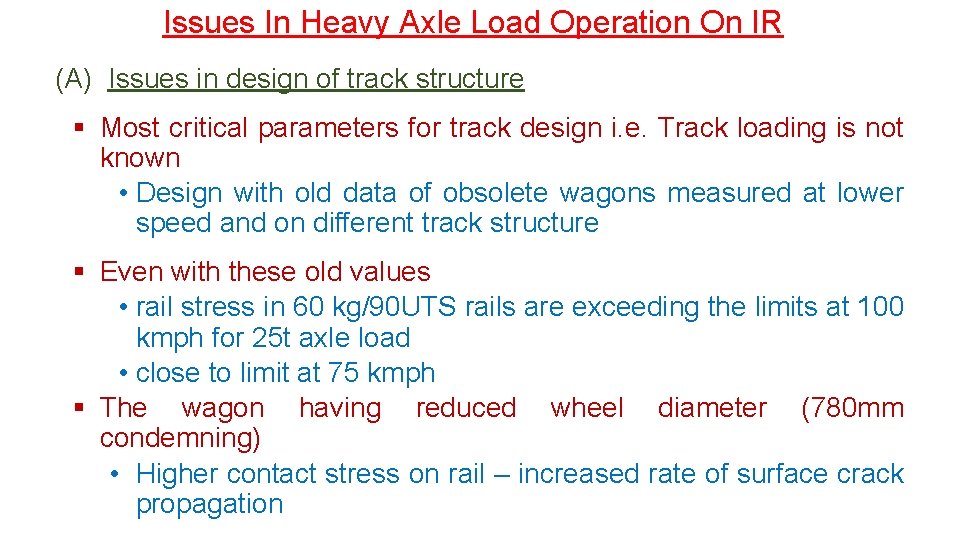
Issues In Heavy Axle Load Operation On IR (A) Issues in design of track structure § Most critical parameters for track design i. e. Track loading is not known • Design with old data of obsolete wagons measured at lower speed and on different track structure § Even with these old values • rail stress in 60 kg/90 UTS rails are exceeding the limits at 100 kmph for 25 t axle load • close to limit at 75 kmph § The wagon having reduced wheel diameter (780 mm condemning) • Higher contact stress on rail – increased rate of surface crack propagation
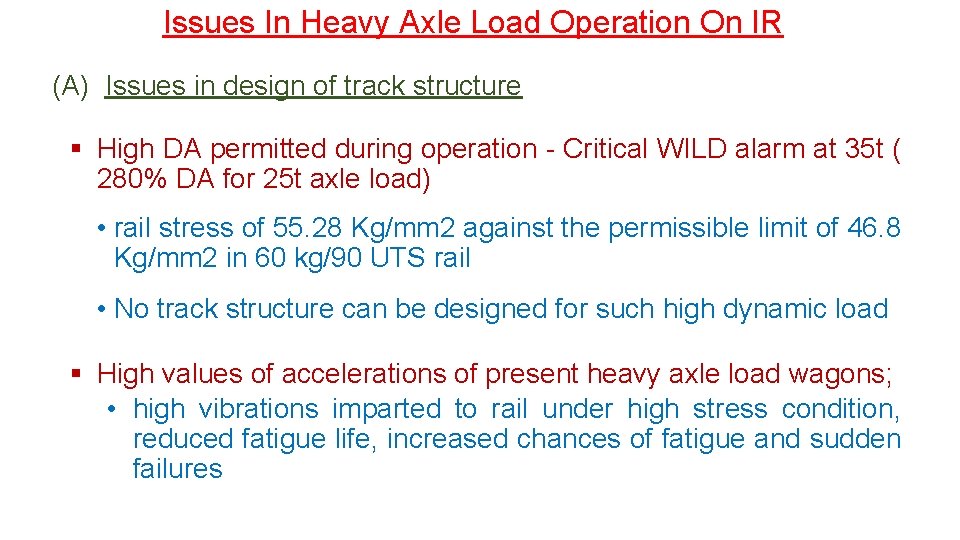
Issues In Heavy Axle Load Operation On IR (A) Issues in design of track structure § High DA permitted during operation - Critical WILD alarm at 35 t ( 280% DA for 25 t axle load) • rail stress of 55. 28 Kg/mm 2 against the permissible limit of 46. 8 Kg/mm 2 in 60 kg/90 UTS rail • No track structure can be designed for such high dynamic load § High values of accelerations of present heavy axle load wagons; • high vibrations imparted to rail under high stress condition, reduced fatigue life, increased chances of fatigue and sudden failures
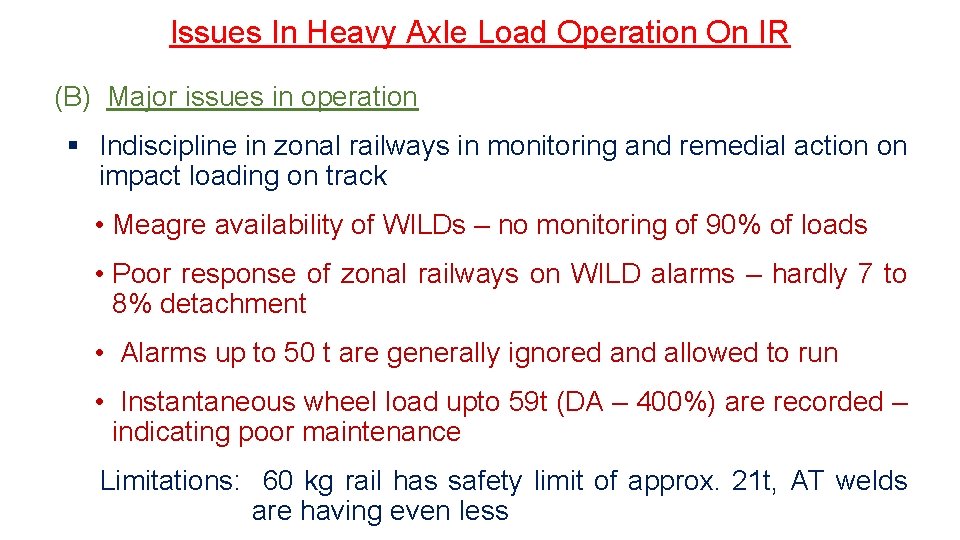
Issues In Heavy Axle Load Operation On IR (B) Major issues in operation § Indiscipline in zonal railways in monitoring and remedial action on impact loading on track • Meagre availability of WILDs – no monitoring of 90% of loads • Poor response of zonal railways on WILD alarms – hardly 7 to 8% detachment • Alarms up to 50 t are generally ignored and allowed to run • Instantaneous wheel load upto 59 t (DA – 400%) are recorded – indicating poor maintenance Limitations: 60 kg rail has safety limit of approx. 21 t, AT welds are having even less
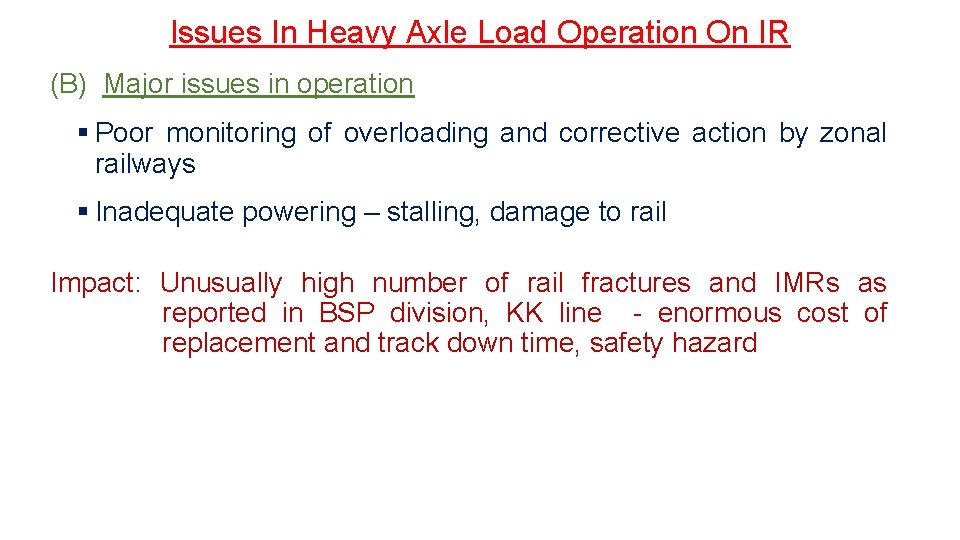
Issues In Heavy Axle Load Operation On IR (B) Major issues in operation § Poor monitoring of overloading and corrective action by zonal railways § Inadequate powering – stalling, damage to rail Impact: Unusually high number of rail fractures and IMRs as reported in BSP division, KK line - enormous cost of replacement and track down time, safety hazard
Issues In Heavy Axle Load Operation On IR (B) Major issues in operation § Required enhanced maintenance blocks and resource § But the situation is grim – corridor blocks have vanished, severe resources constraints putting lot of pressure on infrastructure § maintenance arrears, in-service failures, passengers safety at risks, downtime § Problem of corrosion of rails and fastenings due to human excreta from coaches § reduced sectional area at critical locations as foot, sudden breakage of rail
CONCLUSION & WAY FORWARD § Increase in through-put with increased axle loads and introducing semi-high speed on the same track can be justified to cater to the needs of ever burgeoning population, assuming certain risks. § Mostly, these risks are associated with the high rail-wheel forces. § Keeping the rail-wheel forces low is the only way for economically sustainable heavy axle load operations along with safer semi-high speed passenger operations.
CONCLUSION & WAY FORWARD § For reducing these risks, various elements and regime of heavier axle loads and semi-high speed operations needs to be conceived and implemented meticulously. Main elements are • Proper design of track structure - needing real time measurement of dynamic forces on track • world class freight suspension system with limited dynamic loading • Regime of clearing rolling stocks in line with international std - in order to ensure that rolling stock passes through the track with worn out limits having low dynamic forces
CONCLUSION & WAY FORWARD • Enhanced monitoring and maintenance of rolling stocks: way side monitoring equipment, Installation of WILD at all important/specified locations required • Enhanced monitoring and maintenance of track: - high speed TRC, Vehicular USFD, Broken rail detection system, completely mechanized maintenance • Timely maintenance and replacement of both aged rolling stock and fixed infrastructure • Well laid maintenance regime: 4 hrs corridor block, enhanced funds and material arrangement, better mobility (MMU, RCRV etc)
THANKS