
Challenges in Bhutans internet communications Szymon Zylinski University
Challenges in Bhutan’s internet communications Szymon Zylinski, University of Warmia and Mazury in Olsztyn, Poland
• for centuries it was isolated from the outside world and cultivated its own set of traditions, beliefs • modern communication technologies: - radio and press 1980’s - TV 1999 - Internet 2000
• Review paper • English is the language of: education politics most media
• Computer were first brought to Bhutan in 1984 and were used in government institutions however their use was limited due to the unstable power supply
• Bhutanese were/are very careful to adopt new technologies - not only caused by traditional upbringing and ages old Buddhist customs cultivation but also strongly influenced by Gross National Happiness (GNH) policy
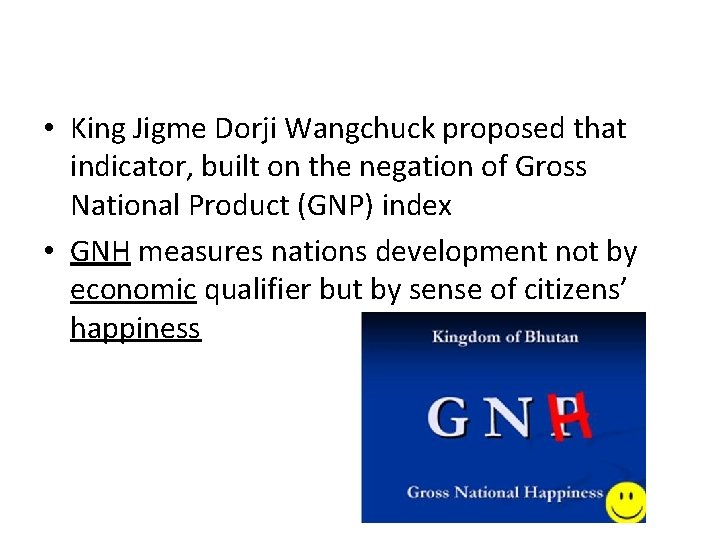
• King Jigme Dorji Wangchuck proposed that indicator, built on the negation of Gross National Product (GNP) index • GNH measures nations development not by economic qualifier but by sense of citizens’ happiness
• Nowadays cellular communications is the most popular one • 92, 8% of households now own mobile phones • 58, 5% own a TV set and • 38. 8% own a radio set • 16. 4% own a computer
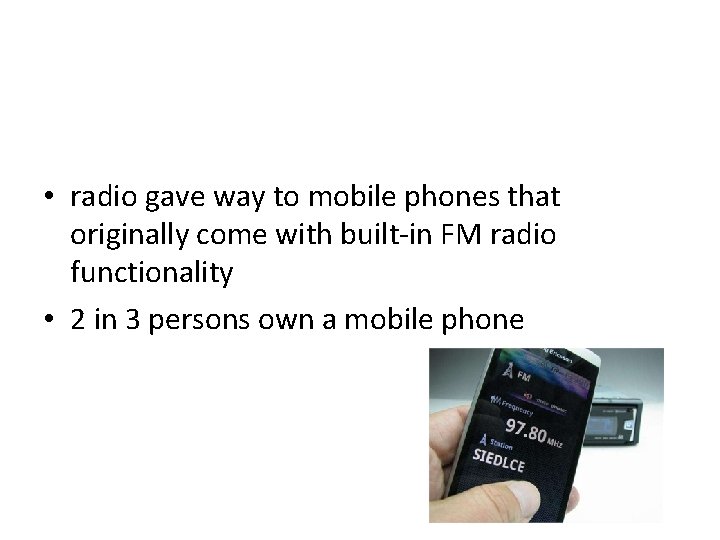
• radio gave way to mobile phones that originally come with built-in FM radio functionality • 2 in 3 persons own a mobile phone
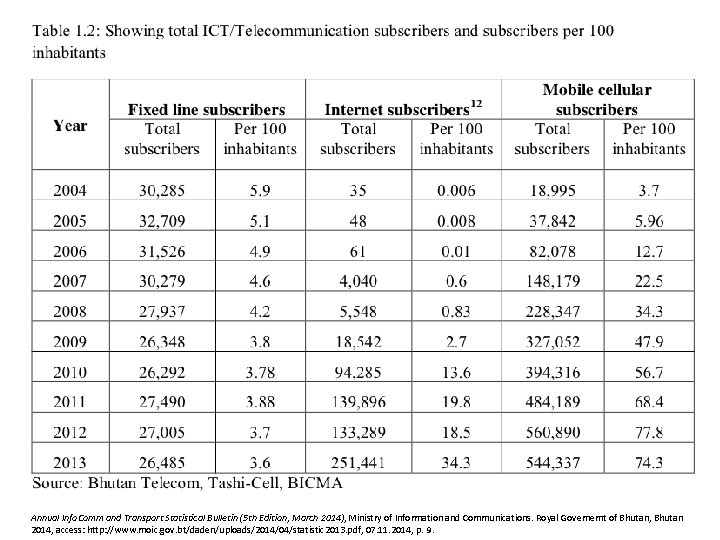
Annual Info. Comm and Transport Statistical Bulletin (5 th Edition, March 2014), Ministry of Information and Communications. Royal Governemt of Bhutan, Bhutan 2014, access: http: //www. moic. gov. bt/daden/uploads/2014/04/statistic 2013. pdf, 07. 11. 2014, p. 9.
• Sonam Tobgay and Kencho Wangmo named a few challenges that Bhutan’s ICT sector faces: • lack of awareness and understanding • lack of ICT expertise and skills • lack of private sector participants • poor research and development initiatives • lack of budget for ICT sector • limited internet access • poor content in the national language • poor local content • difficulties in deploying Internet
• However for the purpose of this prestantation 3 categories were developed: - Axis of tradition and modernity - Institutional involvement - Terrain barriers
Axis of tradition and modernity • Sangay Ngedup, a former prime minister in one interview said: “Until recently, we shied away from killing insects and yet now we Bhutanese are asked to watch people on TV blowing heads off with shotguns”. E. Weiner, Goegraphy of Bliss, New York 2008, p. 109 .
Axis of tradition and modernity • Technologies like information and communication (ICT) have become vital components in teaching and learning process and have alleviated innovation skills • distance and online learning is often considered suspicious by staff, employers, and students alike
Axis of tradition and modernity • Internet in Bhutan : - is welcomed by the youngest generation that embraced it with great enthusiasm and - is used for learning activities and improving language skills, instant communication with family members across the country as well as abroad
Axis of tradition and modernity • Mobile connectivity and use of cellular phones to access social media is a trend growing exponentially • Facebook is a useful tool in bringing attention to social problems and difficulties: Buddhist monk was sentenced to three-year in prison for possessing $3 worth of tobacco
Axis of tradition and modernity • Income level does not play a big role in Internet usage but level of education and job do • Civil servants, corporate and public employees spend more time browsing web, than business owners, students or people with other profession
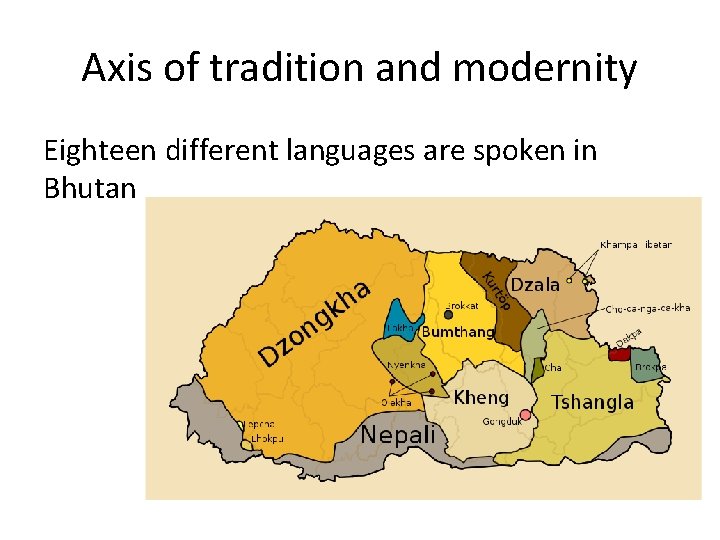
Axis of tradition and modernity Eighteen different languages are spoken in Bhutan
Axis of tradition and modernity • The national language – Dzongkha – the only one with the native literary tradition is well known to most of the Bhutanese, however it written form is not familiar to the majority of Bhutanese people: • 19, 3% read Bhutanese websites in English • 0. 4% read in Dzongkha
Institutional involvement • At the beginning of new media introduction help from outside organizations needed • Pan Asia Networking, helped establish Bhutan’s first Internet provider Druk. Net, international email access and helped built training facilities
Institutional involvement • Ministry of Education (MOE) in the year 2000 started supporting the higher secondary schools particularly with providing computers, LCD’s, internet, multimedia and e-learning resources
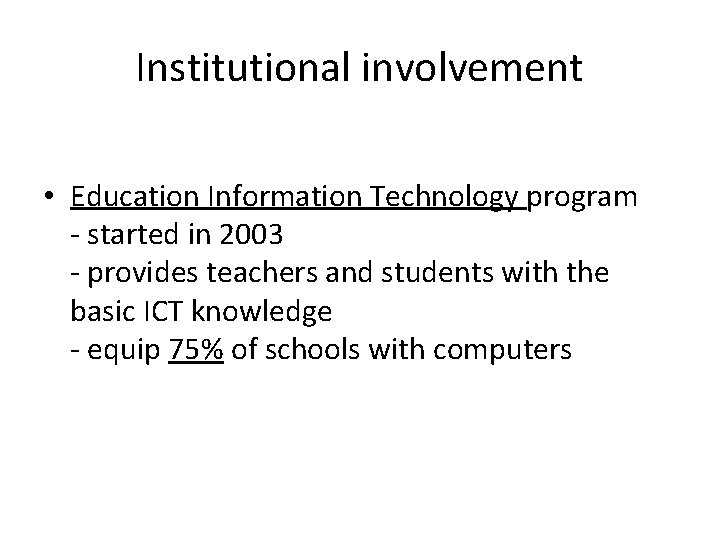
Institutional involvement • Education Information Technology program - started in 2003 - provides teachers and students with the basic ICT knowledge - equip 75% of schools with computers
Institutional involvement • the quality of web discourse may be improved • In 2007 The Bhutan Information, Communication and Media Authority (BICMA) requested internet providers to block, in their opinion offensive, website: bhutantimes. com, which presented information about Bhutan both from local and international perspective
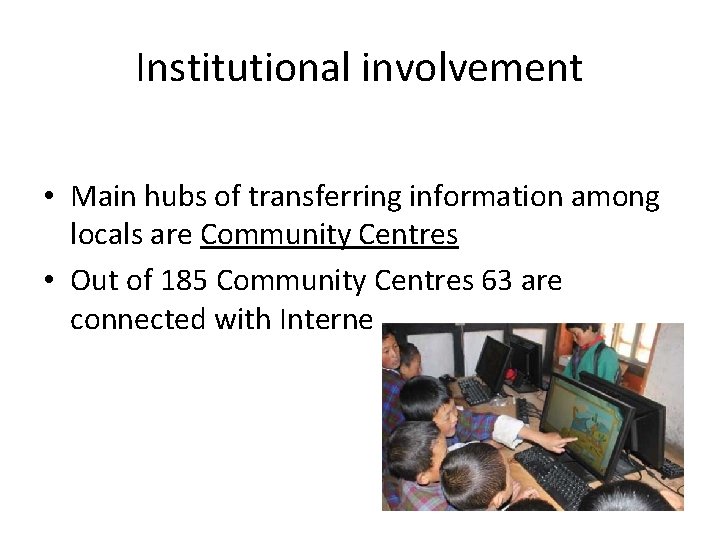
Institutional involvement • Main hubs of transferring information among locals are Community Centres • Out of 185 Community Centres 63 are connected with Interne
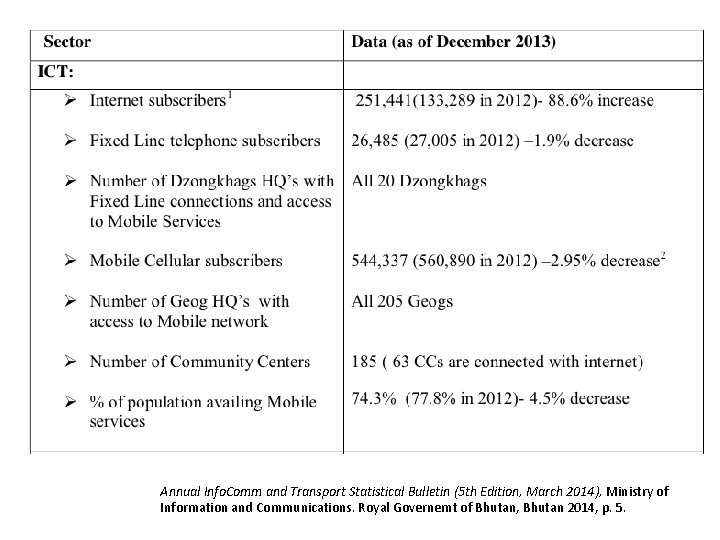
Annual Info. Comm and Transport Statistical Bulletin (5 th Edition, March 2014), Ministry of Information and Communications. Royal Governemt of Bhutan, Bhutan 2014, p. 5.
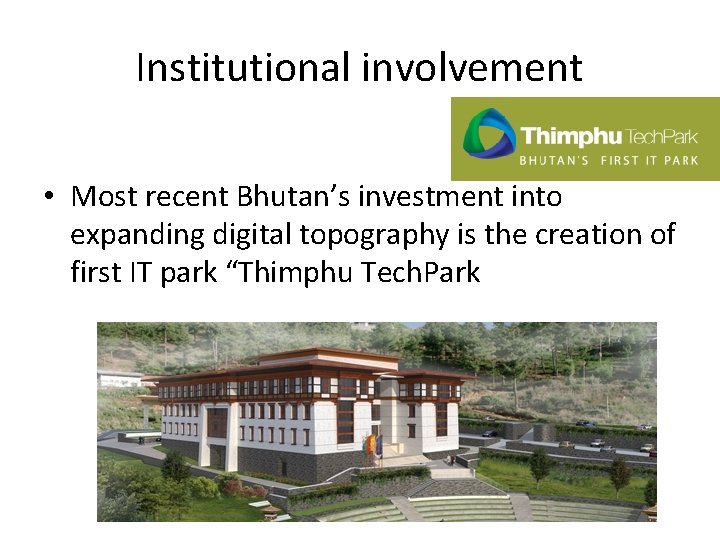
Institutional involvement • Most recent Bhutan’s investment into expanding digital topography is the creation of first IT park “Thimphu Tech. Park
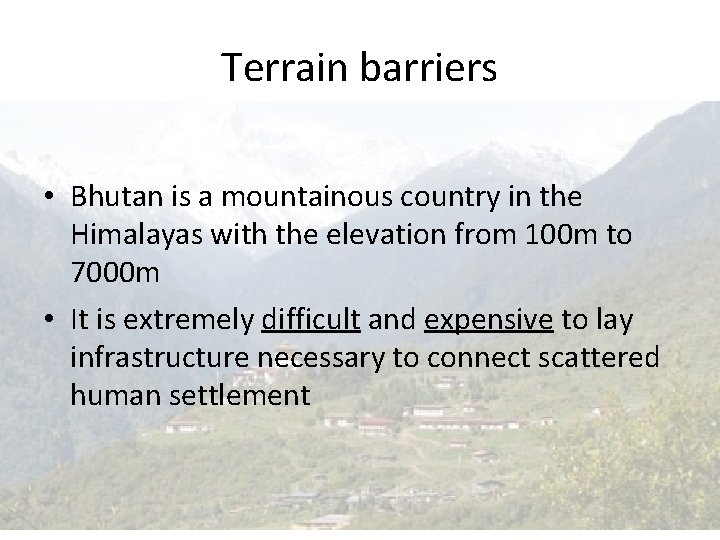
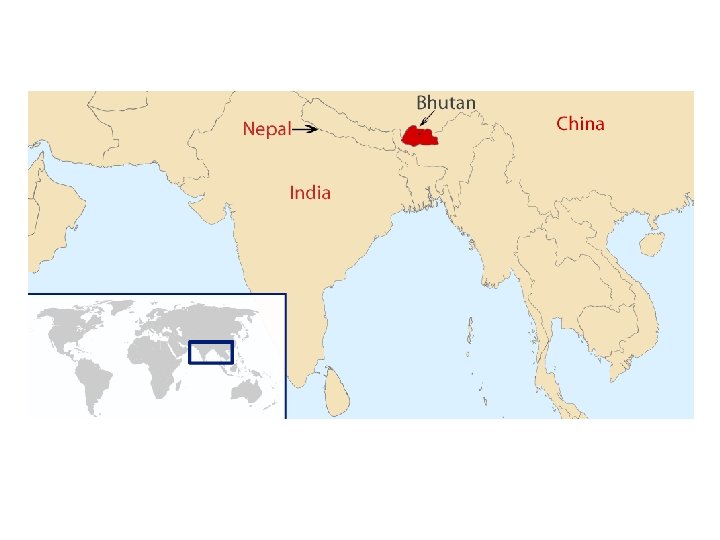
Terrain barriers • Bhutan is a mountainous country in the Himalayas with the elevation from 100 m to 7000 m • It is extremely difficult and expensive to lay infrastructure necessary to connect scattered human settlement
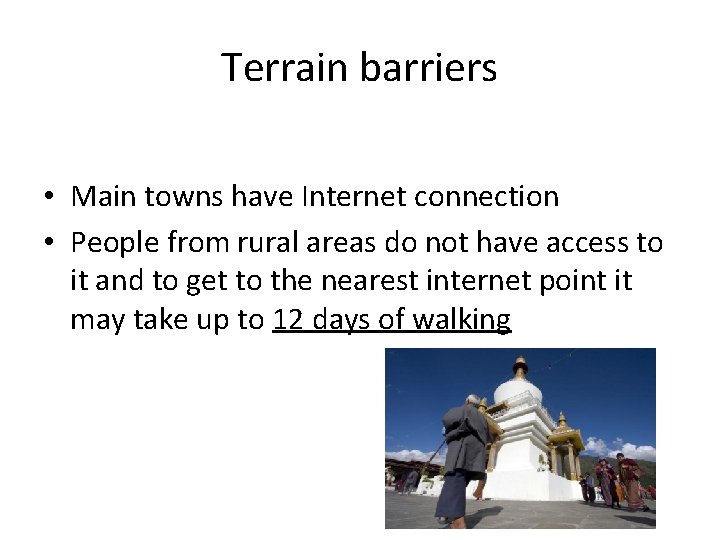
Terrain barriers • Main towns have Internet connection • People from rural areas do not have access to it and to get to the nearest internet point it may take up to 12 days of walking
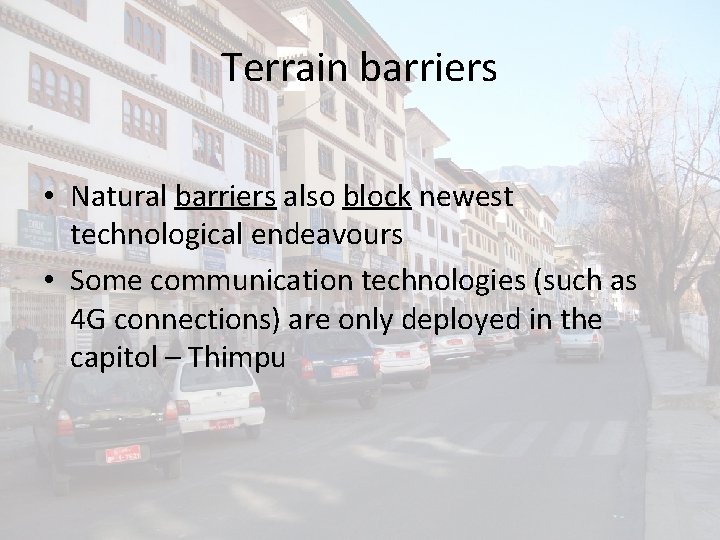
Terrain barriers • Natural barriers also block newest technological endeavours • Some communication technologies (such as 4 G connections) are only deployed in the capitol – Thimpu
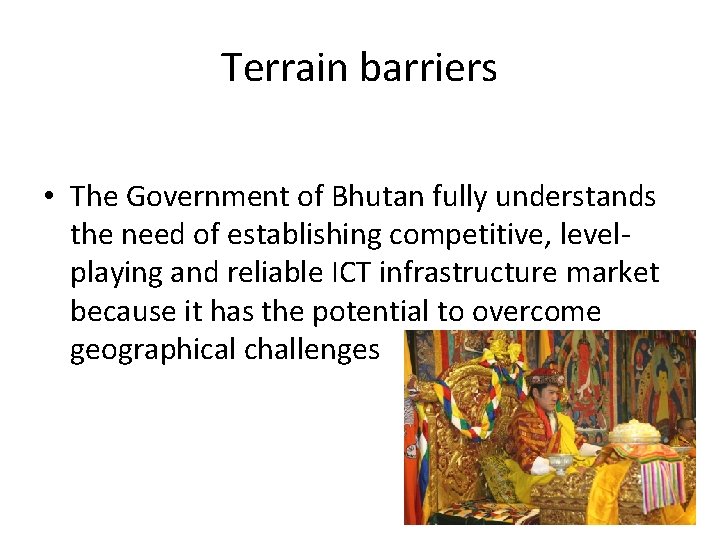
Terrain barriers • The Government of Bhutan fully understands the need of establishing competitive, levelplaying and reliable ICT infrastructure market because it has the potential to overcome geographical challenges
Conclusion • Siok Sian Pek-Dorji, Media Consultant from Thimpu, an insider of Bhutam mentality, tradition and media • “We should avoid the <<dumbing down>> of media that is happening elsewhere in the world, where media feed misinformation and provide sensationalism producing a Disney-type happiness and entertainment; this will lead us far from the path to GNH”
- Slides: 31