
CHALLENGES FOR CORAL REEF MANAGEMENT AND ADAPTIVE POLICY
- Slides: 1
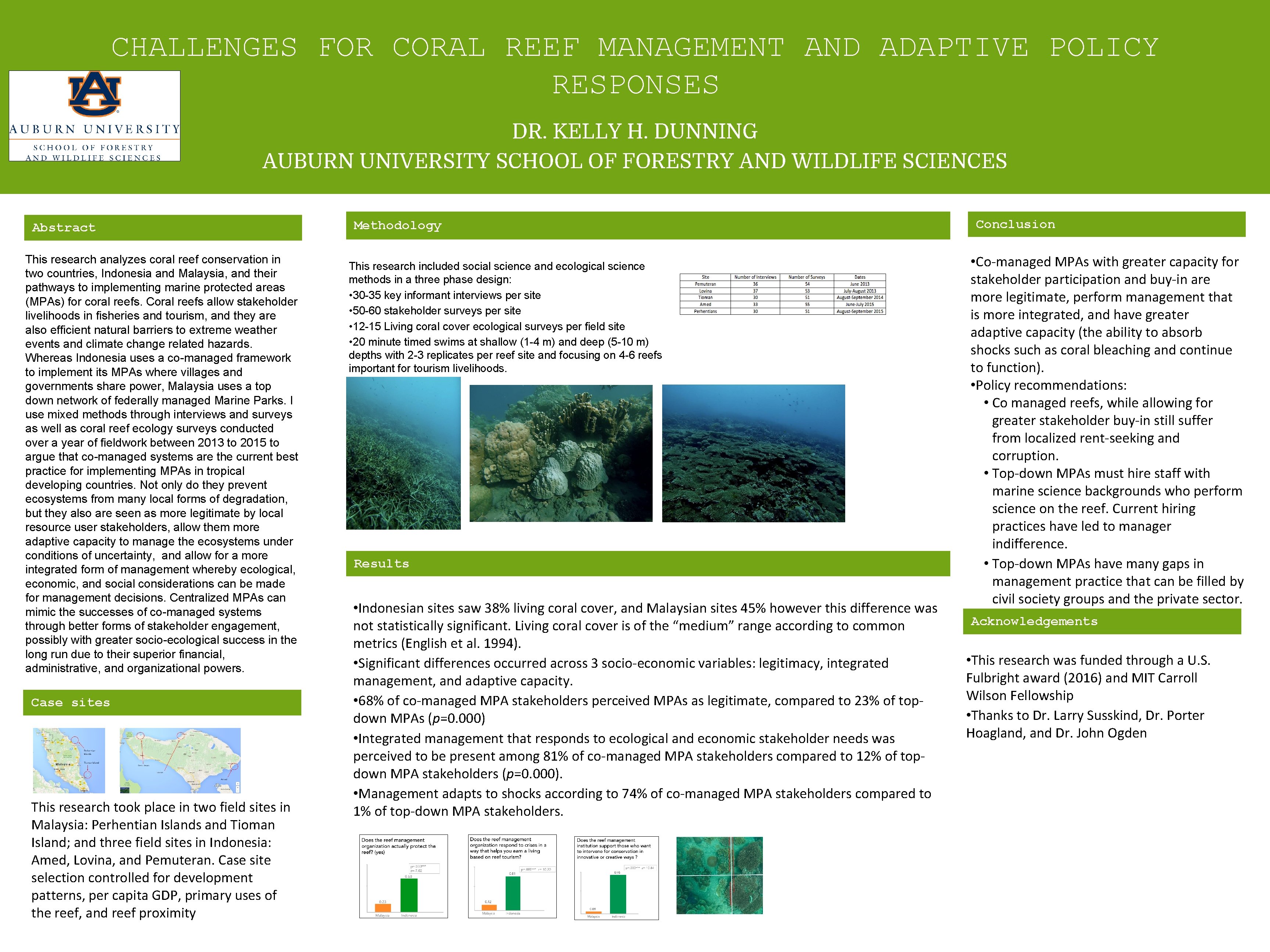
CHALLENGES FOR CORAL REEF MANAGEMENT AND ADAPTIVE POLICY RESPONSES DR. KELLY H. DUNNING AUBURN UNIVERSITY SCHOOL OF FORESTRY AND WILDLIFE SCIENCES Abstract This research analyzes coral reef conservation in two countries, Indonesia and Malaysia, and their pathways to implementing marine protected areas (MPAs) for coral reefs. Coral reefs allow stakeholder livelihoods in fisheries and tourism, and they are also efficient natural barriers to extreme weather events and climate change related hazards. Whereas Indonesia uses a co-managed framework to implement its MPAs where villages and governments share power, Malaysia uses a top down network of federally managed Marine Parks. I use mixed methods through interviews and surveys as well as coral reef ecology surveys conducted over a year of fieldwork between 2013 to 2015 to argue that co-managed systems are the current best practice for implementing MPAs in tropical developing countries. Not only do they prevent ecosystems from many local forms of degradation, but they also are seen as more legitimate by local resource user stakeholders, allow them more adaptive capacity to manage the ecosystems under conditions of uncertainty, and allow for a more integrated form of management whereby ecological, economic, and social considerations can be made for management decisions. Centralized MPAs can mimic the successes of co-managed systems through better forms of stakeholder engagement, possibly with greater socio-ecological success in the long run due to their superior financial, administrative, and organizational powers. Case sites This research took place in two field sites in Malaysia: Perhentian Islands and Tioman Island; and three field sites in Indonesia: Amed, Lovina, and Pemuteran. Case site selection controlled for development patterns, per capita GDP, primary uses of the reef, and reef proximity Methodology This research included social science and ecological science methods in a three phase design: • 30 -35 key informant interviews per site • 50 -60 stakeholder surveys per site • 12 -15 Living coral cover ecological surveys per field site • 20 minute timed swims at shallow (1 -4 m) and deep (5 -10 m) depths with 2 -3 replicates per reef site and focusing on 4 -6 reefs important for tourism livelihoods. Results • Indonesian sites saw 38% living coral cover, and Malaysian sites 45% however this difference was not statistically significant. Living coral cover is of the “medium” range according to common metrics (English et al. 1994). • Significant differences occurred across 3 socio-economic variables: legitimacy, integrated management, and adaptive capacity. • 68% of co-managed MPA stakeholders perceived MPAs as legitimate, compared to 23% of topdown MPAs (p=0. 000) • Integrated management that responds to ecological and economic stakeholder needs was perceived to be present among 81% of co-managed MPA stakeholders compared to 12% of topdown MPA stakeholders (p=0. 000). • Management adapts to shocks according to 74% of co-managed MPA stakeholders compared to 1% of top-down MPA stakeholders. Conclusion • Co-managed MPAs with greater capacity for stakeholder participation and buy-in are more legitimate, perform management that is more integrated, and have greater adaptive capacity (the ability to absorb shocks such as coral bleaching and continue to function). • Policy recommendations: • Co managed reefs, while allowing for greater stakeholder buy-in still suffer from localized rent-seeking and corruption. • Top-down MPAs must hire staff with marine science backgrounds who perform science on the reef. Current hiring practices have led to manager indifference. • Top-down MPAs have many gaps in management practice that can be filled by civil society groups and the private sector. Acknowledgements • This research was funded through a U. S. Fulbright award (2016) and MIT Carroll Wilson Fellowship • Thanks to Dr. Larry Susskind, Dr. Porter Hoagland, and Dr. John Ogden