
Challenges and the Future of HPC Some material


- Slides: 44
Challenges and the Future of HPC Some material from a lecture by David H. Bailey NERSC High Performance Computing 1
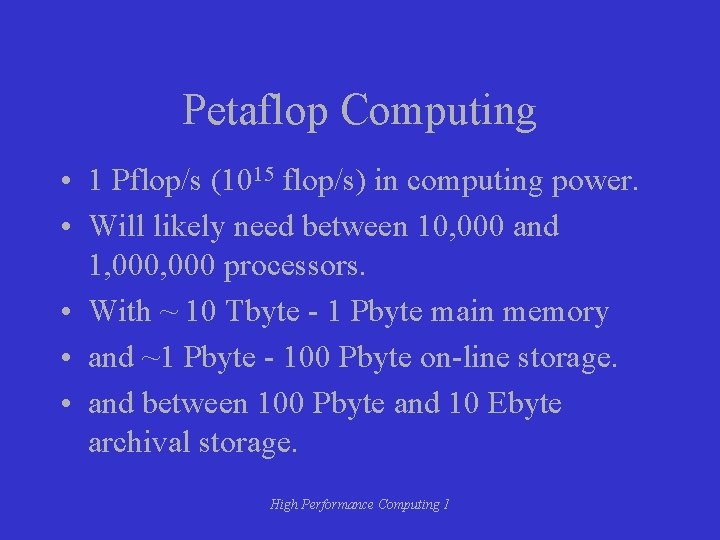
Petaflop Computing • 1 Pflop/s (1015 flop/s) in computing power. • Will likely need between 10, 000 and 1, 000 processors. • With ~ 10 Tbyte - 1 Pbyte main memory • and ~1 Pbyte - 100 Pbyte on-line storage. • and between 100 Pbyte and 10 Ebyte archival storage. High Performance Computing 1
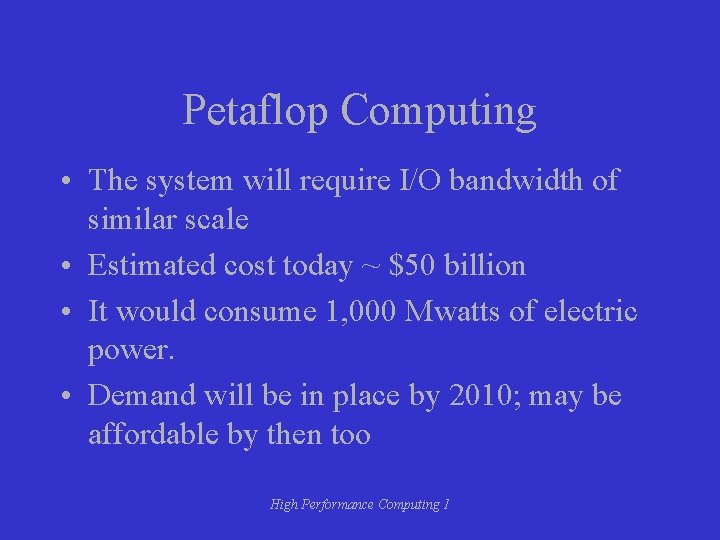
Petaflop Computing • The system will require I/O bandwidth of similar scale • Estimated cost today ~ $50 billion • It would consume 1, 000 Mwatts of electric power. • Demand will be in place by 2010; may be affordable by then too High Performance Computing 1
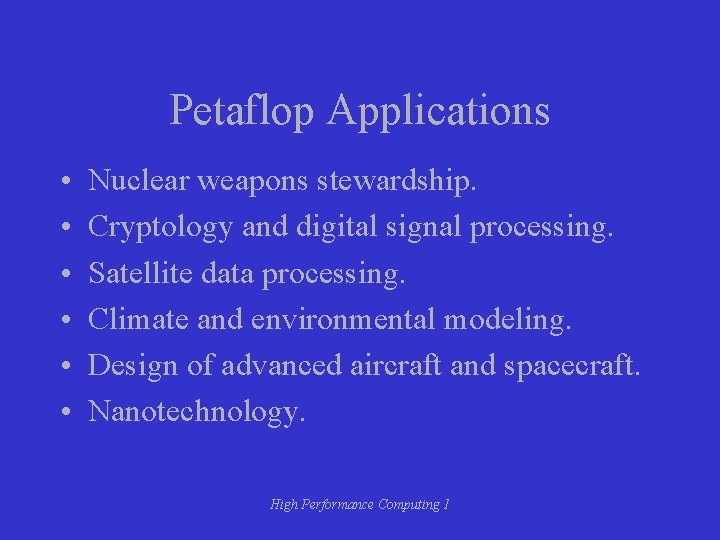
Petaflop Applications • • • Nuclear weapons stewardship. Cryptology and digital signal processing. Satellite data processing. Climate and environmental modeling. Design of advanced aircraft and spacecraft. Nanotechnology. High Performance Computing 1
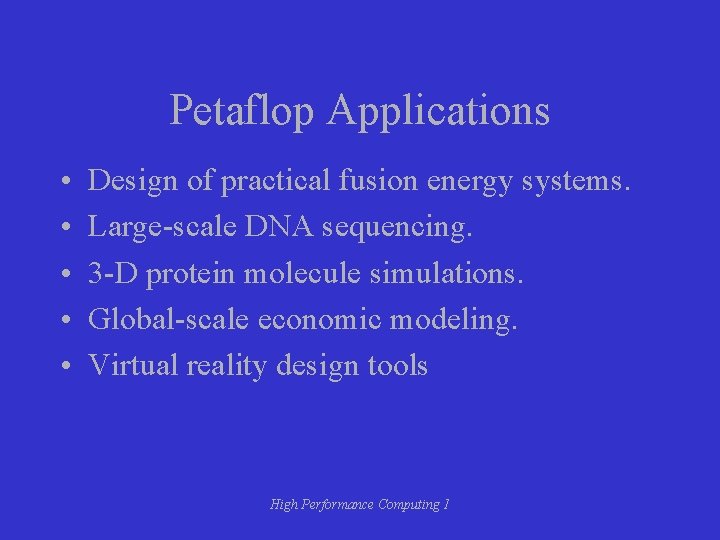
Petaflop Applications • • • Design of practical fusion energy systems. Large-scale DNA sequencing. 3 -D protein molecule simulations. Global-scale economic modeling. Virtual reality design tools High Performance Computing 1
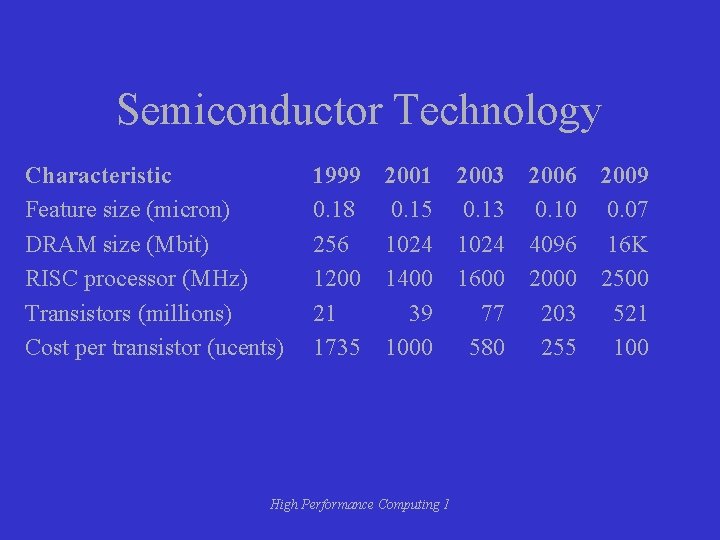
Semiconductor Technology Characteristic Feature size (micron) DRAM size (Mbit) RISC processor (MHz) Transistors (millions) Cost per transistor (ucents) 1999 0. 18 256 1200 21 1735 2001 0. 15 1024 1400 39 1000 High Performance Computing 1 2003 0. 13 1024 1600 77 580 2006 0. 10 4096 2000 203 255 2009 0. 07 16 K 2500 521 100
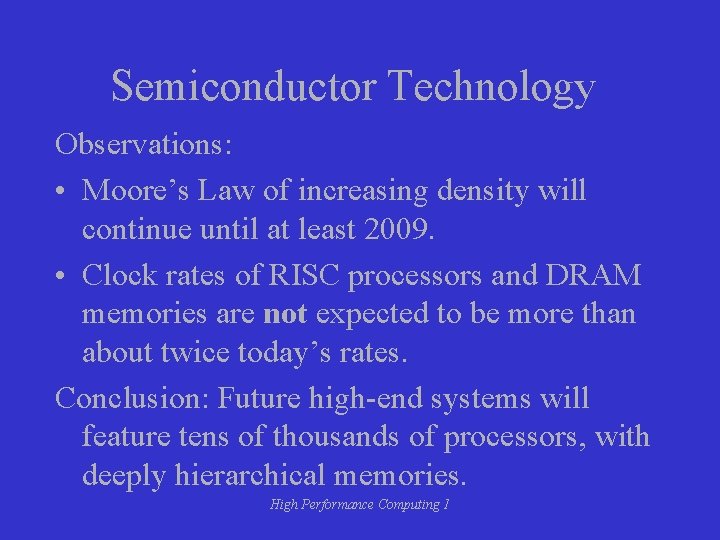
Semiconductor Technology Observations: • Moore’s Law of increasing density will continue until at least 2009. • Clock rates of RISC processors and DRAM memories are not expected to be more than about twice today’s rates. Conclusion: Future high-end systems will feature tens of thousands of processors, with deeply hierarchical memories. High Performance Computing 1
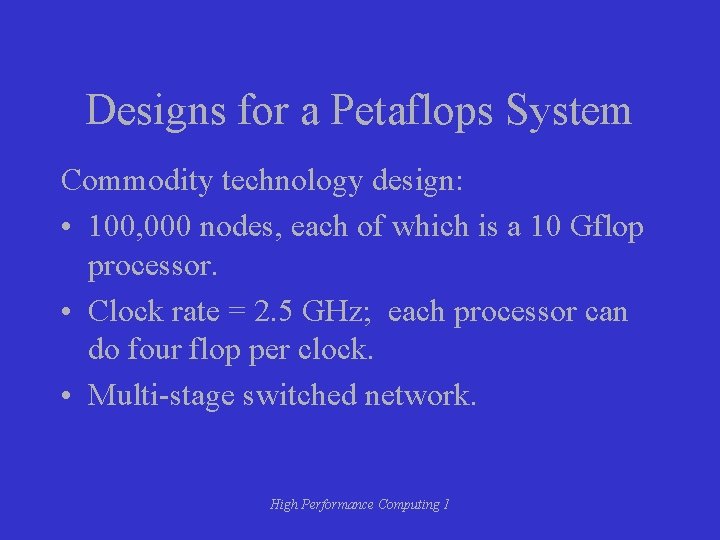
Designs for a Petaflops System Commodity technology design: • 100, 000 nodes, each of which is a 10 Gflop processor. • Clock rate = 2. 5 GHz; each processor can do four flop per clock. • Multi-stage switched network. High Performance Computing 1
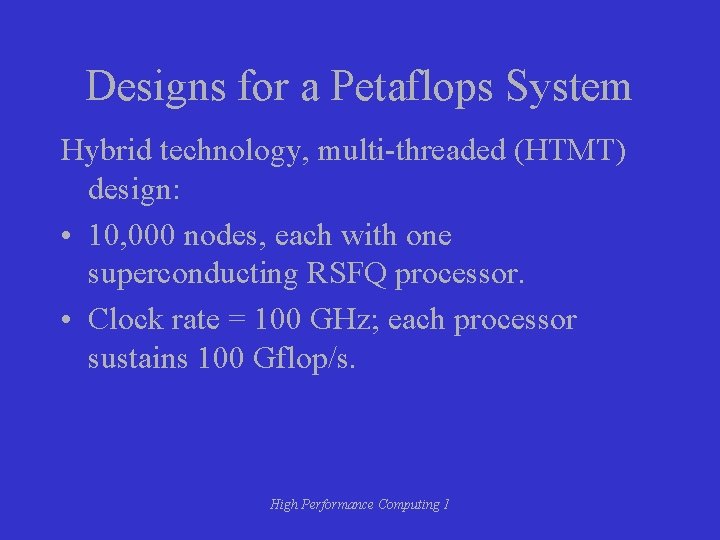
Designs for a Petaflops System Hybrid technology, multi-threaded (HTMT) design: • 10, 000 nodes, each with one superconducting RSFQ processor. • Clock rate = 100 GHz; each processor sustains 100 Gflop/s. High Performance Computing 1
Designs for a Petaflops System • Multi-threaded processor design handles a large number of outstanding memory references. • Multi-level memory hierarchy (CRAM, SRAM, DRAM, etc. ). • Optical interconnection network. High Performance Computing 1
Little’s Law of Queuing Theory Little’s Law: Average number of waiting customers = average arrival rate x average wait time per customer. High Performance Computing 1
Little’s Law of High Performance Computing Assume: • Single processor-memory system. • Computation deals with data in local main memory. • Pipeline between main memory and processor is fully utilized. Then by Little’s Law, the number of words in transit between CPU and memory (i. e. length of vector pipe, size of cache lines, etc. ) = memory latency x bandwidth. High Performance Computing 1
Little’s Law of High Performance Computing This observation generalizes to multiprocessor systems: concurrency = latency x bandwidth, where “concurrency” is aggregate system concurrency, and “bandwidth” is aggregate system memory bandwidth. This form of Little’s Law was first noted by Burton Smith of Tera. High Performance Computing 1
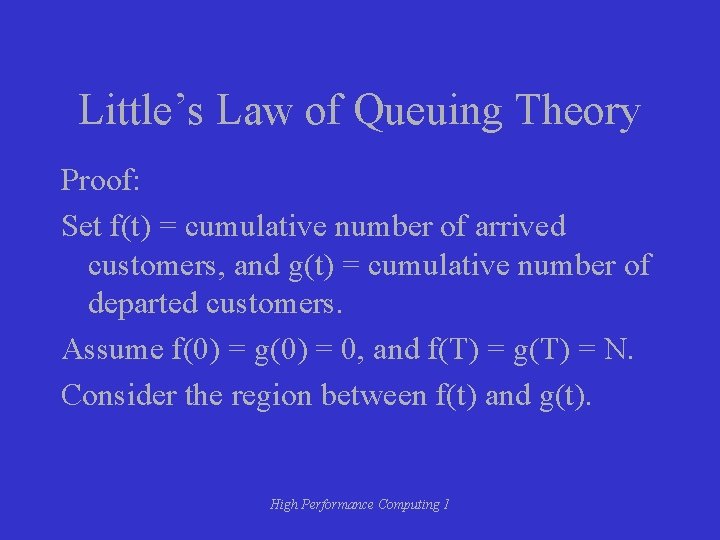
Little’s Law of Queuing Theory Proof: Set f(t) = cumulative number of arrived customers, and g(t) = cumulative number of departed customers. Assume f(0) = g(0) = 0, and f(T) = g(T) = N. Consider the region between f(t) and g(t). High Performance Computing 1
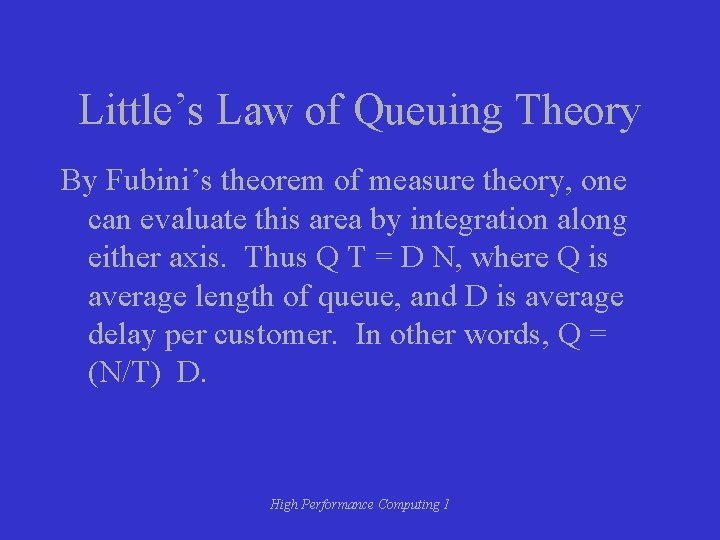
Little’s Law of Queuing Theory By Fubini’s theorem of measure theory, one can evaluate this area by integration along either axis. Thus Q T = D N, where Q is average length of queue, and D is average delay per customer. In other words, Q = (N/T) D. High Performance Computing 1
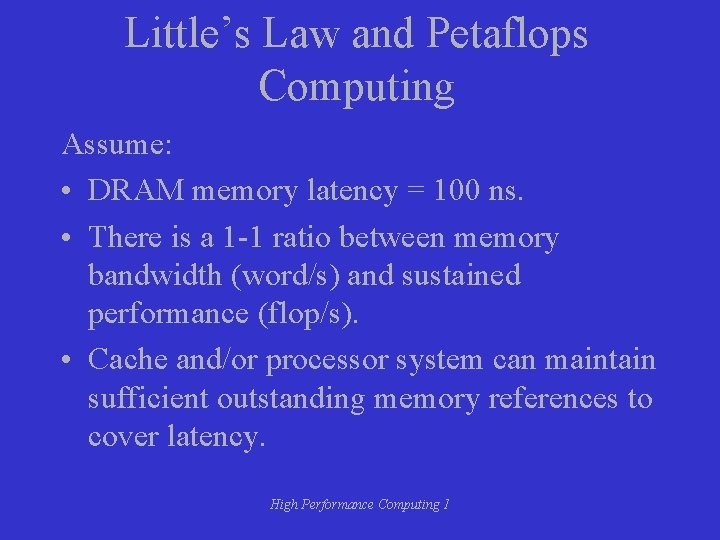
Little’s Law and Petaflops Computing Assume: • DRAM memory latency = 100 ns. • There is a 1 -1 ratio between memory bandwidth (word/s) and sustained performance (flop/s). • Cache and/or processor system can maintain sufficient outstanding memory references to cover latency. High Performance Computing 1
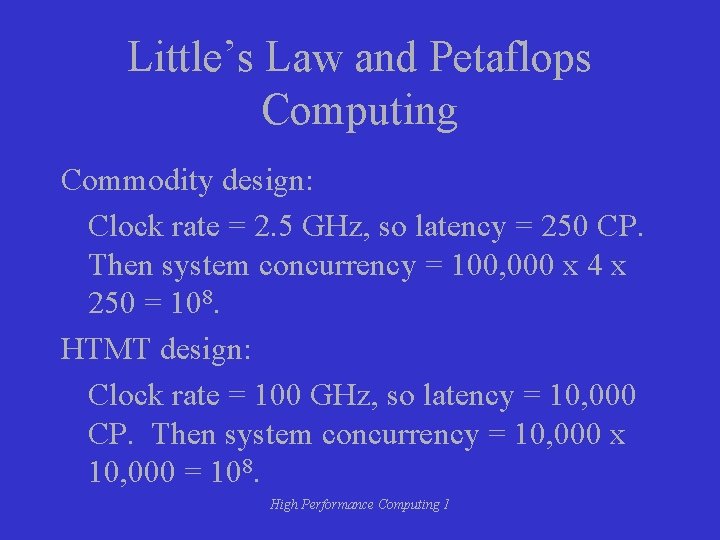
Little’s Law and Petaflops Computing Commodity design: Clock rate = 2. 5 GHz, so latency = 250 CP. Then system concurrency = 100, 000 x 4 x 250 = 108. HTMT design: Clock rate = 100 GHz, so latency = 10, 000 CP. Then system concurrency = 10, 000 x 10, 000 = 108. High Performance Computing 1
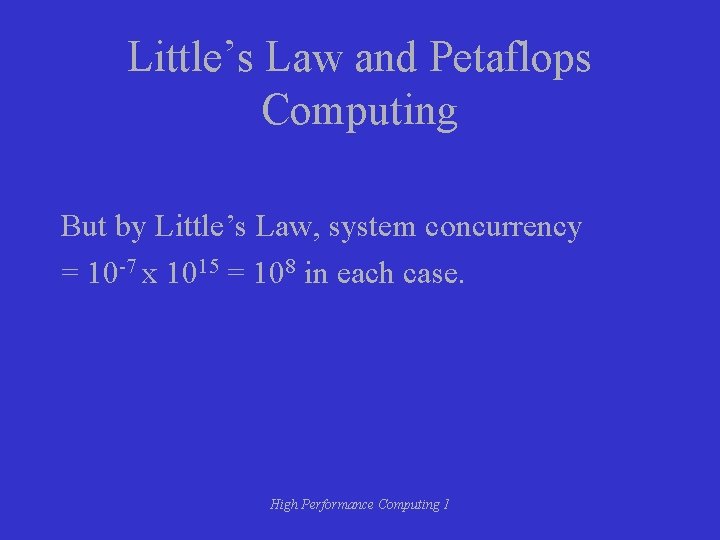
Little’s Law and Petaflops Computing But by Little’s Law, system concurrency = 10 -7 x 1015 = 108 in each case. High Performance Computing 1
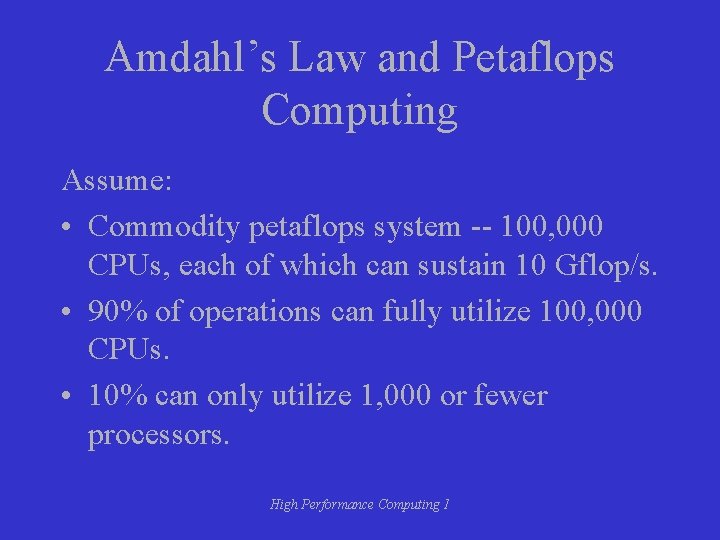
Amdahl’s Law and Petaflops Computing Assume: • Commodity petaflops system -- 100, 000 CPUs, each of which can sustain 10 Gflop/s. • 90% of operations can fully utilize 100, 000 CPUs. • 10% can only utilize 1, 000 or fewer processors. High Performance Computing 1
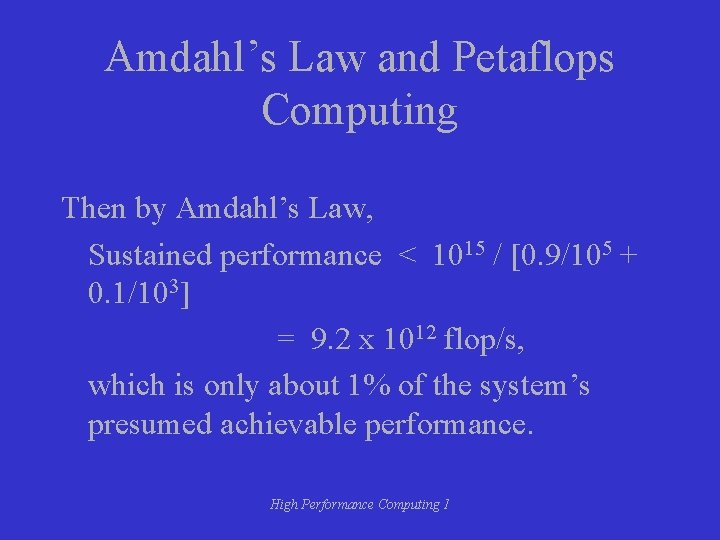
Amdahl’s Law and Petaflops Computing Then by Amdahl’s Law, Sustained performance < 1015 / [0. 9/105 + 0. 1/103] = 9. 2 x 10¹² flop/s, which is only about 1% of the system’s presumed achievable performance. High Performance Computing 1
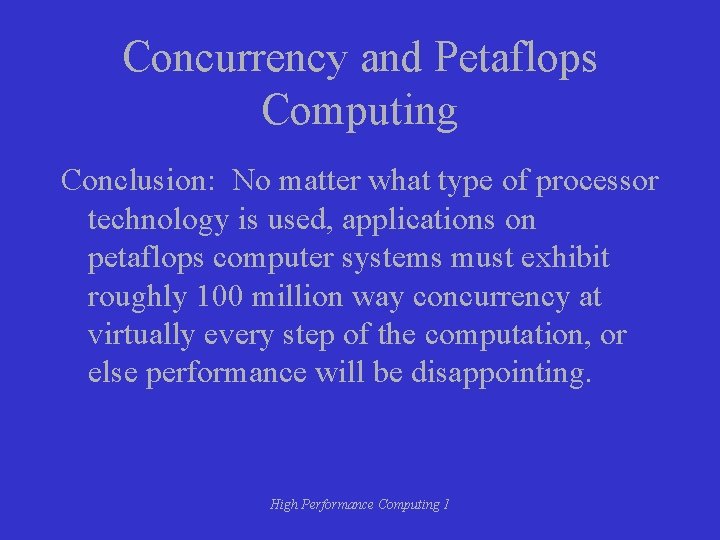
Concurrency and Petaflops Computing Conclusion: No matter what type of processor technology is used, applications on petaflops computer systems must exhibit roughly 100 million way concurrency at virtually every step of the computation, or else performance will be disappointing. High Performance Computing 1
Concurrency and Petaflops Computing • This assumes that most computations access data from local DRAM memory, with little or no cache re-use (typical of many applications). • If substantial long-distance communication is required, the concurrency requirement may be even higher! High Performance Computing 1
Concurrency and Petaflops Computing Key question: Can applications for future systems be structured to exhibit these enormous levels of concurrency? High Performance Computing 1
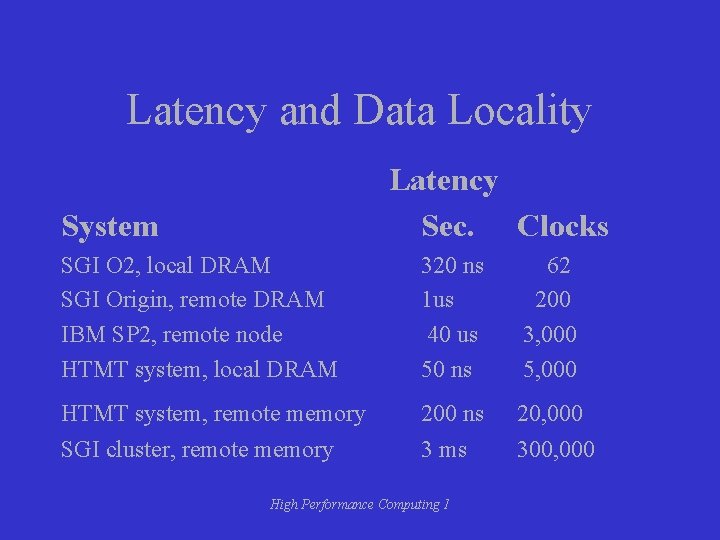
Latency and Data Locality Latency Sec. Clocks System SGI O 2, local DRAM SGI Origin, remote DRAM IBM SP 2, remote node HTMT system, local DRAM 320 ns 1 us 40 us 50 ns 62 200 3, 000 5, 000 HTMT system, remote memory 200 ns 20, 000 SGI cluster, remote memory 3 ms 300, 000 High Performance Computing 1
Algorithms and Data Locality • Can we quantify the inherent data locality of key algorithms? • Do there exist “hierarchical” variants of key algorithms? • Do there exist “latency tolerant” variants of key algorithms? • Can bandwidth-intensive algorithms be substituted for latency-sensitive algorithms? • Can Little’s Law be “beaten” by formulating algorithms that access data lower in the memory hierarchy? If so, then systems such as HTMT can be used effectively. High Performance Computing 1
Numerical Scalability For the solvers used in most of today’s codes, condition numbers of the linear systems increase linearly or quadratically with grid resolution. The number of iterations required for convergence is directly proportional to the condition number. High Performance Computing 1
Numerical Scalability Conclusions: • Solvers used in most of today’s applications are not numerically scalable. • Novel techniques, e. g. domain decomposition and multigrid, may yield fundamentally more efficient methods. High Performance Computing 1
System Performance Modeling Studies must be made of future computer system and network designs, years before they are constructed. Scalability assessments must be made of future algorithms and applications, years before they are implemented on real computers. High Performance Computing 1
System Performance Modeling Approach: • Detailed cost models derived from analysis of codes. • Statistical fits to analytic models. • Detailed system and algorithm simulations, using discrete event simulation programs. High Performance Computing 1
Hardware and Architecture Issues • Commodity technology or advanced technology? • How can the huge projected power consumption and heat dissipation requirements of future systems be brought under control? • Conventional RISC or multi-threaded processors? High Performance Computing 1
Hardware and Architecture Issues • Distributed memory or distributed shared memory? • How many levels of memory hierarchy? • How will cache coherence be handled? • What design will best manage latency and hierarchical memories? High Performance Computing 1
How Much Main Memory? • 5 -10 years ago: One word (8 byte) per sustained flop/s. • Today: One byte per sustained flop/s. • 5 -10 years from now: 1/8 byte per sustained flop/s may be adequate. High Performance Computing 1
How Much Main Memory? • 3/4 rule: For many 3 -D computational physics problems, main memory scales as d^3, while computational cost scales as d^4. However: • Advances in algorithms, such as domain decomposition and multigrid, may overturn the 3/4 rule. • Some data-intensive applications will still require one byte per flop/s or more. High Performance Computing 1
Programming Languages and Models MPI, PVM, etc. • Difficult to learn, use and debug. • Not a natural model for any notable body of applications. • Inappropriate for distributed shared memory (DSM) systems. • The software layer may be an impediment to performance. High Performance Computing 1
Programming Languages and Models HPF, HPC, etc. • Performance significantly lags behind MPI for most applications. • Inappropriate for a number of emerging applications, which feature large numbers of asynchronous tasks. High Performance Computing 1
Programming Languages and Models Java, SISAL, Linda, etc. • Each has its advocates, but none has yet proved its superiority for a large class of highly parallel scientific applications. High Performance Computing 1
Towards a Petaflops Language • High-level features for application scientists. • Low-level features for performance programmers. • Handles both data and task parallelism, and both synchronous and asynchronous tasks. • Scalable for systems with up to 1, 000 processors. High Performance Computing 1
Towards a Petaflops Language • Appropriate for parallel clusters of distributed shared memory nodes. • Permits both automatic and explicit data communication. • Designed with a hierarchical memory system in mind. • Permits the memory hierarchy to be explicitly controlled by performance programmers. High Performance Computing 1
System Software • How can tens or hundreds of thousands of processors, running possibly thousands of separate user jobs, be managed? • How can hardware and software faults be detected and rectified? • How can run-time performance phenomena be monitored? • How should the mass storage system be organized? High Performance Computing 1
System Software • How can real-time visualization be supported? Exotic techniques, such as expert systems and neural nets, may be needed to manage future systems. High Performance Computing 1
Faith, Hope and Charity Until recently, the high performance computing field was sustained by • Faith in highly parallel computing technology. • Hope that current faults will be rectified in the next generation. • Charity of federal government(s). High Performance Computing 1
Faith, Hope and Charity Results: • Numerous firms have gone out of business. • Government funding has been cut. • Many scientists and lab managers have become cynical. Where do we go from here? High Performance Computing 1
Time to Get Quantitative • Quantitative assessments of architecture scalability. • Quantitative measurements of latency and bandwidth. • Quantitative analyses of multi-level memory hierarchies. High Performance Computing 1
Time to Get Quantitative • Quantitative analyses of algorithm and application scalability. • Quantitative assessments of programming languages. • Quantitative assessments of system software and tools. High Performance Computing 1