
Challenges and Opportunities in Funding SMEs Setlakalane Molepo

- Slides: 15
Challenges and Opportunities in Funding SMEs Setlakalane Molepo Managing Director 15 October 2009 1
Table of Contents • • • Khula’s mandate Target market SMME financing landscape Why focus on SMEs Needs of SMEs General challenges facing SMEs Challenges - access to finance Opportunities for SMEs Accelerating SME funding Concluding remarks 2
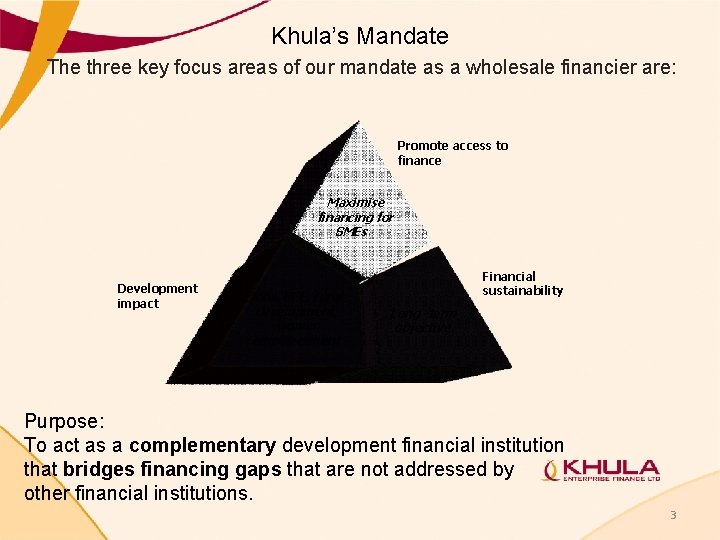
Khula’s Mandate The three key focus areas of our mandate as a wholesale financier are: Promote access to finance Maximise financing for SMEs Development impact Jobs, BEE, rural development, women empowerment Financial sustainability Long -term objective Purpose: To act as a complementary development financial institution that bridges financing gaps that are not addressed by other financial institutions. 3
Target Market • Underserved segments of the SME market; • Primarily Black-owned, owner-managed formal SMEs; • Start-up and development/expansion capital; • Bias towards underserved provinces/rural/townships; and • Loan sizes in the range of R 10, 000 -R 3 m, with particular emphasis on facilities less than R 1 m, especially <R 250, 000. 4
SMME Financing Landscape…Characteristics No. Characteristics Opportunity-driven/ Entrepreneurial • Less than 200 employees Medium enterprises 0, 1 – 0, 3 m • Turnover > R 25 m p. a. • Developed technical & business skills • Less than 50 employees Small enterprises 0, 2 – 0, 5 m • Turnover < R 25 m p. a. • Developed technical /limited business skills • Less than 5 employees Micro enterprises 0, 6 – 1, 0 m • Turnover < R 150 k p. a. • Some technical /limited business skills Necessity-driven/ Survivalist enterprises • Individual self employment • Turnover < R 50 k p. a. 0, 7 – 1, 2 m • Limited technical and business skills Total 1, 6 – 3, 0 m
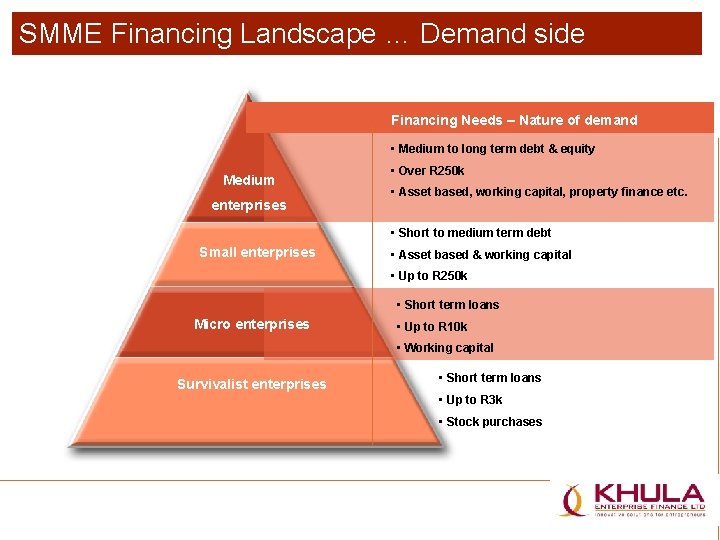
SMME Financing Landscape … Demand side Financing Needs – Nature of demand • Medium to long term debt & equity Medium enterprises • Over R 250 k • Asset based, working capital, property finance etc. • Short to medium term debt Small enterprises • Asset based & working capital • Up to R 250 k • Short term loans Micro enterprises • Up to R 10 k • Working capital Survivalist enterprises • Short term loans • Up to R 3 k • Stock purchases
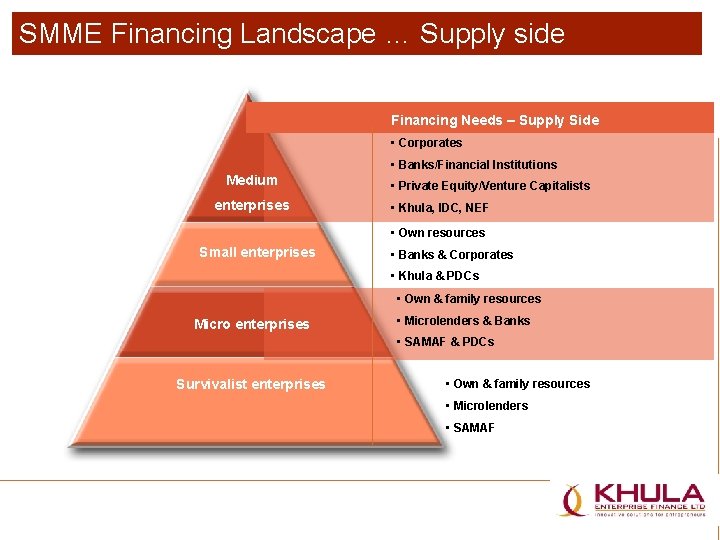
SMME Financing Landscape … Supply side Financing Needs – Supply Side • Corporates • Banks/Financial Institutions Medium enterprises • Private Equity/Venture Capitalists • Khula, IDC, NEF • Own resources Small enterprises • Banks & Corporates • Khula & PDCs • Own & family resources Micro enterprises • Microlenders & Banks • SAMAF & PDCs Survivalist enterprises • Own & family resources • Microlenders • SAMAF
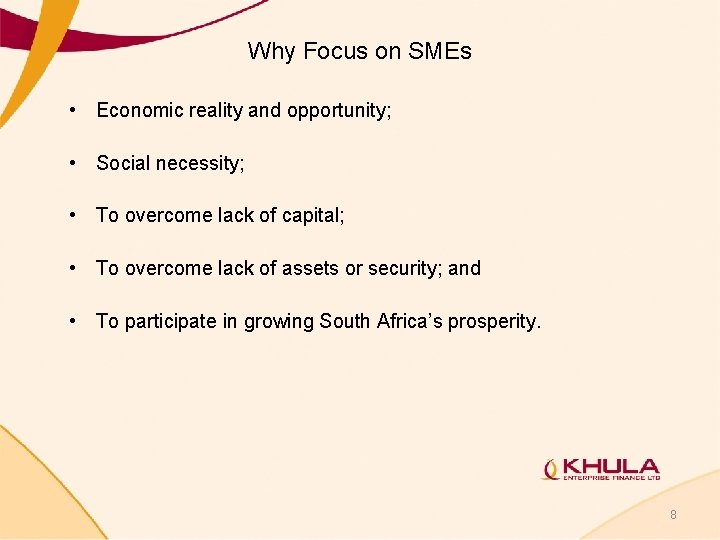
Why Focus on SMEs • Economic reality and opportunity; • Social necessity; • To overcome lack of capital; • To overcome lack of assets or security; and • To participate in growing South Africa’s prosperity. 8
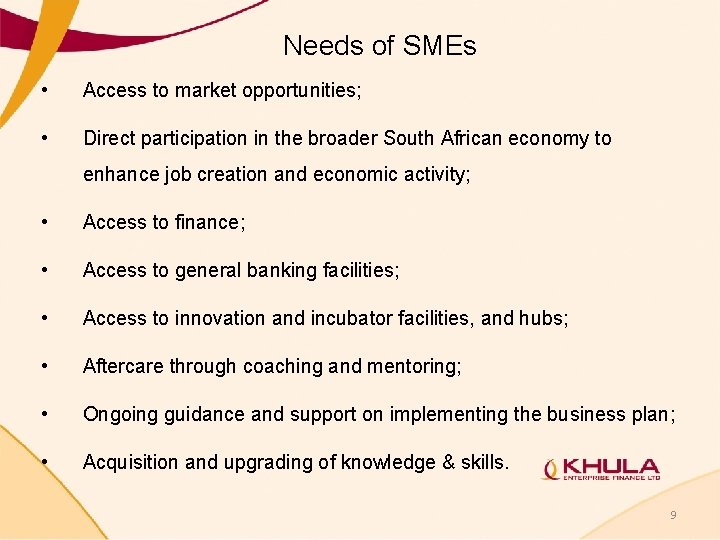
Needs of SMEs • Access to market opportunities; • Direct participation in the broader South African economy to enhance job creation and economic activity; • Access to finance; • Access to general banking facilities; • Access to innovation and incubator facilities, and hubs; • Aftercare through coaching and mentoring; • Ongoing guidance and support on implementing the business plan; • Acquisition and upgrading of knowledge & skills. 9
General Challenges Facing SMEs • Access to finance; • Access to information such as research, technology; • Barriers to markets; • Lack of recognition by big companies (as suppliers to those markets); • Capacity – expertise and resources; • Closing the “income gap”; and • Redistribution of business opportunities and wealth. 10
Challenges Related to Access to Finance • Perceived risk profile of SMEs; • Smaller loan size and cost of funding at the lower level; • Insufficient understanding of the SME landscape by lenders; • Lack of collateral in SMEs; • Information gaps in accessing other finance (other than banks); • Inadequate skills of SMEs; and • Quality of business propositions. 11
Opportunities for SMEs • Government specific policies (IPAP (NIPF)); o R 787 bn public sector Capex & Procurement programme o Procurement space (10 Key products by Government); • Broad Based Black Empowerment; • Other government’s initiatives to increase SME participation in the economy (APDP, CSDP). 12
Accelerating SME Funding - Recommendations • Deepen and integrate the financial services sector’s systems, services and infrastructure; • Monitor to ensure that the reviewed legal and regulatory framework supports SME development fully; • Build institutional capacity for supervision and monitoring and enforcement of SME regulations and general business-related laws; • Invest in rural infrastructure such as communication technology and transport which would attract funders to locate to remote areas; and • Embrace and adapt new information technologies in order to reduce transaction costs. 13
Concluding Remarks • SMEs are still facing challenges due to slow recovery; • Scaling-up of interventions by the DFIs and commercial banks; • Renewed focus on SMEs by the public sector; • Broadening and differentiation of product offering; • Better co-operation amongst DFIs; and • Increase awareness of official programmes (banks, DFIs, and other stakeholders that support). 14
Thank You 08600 54852 helpline@khula. org. za www. khula. org. za 15