
Challenges and Opportunities in Digital Infrastructure at DOE
- Slides: 28
Challenges and Opportunities in Digital Infrastructure at DOE User Facilities David Skinner National Energy Research Scientific Computing (NERSC) Office of Science
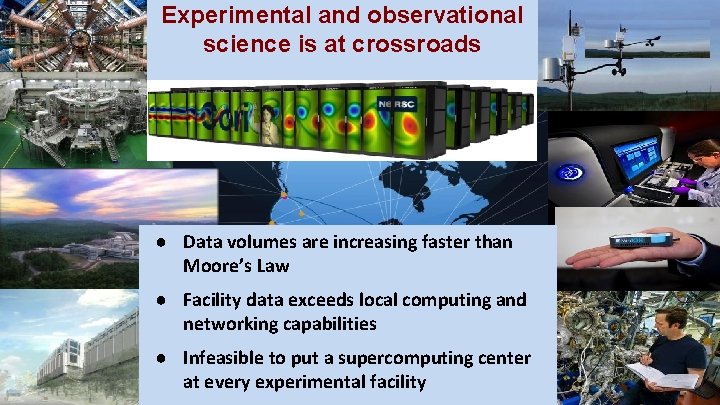
Experimental and observational science is at crossroads ● Data volumes are increasing faster than Moore’s Law ● Facility data exceeds local computing and networking capabilities ● Infeasible to put a supercomputing center Office of at every experimental 2 facility Science
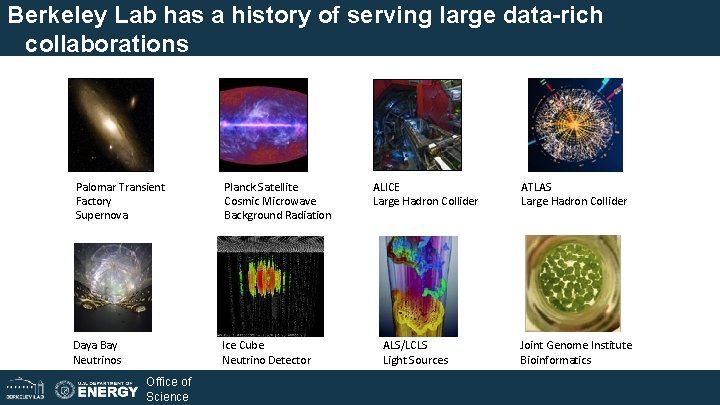
Berkeley Lab has a history of serving large data-rich collaborations Palomar Transient Factory Supernova Planck Satellite Cosmic Microwave Background Radiation Daya Bay Neutrinos Ice Cube Neutrino Detector Office of Science ALICE Large Hadron Collider ALS/LCLS Light Sources ATLAS Large Hadron Collider Joint Genome Institute Bioinformatics
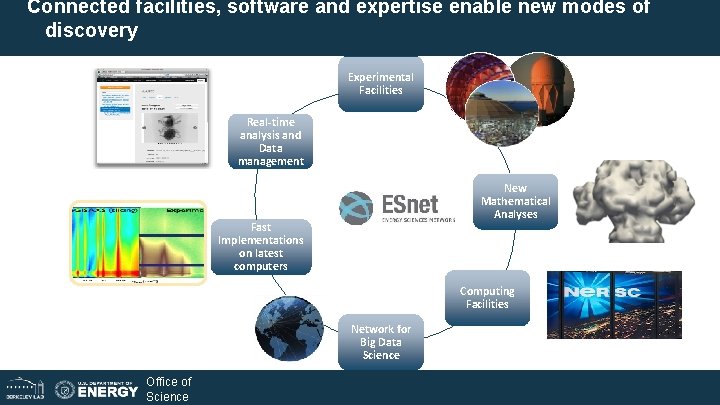
Connected facilities, software and expertise enable new modes of discovery Experimental Facilities Real-time analysis and Data management New Mathematical Analyses Fast Implementations on latest computers Computing Facilities Network for Big Data Science Office of Science
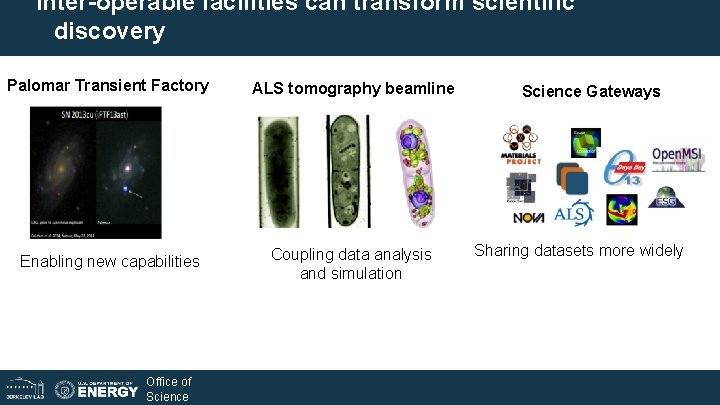
Inter-operable facilities can transform scientific discovery Palomar Transient Factory ALS tomography beamline Enabling new capabilities Coupling data analysis and simulation Office of Science Gateways Sharing datasets more widely
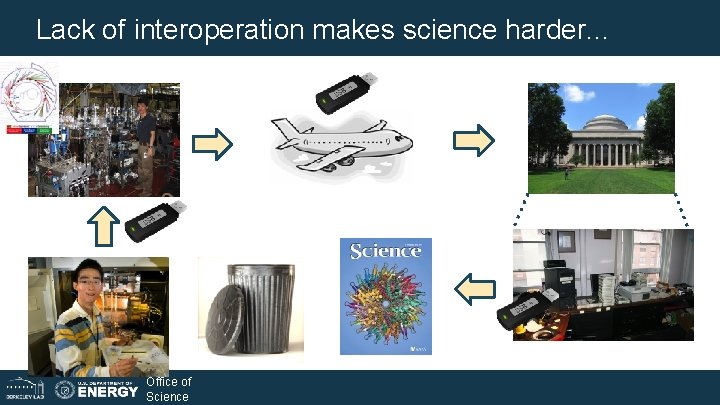
Lack of interoperation makes science harder. . . Office of Science
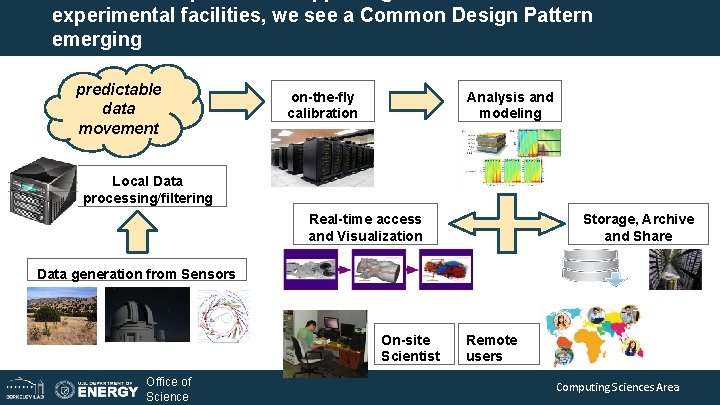
experimental facilities, we see a Common Design Pattern emerging predictable data movement on-the-fly calibration Analysis and modeling Local Data processing/filtering Real-time access and Visualization Storage, Archive and Share Data generation from Sensors On-site Scientist Office of Science Remote users Computing Sciences Area
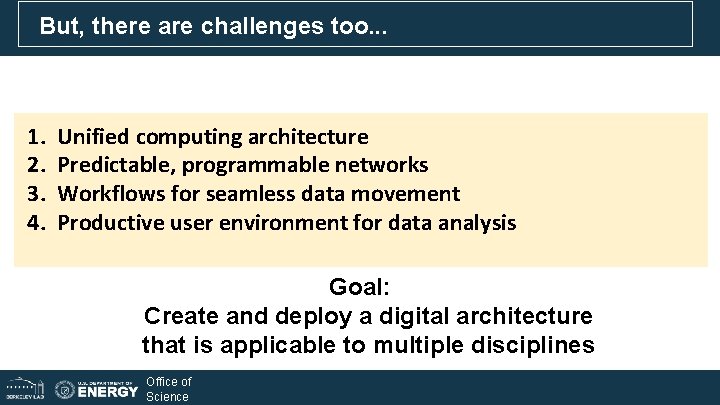
But, there are challenges too. . . 1. 2. 3. 4. Unified computing architecture Predictable, programmable networks Workflows for seamless data movement Productive user environment for data analysis Goal: Create and deploy a digital architecture that is applicable to multiple disciplines Office of Science
Challenge #1: A unified architecture for data analysis and simulation and modeling Office of Science
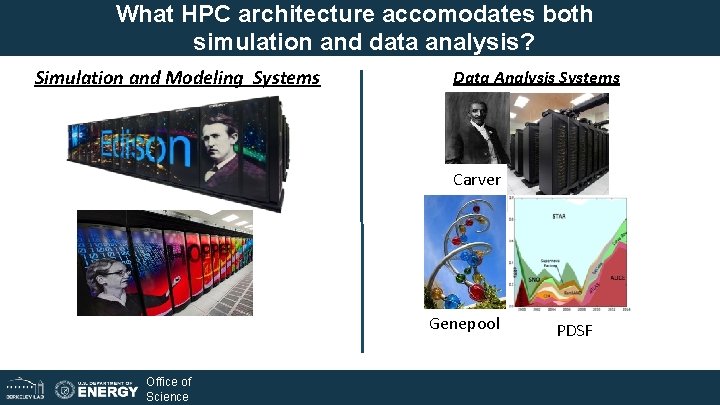
What HPC architecture accomodates both simulation and data analysis? Simulation and Modeling Systems Data Analysis Systems Carver Genepool Office of Science PDSF
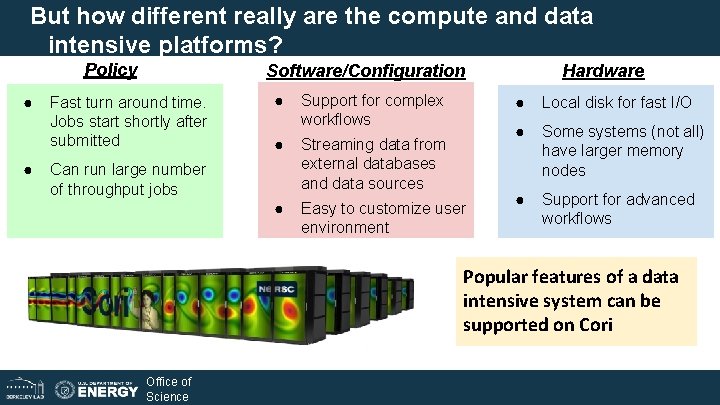
But how different really are the compute and data intensive platforms? Policy ● ● Software/Configuration Fast turn around time. Jobs start shortly after submitted ● Support for complex workflows ● Streaming data from external databases and data sources ● Easy to customize user environment Can run large number of throughput jobs Hardware ● Local disk for fast I/O ● Some systems (not all) have larger memory nodes ● Support for advanced workflows Popular features of a data intensive system can be supported on Cori Office of Science
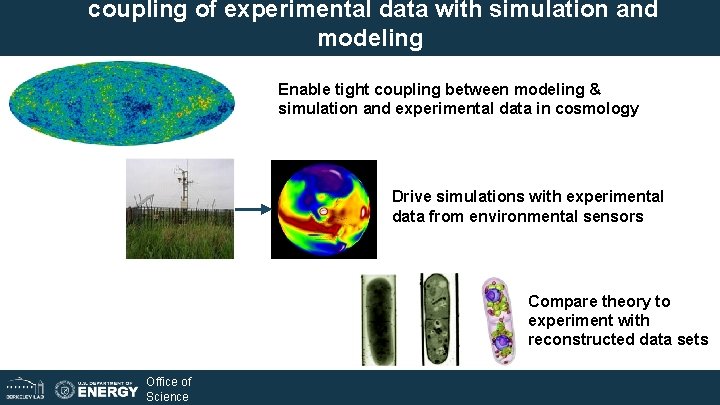
coupling of experimental data with simulation and modeling Enable tight coupling between modeling & simulation and experimental data in cosmology Drive simulations with experimental data from environmental sensors Compare theory to experiment with reconstructed data sets Office of Science
Challenge #2: A predictable and programmable network environment supporting science applications Office of Science
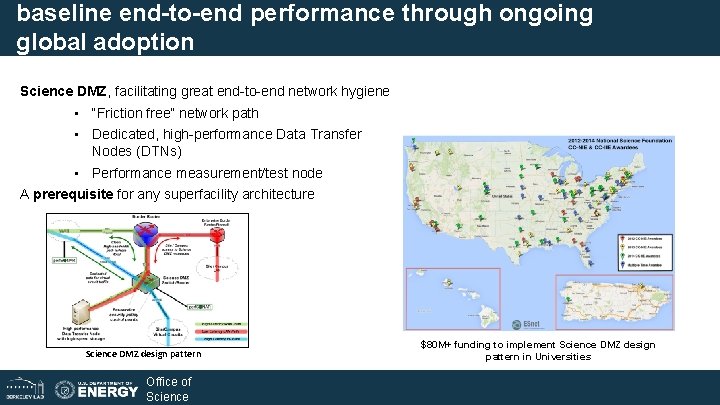
baseline end-to-end performance through ongoing global adoption Science DMZ, facilitating great end-to-end network hygiene • “Friction free” network path • Dedicated, high-performance Data Transfer Nodes (DTNs) • Performance measurement/test node A prerequisite for any superfacility architecture Science DMZ design pattern Office of Science $80 M+ funding to implement Science DMZ design pattern in Universities
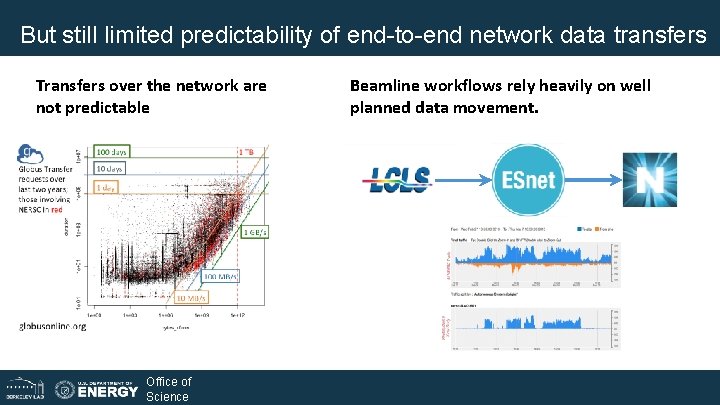
But still limited predictability of end-to-end network data transfers Transfers over the network are not predictable Office of Science Beamline workflows rely heavily on well planned data movement.
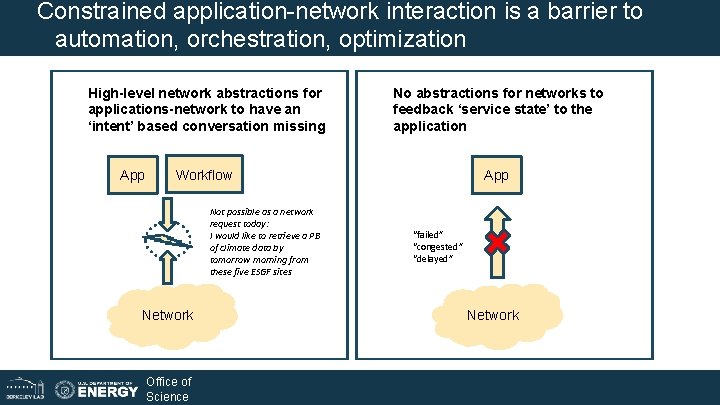
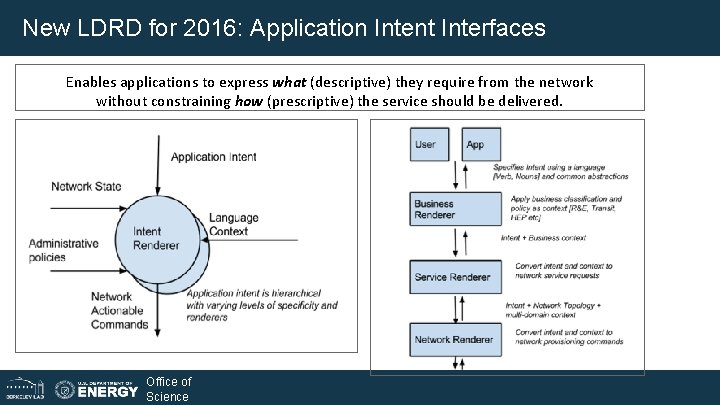
Constrained application-network interaction is a barrier to automation, orchestration, optimization High-level network abstractions for applications-network to have an ‘intent’ based conversation missing No abstractions for networks to feedback ‘service state’ to the application Workflow App Not possible as a network request today: I would like to retrieve a PB of climate data by tomorrow morning from these five ESGF sites Network Office of Science “failed” “congested” “delayed” Network
New LDRD for 2016: Application Intent Interfaces Enables applications to express what (descriptive) they require from the network without constraining how (prescriptive) the service should be delivered. Office of Science
Challenge #3: Supporting workflows that allow seamless data movement from experiment, to analysis and data curation Office of Science
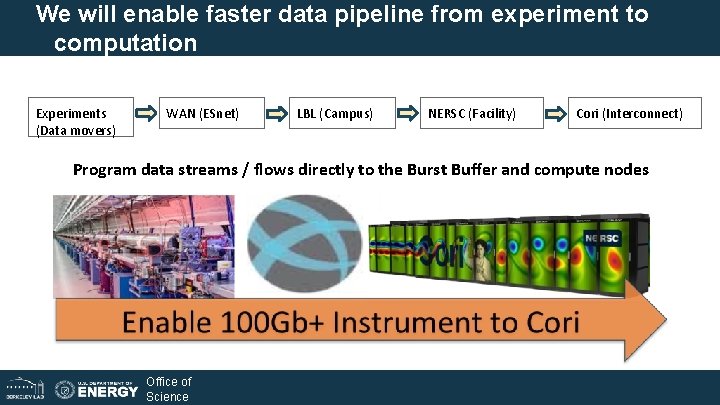
We will enable faster data pipeline from experiment to computation Experiments (Data movers) WAN (ESnet) LBL (Campus) NERSC (Facility) Cori (Interconnect) Program data streams / flows directly to the Burst Buffer and compute nodes Office of Science
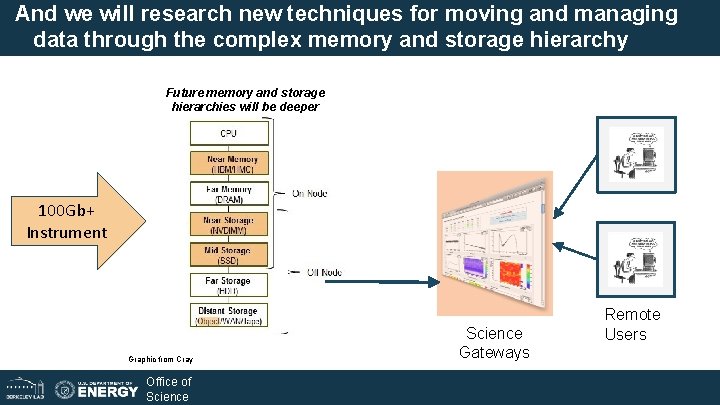
And we will research new techniques for moving and managing data through the complex memory and storage hierarchy Future memory and storage hierarchies will be deeper 100 Gb+ Instrument Graphic from Cray Office of Science Gateways Remote Users
Challenge #4: Creating a productive software environment for data analysis Office of Science
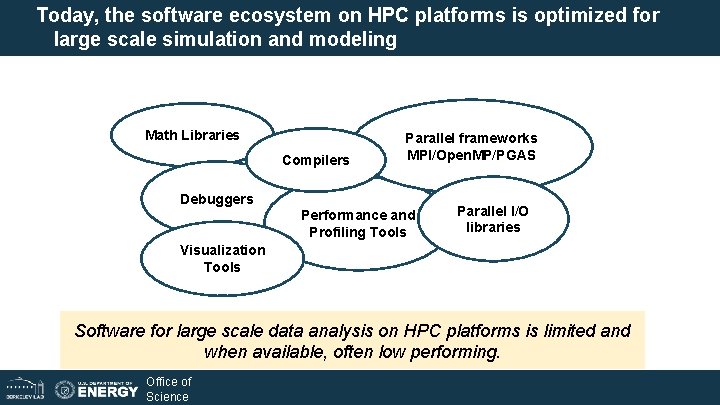
Today, the software ecosystem on HPC platforms is optimized for large scale simulation and modeling Math Libraries Compilers Parallel frameworks MPI/Open. MP/PGAS Debuggers Performance and Profiling Tools Parallel I/O libraries Visualization Tools Software for large scale data analysis on HPC platforms is limited and when available, often low performing. Office of Science
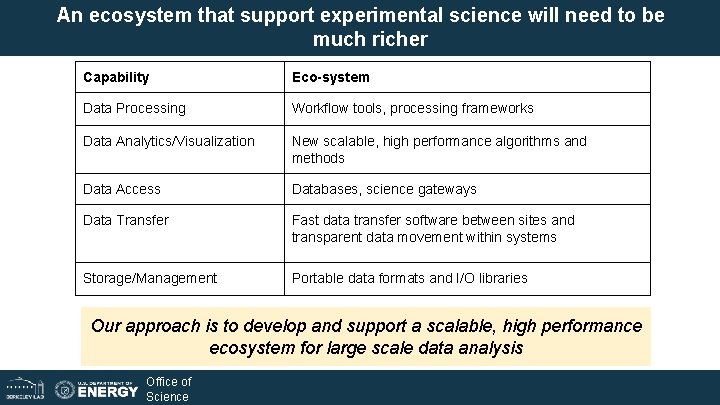
An ecosystem that support experimental science will need to be much richer Capability Eco-system Data Processing Workflow tools, processing frameworks Data Analytics/Visualization New scalable, high performance algorithms and methods Data Access Databases, science gateways Data Transfer Fast data transfer software between sites and transparent data movement within systems Storage/Management Portable data formats and I/O libraries Our approach is to develop and support a scalable, high performance ecosystem for large scale data analysis Office of Science
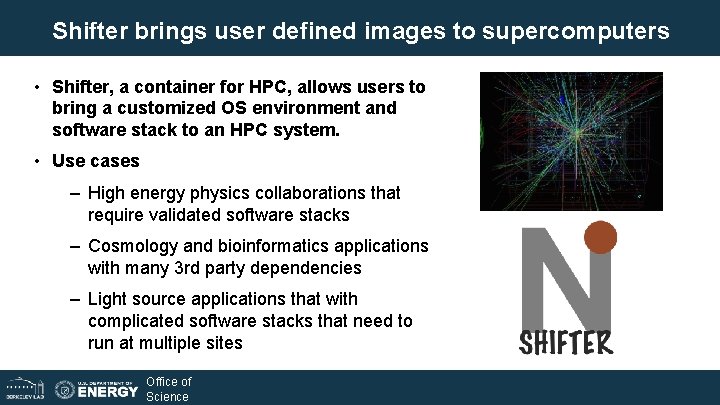
Shifter brings user defined images to supercomputers • Shifter, a container for HPC, allows users to bring a customized OS environment and software stack to an HPC system. • Use cases – High energy physics collaborations that require validated software stacks – Cosmology and bioinformatics applications with many 3 rd party dependencies – Light source applications that with complicated software stacks that need to run at multiple sites Office of Science
DOE user facilities will need to evolve dramatically • New focus on time-sensitive applications, rather than system utilization • Science Engagement i. e. meaningful interaction with scientists will become even more important • Definition of ‘users’ will need to change for example to include another user facility • Coordinated user support across facilities will need to be scaled and responsibilities articulated • Orchestration across facilities will need to be coordinated at multiple levels, from resources to outages. Office of Science
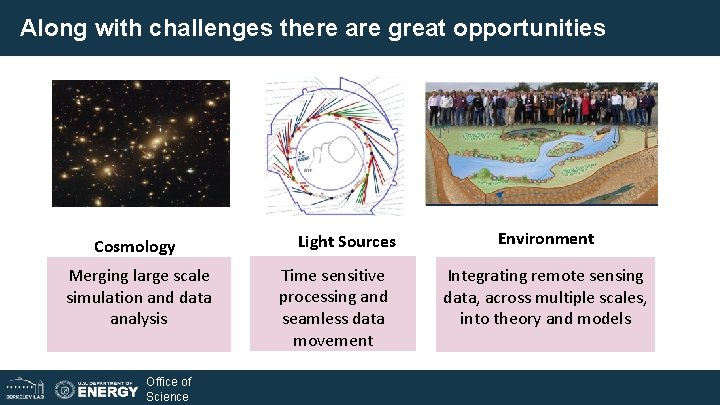
Along with challenges there are great opportunities Cosmology Merging large scale simulation and data analysis Office of Science Light Sources Time sensitive processing and seamless data movement Environment Integrating remote sensing data, across multiple scales, into theory and models
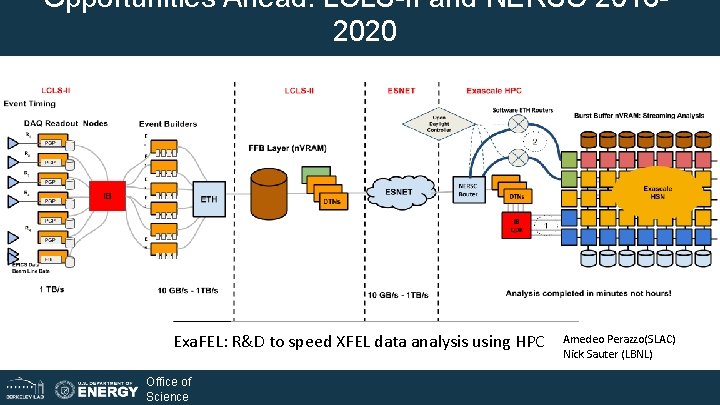
Opportunities Ahead: LCLS-II and NERSC 20162020 Exa. FEL: R&D to speed XFEL data analysis using HPC Office of Science Amedeo Perazzo(SLAC) Nick Sauter (LBNL)
Thanks! deskinner@lbl. gov Office of Science