
Challenges and opportunities in Bridging the Grand Challenges
Challenges and opportunities in Bridging the Grand Challenges : The Malaysian Experience Prof Dato’ Dr Asma Ismail, FASc Vice-President Academy of Science Malaysia Vice-Chancellor, Universiti Sains Islam Malaysia And Professor, Institute for Research in Molecular Medicine Universiti Sains Malaysia
Political will • There is a need for political will to bridge the Grand challenge – Political will provides the funding in order for researchers to find the solutions, develop the solutions, evaluate the solution and when feasible, implement the solutions, study the impact and outcomes of the solutions – Ensures the necessary policies are in place – Identifies the government agencies responsible to implement the solution and determine the success of the deliverables
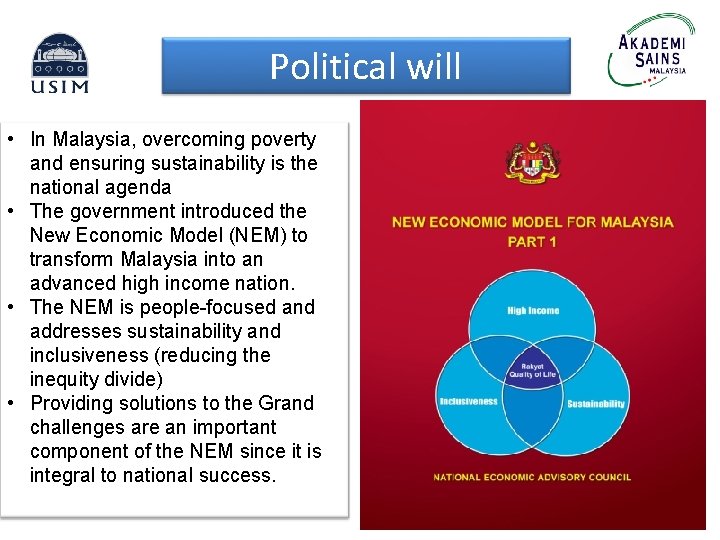
Political will • In Malaysia, overcoming poverty and ensuring sustainability is the national agenda • The government introduced the New Economic Model (NEM) to transform Malaysia into an advanced high income nation. • The NEM is people-focused and addresses sustainability and inclusiveness (reducing the inequity divide) • Providing solutions to the Grand challenges are an important component of the NEM since it is integral to national success.
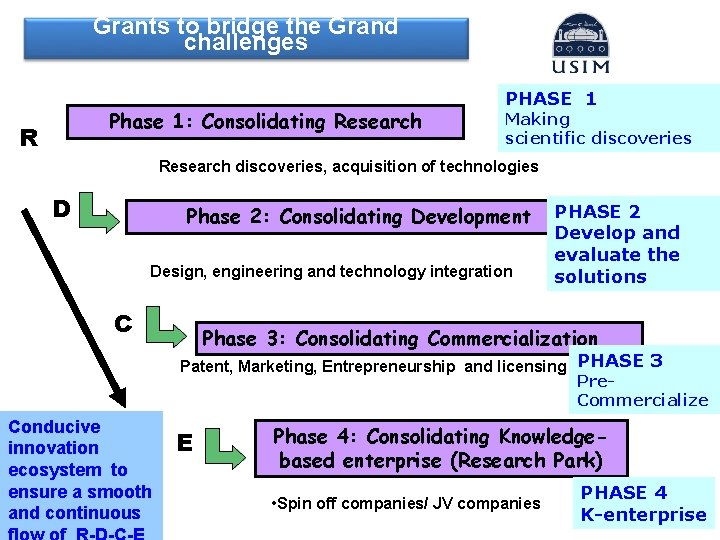
Grants to bridge the Grand challenges Phase 1: Consolidating Research R PHASE 1 Making scientific discoveries Research discoveries, acquisition of technologies D Phase 2: Consolidating Development Design, engineering and technology integration C PHASE 2 Develop and evaluate the solutions Phase 3: Consolidating Commercialization Patent, Marketing, Entrepreneurship and licensing PHASE 3 Pre. Commercialize Conducive innovation ecosystem to ensure a smooth and continuous E Phase 4: Consolidating Knowledgebased enterprise (Research Park) • Spin off companies/ JV companies PHASE 4 K-enterprise
Being realistic • Despite the political will and the grants provided, its not easy to bridge the grand challenge successfully. • There is a need to provide solutions that can create a sustainable change in society. • The solution must also be commercially viable so that it can be accessible to the world market to touch base with the people who need it most • To be commercially viable would require researchers to be innovative, creative with entrepreneurial and pioneering mindset • Bottom line, there is a need to get the buy-in from the scientists and researchers and the stakeholders (NGO, industry, other ministries/agencies, community) to work in a multidisciplinary manner to move the agenda.

Getting the buy-in from researchers R&I challenge: Stop playing catching up and turn around the way we do research • Address the needs of the 5 billion people on the planet living below poverty line including those below poverty line in Malaysia • Concentrate on research outcomes and technology development that will reduce inequity and enhance sustainability that includes availability, affordability, Nurture action-oriented accessibility, appropriateness and quality of our innovations to those who need it research leaders most Blue Ocean Strategy Providing Local Solutions to Answer Global Problems Balance Impact with Impact factor who are able to provide • Undergo real world experiences via sustainable solutions community engagement to transfer Rich for humanity to use. solutions and know-how that ensure 2. 6 billion Bottom Billions 5 billion sustainability of change • Political will via Knowledge Transfer Grants to evaluate feasibility • Brains to business to humanity
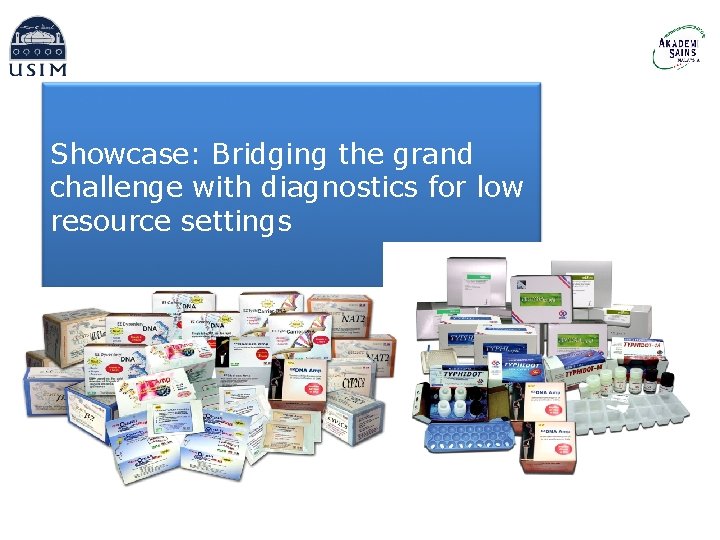
Showcase: Bridging the grand challenge with diagnostics for low resource settings
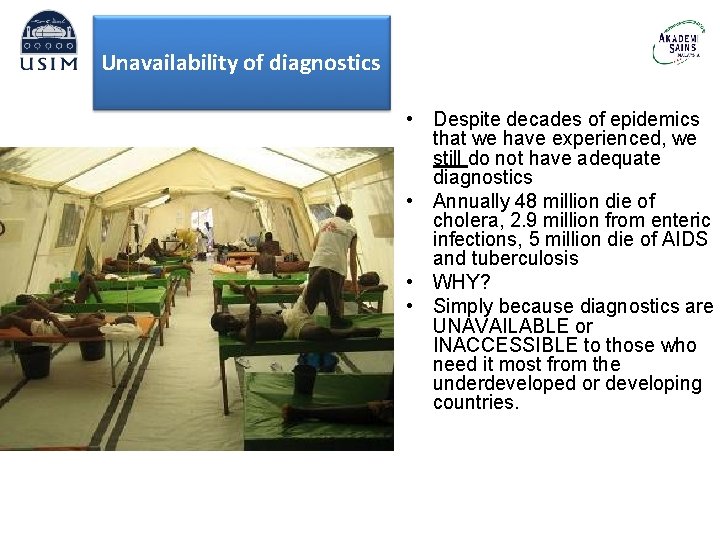
Unavailability of diagnostics • Despite decades of epidemics that we have experienced, we still do not have adequate diagnostics • Annually 48 million die of cholera, 2. 9 million from enteric infections, 5 million die of AIDS and tuberculosis • WHY? • Simply because diagnostics are UNAVAILABLE or INACCESSIBLE to those who need it most from the underdeveloped or developing countries.
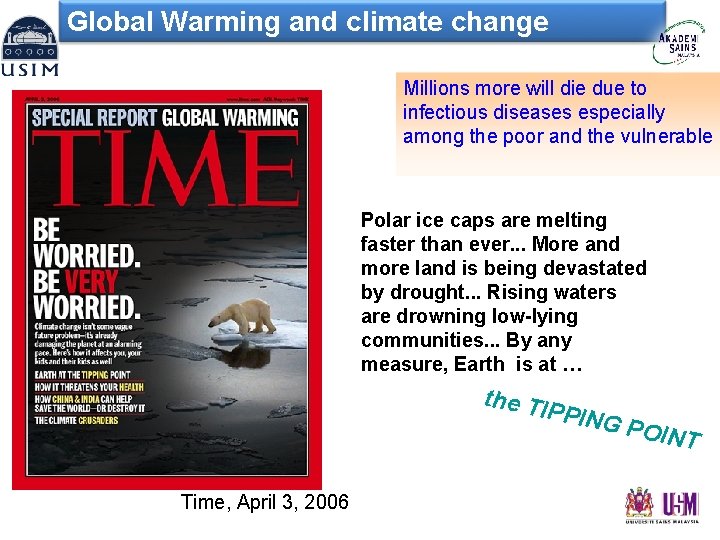
Global Warming and climate change Millions more will die due to infectious diseases especially among the poor and the vulnerable Polar ice caps are melting faster than ever. . . More and more land is being devastated by drought. . . Rising waters are drowning low-lying communities. . . By any measure, Earth is at … the TI PPING Time, April 3, 2006 POIN T
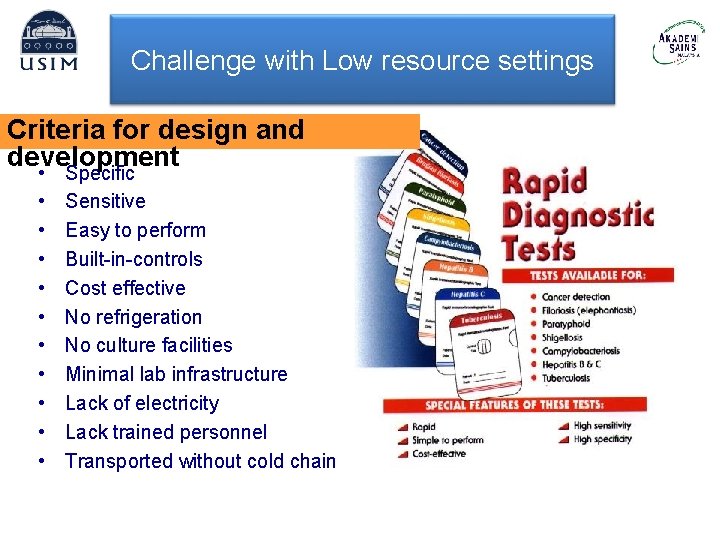
Challenge with Low resource settings Criteria for design and development • Specific • • • Sensitive Easy to perform Built-in-controls Cost effective No refrigeration No culture facilities Minimal lab infrastructure Lack of electricity Lack trained personnel Transported without cold chain
Implications of Low resource settings • Companies are Not interested to develop diagnostics for a market that could not afford to pay • There is a need to reduce the inequity divide. • Bridging the Grand challenge with molecular Diagnostics to be made available and accessible to those who need it most – Creation of thermostable low cost PCR based tests – Creation of low cost point-of-care dipsticks for both protein and DNA based tests – Future: creating non-PCR DNA based tests that can be used directly in the field.
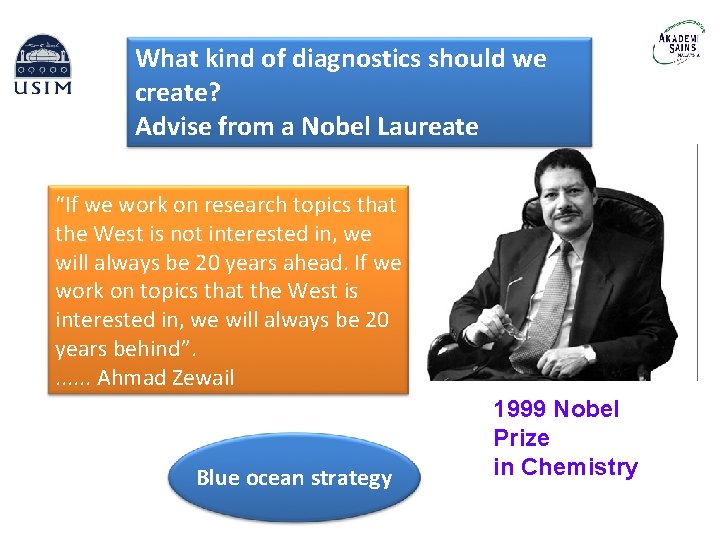
What kind of diagnostics should we create? Advise from a Nobel Laureate “If we work on research topics that the West is not interested in, we will always be 20 years ahead. If we work on topics that the West is interested in, we will always be 20 years behind”. . . . Ahmad Zewail Blue ocean strategy 1999 Nobel Prize in Chemistry
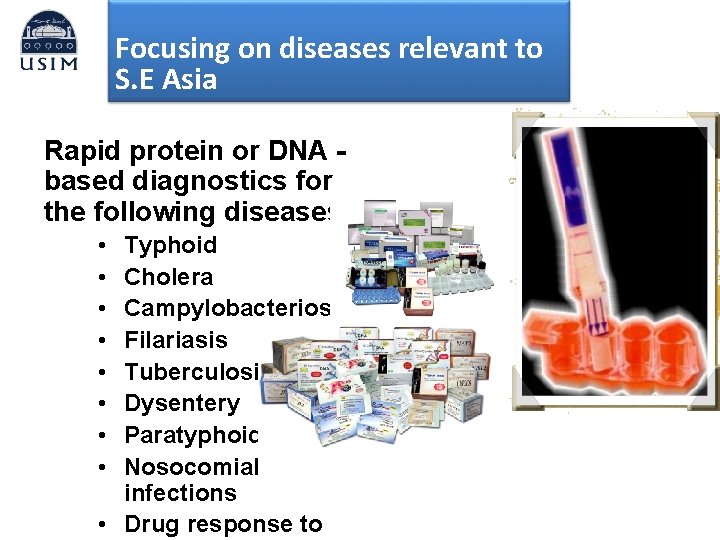
Focusing on diseases relevant to S. E Asia Rapid protein or DNA based diagnostics for the following diseases • • Typhoid Cholera Campylobacteriosis Filariasis Tuberculosis Dysentery Paratyphoid Nosocomial infections • Drug response to
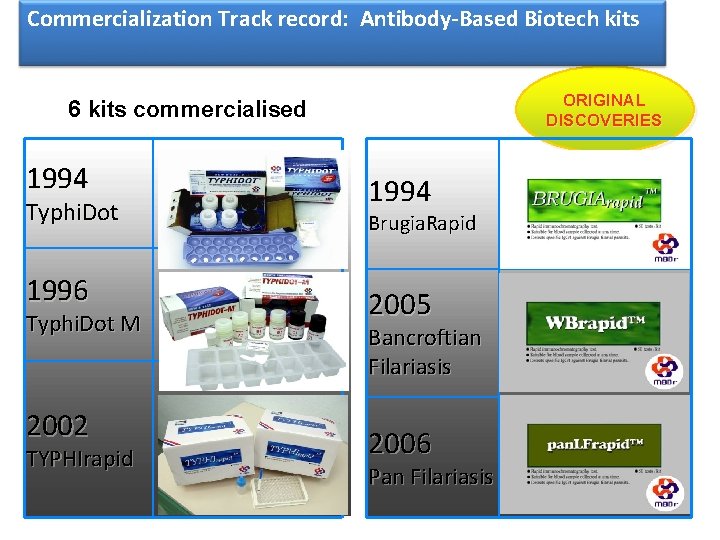
Commercialization Track record: Antibody-Based Biotech kits ORIGINAL DISCOVERIES 6 kits commercialised 1994 Typhi. Dot 1996 Typhi. Dot M 2002 TYPHIrapid 1994 Brugia. Rapid 2005 Bancroftian Filariasis 2006 Pan Filariasis
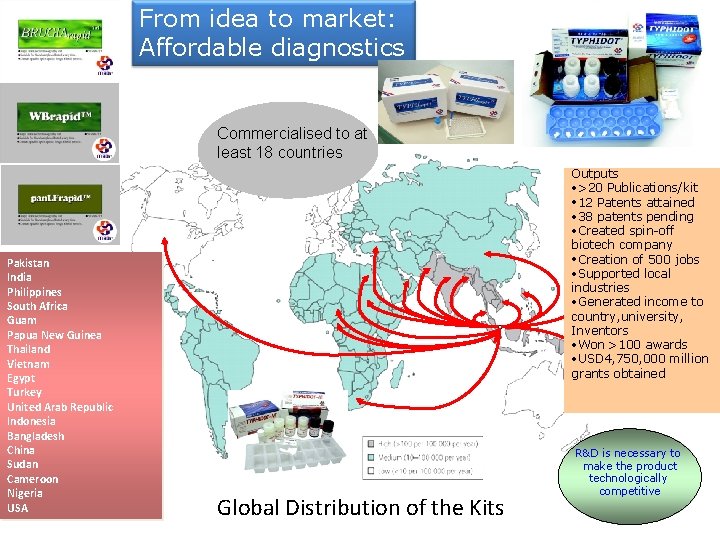
From idea to market: Affordable diagnostics Commercialised to at least 18 countries Pakistan India Philippines South Africa Guam Papua New Guinea Thailand Vietnam Egypt Turkey United Arab Republic Indonesia Bangladesh China Sudan Cameroon Nigeria USA Outputs • >20 Publications/kit • 12 Patents attained • 38 patents pending • Created spin-off biotech company • Creation of 500 jobs • Supported local industries • Generated income to country, university, Inventors • Won >100 awards • USD 4, 750, 000 million grants obtained Global Distribution of the Kits R&D is necessary to make the product technologically competitive
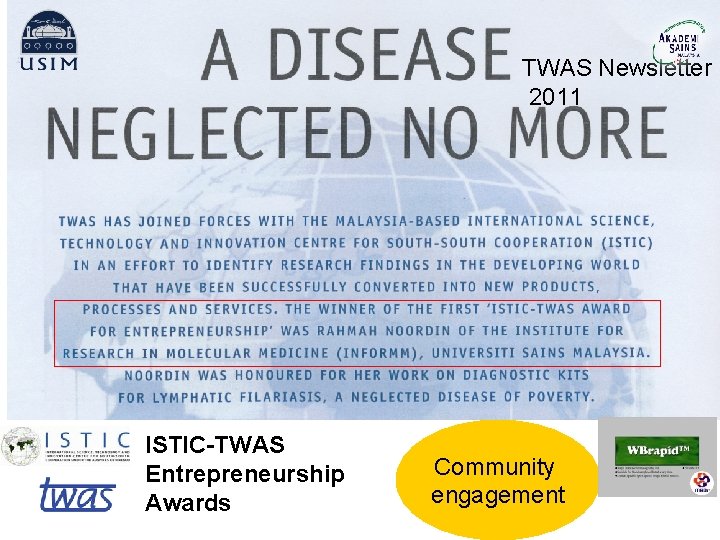
TWAS Newsletter 2011 ISTIC-TWAS Entrepreneurship Awards Community engagement
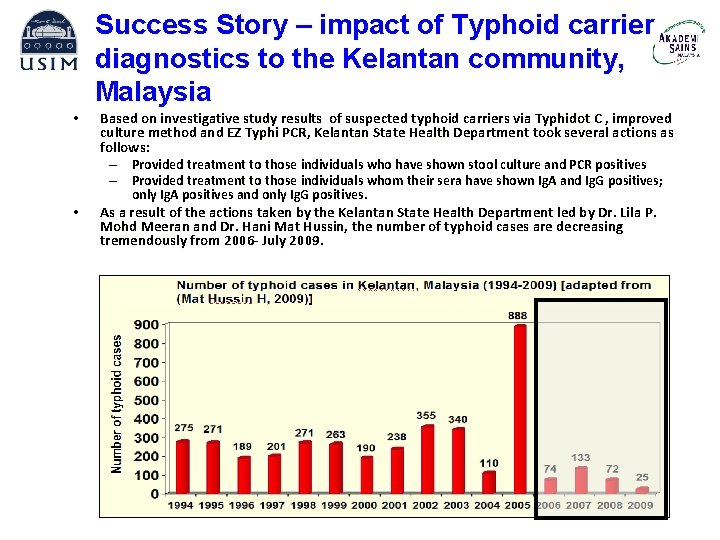
Success Story – impact of Typhoid carrier diagnostics to the Kelantan community, Malaysia • • Based on investigative study results of suspected typhoid carriers via Typhidot C , improved culture method and EZ Typhi PCR, Kelantan State Health Department took several actions as follows: – Provided treatment to those individuals who have shown stool culture and PCR positives – Provided treatment to those individuals whom their sera have shown Ig. A and Ig. G positives; only Ig. A positives and only Ig. G positives. As a result of the actions taken by the Kelantan State Health Department led by Dr. Lila P. Mohd Meeran and Dr. Hani Mat Hussin, the number of typhoid cases are decreasing tremendously from 2006 - July 2009.
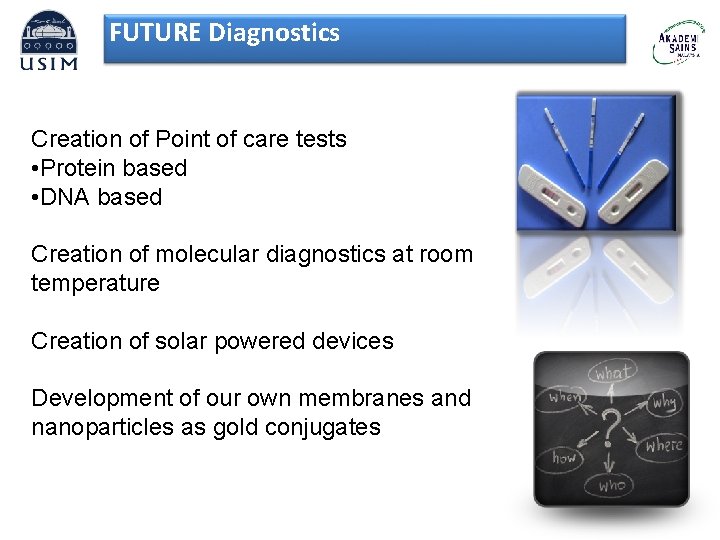
FUTURE Diagnostics Creation of Point of care tests • Protein based • DNA based Creation of molecular diagnostics at room temperature Creation of solar powered devices Development of our own membranes and nanoparticles as gold conjugates
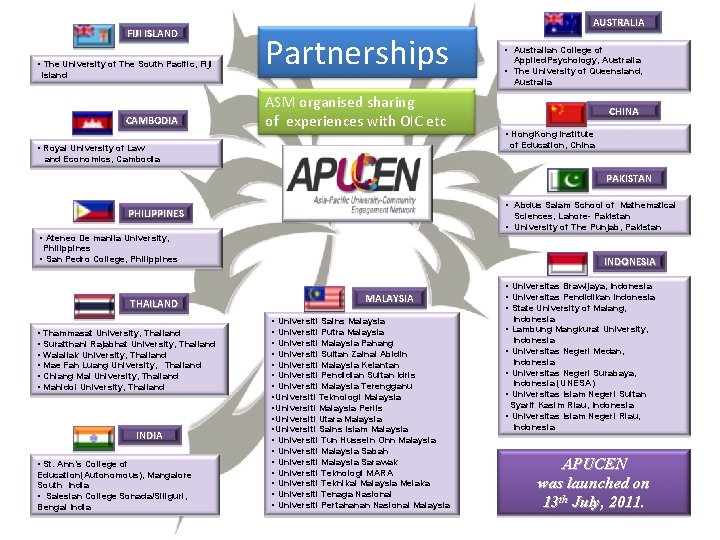
FIJI ISLAND • The University of The South Pacific, Fiji Island AUSTRALIA Partnerships • Australian College of Applied. Psychology, Australia • The University of Queensland, Australia CAMBODIA ASM organised sharing of experiences with OIC etc CHINA • Hong. Kong Institute of Education, China • Royal University of Law and Economics, Cambodia PAKISTAN • Abdus Salam School of Mathematical PHILIPPINES Sciences, Lahore- Pakistan • University of The Punjab, Pakistan • Ateneo De manila University, Philippines • San Pedro College, Philippines THAILAND • Thammasat University, Thailand • Suratthani Rajabhat University, Thailand • Walailak University, Thailand • Mae Fah Luang University, Thailand • Chiang Mai University, Thailand • Mahidol University, Thailand INDIA • St. Ann’s College of Education(Autonomous), Mangalore South India • Salesian College Sonada/Siliguri, Bengal India INDONESIA MALAYSIA • Universiti Sains Malaysia • Universiti Putra Malaysia • Universiti Malaysia Pahang • Universiti Sultan Zainal Abidin • Universiti Malaysia Kelantan • Universiti Pendidian Sultan Idris • Universiti Malaysia Terengganu • Universiti Teknologi Malaysia • Universiti Malaysia Perlis • Universiti Utara Malaysia • Universiti Sains Islam Malaysia • Universiti Tun Hussein Onn Malaysia • Universiti Malaysia Sabah • Universiti Malaysia Sarawak • Universiti Teknologi MARA • Universiti Teknikal Malaysia Melaka • Universiti Tenaga Nasional • Universiti Pertahanan Nasional Malaysia • Universitas Brawijaya, Indonesia • Universitas Pendidikan Indonesia • State University of Malang, Indonesia • Lambung Mangkurat University, Indonesia • Universitas Negeri Medan, Indonesia • Universitas Negeri Surabaya, Indonesia (UNESA) • Universitas Islam Negeri Sultan Syarif Kasim Riau, Indonesia • Universitas Islam Negeri Riau, Indonesia APUCEN was launched on 13 th July, 2011.
Bridging the Grand challenge The future is not about where we are going but what we are creating Thank you asma. ismail@usim. edu. my
- Slides: 20