
Challenges and Opportunities for Building Bridges Between Community
Challenges and Opportunities for Building Bridges Between Community Colleges and Adult Schools (Part 2) Friday, May 4, 2018 – ASCCC Noncredit and Career Institute Dr. Sofia Ramirez Gelpi, Hancock College AEBG Project Director and Consortium Co-Lead
Purpose This panel will discuss effective practices for collaboration between colleges and adult schools. Strategies, activities, and practices will be explored and discussed.
What Went On? Due to AEBG, community colleges and adult schools had to learn to work together to improve or increase: • Literacy, proficiency, or gains skills. • Number of adults completing a HS diploma or recognized equivalent. • Number of completed postsecondary certificates, degrees, or training programs. • Number of adults placed into a job. • Number of adults who saw improved wages.
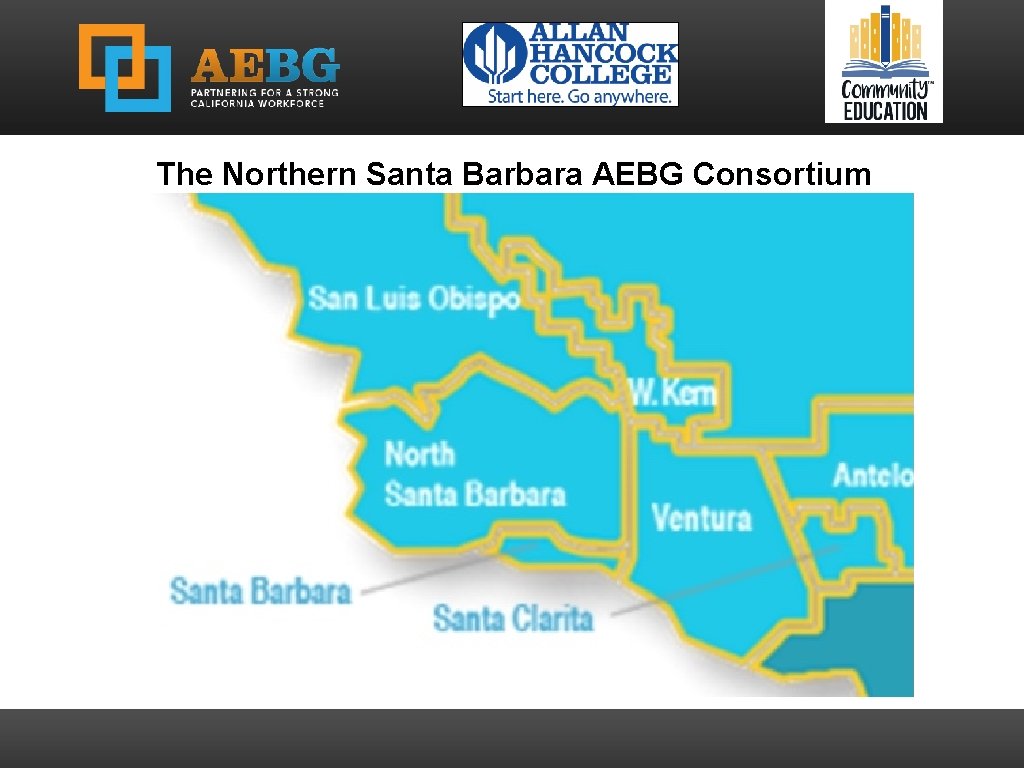
The Northern Santa Barbara AEBG Consortium
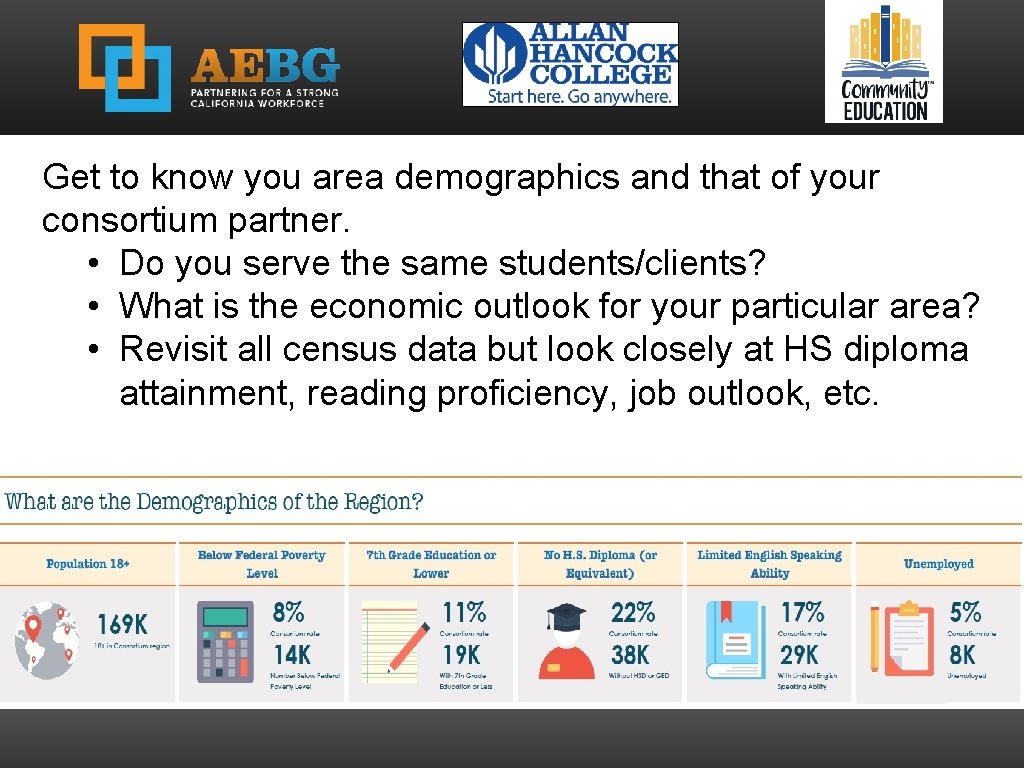
Get to know you area demographics and that of your consortium partner. • Do you serve the same students/clients? • What is the economic outlook for your particular area? • Revisit all census data but look closely at HS diploma attainment, reading proficiency, job outlook, etc.
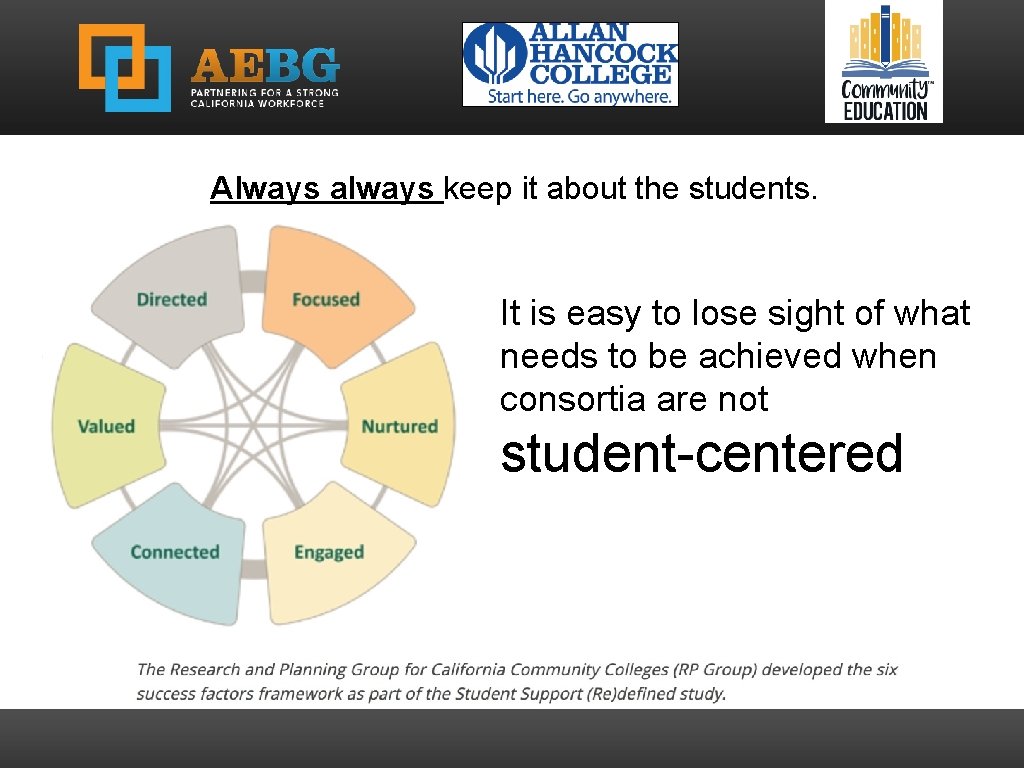
Always always keep it about the students. It is easy to lose sight of what needs to be achieved when consortia are not student-centered
Get to know the programs of your consortium partners but first, there has to be honest : • • What do you offer? What do you not? Why don’t you offer it? Which are your strong programs? Which are weak? Do you offer wrap-around services? Only through this process can you have a conversation about how you strengthen each other.
Training, Workshops, Sessions, Meetings, Retreats… No matter what you call it, always make time for Professional Development opportunities. There is synergy when community colleges and adult ed schools meet together to discuss how to achieve student success. Think innovation, creativity, proactivity, re-energy.
Consider developing articulation agreements. Consider developing curriculum alignment projects. Build your “Rosetta Stone” and share it far and wide (but definitely share it with counselors). Avoid duplication and competition. Upscale on the notion of mirrored courses to develop mirrored enrollment. Create clear pathways for the students. Provide students with the tools to seamlessly move from an adult ed program to a credit or noncredit program at a community college.
WORK SMART, NOT HARD If your partner already offers CTE programs, find synergy points. CTE programs require expensive equipment, specific supplies, meet ratios, address external accreditation… Consider adult ed/noncredit-to-credit pathways for CTE. Consider building basic skills and ESL support courses for this set of students (i. Best model). Strengthen your college preparation support courses.
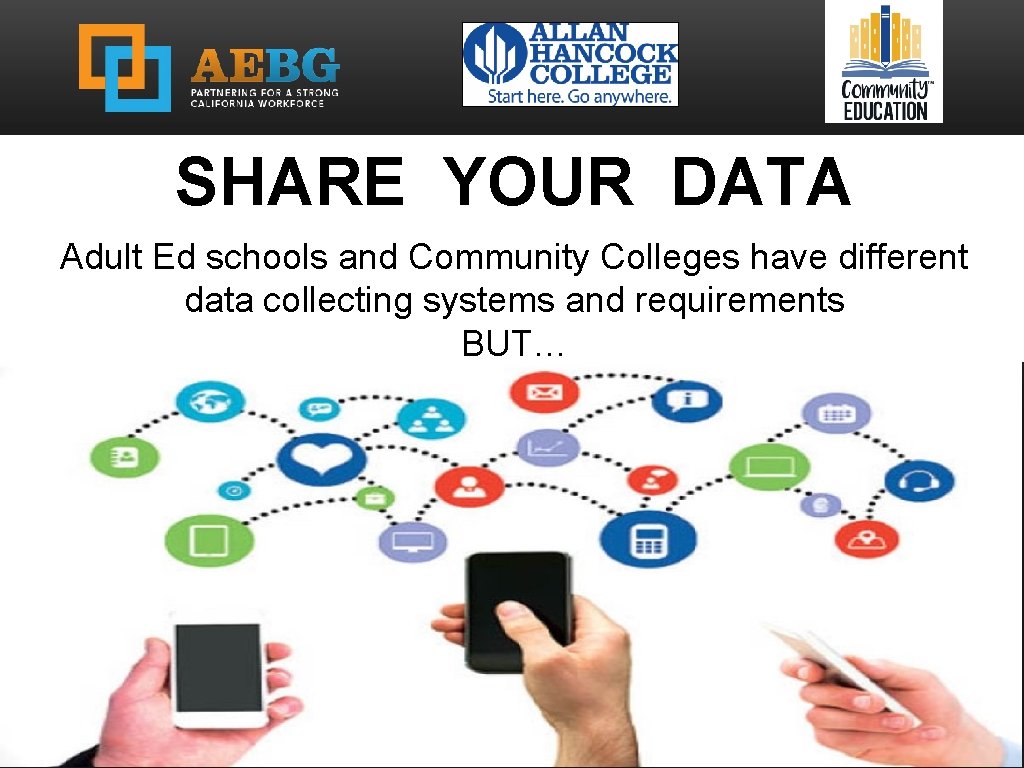
SHARE YOUR DATA Adult Ed schools and Community Colleges have different data collecting systems and requirements BUT…
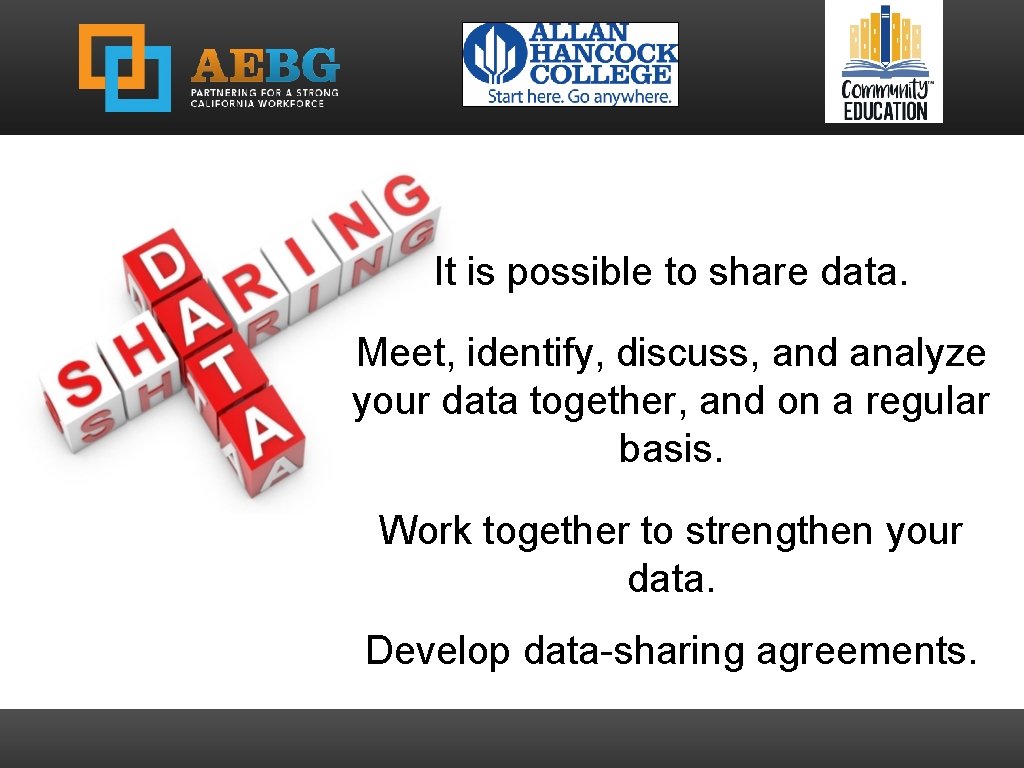
It is possible to share data. Meet, identify, discuss, and analyze your data together, and on a regular basis. Work together to strengthen your data. Develop data-sharing agreements.
And if you thought I was not going to talk about it…

Never ignore the elephant in the room. NOT talking about the elephant doesn’t make it go away. What brings an elephant into the room? Distrust, Inequity, Partiality, Favoritism, Unhealthy Competition, Loss of Focus, Loss of Vision, Misinformed Mission Statement, Lack of a Service Mentality, No Longer Student-Centered, Fear, Potential Loss of AEBG funding… If you have an elephant, big or small, what do you think brought yours in? Why? Talk about it!
Challenges, like outcomes, are ways to improve the system. These are opportunities that serve to make things better, that get us to deepen our understanding, that help us build trust and synergy, that allows us to stop and breathe. Don’t run away from challenges. Embrace challenges as opportunities for growth. (Pseudo-guru Sofia)
Let’s recap: • • • Consider your demographics. Are we serving the same people? Always remain student-centered. Improve/Strengthen each other’s programs. Seek and effectively use Professional Development opportunities. Develop agreements, including but not limited to: • Articulate courses • Align curriculum • Share data • Develop student-friendly logical pathways. • Allow and encourage innovation and out-of-the-box thinking. • Don’t fear challenge. See the opportunity for improvement.

DO YOU HAVE ANY ? S N O I T S E U Q
Sofia Ramirez Gelpi sgelpi@hancockcollege. edu (805) 922 -6966, x 3325
- Slides: 19