
Challenges and Issues for Aggregators Alastair Dunning Julia

- Slides: 19
Challenges and Issues for Aggregators Alastair Dunning, Julia Fallon, Pavel Kats October 2014
The European Cloud project wished to find out more about the challenges and issues faced by aggregators in the Europeana ecosystem
A series of discussion were framed around this central point: “What are aggregators' current and future technical and strategic challenges ? ”
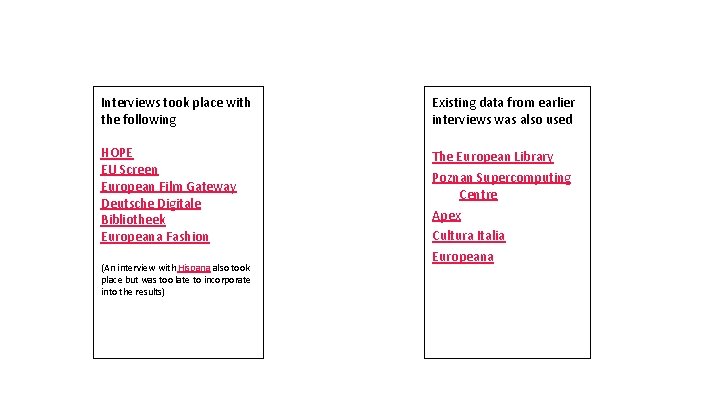
Interviews took place with the following Existing data from earlier interviews was also used HOPE EU Screen European Film Gateway Deutsche Digitale Bibliotheek Europeana Fashion The European Library Poznan Supercomputing Centre Apex Cultura Italia Europeana (An interview with Hispana also took place but was too late to incorporate into the results)
The answers will be used to inform the Europeana Cloud service
The key findings are here:
Metadata mapping is a slow process, with too many steps, services and discussions required ● EFG does conceptual mapping of metadata, but actual mapping is executed via staff at ISTI. ● EFG “wants to have tools for transformation of data without technicians' help” ● DDB have similar workflow, with different places and staff doing the conceptual and technical mapping ● Cultura Italia wishes its data providers to have much more ability to share and edit their own records. Very limited at moment ● EU Screen also interested in harmonising its complex workflow ● HOPE have too much email back-and-forth with partners to iron out issues in metadata mapping ● Apex want to save different mapping profiles for different types of content
Tools for ingestion and mapping are not as reliable as they could be; also some worries over availability of data ● Fashion wants better availability of tools for mapping (eg weekends, holidays) ● EU Screen has identical issues with the software; EFG mentioned this as well ● TEL needs tools and access to data to be reliable and provide for redundancy; same for Poznan
Ingestion and mapping tools have poor usability, and sometimes cannot be used without technical expertise ● Fashion like using MINT but want it to improve; Desire to have better interfaces and greater functionality (better editing of groups of metadata, for instance) ● EFG want to have better usability (and documentation) so individual data providers can use MINT directly ● Key concern of EU Screen as well would allow data providers closer access to data ● Key concern of Poznan too; time wasted getting developers to do things that a good interface would allow metadata experts to do
Aggregators need the ability to curate (ingest, map, enrich) their data at greater speed ● DDB expect to move to 130 data providers to 1000 s. Currently can deal with 30, 000 records an hour; will need more in the future ● TEL needs capacity to manage and enrich several million records ● EU Screen needs to deal with larger datasets, and for quicker processing
Aggregators need better mechanisms for managing identifiers and authority files ● DDB has massive problems with identifiers. Identifiers are a big problem, because many data providers do not have persistent identifiers, and some systems seem to produce new identifiers with every new ingest. Need some kind of mechanism to help improve this. ● EFG wants to work on clustering but automation has not yet been successful, crowdsourcing may help with this ? ● Fashion wishes to implement its own authority files for fashion designers. This needs to be reliable ● EFG also wants to develop authority files ● Cultura Italia wants to maintain and update its SKOSified thesaurus to allow for cross-domain enrichment
Many see possibilities for enrichment, but do not have the tools for it ● Fashion wants to do semi-automatic enrichment based on content analysis (e. g. color extraction) or semantic enrichment on metadata ● EFG keen on geographical enrichment - do not have tools at the moment ● Apex need to improve their enrichment processes before data providers will accept data back ● TEL strategy focussed on enriching and aligning data; also need to harmonise what is done by TEL and what is done by Europeana ● Poznan mentioned Virtual Transcription Tool as a possible way of enriching data ● TEL also mentioned more complex tools and workflows to improve data and quality
Many aggregators either storing content. . * TEL already store content via their hosting providers * EU Screen make use of a third party for streaming TV content * Fashion make use of Amazon * Hope have their own digital repository or considering it as a long-term option * DDB storing only previews, but considering storing content. Demand from smaller institutions * Likewise, DFG considering strategic possibilities between content * Cultura Italia have considered doing storage and preservation Not an urgent problem for any aggregator, but is becoming strategically important
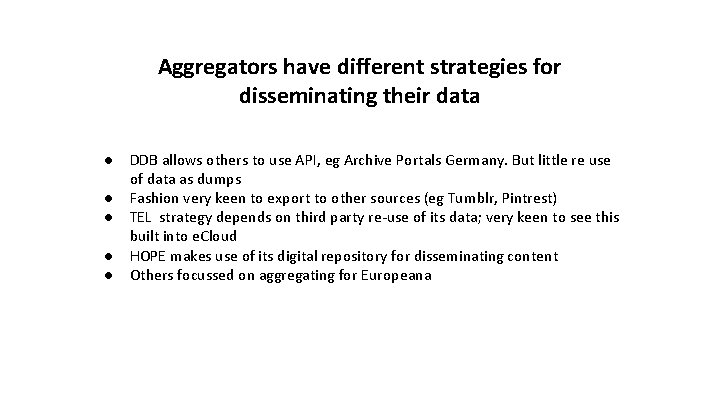
Aggregators have different strategies for disseminating their data ● DDB allows others to use API, eg Archive Portals Germany. But little re use of data as dumps ● Fashion very keen to export to other sources (eg Tumblr, Pintrest) ● TEL strategy depends on third party re-use of its data; very keen to see this built into e. Cloud ● HOPE makes use of its digital repository for disseminating content ● Others focussed on aggregating for Europeana
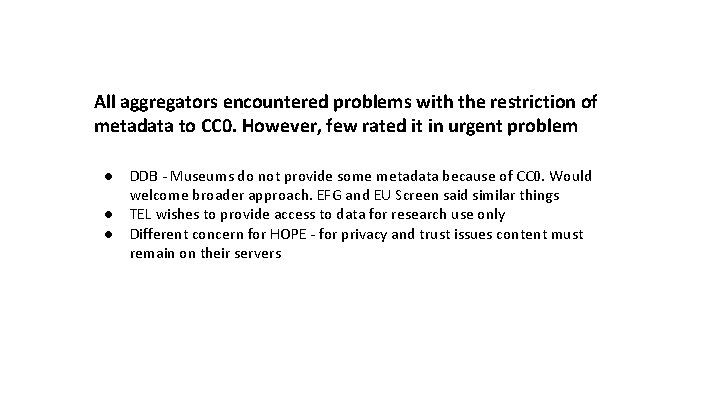
All aggregators encountered problems with the restriction of metadata to CC 0. However, few rated it in urgent problem ● DDB - Museums do not provide some metadata because of CC 0. Would welcome broader approach. EFG and EU Screen said similar things ● TEL wishes to provide access to data for research use only ● Different concern for HOPE - for privacy and trust issues content must remain on their servers
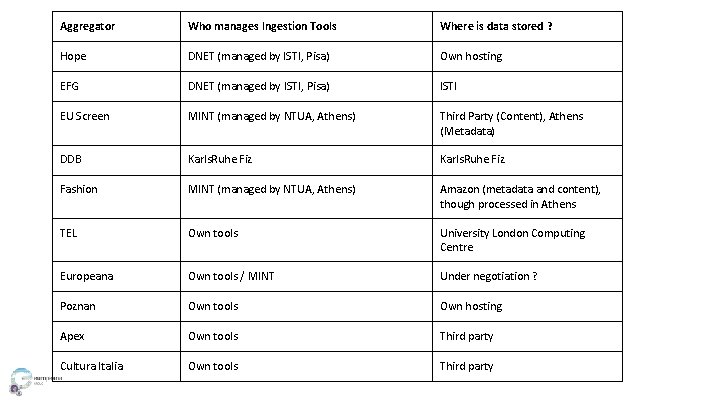
Aggregator Who manages Ingestion Tools Where is data stored ? Hope DNET (managed by ISTI, Pisa) Own hosting EFG DNET (managed by ISTI, Pisa) ISTI EU Screen MINT (managed by NTUA, Athens) Third Party (Content), Athens (Metadata) DDB Karls. Ruhe Fiz Fashion MINT (managed by NTUA, Athens) Amazon (metadata and content), though processed in Athens TEL Own tools University London Computing Centre Europeana Own tools / MINT Under negotiation ? Poznan Own tools Own hosting Apex Own tools Third party Cultura Italia Own tools Third party
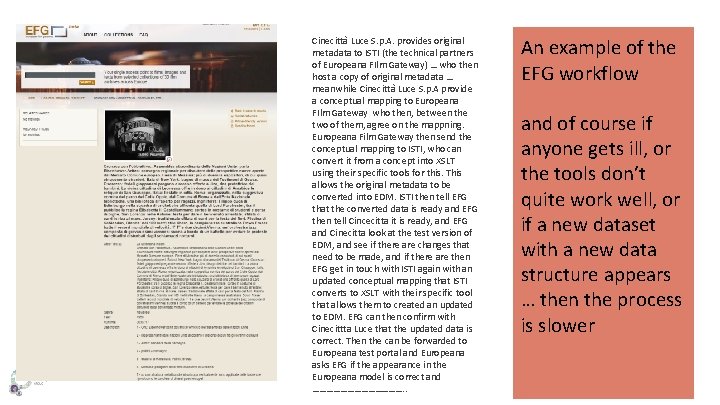
Cinecittà Luce S. p. A. provides original metadata to ISTI (the technical partners of Europeana FIlm Gateway) … who then host a copy of original metadata … meanwhile Cinecittà Luce S. p. A provide a conceptual mapping to Europeana FIlm Gateway who then, between the two of them, agree on the mappning. Europeana Film Gateway then send the conceptual mapping to ISTI, who can convert it from a concept into XSLT using their specific tools for this. This allows the original metadata to be converted into EDM. ISTI then tell EFG that the converted data is ready and EFG then tell Cincecitta it is ready, and EFG and Cinecitta look at the test version of EDM, and see if there are changes that need to be made, and if there are then EFG get in touch with ISTI again with an updated conceptual mapping that ISTI converts to XSLT with their specific tool that allows them to created an updated to EDM. EFG can then confirm with Cinecittta Luce that the updated data is correct. Then the can be forwarded to Europeana test portal and Europeana asks EFG if the appearance in the Europeana model is correct and …………………. . An example of the EFG workflow and of course if anyone gets ill, or the tools don’t quite work well, or if a new dataset with a new data structure appears … then the process is slower
The answers are now being used to inform the actual nature of the Europeana Cloud service
Timeline for Europeana Cloud 2014 - Ongoing project (until 2016) with 3 aggregators (TEL, Europeana, Poznan) building shared storage system and services 2015 and onwards - Ongoing work to connect tools and services to the Cloud 2016 - e. Cloud open to other aggregators to join 2018 (? ) - e. Cloud open for data providers to join