
Challenge Questions What can you learn from these

- Slides: 20
Challenge Questions What can you learn from these questions? Take this like a test. Write down questions you have. “Grade” it using the answer key document. For the questions you missed, can you explain EITHER why you missed it/ why the correct answer is correct/what you learned from that question? TEN BONUS POINTS ON YOUR TEST FOR GOING THROUGH THIS PROCESS AND WRITING DOWN YOUR LEARING!! MUST TURN IN BEFORE THE TEST STARTS TOMORROW. START WITH SLIDE 9 FOR THE EXTRA CREDIT- WE DID 2 -8 IN CLASS TODAY!
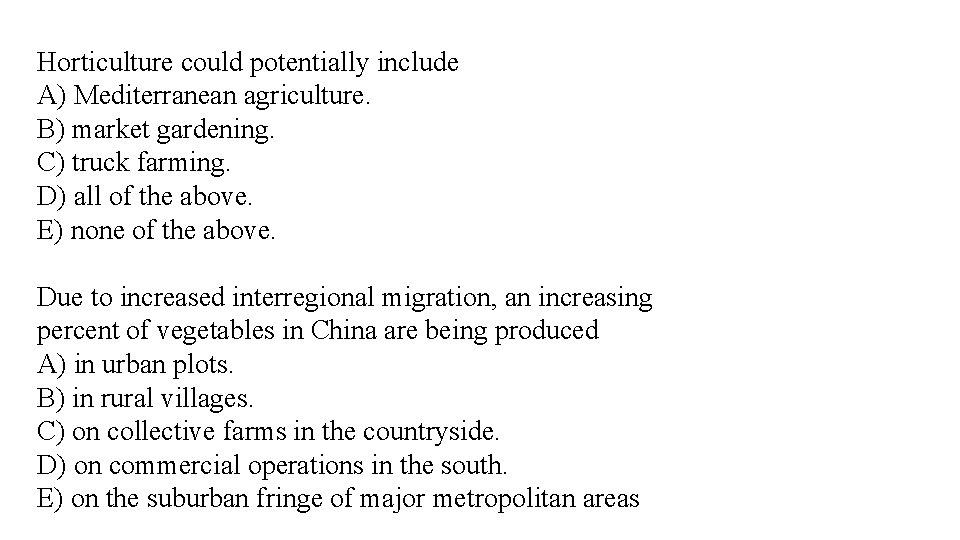
Horticulture could potentially include A) Mediterranean agriculture. B) market gardening. C) truck farming. D) all of the above. E) none of the above. Due to increased interregional migration, an increasing percent of vegetables in China are being produced A) in urban plots. B) in rural villages. C) on collective farms in the countryside. D) on commercial operations in the south. E) on the suburban fringe of major metropolitan areas
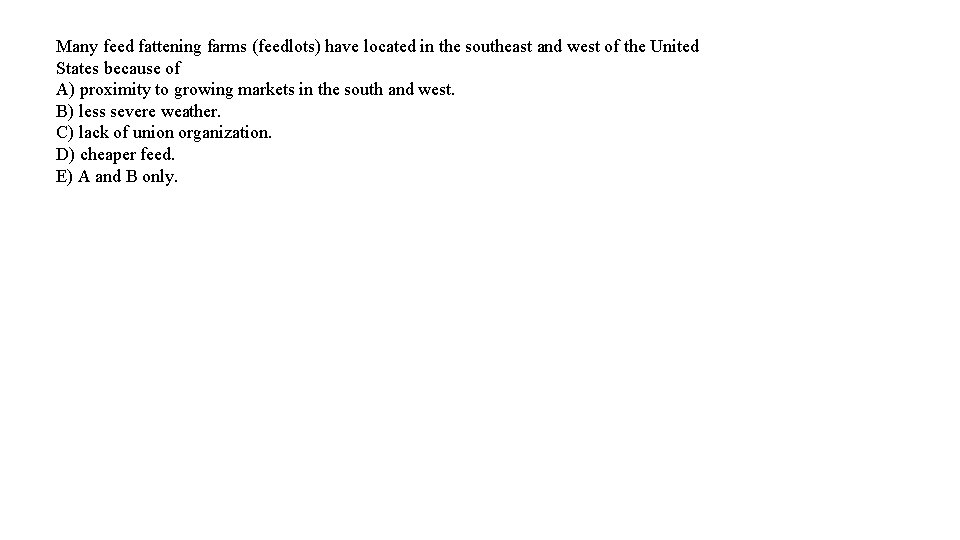
Many feed fattening farms (feedlots) have located in the southeast and west of the United States because of A) proximity to growing markets in the south and west. B) less severe weather. C) lack of union organization. D) cheaper feed. E) A and B only.
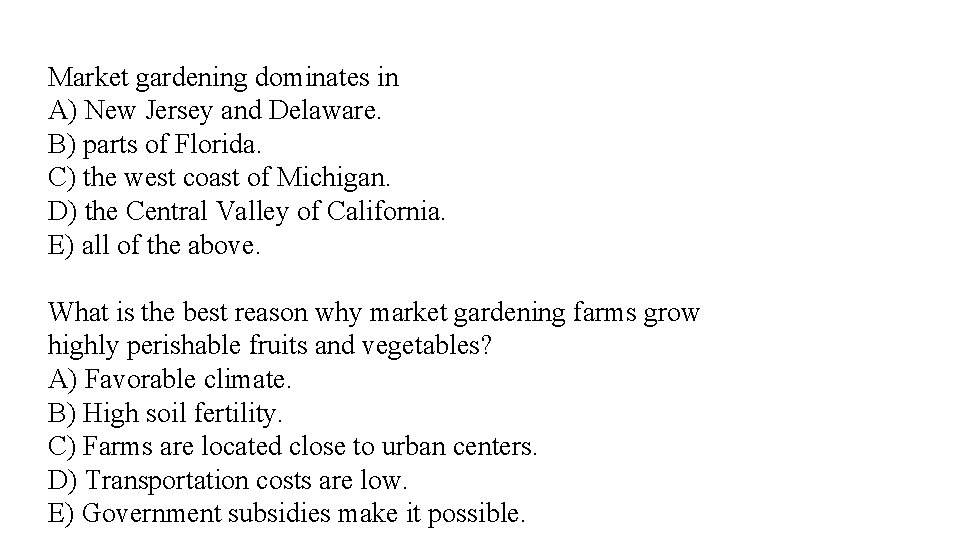
Market gardening dominates in A) New Jersey and Delaware. B) parts of Florida. C) the west coast of Michigan. D) the Central Valley of California. E) all of the above. What is the best reason why market gardening farms grow highly perishable fruits and vegetables? A) Favorable climate. B) High soil fertility. C) Farms are located close to urban centers. D) Transportation costs are low. E) Government subsidies make it possible.
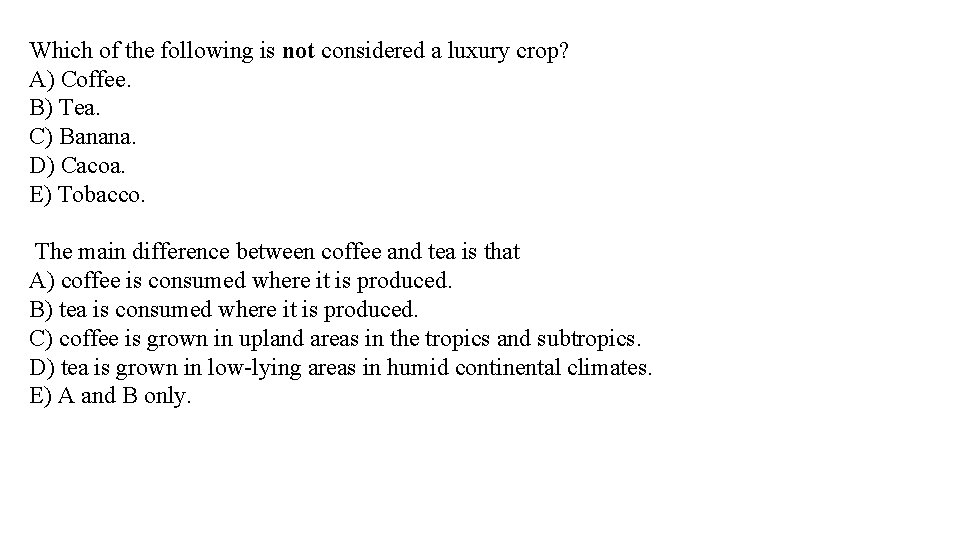
Which of the following is not considered a luxury crop? A) Coffee. B) Tea. C) Banana. D) Cacoa. E) Tobacco. The main difference between coffee and tea is that A) coffee is consumed where it is produced. B) tea is consumed where it is produced. C) coffee is grown in upland areas in the tropics and subtropics. D) tea is grown in low-lying areas in humid continental climates. E) A and B only.
How have globalization and improved transportation links changed the geography of production areas for products such as apples, grapes, and fresh cut flowers? A) Farmers will seek out areas with the lowest production costs. B) North American farmers no longer have a competitive advantage all year. C) Production areas have become more competitive in Least Developed Countries (LDCs). D) Southern hemisphere producers have increased production of these items. E) All of the above. How has containerization changed the geography of linkages between production areas and location of consumers? A) Due to economies of scale, production areas have shifted to many Least Developed Countries (LDCs). B) The Suez and Panama canals are less important because of containerization. C) Containerization has made long distance trade more efficient. D) Containerization has made long distance trade more profitable. E) All of the above.
Many farmers in New England turned to specialty farming, such as growing mushrooms, asparagus, herbs, and nursery plants because A) the climate is better for these types of operations. B) depopulation of rural New England has reduced the customer base. C) the “eat locally” movement has generated more demand for these products. D) dairy farming has become less profitable due to lower milk prices per unit and increasing operating costs. E) the increased use of refrigerated trucks has expanded the market area.
Even though climatic conditions are suitable for wine production in North Africa and Southwest Asia, why is this form of agriculture not practiced in these regions? A) Both areas need economic development to establish a wine industry. B) Strict government regulations discourage development of a wine industry. C) Lack of irrigation engineering is an impediment. D) There is not a cultural tradition of consuming wine in these regions. E) Desalination is still too costly for this type of economic activity.
What activity typifies extensive commercial agriculture? A) Wheat and grain farming. B) Livestock ranching. C) Banana plantations in Latin America. D) Mixed crop and livestock operations in Iowa. E) A and B only. All of the following are examples of intensive commercial agriculture except A) dairy. B) truck farming. C) mixed crop and livestock. D) horticulture. E) paddy rice farming.
Which region is not a major dairy producing area? A) Southeast Canada. B) Northeastern United States. C) Southern California. D) Northwestern Europe. E) Southeast United States.
The most important large-scale commercial wheat producing countries in the world include all of the following except A) United States. B) Ukraine. C) Switzerland. D) Argentina. E) Australia. All of the following are major wheat producing states except A) North Dakota. B) Nebraska. C) Kansas. D) Iowa. E) Montana.
Grain produced in the United States is used for all of the following except it is A) purchased by food processing companies for baked products. B) sent around the world as foreign aid. C) stored in grain elevators for and sold in the market when prices increase. D) consumed predominately by local communities throughout the Midwest. E) sent to sub-Saharan Africa for famine relief.
The area in Canada most associated with grain farming is A) the Maritime Provinces. B) Ontario. C) the Northwest Territories. D) the Prairie Provinces. E) British Columbia. . The invention in the late 1800 s that changed the geography of cattle ranching was A) the harvester. B) barbed wire. C) the steel tipped plow. D) the John Deere tractor. E) none of the above.
Dairy farmers specialize in other products rather than fresh milk because A) of the low profit margin of milk. B) they are located outside the milkshed. C) of the high cost of feed. D) of the high cost of land. E) none of the above. What is the best reason for why many dairy farmers in Wisconsin choose to produce butter and cheese rather than fresh milk? A) Most dairy farmers are located too far from Milwaukee and Chicago. B) The profit margin is higher on cheese. C) The entire country is their market area for these products. D) Wisconsin’s peripheral location within the United States is ideal. E) All of the above.
According to the von Thunen model, what type of agricultural practice would locate in the outer most concentric ring? A) Dairy. B) Forestry. C) Grazing. D) Mixed crop and livestock. E) Horticulture. According to the von Thunen model, the first ring is used for A) dairy. B) forestry. C) mixed crop and livestock. D) crop rotation. E) grain farming. Using von Thunen’s model as a basis for analysis, assume New York City is the single market for the United States, dairy agriculture would dominate in A) New England upstate New York. B) southeastern states. C) California. D) the Pacific Northwest. E) none of the above.
Using von Thunen’s model as a basis for analysis, assume New York City is the single market for the United States, mixed crop and livestock agriculture would be located in A) New England. B) the Midwest. C) the Pacific Northwest. D) southeastern states. E) Great Plains. Using von Thunen’s model as a basis for analysis, assume London, England, and Paris, France, is the single market for Europe. Dairy agriculture would be located in A) southern England. B) Scandinavia. C) southern Spain. D) the steppes of Russia. E) Hungary.
von Thunen’s agricultural land use model assumes A) there is a flat isotopic plane. B) there are uniform soils across the landscape. C) there are no physical features present, such as rivers or mountains. D) all goods use the same form of transportation. E) all of the above. The single most important factor contributing to rural land use patterns for most of the Great Plains in the United States is a result of the A) township and range land survey system. B) metes and bounds land property division method. C) physical geography of the region. D) extensive river systems. E) capitalist economic system.
All of the following areas in the United States most susceptible to losing prime agricultural land except A) California’s Central Valley. B) the Chicago-Milwaukee-Madison triangle. C) coastal California. D) South Florida. E) all of the above. Area(s) of the world traditionally known for their circular rural land use patterns include A) Northern Germany. B) Sub-Saharan Africa C) East Asia. D) South America. E) A and B only. Today circular rural settlements are most commonly associated with A) Sub-Saharan Africa. B) Southeast Asia. C) Latin America. D) Central America. E) the Middle East.
The linear agricultural land use pattern commonly found in Quebec and Louisiana is A) the long lot system. B) the range and township land survey system. C) the metes and bounds land ownership method. D) a result of the Enclosure Movement. E) none of the above. Clustered rural settlements are most commonly associated with A) the mid-Atlantic region. B) New England. C) the lower Mississippi Valley. D) the Southeast. E) the Ohio River Valley. The land division system most responsible for dispersed rural settlements in many parts of the United States is the A) long lot system. B) township and range system. C) metes and bounds system. D) enclosure movement. E) none of the above.
The region of the world that benefited the least from the Green Revolution was A) South Asia. B) East Asia. C) South America. D) Sub-Saharan Africa. E) Central America.