
Challenge Potential and Success A Universitywide Approach to

- Slides: 19
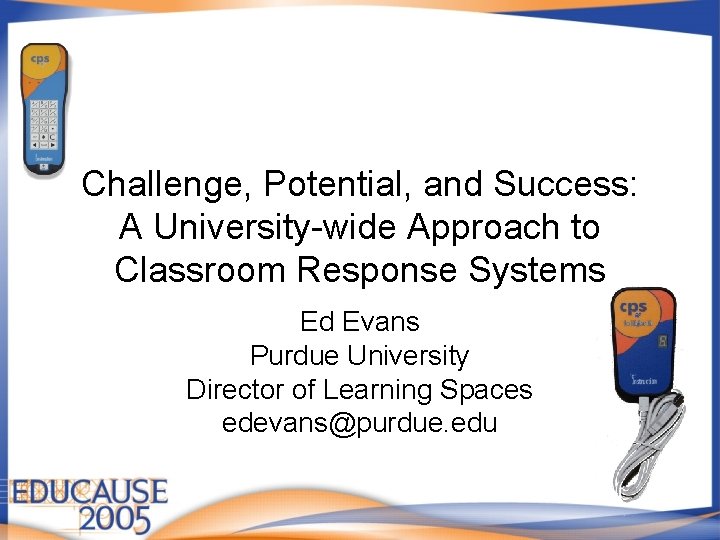
Challenge, Potential, and Success: A University-wide Approach to Classroom Response Systems Ed Evans Purdue University Director of Learning Spaces edevans@purdue. edu
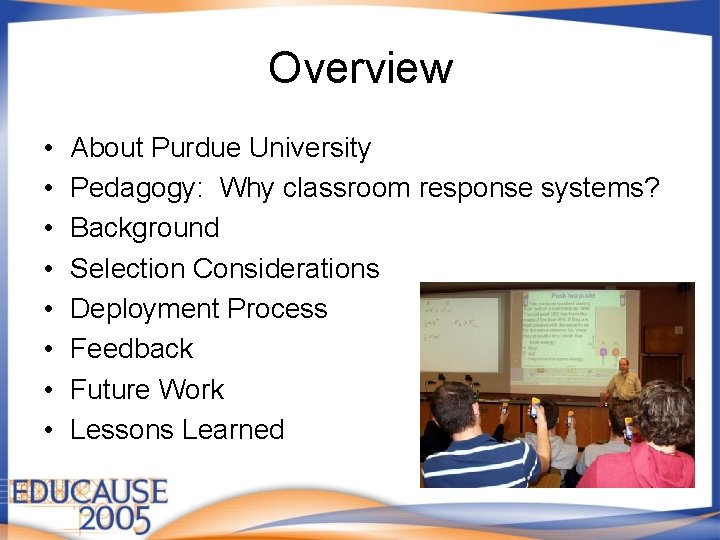
Overview • • About Purdue University Pedagogy: Why classroom response systems? Background Selection Considerations Deployment Process Feedback Future Work Lessons Learned
About Purdue • Founded in 1869 • Public, Land Grant Institution • 4 campuses, main campus in West Lafayette, IN • System wide enrollment of 69, 000 Main campus enrollment of 38, 700
Pedagogy: Why classroom response systems? • “Seven Principles for Good Practice in Undergraduate Education” by Chickering & Gamson in 1987. – Good practice encourages contact between students and faculty – Good practice communicates high expectation – Good practice develops reciprocity and cooperation among students – Good practice uses active learning techniques and gives prompt feedback
Background • Technology In the Classroom (TIC): 207 classrooms • Classroom response initiative began December 2003 • Grassroots Initiative • Began with IR clickers in 6 classes with 1200 students using e. Instruction CPS through Mc. Graw-Hill
Selection Considerations • Technology evaluation – IR vs. RF – What about RF interference? • Software evaluation • Vendor evaluation – Support process for students • Pricing Considerations
Deployment Goals • Adopt a standard response system for campus that would – minimize student costs – minimize barriers to faculty use – and maximize the ability of ITa. P to support classroom communication systems.
Deployment Goals • Equipment for all system-wide classrooms (over 350 rooms) • Integration into Web. CT Vista (which would reduce effort in creating student accounts and courses in e. Instruction software) • No semesterly subscription cost for students (absorbed by the institution) • Students would be required to purchase their own input device which can be used for their entire Purdue career • Upgrades to future classroom software and equipment
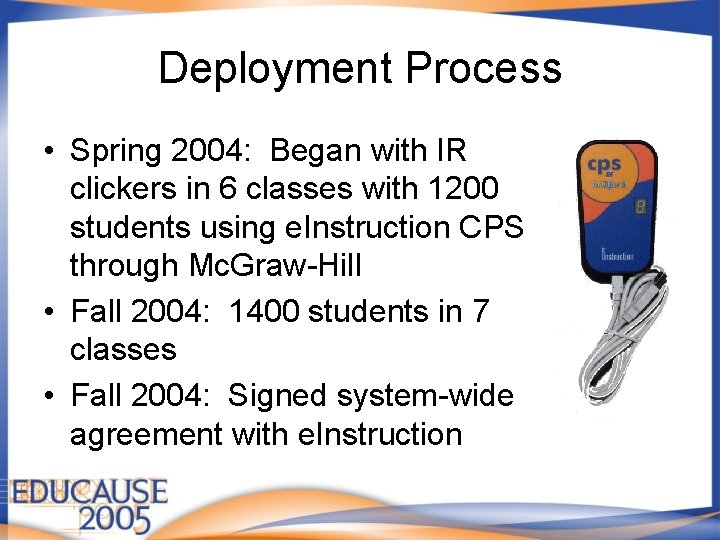
Deployment Process • Spring 2004: Began with IR clickers in 6 classes with 1200 students using e. Instruction CPS through Mc. Graw-Hill • Fall 2004: 1400 students in 7 classes • Fall 2004: Signed system-wide agreement with e. Instruction
Deployment Process • Spring 2005: – Move to RF system – 2500 students in 13 classes – Began regular meetings and training sessions for faculty • Summer 2005: Integrate registration with Web. CT Vista
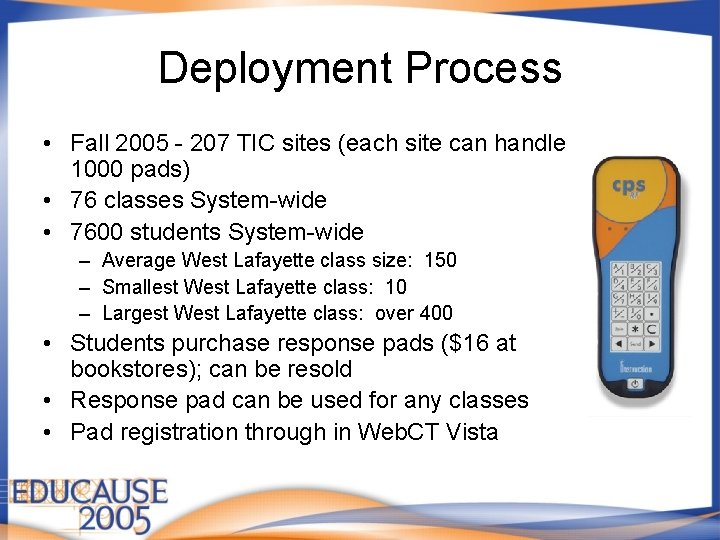
Deployment Process • Fall 2005 - 207 TIC sites (each site can handle 1000 pads) • 76 classes System-wide • 7600 students System-wide – Average West Lafayette class size: 150 – Smallest West Lafayette class: 10 – Largest West Lafayette class: over 400 • Students purchase response pads ($16 at bookstores); can be resold • Response pad can be used for any classes • Pad registration through in Web. CT Vista
Deployment Process • Primary Staffing: – Project Manager – oversaw project handled many of the faculty meetings – Instructional Technologist – oversaw deployment process to TIC sites, worked with technical problems – Instruction Designer/Trainer – developed faculty training, provided overview sessions – Other staff drawn in as needed for software installs, Vista integration consulting, etc.
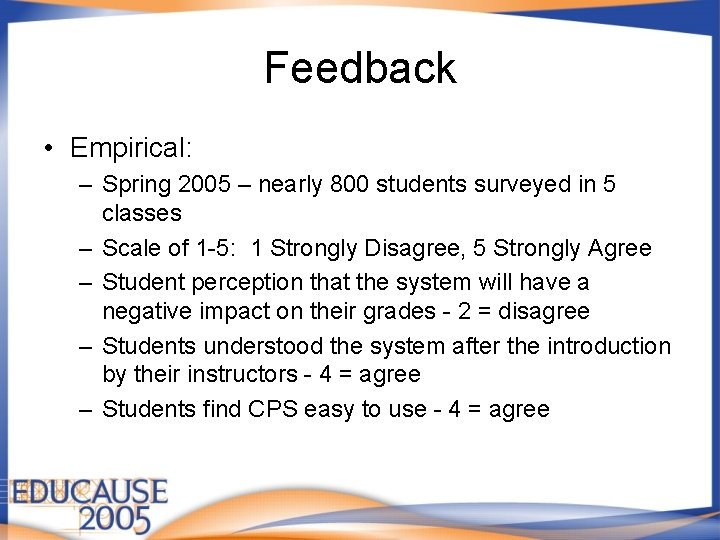
Feedback • Empirical: – Spring 2005 – nearly 800 students surveyed in 5 classes – Scale of 1 -5: 1 Strongly Disagree, 5 Strongly Agree – Student perception that the system will have a negative impact on their grades - 2 = disagree – Students understood the system after the introduction by their instructors - 4 = agree – Students find CPS easy to use - 4 = agree
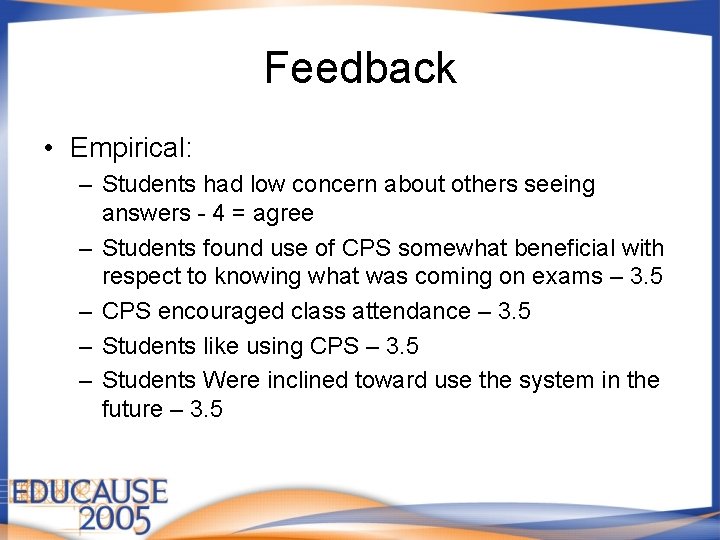
Feedback • Empirical: – Students had low concern about others seeing answers - 4 = agree – Students found use of CPS somewhat beneficial with respect to knowing what was coming on exams – 3. 5 – CPS encouraged class attendance – 3. 5 – Students like using CPS – 3. 5 – Students Were inclined toward use the system in the future – 3. 5
Feedback • Anecdotal: – Students believe the system encourages preparation and attendance – Faculty believe attendance is better and test scores are higher
Future Work • Couple CPS to our LMS – Ease of gradebook uploads – Access question databases • Review and document policies and standards related to protected data access for instructional applications • Develop more resources for student support
Lessons Learned • Opportunities to engage new areas of campus • Consider support issues for student devices • Engage the text book managers at the bookstores
the Quiz!
More information • Purdue’s website: – http: //www. itap. purdue. edu/tlt/einstruction • Discussion group at Purdue: – send mail to majordomo@purdue. edu – with message body of: subscribe crs-discuss • Educause Instructional Technologies Constituent Group – http: //www. educause. edu/Community/Constitu entand. Discussion. Groups/5982