
Challenge For All Formerly More Able Pupils Primary

Challenge For All (Formerly: More Able Pupils) Primary School Provision Analysis
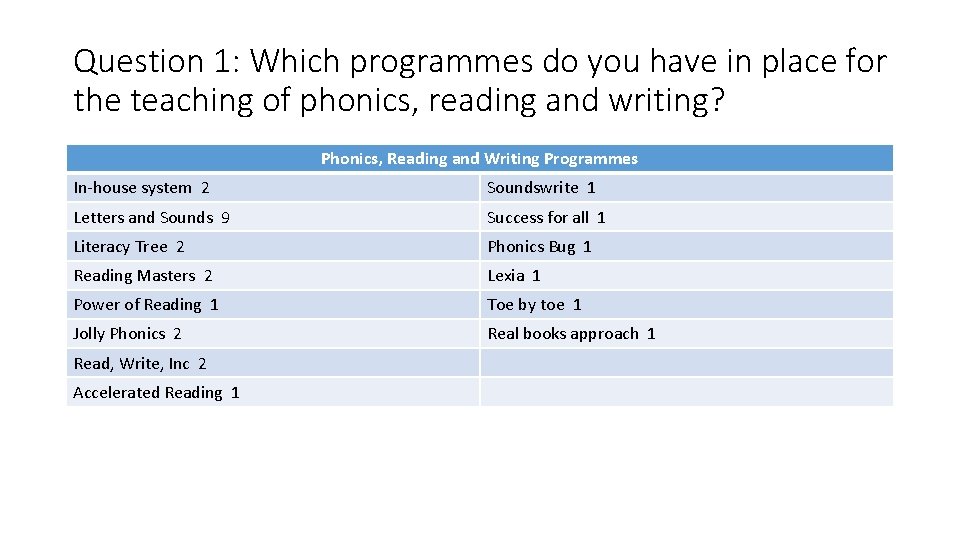
Question 1: Which programmes do you have in place for the teaching of phonics, reading and writing? Phonics, Reading and Writing Programmes In-house system 2 Soundswrite 1 Letters and Sounds 9 Success for all 1 Literacy Tree 2 Phonics Bug 1 Reading Masters 2 Lexia 1 Power of Reading 1 Toe by toe 1 Jolly Phonics 2 Real books approach 1 Read, Write, Inc 2 Accelerated Reading 1
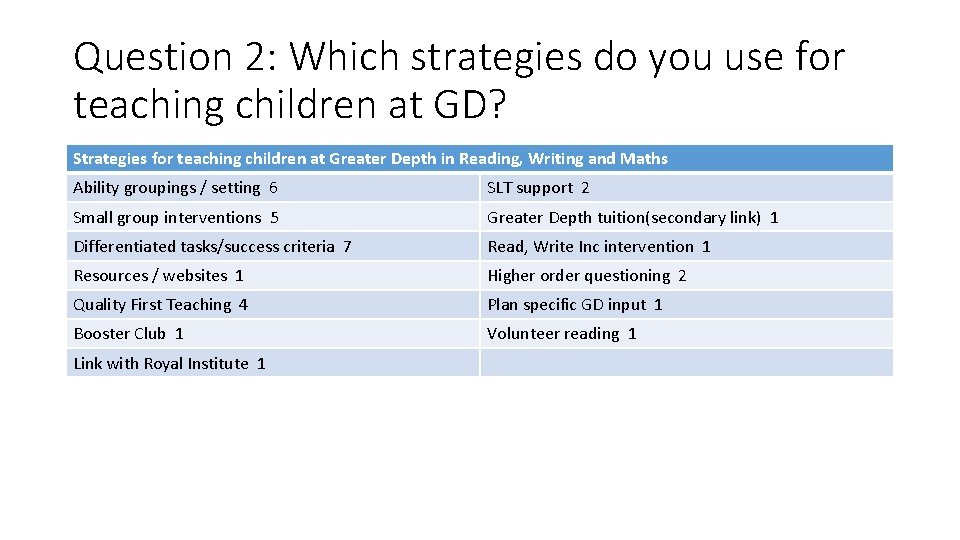
Question 2: Which strategies do you use for teaching children at GD? Strategies for teaching children at Greater Depth in Reading, Writing and Maths Ability groupings / setting 6 SLT support 2 Small group interventions 5 Greater Depth tuition(secondary link) 1 Differentiated tasks/success criteria 7 Read, Write Inc intervention 1 Resources / websites 1 Higher order questioning 2 Quality First Teaching 4 Plan specific GD input 1 Booster Club 1 Volunteer reading 1 Link with Royal Institute 1
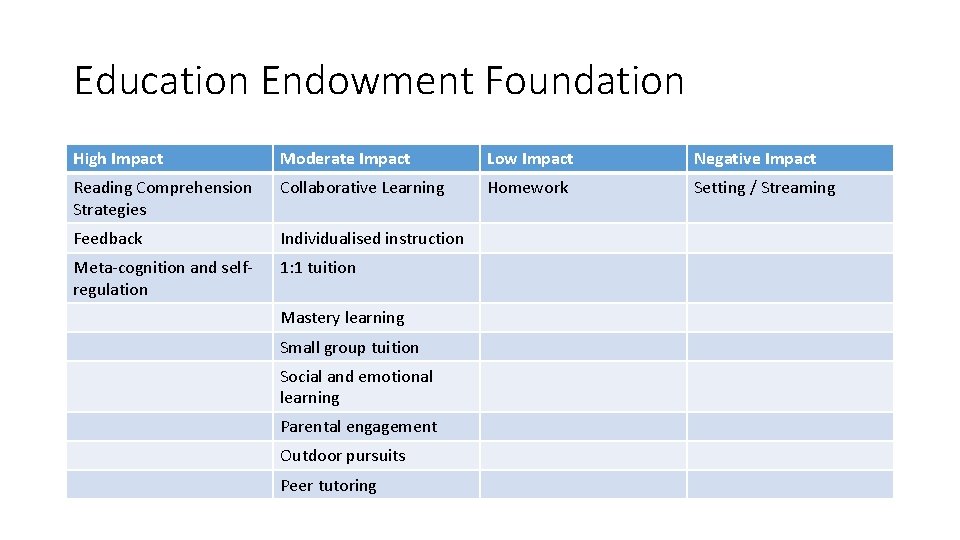
Education Endowment Foundation High Impact Moderate Impact Low Impact Negative Impact Reading Comprehension Strategies Collaborative Learning Homework Setting / Streaming Feedback Individualised instruction Meta-cognition and selfregulation 1: 1 tuition Mastery learning Small group tuition Social and emotional learning Parental engagement Outdoor pursuits Peer tutoring
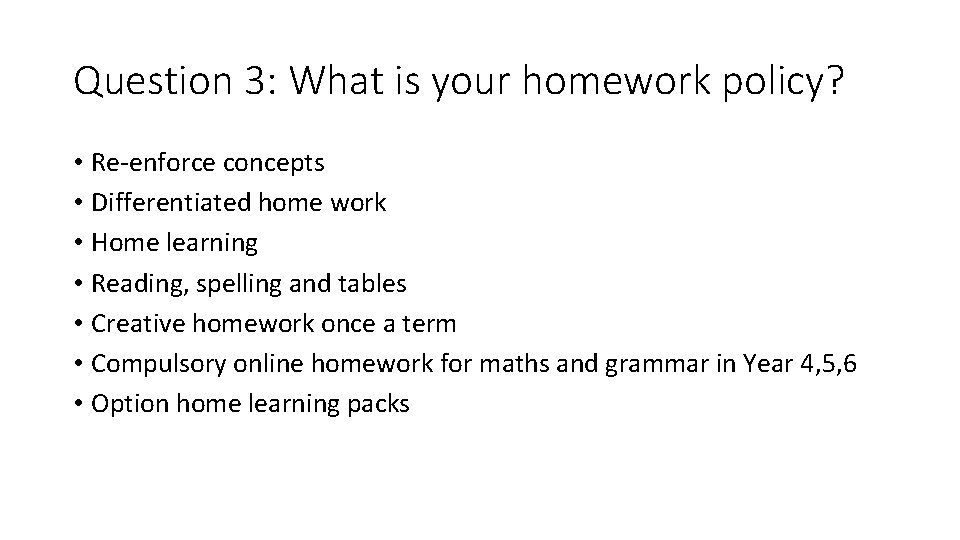
Question 3: What is your homework policy? • Re-enforce concepts • Differentiated home work • Home learning • Reading, spelling and tables • Creative homework once a term • Compulsory online homework for maths and grammar in Year 4, 5, 6 • Option home learning packs
Parental Engagement (EEF) • Engagement is often easier to achieve with parents of very young children. How will you maintain it as children get older? • Have you provided a flexible approach to allow parental engagement to fit around parents’ schedules? Parents of older children may appreciate short sessions at flexible times. • How will you make your school welcoming for parents, especially those whose own experience of school may not have been positive? • What practical support, advice and guidance can you give to parents who are not confident in their ability to support their children’s learning, such as simple strategies to help early readers?
Question 4: What is your vision/provision for more able pupils on their journey through your school? • 6 schools articulated a vision of sorts – similar themes around commitment to children thriving, reach full potential, confident and independent learners, challenge for all, to challenge and inspire. Some named data performance indicators. • Provision – creative curriculum, high standards, QFT, in-class routines rather than interventions, learning behaviours encouraged. • It was clear that one school had a policy as the language used was structured and articulated as opposed to just opinion.
Question 5: How will you sustain excellent outcomes for more able pupils despite financial constraints? • • • High quality teaching CPD Being creative Data analysis Use of volunteers SLT teaching Collaboration with other schools High expectations Interventions EFFRA –developing at STEM curriculum, partnerships with UTC and ICE
Question 6: Who is your lead teacher for more able pupils, what is their remit and how are they remunerated? • 11 schools have identified someone who leads • 2 get a TLR (Inclusion / More Able Lead) others tend to be part of SLT remit. One school commented that it was everyone’s responsibility. • Summary of role: (not consistent across the borough) ØIdentify children ØEnsure needs are met ØMonitor progress and attainment ØChallenge in pupil progress meetings ØExtra curricular opportunities ØWorking towards NACE awards

Question 7: What is your curriculum provision for more able pupils including extra-curricular. • Curriculum encompasses all • Differentiated curriculum • Specialist coaching for more able in PE • Small group work • Link with secondary • Boosters • No specific curriculum provision • Clubs – Art, Brain Games, Lambeth Music masters, sporting activities, quiz clubs, book groups, sign-post to outside activities.
Summary • Not a consistent approach across the borough • Vision VS provision: a muddle here, but the question also muddled the 2 concepts • More Able Policy – do all schools have one, do we need one, does it make a difference? • Effra Nursery – STEM project (do we want to hear more from this setting about their approach and vision? ) • Predominant approach - Quality First Teaching, questioning, differentiation, setting • Some collaboration between primary, secondary and University • Not a consistent approach to the leadership of the More Able
Thoughts and questions • If our vision doesn’t articulate why, our strategy may be having a negative impact, if there isn’t specific curriculum provision and we rely on boosters… how do we know if our more able children are truly reaching their full potential? (a statement just to get us thinking!) • Vision – how is a vision for more able pupils articulated across the school? Do people know what it is? Have you tested it out? • No evidence of clarity regarding pedagogy and strategy for the more able • How does our school curriculum intrinsically support the more able? How do you structure the knowledge and the learning journey for a more able child? • What emotional support do more able children need? How can we best support them and motivate them? • Teaching mastery and accelerating the more able? Is this a conflict? • Should we recognise and celebrate achievements outside of school better? • Assessment for learning: feedback, differentiation – how much CPD is spent on this with a particular emphasis on the more able?
- Slides: 12