
Challenge Examples These examples come from a Challenge



- Slides: 12
Challenge Examples • • These examples come from a Challenge Toolkit we have used in REP to help us develop ideas. I have included some examples that I have tried over the last few weeks or that I use regularly.
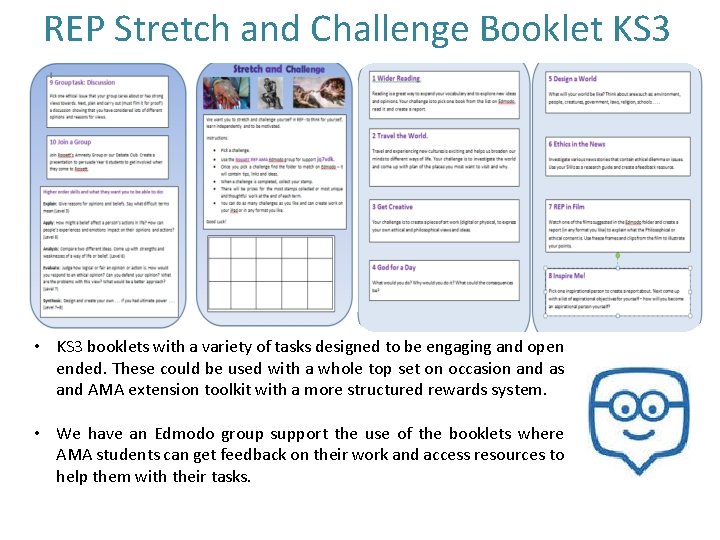
REP Stretch and Challenge Booklet KS 3 • KS 3 booklets with a variety of tasks designed to be engaging and open ended. These could be used with a whole top set on occasion and as and AMA extension toolkit with a more structured rewards system. • We have an Edmodo group support the use of the booklets where AMA students can get feedback on their work and access resources to help them with their tasks.
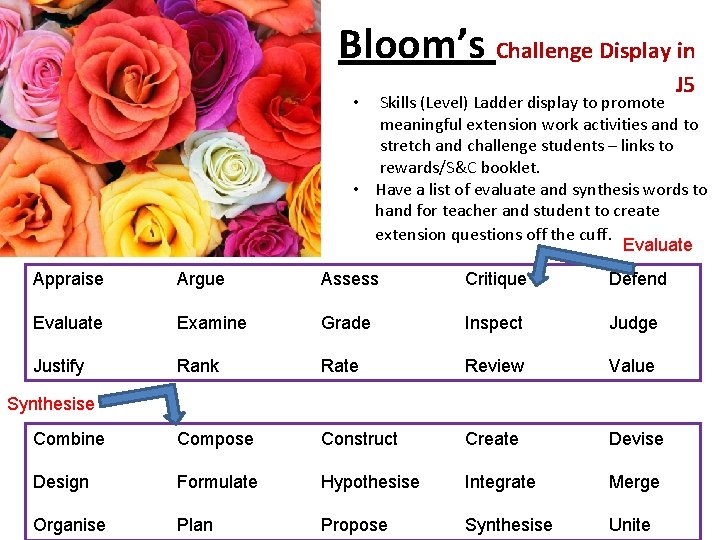
Bloom’s Challenge Display in J 5 Skills (Level) Ladder display to promote meaningful extension work activities and to stretch and challenge students – links to rewards/S&C booklet. • Have a list of evaluate and synthesis words to hand for teacher and student to create extension questions off the cuff. Evaluate • Appraise Argue Assess Critique Defend Evaluate Examine Grade Inspect Judge Justify Rank Rate Review Value Combine Compose Construct Create Devise Design Formulate Hypothesise Integrate Merge Organise Plan Propose Synthesise Unite Synthesise
Ethical Scramble
Articles Laminate newspaper, journal or magazine articles relevant to your subject area or topic. These can be kept to hand for when students finish their work. Supplement with questions or tasks that give the student’s reading purpose, e. g. : - What is the Moral dilemma or issue? - What is your ‘gut’ response to this issue? - What is the main argument? -Do you agree with the article? Why? - Who may disagree with you views and why? -How might you summarize the content of the article for a peer? -What if everyone disagreed with you on this issue?
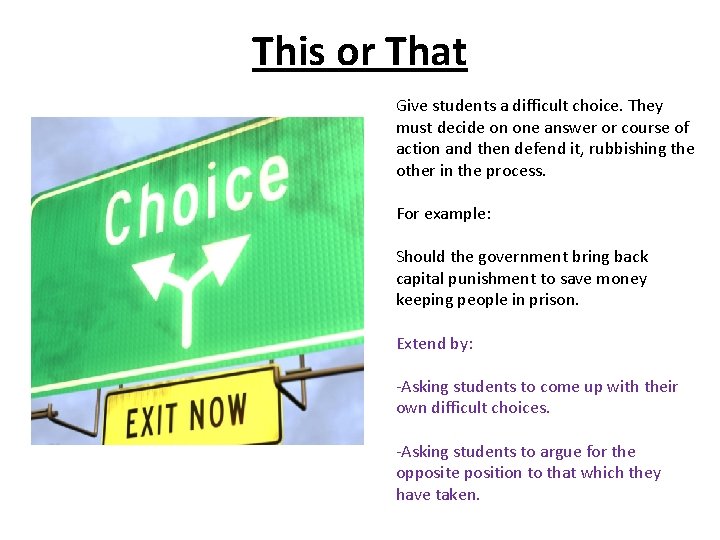
This or That Give students a difficult choice. They must decide on one answer or course of action and then defend it, rubbishing the other in the process. For example: Should the government bring back capital punishment to save money keeping people in prison. Extend by: -Asking students to come up with their own difficult choices. -Asking students to argue for the opposite position to that which they have taken.
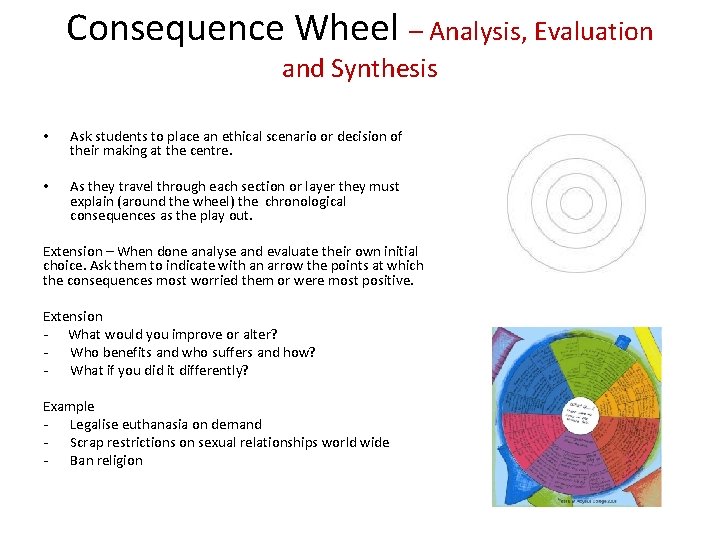
Consequence Wheel – Analysis, Evaluation and Synthesis • Ask students to place an ethical scenario or decision of their making at the centre. • As they travel through each section or layer they must explain (around the wheel) the chronological consequences as the play out. Extension – When done analyse and evaluate their own initial choice. Ask them to indicate with an arrow the points at which the consequences most worried them or were most positive. Extension - What would you improve or alter? - Who benefits and who suffers and how? - What if you did it differently? Example - Legalise euthanasia on demand - Scrap restrictions on sexual relationships world wide - Ban religion
Round Table Take a specific idea, question or thought linked to the lesson and ask students to imagine it as the focal point for a roundtable discussion. They must then construct a debate in which the different contributors discuss and argue back and forth with one another. Structure the debate in a variety of ways - Debate chips/matchsticks - Parliamentary - Kagan You could give students a list of participants or ask them to come up with their own. Example: - Is freedom a human right? Participants: A dictator, a farmer in the third world, a middle-class professional, a school-age child.
Make a Proposal Challenge students to make a proposal for something. This could be given to them by the teacher or they could be asked to come up with it themselves. Proposals should focus on something new or something that could be changed. The proposal can be left up to students or scaffolded with a set of criteria. Examples might be: -Come up with a proposal for updating UK laws on euthanasia -Make a proposal for how we might balance freedom of speech against prejudice.
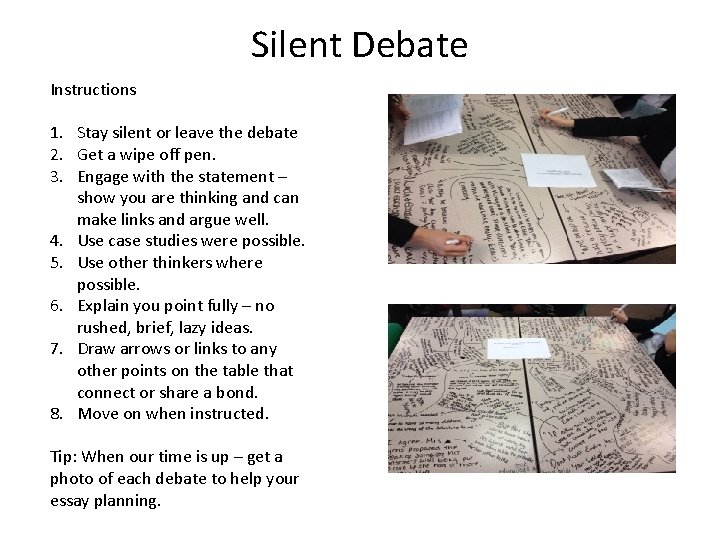
Silent Debate Instructions 1. Stay silent or leave the debate 2. Get a wipe off pen. 3. Engage with the statement – show you are thinking and can make links and argue well. 4. Use case studies were possible. 5. Use other thinkers where possible. 6. Explain you point fully – no rushed, brief, lazy ideas. 7. Draw arrows or links to any other points on the table that connect or share a bond. 8. Move on when instructed. Tip: When our time is up – get a photo of each debate to help your essay planning.
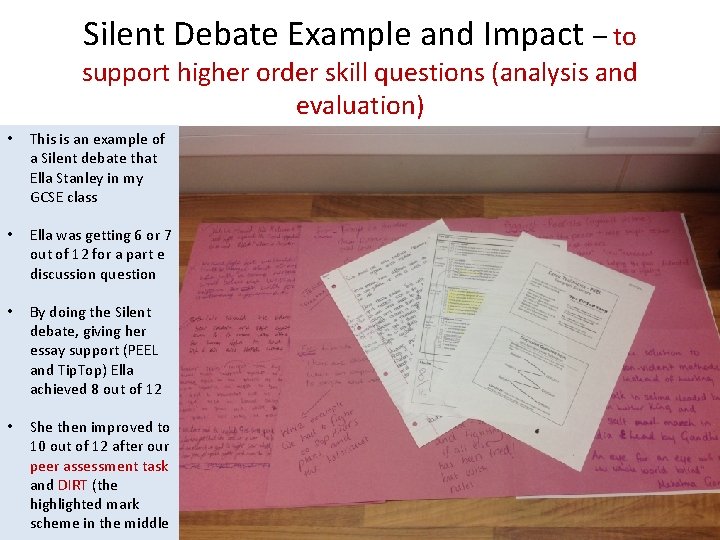
Silent Debate Example and Impact – to support higher order skill questions (analysis and evaluation) • This is an example of a Silent debate that Ella Stanley in my GCSE class • Ella was getting 6 or 7 out of 12 for a part e discussion question • By doing the Silent debate, giving her essay support (PEEL and Tip. Top) Ella achieved 8 out of 12 • She then improved to 10 out of 12 after our peer assessment task and DIRT (the highlighted mark scheme in the middle
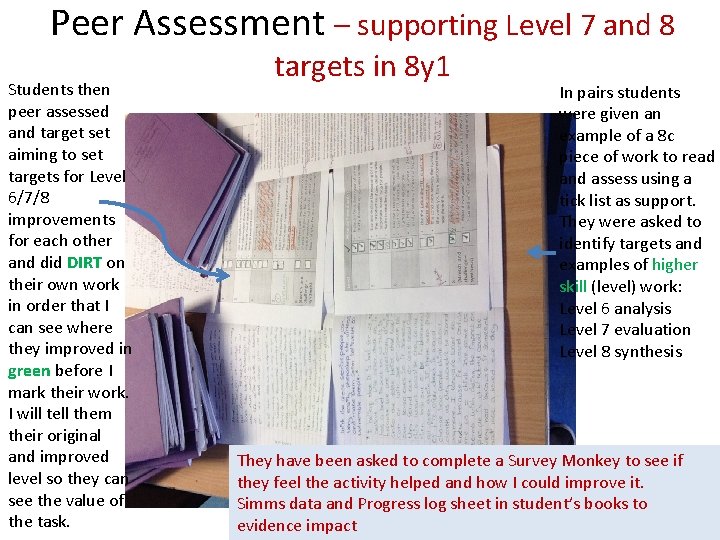
Peer Assessment – supporting Level 7 and 8 Students then peer assessed and target set aiming to set targets for Level 6/7/8 improvements for each other and did DIRT on their own work in order that I can see where they improved in green before I mark their work. I will tell them their original and improved level so they can see the value of the task. targets in 8 y 1 In pairs students were given an example of a 8 c piece of work to read and assess using a tick list as support. They were asked to identify targets and examples of higher skill (level) work: Level 6 analysis Level 7 evaluation Level 8 synthesis They have been asked to complete a Survey Monkey to see if they feel the activity helped and how I could improve it. Simms data and Progress log sheet in student’s books to evidence impact