
Chain of Infection Isolation precautions January 25 2018



- Slides: 20
Chain of Infection Isolation precautions January 25, 2018
Bell Work 1. What is another word for healthcare-associated infection? 2. What is the number one way to prevent infection? 3. When should health care workers wash their hands? a) Only when they are visibly dirty b) Every 20 minutes c) Before providing care and between patients d) Only at the beginning of the work day
Standard Correlate the function of normal flora with homeostasis and relate deviation to disease states. Evaluate specific measures to prevent deviation that are aligned with accepted standards of care. Assess the differences between healthcare associated infections and non-healthcare associated infections using examples drawn from mock case studies. Support explanations with relevant surveillance statistics, preventive measures, and methodologies concerning outbreak detection, management, and education.
Objective By the end of class, students will be able to: Apply and Identify the steps in the Chain of Infection
Classification of Infections and Diseases Endogenous Exogenous – begins inside the body – caused by something outside the body Opportunistic are weak – occur when the body’s defenses
Infectious and Communicable Diseases An infectious disease results from an invasion of microorganisms. A communicable disease is a type of infectious disease that can be transmitted from one person to another person (direct or indirect contact) Not all infectious diseases are communicable cardiovascular diseases, cancers, chronic respiratory diseases and diabetes
Draw a Chain in Course Notes
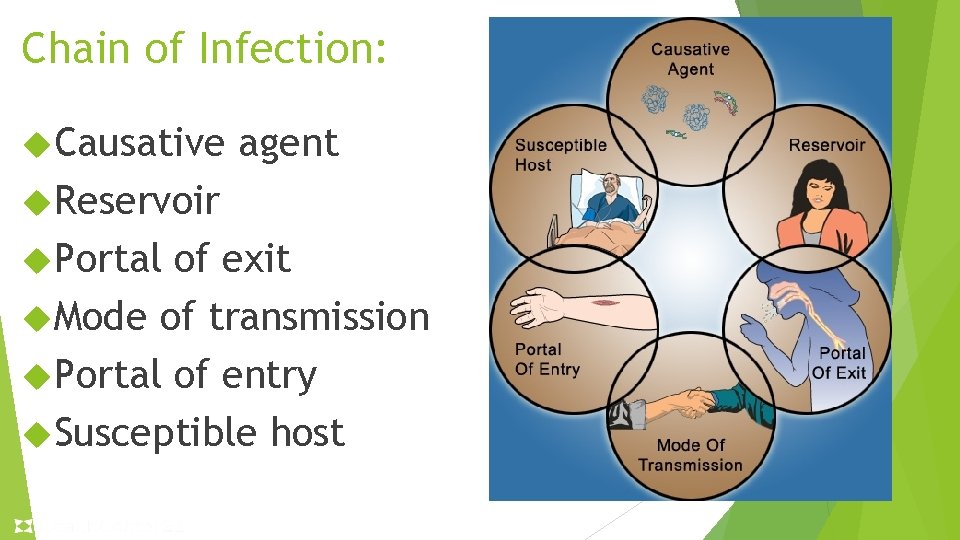
Chain of Infection: Causative agent Reservoir Portal of exit Mode of transmission Portal of entry Susceptible host
Causative Agent = Pathogen Disease-producing microorganism; bacteria, virus, fungus, protozoa, and rickettsia Present in blood or body fluids, called “bloodborne pathogens” Pathogens need an environment that enables them to survive, grow, and multiply The human body is a perfect environment
Reservoir Human, animal, or insect that is infected with disease Other reservoirs may be water, food, and contaminated objects Host may be symptomatic or asymptomatic Reservoir host is contagious even though he or she may not appear ill
Portal of Exit Pathogen must be able to exit reservoir host Any body opening lined with mucous membranes: eyes, nose, throat, vagina, rectum, penis Injury Blood, or surgery body fluids: vaginal secretions, semen, urine, feces
Mode of Transmission Direct contact— person-to-person contact or skin-to -skin contact Handshaking, kissing, and sexual contact Indirect contact— fomites; ticks, fleas, lice, and countertops Indirect contact includes airborne and droplet infection—sneezing, coughing, and talking
Portal of Entry Pathogen must find entry into new host Any opening in the body lined with mucous membranes: nose, mouth, throat, vagina, penis, rectum Wounds to the skin
Susceptible Host Weakened immune system Poor hygiene Inadequate nutrition Stress Chronic disease Poor environmental conditions Elderly Very young Certain medications Smoking Alcohol abuse
Chain of Infection Video https: //www. youtube. com/watch? v=_o 9 Sx. DFPUi. A Write down all the ways you see the chain of infection spread.
Chain of Infection http: //www. vdh. virginia. gov/content/uploads/sites/13/2016/03/Chain-of. Infection-Fact-Sheet. pdf
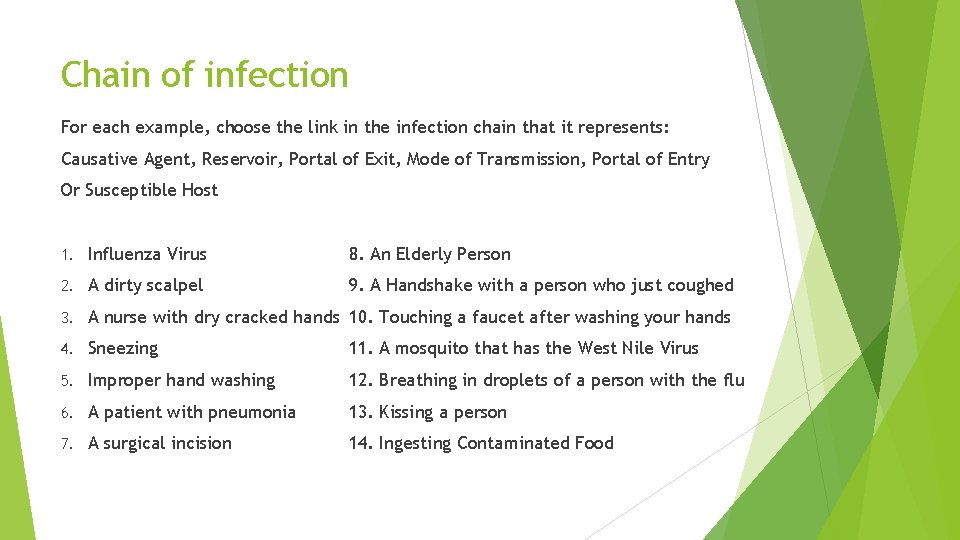
Chain of infection For each example, choose the link in the infection chain that it represents: Causative Agent, Reservoir, Portal of Exit, Mode of Transmission, Portal of Entry Or Susceptible Host 1. Influenza Virus 8. An Elderly Person 2. A dirty scalpel 9. A Handshake with a person who just coughed 3. A nurse with dry cracked hands 10. Touching a faucet after washing your hands 4. Sneezing 11. A mosquito that has the West Nile Virus 5. Improper hand washing 12. Breathing in droplets of a person with the flu 6. A patient with pneumonia 13. Kissing a person 7. A surgical incision 14. Ingesting Contaminated Food
Work it out! Work on Sub Grid #3 Get with your shoulder partner and quiz each other on your vocabulary
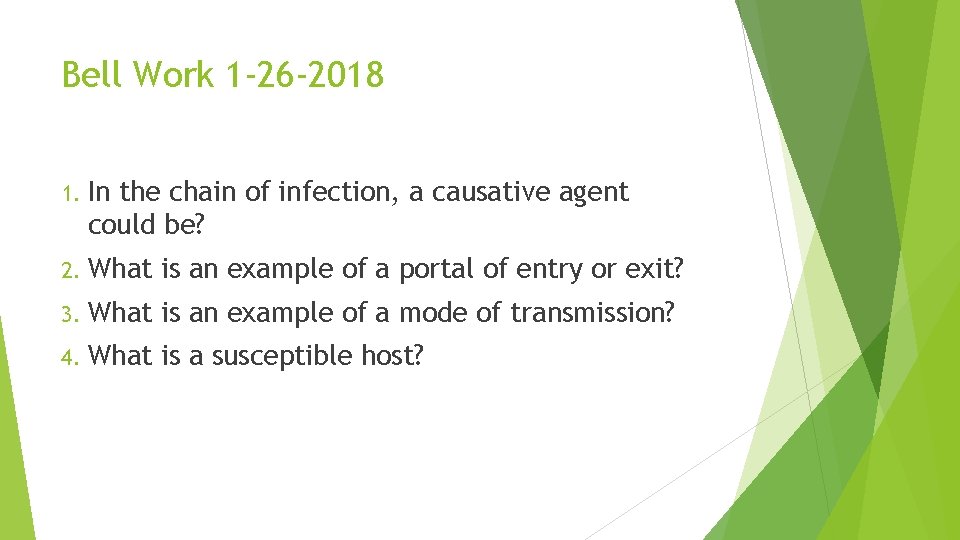
Bell Work 1 -26 -2018 1. In the chain of infection, a causative agent could be? 2. What is an example of a portal of entry or exit? 3. What is an example of a mode of transmission? 4. What is a susceptible host?
Journal Work Go to Web site and read: Breaking the Chain of Infection Write 3 paragraphs summarizing what you read. Make sure you have an introduction (1 -2 sentences, a body (3 -5 sentences) and a closing (1 -2) sentences.