
Ch IPseq analysis Acknowledgements Much of the content

- Slides: 33
Ch. IP-seq analysis
Acknowledgements Much of the content of this lecture is from: ● ● ● Furey (2012) – Ch. IP-seq and beyond Park (2009) – Ch. IP-seq – advantages + challenges Landt et al. (2012) – Ch. IP-seq guidelines + practices
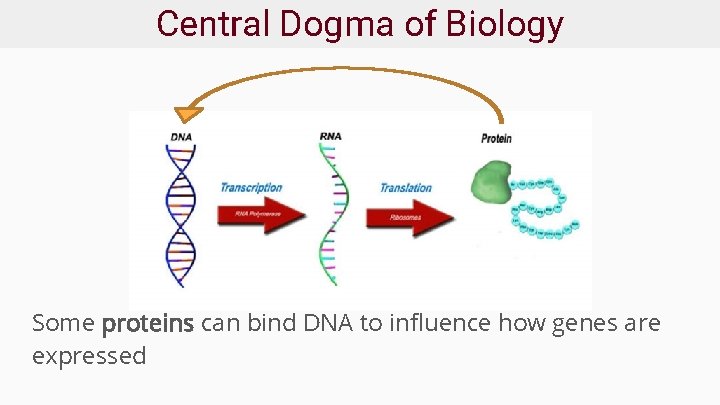
Central Dogma of Biology Some proteins can bind DNA to influence how genes are expressed
Ch. IP-seq ● Chromatin immunoprecipitation followed by high-throughput sequencing ● Assays the genome-wide locations of a single protein (bound to DNA) or a single histone modification
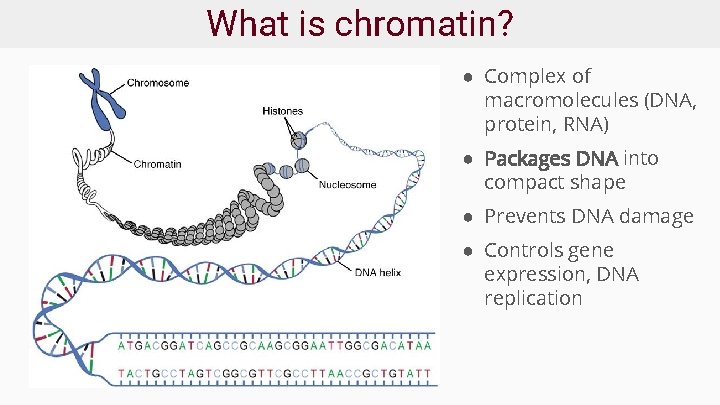
What is chromatin? ● Complex of macromolecules (DNA, protein, RNA) ● Packages DNA into compact shape ● Prevents DNA damage ● Controls gene expression, DNA replication
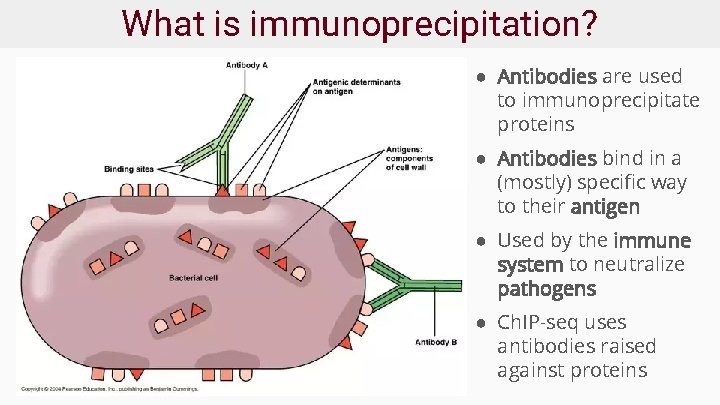
What is immunoprecipitation? ● Antibodies are used to immunoprecipitate proteins ● Antibodies bind in a (mostly) specific way to their antigen ● Used by the immune system to neutralize pathogens ● Ch. IP-seq uses antibodies raised against proteins
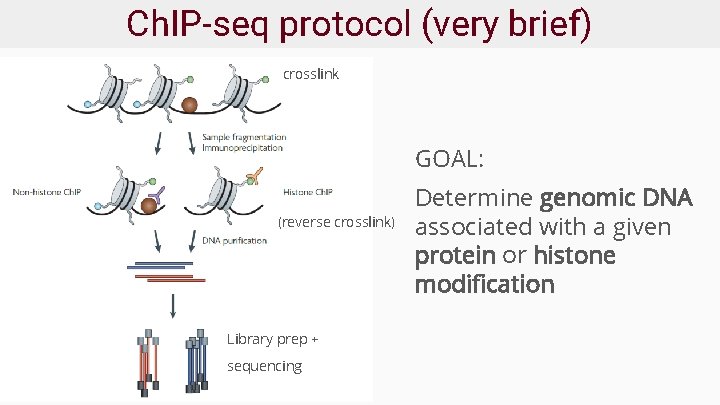
Ch. IP-seq protocol (very brief) crosslink GOAL: (reverse crosslink) Library prep + sequencing Determine genomic DNA associated with a given protein or histone modification
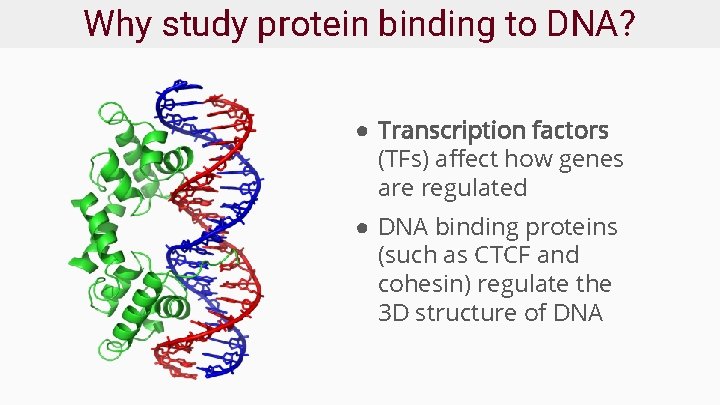
Why study protein binding to DNA? ● Transcription factors (TFs) affect how genes are regulated ● DNA binding proteins (such as CTCF and cohesin) regulate the 3 D structure of DNA
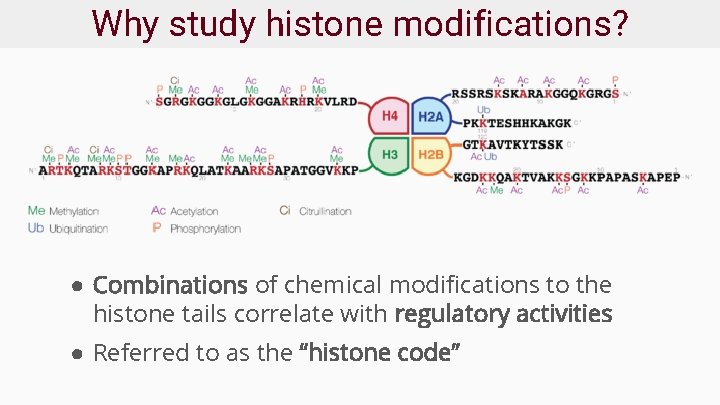
Why study histone modifications? ● Combinations of chemical modifications to the histone tails correlate with regulatory activities ● Referred to as the “histone code”
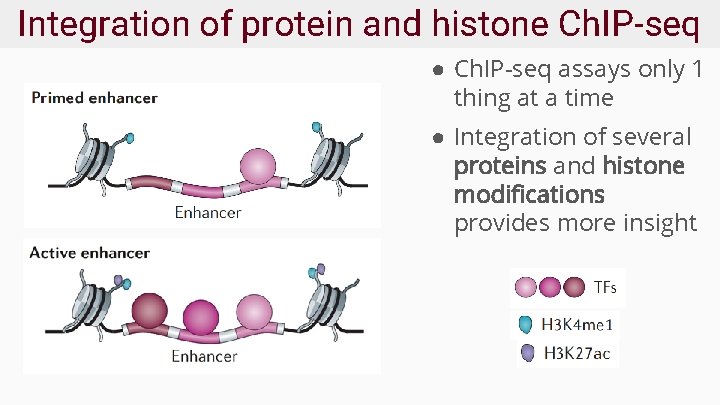
Integration of protein and histone Ch. IP-seq ● Ch. IP-seq assays only 1 thing at a time ● Integration of several proteins and histone modifications provides more insight
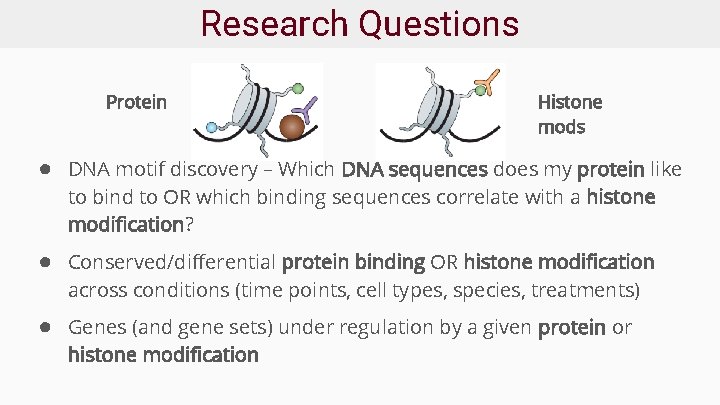
Research Questions Protein Histone mods ● DNA motif discovery – Which DNA sequences does my protein like to bind to OR which binding sequences correlate with a histone modification? ● Conserved/differential protein binding OR histone modification across conditions (time points, cell types, species, treatments) ● Genes (and gene sets) under regulation by a given protein or histone modification
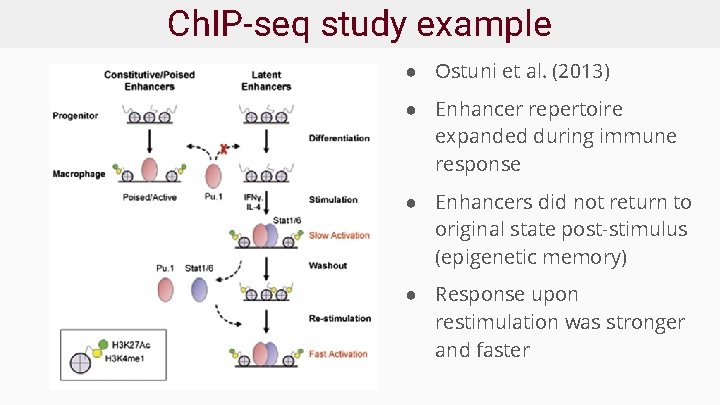
Ch. IP-seq study example ● Ostuni et al. (2013) ● Enhancer repertoire expanded during immune response ● Enhancers did not return to original state post-stimulus (epigenetic memory) ● Response upon restimulation was stronger and faster
Ch. IP-seq Analysis Methods
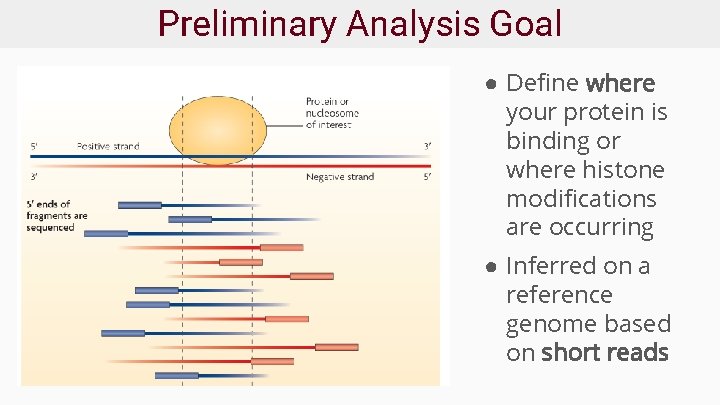
Preliminary Analysis Goal ● Define where your protein is binding or where histone modifications are occurring ● Inferred on a reference genome based on short reads
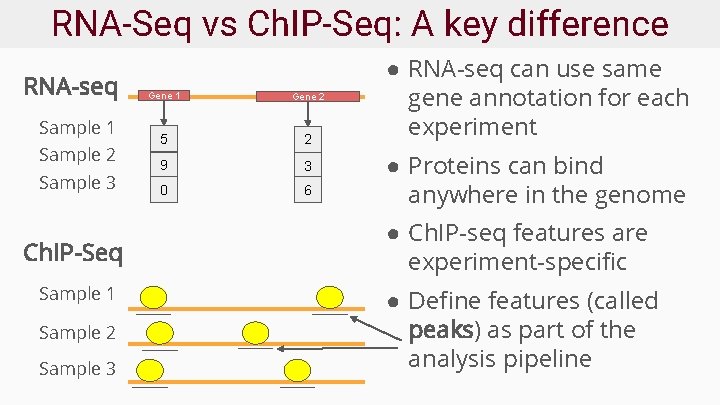
RNA-Seq vs Ch. IP-Seq: A key difference RNA-seq Sample 1 Sample 2 Sample 3 Ch. IP-Seq Sample 1 Sample 2 Sample 3 Gene 1 Gene 2 5 2 9 3 0 6 ● RNA-seq can use same gene annotation for each experiment ● Proteins can bind anywhere in the genome ● Ch. IP-seq features are experiment-specific ● Define features (called peaks) as part of the analysis pipeline
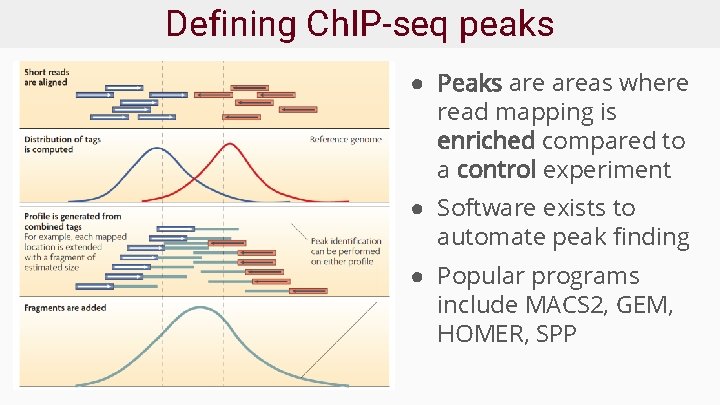
Defining Ch. IP-seq peaks ● Peaks areas where read mapping is enriched compared to a control experiment ● Software exists to automate peak finding ● Popular programs include MACS 2, GEM, HOMER, SPP
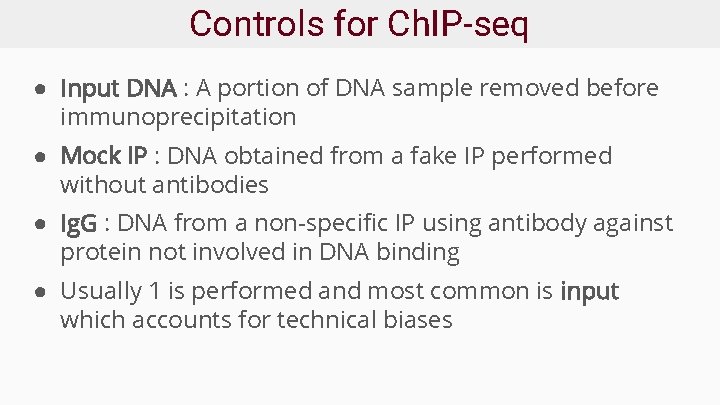
Controls for Ch. IP-seq ● Input DNA : A portion of DNA sample removed before immunoprecipitation ● Mock IP : DNA obtained from a fake IP performed without antibodies ● Ig. G : DNA from a non-specific IP using antibody against protein not involved in DNA binding ● Usually 1 is performed and most common is input which accounts for technical biases
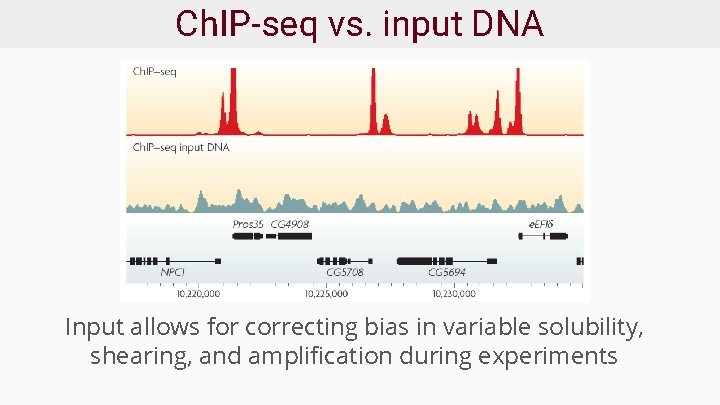
Ch. IP-seq vs. input DNA Input allows for correcting bias in variable solubility, shearing, and amplification during experiments
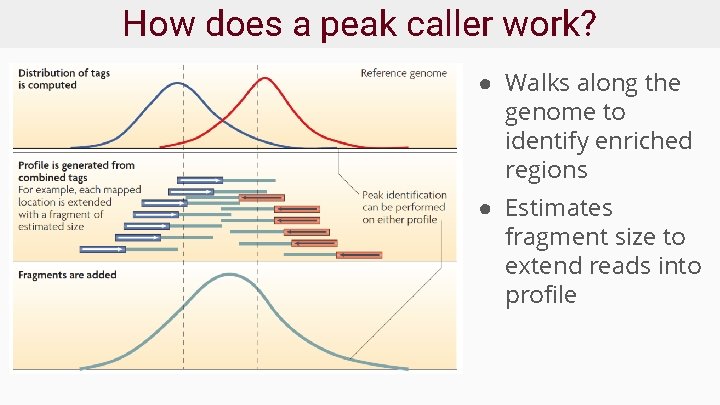
How does a peak caller work? ● Walks along the genome to identify enriched regions ● Estimates fragment size to extend reads into profile
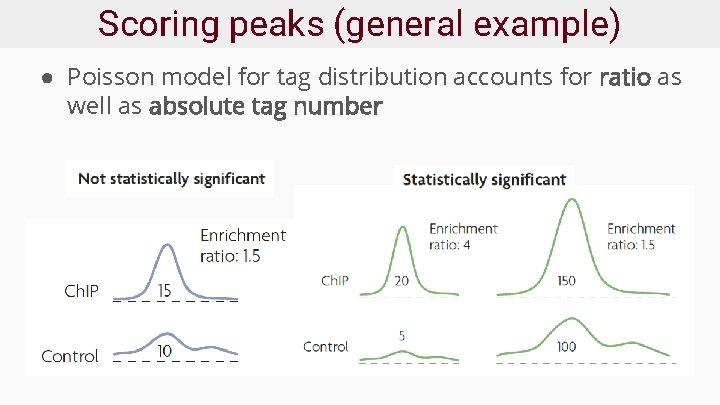
Scoring peaks (general example) ● Poisson model for tag distribution accounts for ratio as well as absolute tag number
Significance of a Peak ● Statistical significance formally measured using false discovery rate (FDR) ● FDR is expected proportion of incorrectly identified sites among those found to be significant ● Can be measured by swapping input with Ch. IP sample and identifying false peaks ● The q value of a peak is the minimum FDR at which the peak is deemed significant ● Analogous to p value for a single hypothesis test
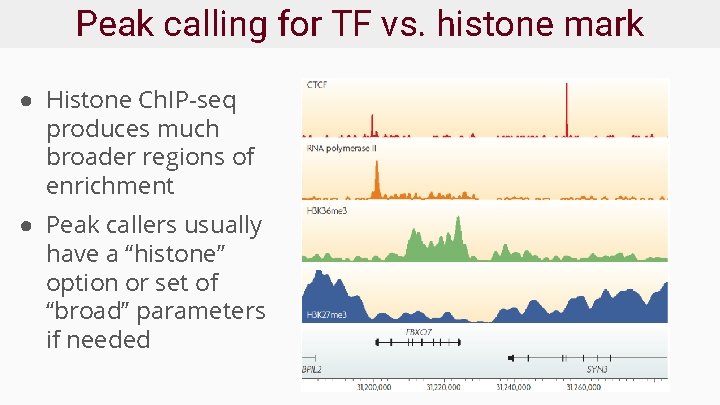
Peak calling for TF vs. histone mark ● Histone Ch. IP-seq produces much broader regions of enrichment ● Peak callers usually have a “histone” option or set of “broad” parameters if needed
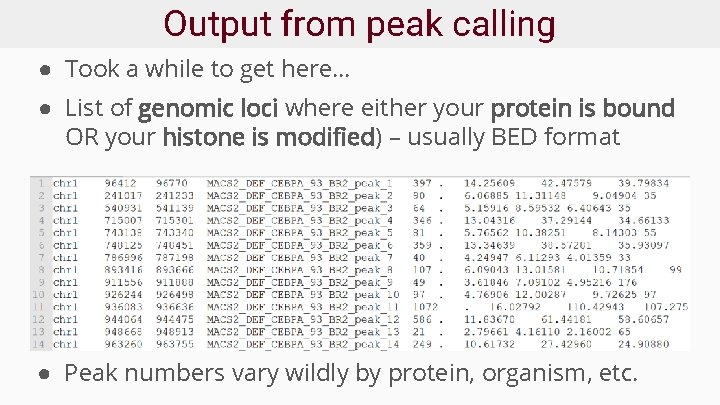
Output from peak calling ● Took a while to get here… ● List of genomic loci where either your protein is bound OR your histone is modified) – usually BED format ● Peak numbers vary wildly by protein, organism, etc.
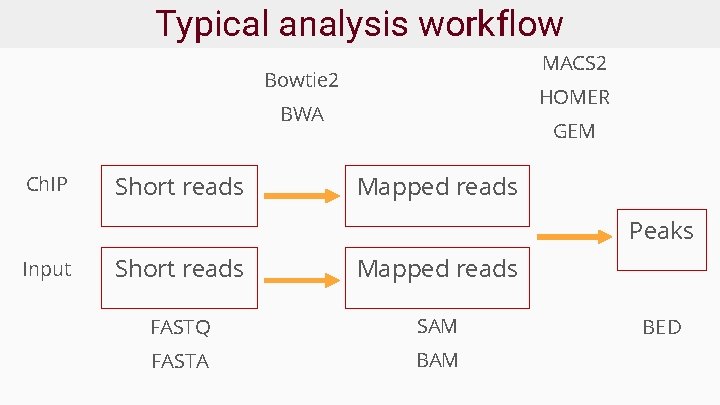
Typical analysis workflow MACS 2 Bowtie 2 HOMER BWA Ch. IP Short reads GEM Mapped reads Peaks Input Short reads Mapped reads FASTQ SAM FASTA BAM BED
Functional Characterization
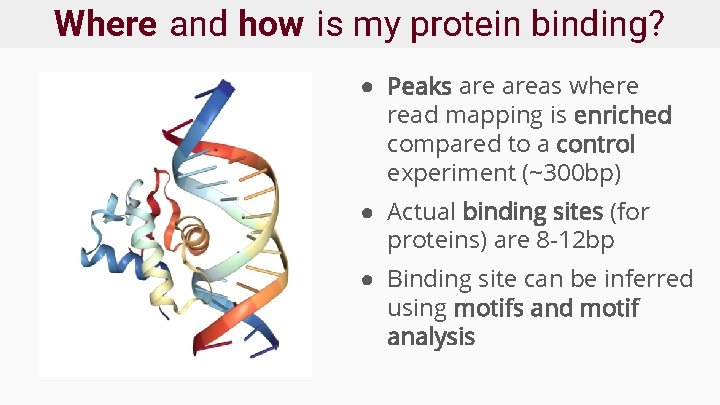
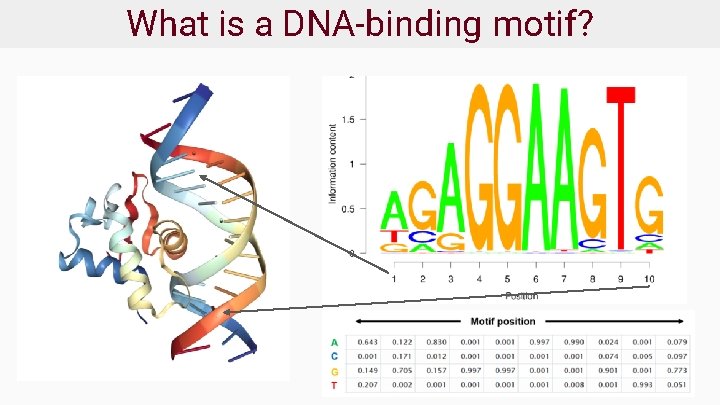
Where and how is my protein binding? ● Peaks areas where read mapping is enriched compared to a control experiment (~300 bp) ● Actual binding sites (for proteins) are 8 -12 bp ● Binding site can be inferred using motifs and motif analysis
What is a DNA-binding motif?
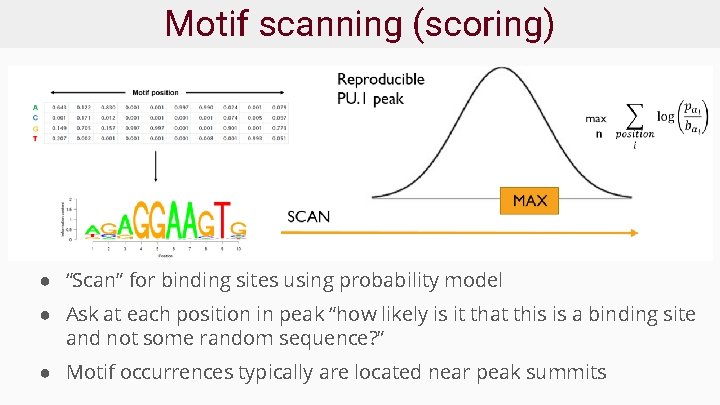
Motif scanning (scoring) ● “Scan” for binding sites using probability model ● Ask at each position in peak “how likely is it that this is a binding site and not some random sequence? ” ● Motif occurrences typically are located near peak summits
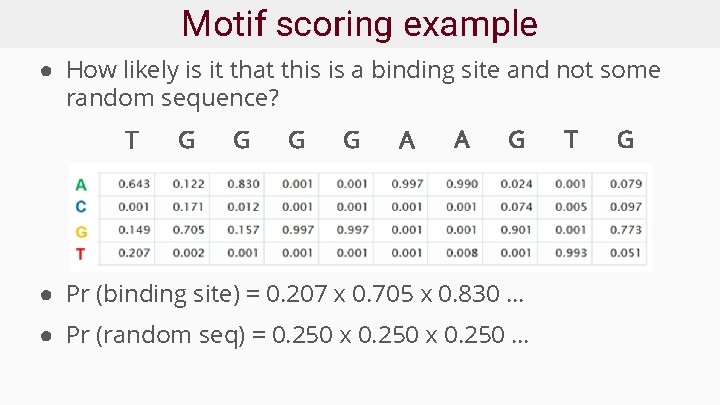
Motif scoring example ● How likely is it that this is a binding site and not some random sequence? T G G A A G ● Pr (binding site) = 0. 207 x 0. 705 x 0. 830 … ● Pr (random seq) = 0. 250 x 0. 250 … T G
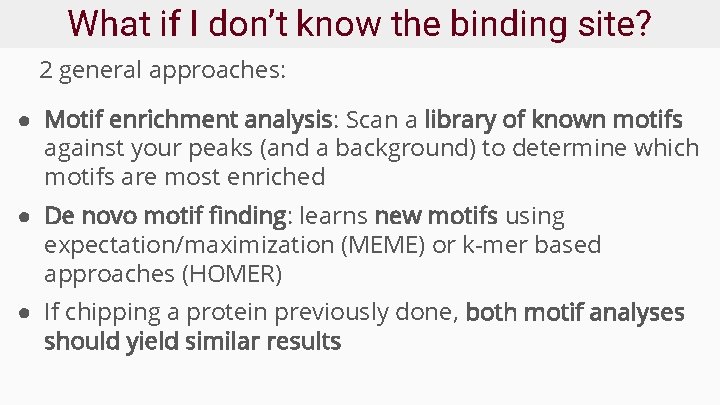
What if I don’t know the binding site? 2 general approaches: ● Motif enrichment analysis: Scan a library of known motifs against your peaks (and a background) to determine which motifs are most enriched ● De novo motif finding: learns new motifs using expectation/maximization (MEME) or k-mer based approaches (HOMER) ● If chipping a protein previously done, both motif analyses should yield similar results
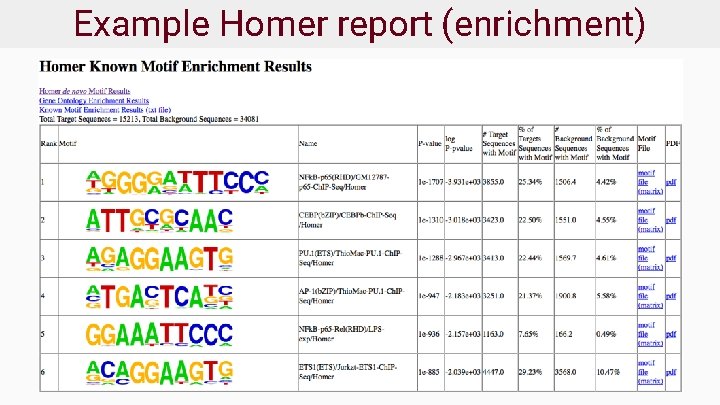
Example Homer report (enrichment)
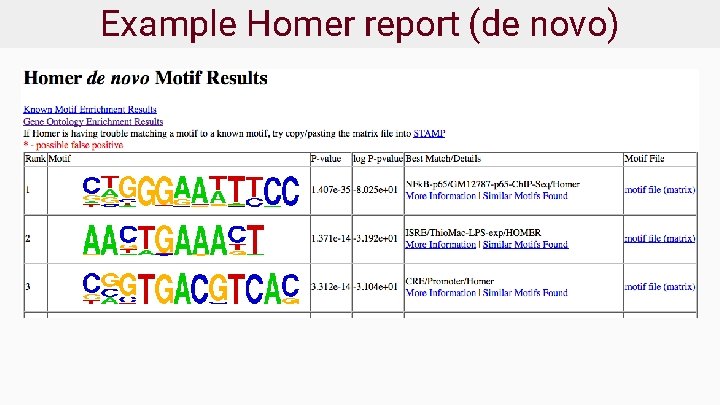
Example Homer report (de novo)
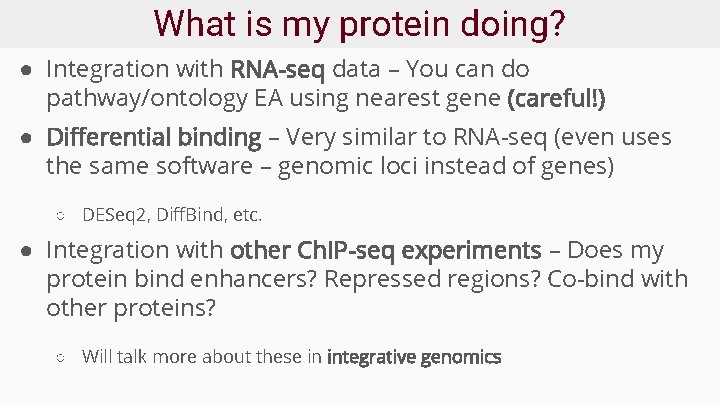
What is my protein doing? ● Integration with RNA-seq data – You can do pathway/ontology EA using nearest gene (careful!) ● Differential binding – Very similar to RNA-seq (even uses the same software – genomic loci instead of genes) ○ DESeq 2, Diff. Bind, etc. ● Integration with other Ch. IP-seq experiments – Does my protein bind enhancers? Repressed regions? Co-bind with other proteins? ○ Will talk more about these in integrative genomics